
Homework Answers
Add Answer to:
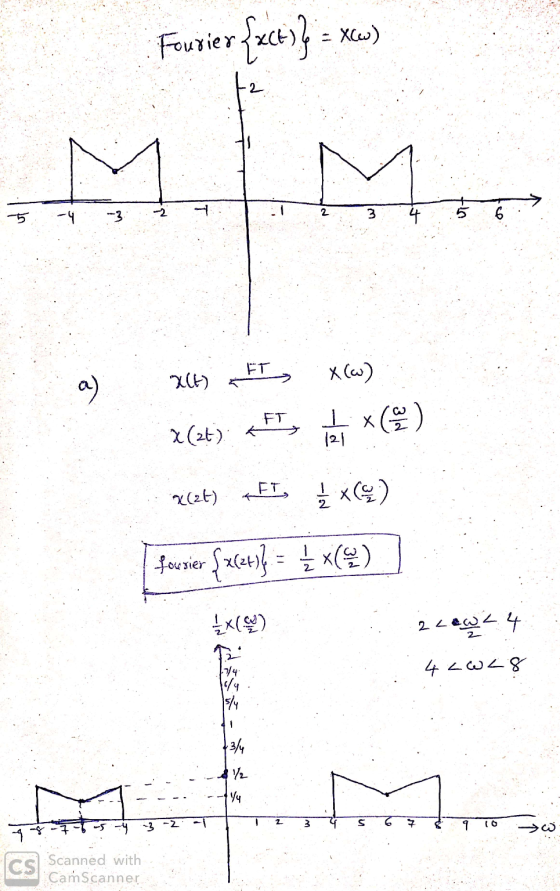
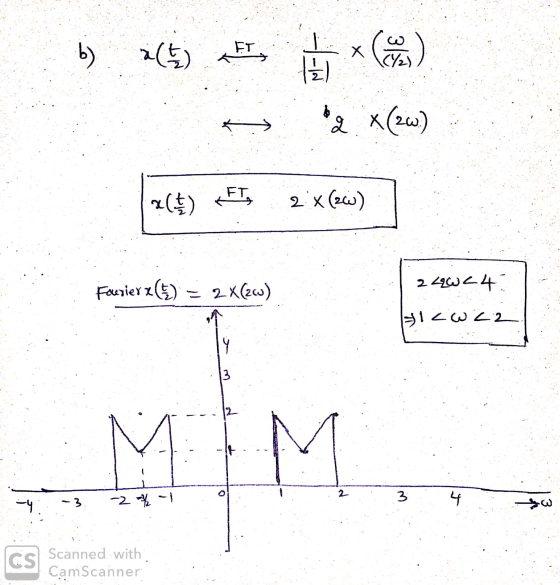
The Fourier transform of (t) is plotted below. In the following two graphs, plot the Fourier...
Find and plot the Fourier transforms of the following signals. (if the Fourier transform is a...
 Find and plot the Fourier transforms of the following signals. (if the Fourier transform is a complex function, plot the magnitude absolute value) and phase (argument) parts separately) [70 points]. [Hint: You can use the time shifting property if applicable] 5, 0 <ts3 Xs(t)-〈0, otherwise
how to derive the underlying signal x(t) using the definition of the Inverse Fourier transform Inverse Fourier Transforms by Definition Plot the following spectra and using the definition of the i...
 how to derive the underlying signal x(t) using the
definition of the Inverse Fourier transform
Inverse Fourier Transforms by Definition Plot the following spectra and using the definition of the inverse Fourier transform, derive the underlying signal z(t). 1. Fał(w) w rect(w/wo) 2. Ffa) cos(w) rect (w/T)
Inverse Fourier Transforms by Definition Plot the following spectra and using the definition of the inverse Fourier transform, derive the underlying signal z(t). 1. Fał(w) w rect(w/wo) 2. Ffa) cos(w) rect (w/T)
how to derive the underlying signal x(t) using the
definition of the Inverse Fourier transform
Inverse Fourier Transforms by Definition Plot the following spectra and using the definition of the inverse Fourier transform, derive the underlying signal z(t). 1. Fał(w) w rect(w/wo) 2. Ffa) cos(w) rect (w/T)
Inverse Fourier Transforms by Definition Plot the following spectra and using the definition of the inverse Fourier transform, derive the underlying signal z(t). 1. Fał(w) w rect(w/wo) 2. Ffa) cos(w) rect (w/T)
2) (Fourier Transforms Using Properties) - Given that the Fourier Transform of x(t) e Find the Fourier Transform of the following signals (using properties of the Fourier Transform). Sketch each sign...
 2) (Fourier Transforms Using Properties) - Given that the Fourier Transform of x(t) e Find the Fourier Transform of the following signals (using properties of the Fourier Transform). Sketch each signal, and sketch its Fourier Transform magnitude and phase spectra, in addition to finding and expression for X(f): (a) x(t) = e-21,-I ! (b) x(t)-t e 21 1 (c) x(t)-sinc(rt ) * sinc(2π1) (convolution) [NOTE: X(f) is noLI i (1 + ㎡fy for part (c)]
2) (Fourier Transforms Using Properties)...
2) (Fourier Transforms Using Properties) - Given that the Fourier Transform of x(t) e Find the Fourier Transform of the following signals (using properties of the Fourier Transform). Sketch each signal, and sketch its Fourier Transform magnitude and phase spectra, in addition to finding and expression for X(f): (a) x(t) = e-21,-I ! (b) x(t)-t e 21 1 (c) x(t)-sinc(rt ) * sinc(2π1) (convolution) [NOTE: X(f) is noLI i (1 + ㎡fy for part (c)]
2) (Fourier Transforms Using Properties)...
Fourier transform from Laplace transform-The Fourier transform of finite support signals, which a...
 Fourier transform from Laplace transform-The Fourier transform of finite support signals, which are absolutely integrable or finite energy, can be obtained from their Laplace transform rather than doing the integral. Consider the following signals 5.30 x3(t) - r(t + 1) - 2r(t) + r(t - 1) (a) Plot each of the above signals. (b) Find the Fourier transforms (X,(S2)) for1, 2, and 3 using the Laplace transform (c) Use MATLAB's symbolic integration function int to compute the Fourier transform of...
QUESTION 3 (a) If the Fourier transform of (t) is X(c) = 12 (a+2)j@+6) determine the...
 QUESTION 3 (a) If the Fourier transform of (t) is X(c) = 12 (a+2)j@+6) determine the transform for (-21-1). [5 marks] (b) Based on Figure Q3(b), give the expression for signal xt) in unit step function. From your obtained expression, find the Fourier transform of x(). Then compare your answer using the formula of Fourier transform. x() 10 0 Figure Q3(b) [9 marks] 다. For the linear system in Figure Q3(e), when the input voltage is vr(t) = 2sgn(t) V....
Q4) Calculate the Fourier transform of the following time domain signals. Use the properties of t...
 Q4) Calculate the Fourier transform of the following time domain signals. Use the properties of the Fourier transform found in the "Properties of Fourier Transforms" table in textbook and the "Famous Fourier Transforms Table" in textbook instead of direct integration as much as possible to simplify your calculation wherever appropriate: 2-2
3) (Fourier Transforms Using Properties) - Given that the Fourier Transform of a signal x(t) is X(f) - rect(f/ 2), find the Fourier Transform of the following signals using properties of the Fourier...
 3) (Fourier Transforms Using Properties) - Given that the Fourier Transform of a signal x(t) is X(f) - rect(f/ 2), find the Fourier Transform of the following signals using properties of the Fourier Transform: (a) d(t) -x(t - 2) (d) h(t) = t x( t ) (e) p(t) = x( 2 t ) (f) g(t)-x( t ) cos(2π) (g) s(t) = x2(t ) (h)p()-x(1)* x(t) (convolution)
3) (Fourier Transforms Using Properties) - Given that the Fourier Transform of a signal...
3) (Fourier Transforms Using Properties) - Given that the Fourier Transform of a signal x(t) is X(f) - rect(f/ 2), find the Fourier Transform of the following signals using properties of the Fourier Transform: (a) d(t) -x(t - 2) (d) h(t) = t x( t ) (e) p(t) = x( 2 t ) (f) g(t)-x( t ) cos(2π) (g) s(t) = x2(t ) (h)p()-x(1)* x(t) (convolution)
3) (Fourier Transforms Using Properties) - Given that the Fourier Transform of a signal...
Need solution pls... 2. Find the Fourier transform of f() = {6 1 – 12 \t...
 Need solution pls...
2. Find the Fourier transform of f() = {6 1 – 12 \t <1 1t| > 1 Use the first shift theorem to deduce the Fourier transforms of e3jt (1-12) 11 <1 (a) g(t) 1t| > 1 {" (b)h() = {**"1 –1) "151 It| > 1 Answer: 63 4 cos o 4 sin o + -62 -4 cos(w – 3) (a) (0 – 3)2 -4 cos(w – j) (b) (w – j)2 + 4 sin(0 – 3)...
Need solution pls...
2. Find the Fourier transform of f() = {6 1 – 12 \t <1 1t| > 1 Use the first shift theorem to deduce the Fourier transforms of e3jt (1-12) 11 <1 (a) g(t) 1t| > 1 {" (b)h() = {**"1 –1) "151 It| > 1 Answer: 63 4 cos o 4 sin o + -62 -4 cos(w – 3) (a) (0 – 3)2 -4 cos(w – j) (b) (w – j)2 + 4 sin(0 – 3)...
Problem 7.3 r(t) has the Fourier transform Xjw Determine the Fourier transforms of the following signals....
 Problem 7.3 r(t) has the Fourier transform Xjw Determine the Fourier transforms of the following signals. (a) Fal)-5r(3t -2) (b) r(t)(t 1)sin(2t) (c) elt)5) HINT: Find the value of r(t) first. (d) ralt) (t)cos(2mt
5) (1pt) Assume x(t) with Fourier Transform X(w) shown below (where 1X(15)1-3 and 1X(4511e1). Assume x(t)...
 5) (1pt) Assume x(t) with Fourier Transform X(w) shown below (where 1X(15)1-3 and 1X(4511e1). Assume x(t) is the input to a system with |H(w)| shown below. Let yt) be the output of the system and Y(w) be its Fourier Transform. Sketch IYwll. Make sure to mark the most significant points in the graph for full credit IX(w) IY(w) -60 0 60 w IH(w)l 45 -15 0 15 45 X,(w) X,(w) ?6) (1pt) Assume two signals x1(t) and x2(t) have Fourier...
 Find and plot the Fourier transforms of the following signals. (if the Fourier transform is a complex function, plot the magnitude absolute value) and phase (argument) parts separately) [70 points]. [Hint: You can use the time shifting property if applicable] 5, 0 <ts3 Xs(t)-〈0, otherwise
 how to derive the underlying signal x(t) using the
definition of the Inverse Fourier transform
Inverse Fourier Transforms by Definition Plot the following spectra and using the definition of the inverse Fourier transform, derive the underlying signal z(t). 1. Fał(w) w rect(w/wo) 2. Ffa) cos(w) rect (w/T)
Inverse Fourier Transforms by Definition Plot the following spectra and using the definition of the inverse Fourier transform, derive the underlying signal z(t). 1. Fał(w) w rect(w/wo) 2. Ffa) cos(w) rect (w/T)
how to derive the underlying signal x(t) using the
definition of the Inverse Fourier transform
Inverse Fourier Transforms by Definition Plot the following spectra and using the definition of the inverse Fourier transform, derive the underlying signal z(t). 1. Fał(w) w rect(w/wo) 2. Ffa) cos(w) rect (w/T)
Inverse Fourier Transforms by Definition Plot the following spectra and using the definition of the inverse Fourier transform, derive the underlying signal z(t). 1. Fał(w) w rect(w/wo) 2. Ffa) cos(w) rect (w/T)
 2) (Fourier Transforms Using Properties) - Given that the Fourier Transform of x(t) e Find the Fourier Transform of the following signals (using properties of the Fourier Transform). Sketch each signal, and sketch its Fourier Transform magnitude and phase spectra, in addition to finding and expression for X(f): (a) x(t) = e-21,-I ! (b) x(t)-t e 21 1 (c) x(t)-sinc(rt ) * sinc(2π1) (convolution) [NOTE: X(f) is noLI i (1 + ㎡fy for part (c)]
2) (Fourier Transforms Using Properties)...
2) (Fourier Transforms Using Properties) - Given that the Fourier Transform of x(t) e Find the Fourier Transform of the following signals (using properties of the Fourier Transform). Sketch each signal, and sketch its Fourier Transform magnitude and phase spectra, in addition to finding and expression for X(f): (a) x(t) = e-21,-I ! (b) x(t)-t e 21 1 (c) x(t)-sinc(rt ) * sinc(2π1) (convolution) [NOTE: X(f) is noLI i (1 + ㎡fy for part (c)]
2) (Fourier Transforms Using Properties)...
 Fourier transform from Laplace transform-The Fourier transform of finite support signals, which are absolutely integrable or finite energy, can be obtained from their Laplace transform rather than doing the integral. Consider the following signals 5.30 x3(t) - r(t + 1) - 2r(t) + r(t - 1) (a) Plot each of the above signals. (b) Find the Fourier transforms (X,(S2)) for1, 2, and 3 using the Laplace transform (c) Use MATLAB's symbolic integration function int to compute the Fourier transform of...
 QUESTION 3 (a) If the Fourier transform of (t) is X(c) = 12 (a+2)j@+6) determine the transform for (-21-1). [5 marks] (b) Based on Figure Q3(b), give the expression for signal xt) in unit step function. From your obtained expression, find the Fourier transform of x(). Then compare your answer using the formula of Fourier transform. x() 10 0 Figure Q3(b) [9 marks] 다. For the linear system in Figure Q3(e), when the input voltage is vr(t) = 2sgn(t) V....
 Q4) Calculate the Fourier transform of the following time domain signals. Use the properties of the Fourier transform found in the "Properties of Fourier Transforms" table in textbook and the "Famous Fourier Transforms Table" in textbook instead of direct integration as much as possible to simplify your calculation wherever appropriate: 2-2
 3) (Fourier Transforms Using Properties) - Given that the Fourier Transform of a signal x(t) is X(f) - rect(f/ 2), find the Fourier Transform of the following signals using properties of the Fourier Transform: (a) d(t) -x(t - 2) (d) h(t) = t x( t ) (e) p(t) = x( 2 t ) (f) g(t)-x( t ) cos(2π) (g) s(t) = x2(t ) (h)p()-x(1)* x(t) (convolution)
3) (Fourier Transforms Using Properties) - Given that the Fourier Transform of a signal...
3) (Fourier Transforms Using Properties) - Given that the Fourier Transform of a signal x(t) is X(f) - rect(f/ 2), find the Fourier Transform of the following signals using properties of the Fourier Transform: (a) d(t) -x(t - 2) (d) h(t) = t x( t ) (e) p(t) = x( 2 t ) (f) g(t)-x( t ) cos(2π) (g) s(t) = x2(t ) (h)p()-x(1)* x(t) (convolution)
3) (Fourier Transforms Using Properties) - Given that the Fourier Transform of a signal...
 Need solution pls...
2. Find the Fourier transform of f() = {6 1 – 12 \t <1 1t| > 1 Use the first shift theorem to deduce the Fourier transforms of e3jt (1-12) 11 <1 (a) g(t) 1t| > 1 {" (b)h() = {**"1 –1) "151 It| > 1 Answer: 63 4 cos o 4 sin o + -62 -4 cos(w – 3) (a) (0 – 3)2 -4 cos(w – j) (b) (w – j)2 + 4 sin(0 – 3)...
Need solution pls...
2. Find the Fourier transform of f() = {6 1 – 12 \t <1 1t| > 1 Use the first shift theorem to deduce the Fourier transforms of e3jt (1-12) 11 <1 (a) g(t) 1t| > 1 {" (b)h() = {**"1 –1) "151 It| > 1 Answer: 63 4 cos o 4 sin o + -62 -4 cos(w – 3) (a) (0 – 3)2 -4 cos(w – j) (b) (w – j)2 + 4 sin(0 – 3)...
 Problem 7.3 r(t) has the Fourier transform Xjw Determine the Fourier transforms of the following signals. (a) Fal)-5r(3t -2) (b) r(t)(t 1)sin(2t) (c) elt)5) HINT: Find the value of r(t) first. (d) ralt) (t)cos(2mt
 5) (1pt) Assume x(t) with Fourier Transform X(w) shown below (where 1X(15)1-3 and 1X(4511e1). Assume x(t) is the input to a system with |H(w)| shown below. Let yt) be the output of the system and Y(w) be its Fourier Transform. Sketch IYwll. Make sure to mark the most significant points in the graph for full credit IX(w) IY(w) -60 0 60 w IH(w)l 45 -15 0 15 45 X,(w) X,(w) ?6) (1pt) Assume two signals x1(t) and x2(t) have Fourier...
Most questions answered within 3 hours.
-
Where is the error in this code sequence?
String s1 = "Hello";
String s2 = "ello";...
asked 10 months ago -
Financial data for Joel de Paris, Inc., for last year
follow:
Joel de Paris, Inc.
Balance...
asked 10 months ago -
Consider this reaction:
Al2(SO4)3 (aq)+ BaCl3
(aq) Al2Cl6 (aq)- +
3BaSO4(s) . What is the...
asked 10 months ago -
Suppose that Savneet is considering increasing her
recent random sample from 20 car rentals to 40...
asked 10 months ago -
Trucks arrive at an unloading terminal at an average rate of 120
per hour.
Trucks arrive...
asked 10 months ago -
Why are methanol and ethanol completely soluble in water while
octanol is not very little soluble....
asked 10 months ago -
A facilities manager at a university reads in a research report
that the mean amount of...
asked 10 months ago -
When the CuSO4 is rehydrated by adding water to the anhydrous
compound, is this an endothermic...
asked 10 months ago -
A ray of sunlight is passing from diamond into crown glass; the
angle of incidence is...
asked 10 months ago -
A block of mass 0.249 kg is placed on top of a light, vertical
spring of...
asked 10 months ago -
how do the kidneys compensate in the presences of acidosis
a) trigger hyperventilate
b) reserve acid...
asked 10 months ago -
Question 501 pts
The rental rate of capital to the firm increases. Which of the
following...
asked 10 months ago