
Homework Answers
Add Answer to:
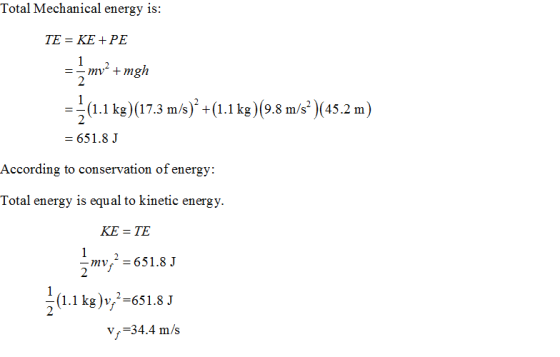
Calculate the mechanical energy and final speed of a 1.1 kg ball tossed at 17.3 m/s...
Let h = 25.5 m and vi = 11.8 m/s. Find the speed of the ball...
Let h = 25.5 m and vi = 11.8 m/s. Find the speed of the ball just before it hits the ground. vf = m/s Find the ball's mechanical energy at the release point. KEi + PEi = J Find the ball's mechanical energy just before it hits the ground. KEf + PEf = J Remarks Notice that the final speed does not depend on the initial release angle. Kinetic energy is not a vector. The initial kinetic energy of...
is Select the equation that shows that the kinetic energy of a 3.0-kg book tossed across...
 is Select the equation that shows that the kinetic energy of a 3.0-kg book tossed across the room at a speed of 2.0 m/s 6.0 J. (1 J is equivalent to 1 kg(m/s)) KE=측mu-름(3.0 kg)(2.0 m/s)2=6.0J o KE-mu? (3.0 kg)(2.0 m/s) -6.0J KE-3mt, = (3.0 kg)(2.0 m/s) = 6.0 J O KE-|mu-4 (3.0 kg)(2.0 m/s)2=6.0J
Calculate Average Force for a tennis ball if m=0.057 kg, vi = -30 m/s, vf =...
Calculate Average Force for a tennis ball if m=0.057 kg, vi = -30 m/s, vf = 58 m/s, and t = 5 ms = 5 x 10⁻³ s mass of the ball = 0.057 kg Initial velocity = vi = - 30 m/s Final velocity = vf = 58 m/s time of contact t = 5x10⁻³ s FORCE ?
A 6.60-kg bowling ball moving at 10.0 m/s collides with a 1.60-kg bowling pin, scattering it...
A 6.60-kg bowling ball moving at 10.0 m/s collides with a 1.60-kg bowling pin, scattering it with a speed of 8.00 m/s and at an angle of 32.5° with respect to the initial direction of the bowling ball. (a) Calculate the final velocity (magnitude and direction) of the bowling ball. magnitude m/s direction ° counterclockwise from the original direction of the bowling ball (b) Ignoring rotation, what was the original kinetic energy of the bowling ball before the collision? J...
3. A 0.010 kg bullet is shot at 202 m/s into a 1.250 kg wooden ball...
 3. A 0.010 kg bullet is shot at 202 m/s into a 1.250 kg wooden ball which is hanging motionless from a 3.00 m long cord. If the bullet sticks into the wooden ball, a. At what speed will the ball and bullet travel after impact? b. Calculate the kinetic energy of the bullet before impact. c. Calculate the kinetic energy of the ball and bullet after 5 the collision. d. How much kinetic energy is lost in the impact?...
A 54 kg pole vaulter intends to pass over a 6.4-meter high bar. She needs to...
 A 54 kg pole vaulter intends to pass over a 6.4-meter high bar. She needs to maintain a minimal speed of 0.72 m/s at the top in order to pass the bar. What is the minimum speed at which she should run in order to attain the height? Neglect air resistance, as well as any energy absorbed by the pole Answer in units of m/s and round to one decimal place. Hints: Mechanical energy is conserved during vaulting. KE at...
QUESTION 3 A 54 kg pole vaulter intends to pass over a 6.9-meter high bar. She...
QUESTION 3 A 54 kg pole vaulter intends to pass over a 6.9-meter high bar. She needs to maintain a minimal speed of 0.79 m/s at the top in order to pass the bar. What is the minimum speed at which she should run in order to attain the height? Neglect air resistance, as well as any energy absorbed by the pole. Answer in units of m/s and round to one decimal place. Hints: Mechanical energy is conserved during vaulting....
A 1.0-kg ball with a speed of 3.0 m/s strikes a 2.0-kg stationary ball. The collision...
A 1.0-kg ball with a speed of 3.0 m/s strikes a 2.0-kg stationary ball. The collision is completely inelastic. (a) Calculate the speed of the balls after collision. (b) Calculate the total kinetic energy change during the collision
A 19.0-kg cannonball is fired from a cannon with muzzle speed of 1 050 m/s at...
A 19.0-kg cannonball is fired from a cannon with muzzle speed of 1 050 m/s at an angle of 36.0° with the horizontal. A second ball is fired with the same initial speed at an angle of 90.0°. Let y = 0 at the cannon. (a) Use the isolated system model to find the maximum height reached by each ball. hfirst ball = m hsecond ball = m (b) Use the isolated system model to find the total mechanical energy of the...
A bowling ball rolls 1.1 m up a ramp without slipping. It has an initial speed...
 A bowling ball rolls 1.1 m up a ramp without slipping. It has an initial speed of its center of mass of 9.5 m/s, and the ramp is 27.2 degrees up from the horizontal. What is its speed at the top of the ramp? (HINT: Consider which approach is the best to use here: Kinematics+Dynamics or Energy?)
 is Select the equation that shows that the kinetic energy of a 3.0-kg book tossed across the room at a speed of 2.0 m/s 6.0 J. (1 J is equivalent to 1 kg(m/s)) KE=측mu-름(3.0 kg)(2.0 m/s)2=6.0J o KE-mu? (3.0 kg)(2.0 m/s) -6.0J KE-3mt, = (3.0 kg)(2.0 m/s) = 6.0 J O KE-|mu-4 (3.0 kg)(2.0 m/s)2=6.0J
 3. A 0.010 kg bullet is shot at 202 m/s into a 1.250 kg wooden ball which is hanging motionless from a 3.00 m long cord. If the bullet sticks into the wooden ball, a. At what speed will the ball and bullet travel after impact? b. Calculate the kinetic energy of the bullet before impact. c. Calculate the kinetic energy of the ball and bullet after 5 the collision. d. How much kinetic energy is lost in the impact?...
 A 54 kg pole vaulter intends to pass over a 6.4-meter high bar. She needs to maintain a minimal speed of 0.72 m/s at the top in order to pass the bar. What is the minimum speed at which she should run in order to attain the height? Neglect air resistance, as well as any energy absorbed by the pole Answer in units of m/s and round to one decimal place. Hints: Mechanical energy is conserved during vaulting. KE at...
 A bowling ball rolls 1.1 m up a ramp without slipping. It has an initial speed of its center of mass of 9.5 m/s, and the ramp is 27.2 degrees up from the horizontal. What is its speed at the top of the ramp? (HINT: Consider which approach is the best to use here: Kinematics+Dynamics or Energy?)
Most questions answered within 3 hours.
-
Where is the error in this code sequence?
String s1 = "Hello";
String s2 = "ello";...
asked 10 months ago -
Financial data for Joel de Paris, Inc., for last year
follow:
Joel de Paris, Inc.
Balance...
asked 10 months ago -
Consider this reaction:
Al2(SO4)3 (aq)+ BaCl3
(aq) Al2Cl6 (aq)- +
3BaSO4(s) . What is the...
asked 10 months ago -
Suppose that Savneet is considering increasing her
recent random sample from 20 car rentals to 40...
asked 10 months ago -
Trucks arrive at an unloading terminal at an average rate of 120
per hour.
Trucks arrive...
asked 10 months ago -
Why are methanol and ethanol completely soluble in water while
octanol is not very little soluble....
asked 10 months ago -
A facilities manager at a university reads in a research report
that the mean amount of...
asked 10 months ago -
When the CuSO4 is rehydrated by adding water to the anhydrous
compound, is this an endothermic...
asked 10 months ago -
A ray of sunlight is passing from diamond into crown glass; the
angle of incidence is...
asked 10 months ago -
A block of mass 0.249 kg is placed on top of a light, vertical
spring of...
asked 10 months ago -
how do the kidneys compensate in the presences of acidosis
a) trigger hyperventilate
b) reserve acid...
asked 10 months ago -
Question 501 pts
The rental rate of capital to the firm increases. Which of the
following...
asked 10 months ago