Please show the full reaction step by step for the synthesis of potassium trioxalatoaluminate trihydrate. Al...
Please show the full reaction step by step for the synthesis of potassium trioxalatoaluminate trihydrate.
Al + 3KOH + 3H2C2O4 x 2H2O = K3Al(C2O4)3 x 3 H2O + 6H2O + 3H2
Homework Answers

Add Answer to:
Please show the full reaction step by step for the synthesis of
potassium trioxalatoaluminate trihydrate.
Al...
A reaction of 7.20 mL of Iron(III) chloride solution (0.40 g/mL) and 8.95 g of K2C2O4.H2O...
A reaction of 7.20 mL of Iron(III) chloride solution (0.40 g/mL) and 8.95 g of K2C2O4.H2O (Potassium oxalate monohydrate) produced 6.22 g of K3Fe(C2O4)3.3H2O [Potassium trioxalatoferrate(III) trihydrate] A) Calculate number moles of Iron(III) chloride? B)Calculate number moles K2C2O4.H2O (Potassium oxalate monohydrate). C)What is limiting reagent of the reaction (Consider stochiometry)? D)Molar mass of Potassium trioxalatoferrate(III) trihydrate E)Calculate the percent yield of the synthesis?
4. In a similar synthesis, the complex ion potassium tris(oxalato)aluminate (III) trihydrate was prepared from scrap...
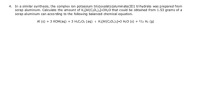 4. In a similar synthesis, the complex ion potassium tris(oxalato)aluminate (III) trihydrate was prepared from scrap aluminum. Calculate the amount of K[AI (C.O.),]+3 H,O that could be obtained from 1.53 grams of a scrap aluminum can according to the following balanced chemical equation. Al (s)+3 KOH(aq) +3 H.C.O. (aq)t K[A (C.o.)] 3 HO (s) + /2 H: (9)
Show FULL arrow pushing mechanism for this reaction, and explain it step by step. Reagent used...
 Show FULL arrow pushing mechanism for this reaction, and explain
it step by step. Reagent used was c) K2CO3, MeOH, room temp., 1 h
(quant.).
(please disregard BOTH arrows on s11, as this only one step of a
multi-step synthesis)
Label all chiral centers on s12 and draw its enantiomer
ОН OH C Y і 0 (97 : 3) Л s11 Л s12
Show FULL arrow pushing mechanism for this reaction, and explain
it step by step. Reagent used was c) K2CO3, MeOH, room temp., 1 h
(quant.).
(please disregard BOTH arrows on s11, as this only one step of a
multi-step synthesis)
Label all chiral centers on s12 and draw its enantiomer
ОН OH C Y і 0 (97 : 3) Л s11 Л s12
Insert the values from the question above for x, y, z, & n into KxFey(C2O4)z·nH2O and...
Insert the values from the question above for x, y, z, & n into KxFey(C2O4)z·nH2O and provide the correct coefficients to balance the following equation: ___ Fe(NH4)2(SO4)2·6H2O + ___ H2C2O4 + ___ K2C2O4 + ___ H2O2 → ___ KxFey(C2O4)z·nH2O + ___ (NH4)2SO4 + ___ H2SO4 + ___ H2O (Hint: Remember H2O2, an oxidizing agent, was used in the synthesis, so you’ll need to do a redox balance. Start with just the iron ions, balance the reaction, and then add the...
Show the Principle side reaction (The one that produces MI NOV Product in this synthesis, Nome...
 Show the Principle side reaction (The one that produces MI NOV Product in this synthesis, Nome all of the organic Products and reactants. Underneath this reaction, show the mechanism A la tallao Snoo tal + 2H2O > +Hsoci+H2O MINOR Produch
Please explain step by step 12. Calculate the standard reaction enthalpy for the reaction: N2H4(4) +...
 Please explain step by step
12. Calculate the standard reaction enthalpy for the reaction: N2H4(4) + H2(g) → 2NH3(g) Given: N2H4(4) + O2(g) → N2(g) + 2H2O(g) AH° = 0543 kJ 2H2(g) + O2(g) → 2H2O(g) AH° = 1484 kJ N2(g) + 3H2(g) + 2NH3(g) AH° = 092.2 kJ A. - 1119 kJ B. - 33 kJ C. -151 kJ D. + 151 kJ E. + 1119 kJ
Please explain step by step
12. Calculate the standard reaction enthalpy for the reaction: N2H4(4) + H2(g) → 2NH3(g) Given: N2H4(4) + O2(g) → N2(g) + 2H2O(g) AH° = 0543 kJ 2H2(g) + O2(g) → 2H2O(g) AH° = 1484 kJ N2(g) + 3H2(g) + 2NH3(g) AH° = 092.2 kJ A. - 1119 kJ B. - 33 kJ C. -151 kJ D. + 151 kJ E. + 1119 kJ
3. Devise a multi-step synthesis of the target molecule from the given starting material. Show all...
 3. Devise a multi-step synthesis of the target molecule from the given starting material. Show all necessary reagents and conditions for each step and the product of each step. (7) OH BONUS: Please provide the arrow pushing mechanism of this reaction. Be sure to show a charges and stereochemistry where needed. To receive full credit, what is the name of this reaction? (4) NaOE HOE Br
the detailed mecanism, step by step is for the reaction of trans-pent-2-eno. Show the synthesis of...
 the detailed mecanism, step by step is for the reaction of
trans-pent-2-eno.
Show the synthesis of trans-pent-2-eno from propyne. Include the detailed mechanism, step by step, of the following reaction
the detailed mecanism, step by step is for the reaction of
trans-pent-2-eno.
Show the synthesis of trans-pent-2-eno from propyne. Include the detailed mechanism, step by step, of the following reaction
Please need help on QUESTION 4 Show step by step in the synthesis of trans-2-butene from...
 Please need help on QUESTION 4
Show step by step in the synthesis of trans-2-butene from acetylene and an alkyl halide. Convert cis-3-hexene to trans-3-hexene. Calculate % yields of 1 -chloropropane and 2-chloroprpane from monochlorination of propane. Refer to the reaction, cyclohexene + NBS rightarrow 3-bromocyclohene, in Fig. 10-2 (p. 293). Write the propagation in three separate steps.
Please need help on QUESTION 4
Show step by step in the synthesis of trans-2-butene from acetylene and an alkyl halide. Convert cis-3-hexene to trans-3-hexene. Calculate % yields of 1 -chloropropane and 2-chloroprpane from monochlorination of propane. Refer to the reaction, cyclohexene + NBS rightarrow 3-bromocyclohene, in Fig. 10-2 (p. 293). Write the propagation in three separate steps.
2. [10 pts] Of the following 2-step synthesis, the first step is the reaction utilizing organometallic...
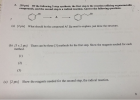 2. [10 pts] Of the following 2-step synthesis, the first step is the reaction utilizing organometallic compounds, and the second step is a radical reaction. Answer the following questions. Br Br (a) [2 pts] What should be the compound A? No need to explain; just draw the structure. (b) [3 x 2 pts] method. There can be three [3] methods for the first step. Show the reagents needed for each (1) (2) (3) Show the reagents needed for the second...
 4. In a similar synthesis, the complex ion potassium tris(oxalato)aluminate (III) trihydrate was prepared from scrap aluminum. Calculate the amount of K[AI (C.O.),]+3 H,O that could be obtained from 1.53 grams of a scrap aluminum can according to the following balanced chemical equation. Al (s)+3 KOH(aq) +3 H.C.O. (aq)t K[A (C.o.)] 3 HO (s) + /2 H: (9)
 Show FULL arrow pushing mechanism for this reaction, and explain
it step by step. Reagent used was c) K2CO3, MeOH, room temp., 1 h
(quant.).
(please disregard BOTH arrows on s11, as this only one step of a
multi-step synthesis)
Label all chiral centers on s12 and draw its enantiomer
ОН OH C Y і 0 (97 : 3) Л s11 Л s12
Show FULL arrow pushing mechanism for this reaction, and explain
it step by step. Reagent used was c) K2CO3, MeOH, room temp., 1 h
(quant.).
(please disregard BOTH arrows on s11, as this only one step of a
multi-step synthesis)
Label all chiral centers on s12 and draw its enantiomer
ОН OH C Y і 0 (97 : 3) Л s11 Л s12
 Show the Principle side reaction (The one that produces MI NOV Product in this synthesis, Nome all of the organic Products and reactants. Underneath this reaction, show the mechanism A la tallao Snoo tal + 2H2O > +Hsoci+H2O MINOR Produch
 Please explain step by step
12. Calculate the standard reaction enthalpy for the reaction: N2H4(4) + H2(g) → 2NH3(g) Given: N2H4(4) + O2(g) → N2(g) + 2H2O(g) AH° = 0543 kJ 2H2(g) + O2(g) → 2H2O(g) AH° = 1484 kJ N2(g) + 3H2(g) + 2NH3(g) AH° = 092.2 kJ A. - 1119 kJ B. - 33 kJ C. -151 kJ D. + 151 kJ E. + 1119 kJ
Please explain step by step
12. Calculate the standard reaction enthalpy for the reaction: N2H4(4) + H2(g) → 2NH3(g) Given: N2H4(4) + O2(g) → N2(g) + 2H2O(g) AH° = 0543 kJ 2H2(g) + O2(g) → 2H2O(g) AH° = 1484 kJ N2(g) + 3H2(g) + 2NH3(g) AH° = 092.2 kJ A. - 1119 kJ B. - 33 kJ C. -151 kJ D. + 151 kJ E. + 1119 kJ
 3. Devise a multi-step synthesis of the target molecule from the given starting material. Show all necessary reagents and conditions for each step and the product of each step. (7) OH BONUS: Please provide the arrow pushing mechanism of this reaction. Be sure to show a charges and stereochemistry where needed. To receive full credit, what is the name of this reaction? (4) NaOE HOE Br
 the detailed mecanism, step by step is for the reaction of
trans-pent-2-eno.
Show the synthesis of trans-pent-2-eno from propyne. Include the detailed mechanism, step by step, of the following reaction
the detailed mecanism, step by step is for the reaction of
trans-pent-2-eno.
Show the synthesis of trans-pent-2-eno from propyne. Include the detailed mechanism, step by step, of the following reaction
 Please need help on QUESTION 4
Show step by step in the synthesis of trans-2-butene from acetylene and an alkyl halide. Convert cis-3-hexene to trans-3-hexene. Calculate % yields of 1 -chloropropane and 2-chloroprpane from monochlorination of propane. Refer to the reaction, cyclohexene + NBS rightarrow 3-bromocyclohene, in Fig. 10-2 (p. 293). Write the propagation in three separate steps.
Please need help on QUESTION 4
Show step by step in the synthesis of trans-2-butene from acetylene and an alkyl halide. Convert cis-3-hexene to trans-3-hexene. Calculate % yields of 1 -chloropropane and 2-chloroprpane from monochlorination of propane. Refer to the reaction, cyclohexene + NBS rightarrow 3-bromocyclohene, in Fig. 10-2 (p. 293). Write the propagation in three separate steps.
 2. [10 pts] Of the following 2-step synthesis, the first step is the reaction utilizing organometallic compounds, and the second step is a radical reaction. Answer the following questions. Br Br (a) [2 pts] What should be the compound A? No need to explain; just draw the structure. (b) [3 x 2 pts] method. There can be three [3] methods for the first step. Show the reagents needed for each (1) (2) (3) Show the reagents needed for the second...
Most questions answered within 3 hours.
-
Where is the error in this code sequence?
String s1 = "Hello";
String s2 = "ello";...
asked 10 months ago -
Financial data for Joel de Paris, Inc., for last year
follow:
Joel de Paris, Inc.
Balance...
asked 10 months ago -
Consider this reaction:
Al2(SO4)3 (aq)+ BaCl3
(aq) Al2Cl6 (aq)- +
3BaSO4(s) . What is the...
asked 10 months ago -
Suppose that Savneet is considering increasing her
recent random sample from 20 car rentals to 40...
asked 10 months ago -
Trucks arrive at an unloading terminal at an average rate of 120
per hour.
Trucks arrive...
asked 10 months ago -
Why are methanol and ethanol completely soluble in water while
octanol is not very little soluble....
asked 10 months ago -
A facilities manager at a university reads in a research report
that the mean amount of...
asked 10 months ago -
When the CuSO4 is rehydrated by adding water to the anhydrous
compound, is this an endothermic...
asked 10 months ago -
A ray of sunlight is passing from diamond into crown glass; the
angle of incidence is...
asked 10 months ago -
A block of mass 0.249 kg is placed on top of a light, vertical
spring of...
asked 10 months ago -
how do the kidneys compensate in the presences of acidosis
a) trigger hyperventilate
b) reserve acid...
asked 10 months ago -
Question 501 pts
The rental rate of capital to the firm increases. Which of the
following...
asked 10 months ago