

Homework Answers
Add Answer to:
A quarter-car suspension model consisting of a spring and a damper is shown in Figure 1....
Problem 2 - A modified mass-spring-damper system: Model the modified mass-spring-damper system shown below. The mass...
 Problem 2 - A modified mass-spring-damper system: Model the modified mass-spring-damper system shown below. The mass of the handle is negligi- ble (only 1 FBD is necessary). Consider the displacement (t) to be the input to the system and the cart displacement az(t) to be the output. You may assume negligible drag. MwSpring-Damper System M0 Problem 3 Repeat problem 2, but with the following differences: • Assume the mass of the handle m, is not equal to zero. You may...
The suspension of a modified baby bouncer is modelled by a model spring 9 A with...
 The suspension of a modified baby bouncer is modelled by a model spring 9 A with stiffness k1 and a model damper T A with damping coefficient r. The seat is tethered to the ground, and this tether is modelled by a second model springAS with stiffness k2. Model the combination of baby and seat as a particle of mass m at a point A that is a distance r above floor level. The bouncer is suspended from a fixed...
For a mass-spring-damper mechanical systems shown below, x200) K1-1 N/m 0000 -X,(0) K-1 N/m 00004 =...
 For a mass-spring-damper mechanical systems shown below, x200) K1-1 N/m 0000 -X,(0) K-1 N/m 00004 = 1 N-s/m fr2 M1=1 kg = 2 N-s/m M2 -1 kg 13 = 1 N-s/m 1. Find the differential equations relating input force f(t) and output displacement xi(t) and x2(C) in the system. (40 marks) (Hint: K, fy and M are spring constant, friction coefficient and mass respectively) 2. Determine the transfer function G(s)= X1(s)/F(s) (20 marks)
Question8 n the spring-mass-damper system in Figure 8, the force F, is applied to the mass and it...
 Question8 n the spring-mass-damper system in Figure 8, the force F, is applied to the mass and its displacement is measured via r(t), whilst k and c are the spring and damper constants, respectively x(t) Figure 8: A spring-mass-damper system. a) Obtain the differential equation that relates the input force F, to the measured dis- (6 marks) placement x(t) for the system in Figure 8. b) Draw the block diagram representation of the system in Figure 8. c) Based on...
Problem 1 (Harmonic Oscillators) A mass-damper-spring system is a simple harmonic oscillator whose dynamics is governed...
 Problem 1 (Harmonic Oscillators) A mass-damper-spring system is a simple harmonic oscillator whose dynamics is governed by the equation of motion where m is the mass, c is the damping coefficient of the damper, k is the stiffness of the spring, F is the net force applied on the mass, and x is the displacement of the mass from its equilibrium point. In this problem, we focus on a mass-damper-spring system with m = 1 kg, c-4 kg/s, k-3 N/m,...
The rear suspension of a mountain bike consists of a spring suspended in a fluid and can be model...
 Please i need help with question 4 and 5
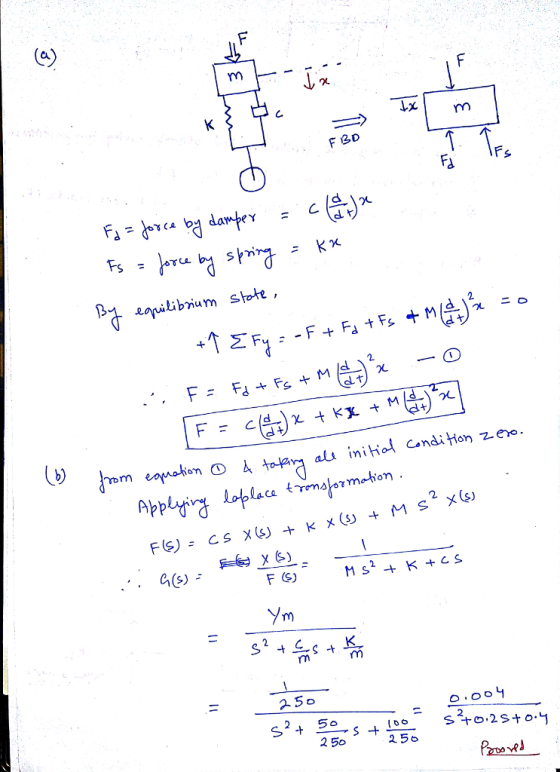
The rear suspension of a mountain bike consists of a spring suspended in a fluid and can be modelled as a spring and damper system r(t) 1. Draw a free body diagram of the scenario above and show that the resulting ODE is given by where c is the damping constant, k is the spring stiffness, r(t) is the force pressing into the frame and x(t) is the downward displacement of...
Please i need help with question 4 and 5
The rear suspension of a mountain bike consists of a spring suspended in a fluid and can be modelled as a spring and damper system r(t) 1. Draw a free body diagram of the scenario above and show that the resulting ODE is given by where c is the damping constant, k is the spring stiffness, r(t) is the force pressing into the frame and x(t) is the downward displacement of...
Question B A machine on a viscoelastic foundation (Figure 31.1), modelled as a spring mass-damper system...
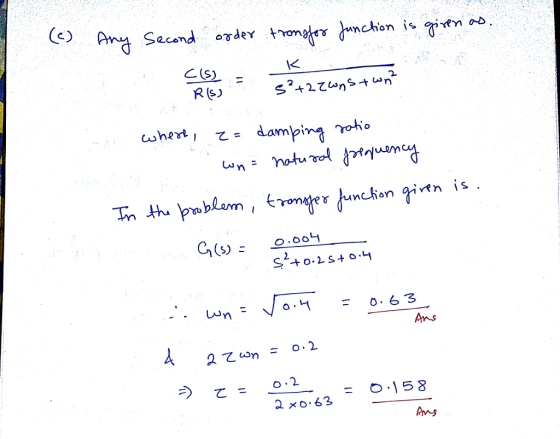
 Question B A machine on a viscoelastic foundation (Figure 31.1), modelled as a spring mass-damper system is acted upon by a force modelled as a harmonic force: F(t) = 0.2 sin(wt) Force is given in N and time in seconds. W Figure 31.1 Nos Given numerical values: m = 10 kg C=5 M k = 1000 = 1) draw the correct Free-Body-Diagram and determine the equation of motion [2 marks) 2) determine the natural frequency and the damping ratio of...
The rear suspension of a mountain bike consists of a spring suspended in a fluid and can be model...
 The rear suspension of a mountain bike consists of a spring suspended in a fluid and can be modelled as a spring and damper system. r(t) 1. Draw a free body diagram of the scenario above and show that the resulting ODE is given by dt m dt m where c is the damping constant, k is the spring stiffness, r(t) is the force pressing into the frame and r(t) is the downward displacement of the mass. 2. Find the...
PLEASE READ CAREFULLY TASK GIVEN BELOW AND ANSWERS THE QUESTIONS WHICH BEEN ASKED A vehicle suspension...
 PLEASE READ CAREFULLY TASK GIVEN BELOW AND ANSWERS THE QUESTIONS WHICH BEEN ASKED A vehicle suspension system can be modelled by the block diagram shown in Figure 1 below: Body mas:s 12 er of s cmicen G, Roac rgut Figure 1: Block diogrom of vehicle suspension system In this block diagram, the variation in the road surface height r as the vehicle moves is the input to the system. The tyre is modelled by the spring and dashpot (damping) system...
Given: A schematic of a quarter car model and parameters. X= input yu= unsprung weight (tire + etc.) position y, s...
 Given: A schematic of a quarter car model and parameters. X= input yu= unsprung weight (tire + etc.) position y, sprung weight (body) position tire damping c,= suspension damping k tire stiffness k, spring stiffness ys Ms C ks Yu Mu Figure 1. Schematic of a quarter car model Tasks: Determine any potential non-linear behavior exists for any of the components. Give a brief description of the scenario where non-linearity can occur. Produce a linearized model (i.e. assume a non-linear...
 Problem 2 - A modified mass-spring-damper system: Model the modified mass-spring-damper system shown below. The mass of the handle is negligi- ble (only 1 FBD is necessary). Consider the displacement (t) to be the input to the system and the cart displacement az(t) to be the output. You may assume negligible drag. MwSpring-Damper System M0 Problem 3 Repeat problem 2, but with the following differences: • Assume the mass of the handle m, is not equal to zero. You may...
 The suspension of a modified baby bouncer is modelled by a model spring 9 A with stiffness k1 and a model damper T A with damping coefficient r. The seat is tethered to the ground, and this tether is modelled by a second model springAS with stiffness k2. Model the combination of baby and seat as a particle of mass m at a point A that is a distance r above floor level. The bouncer is suspended from a fixed...
 For a mass-spring-damper mechanical systems shown below, x200) K1-1 N/m 0000 -X,(0) K-1 N/m 00004 = 1 N-s/m fr2 M1=1 kg = 2 N-s/m M2 -1 kg 13 = 1 N-s/m 1. Find the differential equations relating input force f(t) and output displacement xi(t) and x2(C) in the system. (40 marks) (Hint: K, fy and M are spring constant, friction coefficient and mass respectively) 2. Determine the transfer function G(s)= X1(s)/F(s) (20 marks)
 Question8 n the spring-mass-damper system in Figure 8, the force F, is applied to the mass and its displacement is measured via r(t), whilst k and c are the spring and damper constants, respectively x(t) Figure 8: A spring-mass-damper system. a) Obtain the differential equation that relates the input force F, to the measured dis- (6 marks) placement x(t) for the system in Figure 8. b) Draw the block diagram representation of the system in Figure 8. c) Based on...
 Problem 1 (Harmonic Oscillators) A mass-damper-spring system is a simple harmonic oscillator whose dynamics is governed by the equation of motion where m is the mass, c is the damping coefficient of the damper, k is the stiffness of the spring, F is the net force applied on the mass, and x is the displacement of the mass from its equilibrium point. In this problem, we focus on a mass-damper-spring system with m = 1 kg, c-4 kg/s, k-3 N/m,...
 Please i need help with question 4 and 5
The rear suspension of a mountain bike consists of a spring suspended in a fluid and can be modelled as a spring and damper system r(t) 1. Draw a free body diagram of the scenario above and show that the resulting ODE is given by where c is the damping constant, k is the spring stiffness, r(t) is the force pressing into the frame and x(t) is the downward displacement of...
Please i need help with question 4 and 5
The rear suspension of a mountain bike consists of a spring suspended in a fluid and can be modelled as a spring and damper system r(t) 1. Draw a free body diagram of the scenario above and show that the resulting ODE is given by where c is the damping constant, k is the spring stiffness, r(t) is the force pressing into the frame and x(t) is the downward displacement of...
 Question B A machine on a viscoelastic foundation (Figure 31.1), modelled as a spring mass-damper system is acted upon by a force modelled as a harmonic force: F(t) = 0.2 sin(wt) Force is given in N and time in seconds. W Figure 31.1 Nos Given numerical values: m = 10 kg C=5 M k = 1000 = 1) draw the correct Free-Body-Diagram and determine the equation of motion [2 marks) 2) determine the natural frequency and the damping ratio of...
 The rear suspension of a mountain bike consists of a spring suspended in a fluid and can be modelled as a spring and damper system. r(t) 1. Draw a free body diagram of the scenario above and show that the resulting ODE is given by dt m dt m where c is the damping constant, k is the spring stiffness, r(t) is the force pressing into the frame and r(t) is the downward displacement of the mass. 2. Find the...
 PLEASE READ CAREFULLY TASK GIVEN BELOW AND ANSWERS THE QUESTIONS WHICH BEEN ASKED A vehicle suspension system can be modelled by the block diagram shown in Figure 1 below: Body mas:s 12 er of s cmicen G, Roac rgut Figure 1: Block diogrom of vehicle suspension system In this block diagram, the variation in the road surface height r as the vehicle moves is the input to the system. The tyre is modelled by the spring and dashpot (damping) system...
 Given: A schematic of a quarter car model and parameters. X= input yu= unsprung weight (tire + etc.) position y, sprung weight (body) position tire damping c,= suspension damping k tire stiffness k, spring stiffness ys Ms C ks Yu Mu Figure 1. Schematic of a quarter car model Tasks: Determine any potential non-linear behavior exists for any of the components. Give a brief description of the scenario where non-linearity can occur. Produce a linearized model (i.e. assume a non-linear...
Most questions answered within 3 hours.
-
Where is the error in this code sequence?
String s1 = "Hello";
String s2 = "ello";...
asked 11 months ago -
Financial data for Joel de Paris, Inc., for last year
follow:
Joel de Paris, Inc.
Balance...
asked 11 months ago -
Consider this reaction:
Al2(SO4)3 (aq)+ BaCl3
(aq) Al2Cl6 (aq)- +
3BaSO4(s) . What is the...
asked 11 months ago -
Suppose that Savneet is considering increasing her
recent random sample from 20 car rentals to 40...
asked 11 months ago -
Trucks arrive at an unloading terminal at an average rate of 120
per hour.
Trucks arrive...
asked 11 months ago -
Why are methanol and ethanol completely soluble in water while
octanol is not very little soluble....
asked 11 months ago -
A facilities manager at a university reads in a research report
that the mean amount of...
asked 11 months ago -
When the CuSO4 is rehydrated by adding water to the anhydrous
compound, is this an endothermic...
asked 11 months ago -
A ray of sunlight is passing from diamond into crown glass; the
angle of incidence is...
asked 11 months ago -
A block of mass 0.249 kg is placed on top of a light, vertical
spring of...
asked 11 months ago -
how do the kidneys compensate in the presences of acidosis
a) trigger hyperventilate
b) reserve acid...
asked 11 months ago -
Question 501 pts
The rental rate of capital to the firm increases. Which of the
following...
asked 11 months ago