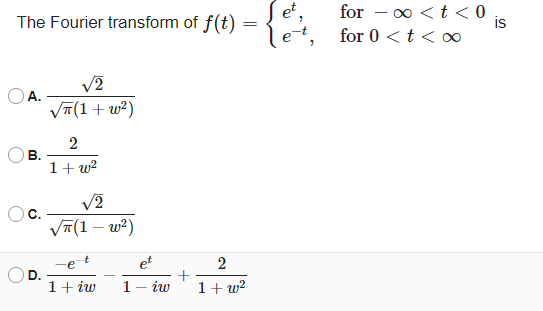
Hi, please include all steps. Will rate. I feel like its option A or option C but I am not sure.
Homework Answers
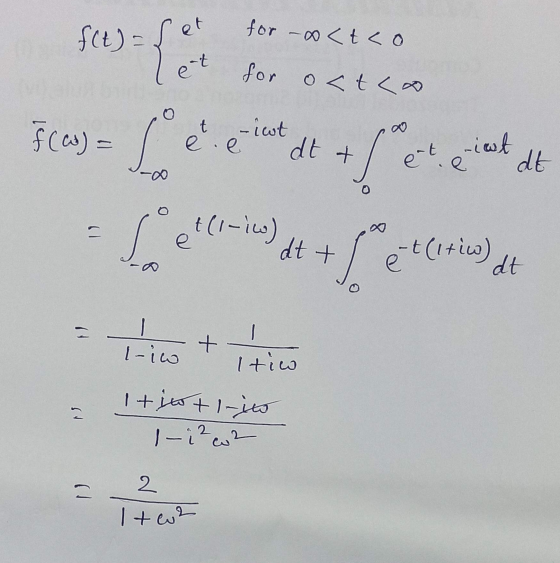
So the option B is correct.
Add Answer to:
Hi, please include all steps. Will rate. I feel like its option
A or option C...
Need help please the steps, thanks. K=2 (i) Let 0 < x < 1; et f(x)...
 Need help please the steps, thanks.
K=2
(i) Let 0 < x < 1; et f(x) x tk, 1<x<2, } the Fourier series at x = 1. مر and let f(x) be 2-periodic. Find the value of
Need help please the steps, thanks.
K=2
(i) Let 0 < x < 1; et f(x) x tk, 1<x<2, } the Fourier series at x = 1. مر and let f(x) be 2-periodic. Find the value of
Pleaase answer all parts with neat and precise work. show all steps. Please 24. The following...
 Pleaase answer all parts with neat and precise work. show all
steps. Please
24. The following Fourier pair for the Lorentzian/Cauchy pulse was discussed in class: f(t)-_a (21) where a > 0 is a measure of the width of the time signal. The domains of f (t) and F(w) are -oo < t < oo and-oo <ω<00, respectively. (a) Showing all work, determine the time signal g (t) that has the following Fourier transform, where to is a given constant:...
Pleaase answer all parts with neat and precise work. show all
steps. Please
24. The following Fourier pair for the Lorentzian/Cauchy pulse was discussed in class: f(t)-_a (21) where a > 0 is a measure of the width of the time signal. The domains of f (t) and F(w) are -oo < t < oo and-oo <ω<00, respectively. (a) Showing all work, determine the time signal g (t) that has the following Fourier transform, where to is a given constant:...
Please write all steps and include final answer in simple form (1 point) Compute the Laplace...
 Please write all steps and include final
answer in simple form
(1 point) Compute the Laplace transform: <{u1(b)te+ (t)} = 0 If you don't get this in 2 tries, you can get a hint. Hint:
Please write all steps and include final
answer in simple form
(1 point) Compute the Laplace transform: <{u1(b)te+ (t)} = 0 If you don't get this in 2 tries, you can get a hint. Hint:
Engineering and numerical analyzes - fourier transform .. please i need answer in 30 minute QIL...
 Engineering and numerical analyzes - fourier transform
.. please i need answer in 30 minute
QIL (7 Marks) Compute the Fourier transform of f(t) = V1 + t2 when 0<t<1. 021 (6 Marks)
Engineering and numerical analyzes - fourier transform
.. please i need answer in 30 minute
QIL (7 Marks) Compute the Fourier transform of f(t) = V1 + t2 when 0<t<1. 021 (6 Marks)
Please show work for 1a through c. Will rate thumbs up for all parts shown! Thank...
 Please show work for 1a through c. Will rate thumbs up for all
parts shown!
Thank you!
1. Find the Fourier coefficients of the given functions. (a) f(c) = (cos x + sin x)?, -1 < x < T; f(x + 2) = f(x) (b) f(x) = x, -1 < x < T; f(x + 2) = f(x) (b) f(x) = x, -1 < x < T; f(x + 2) = f(x) (c) f(x) = - <x<0, "; f(x +...
Please show work for 1a through c. Will rate thumbs up for all
parts shown!
Thank you!
1. Find the Fourier coefficients of the given functions. (a) f(c) = (cos x + sin x)?, -1 < x < T; f(x + 2) = f(x) (b) f(x) = x, -1 < x < T; f(x + 2) = f(x) (b) f(x) = x, -1 < x < T; f(x + 2) = f(x) (c) f(x) = - <x<0, "; f(x +...
Could I please have some help with this question? Is there like steps you can remember...
 Could I please have some help with this question? Is there like
steps you can remember to apply to any question like this, am
getting really confused. Thank you :)
Consider the initial value problem 31 yg(t); y(0)(0) 0 where if 0tT )0 if t T (a) Use the Laplace transform to find the solution of the problem (b) Sketch the solution y(t) on the interval [0, 67] (c) What is the value of y(37)?
Consider the initial value problem...
Could I please have some help with this question? Is there like
steps you can remember to apply to any question like this, am
getting really confused. Thank you :)
Consider the initial value problem 31 yg(t); y(0)(0) 0 where if 0tT )0 if t T (a) Use the Laplace transform to find the solution of the problem (b) Sketch the solution y(t) on the interval [0, 67] (c) What is the value of y(37)?
Consider the initial value problem...
Hi, I am doing some revision on Fourier Transform on my own and I got stuck...
 Hi,
I am doing some revision on Fourier Transform on my own and I
got stuck on this question for five days now. Wonder if you can
help me.
Engineering Mathematics 4E, Anthony Croft
Ex, 24.8 Q1
I want to understand how to set the lower and upper bound in
each "range" by applying the floating "t" value.
And how does sliding the triangle or the square block affect the
convolution process.
Does fourier transform gives us greater flexibility than...
Hi,
I am doing some revision on Fourier Transform on my own and I
got stuck on this question for five days now. Wonder if you can
help me.
Engineering Mathematics 4E, Anthony Croft
Ex, 24.8 Q1
I want to understand how to set the lower and upper bound in
each "range" by applying the floating "t" value.
And how does sliding the triangle or the square block affect the
convolution process.
Does fourier transform gives us greater flexibility than...
Please show all work and steps I will provide like for answer 9. Suppose a particle...
 Please show all work and steps I will provide like for
answer
9. Suppose a particle traverses a path given by r(t) = (+2+1)i+(t sinht)j + (Int)k. Determine the speed of the particle when t = 1. (Recall that sinh t = (et - e-t)/2 is the hyperbolic sine function.]
Please show all work and steps I will provide like for
answer
9. Suppose a particle traverses a path given by r(t) = (+2+1)i+(t sinht)j + (Int)k. Determine the speed of the particle when t = 1. (Recall that sinh t = (et - e-t)/2 is the hyperbolic sine function.]
Please answer all questions with math detail 3. (21 points) Laplace Transform (a) (15 points) Find...
 Please answer all questions with math detail
3. (21 points) Laplace Transform (a) (15 points) Find the Laplace transforms of the following signals and determine their region of convergence sinwot)-iu i. f(t) -i, e-2(t-3 2<t otherwise (b) (6 points) The Laplace transform of a causal signal x(t) is given by X (s) = s2 , ROC: Re{s) > -1 Which of the following Fourier transforms can be obtained from X(s) without actu- ally determining the signal x(t)? In each case,...
Please answer all questions with math detail
3. (21 points) Laplace Transform (a) (15 points) Find the Laplace transforms of the following signals and determine their region of convergence sinwot)-iu i. f(t) -i, e-2(t-3 2<t otherwise (b) (6 points) The Laplace transform of a causal signal x(t) is given by X (s) = s2 , ROC: Re{s) > -1 Which of the following Fourier transforms can be obtained from X(s) without actu- ally determining the signal x(t)? In each case,...
Problem 3. 0 Figure 2 Given: f(t) = { 2.5, -1.5 <=<= 1.5 f(t) = {...
 Problem 3. 0 Figure 2 Given: f(t) = { 2.5, -1.5 <=<= 1.5 f(t) = { 0 otherwise See figure(2) above. A) Find the Fourier transform for f( (see figure 2) and sketch its waveform. B) Determine the values of the first three frequency terms (w1, W2, W3) where F(w) = 0. C) Given x(t) = 1.58(-0.8) edt Determine whether or not Fourier transform exists for x(t). If yes, find the Fourier transfe not explain why it does not. Problem...
 Need help please the steps, thanks.
K=2
(i) Let 0 < x < 1; et f(x) x tk, 1<x<2, } the Fourier series at x = 1. مر and let f(x) be 2-periodic. Find the value of
Need help please the steps, thanks.
K=2
(i) Let 0 < x < 1; et f(x) x tk, 1<x<2, } the Fourier series at x = 1. مر and let f(x) be 2-periodic. Find the value of
 Pleaase answer all parts with neat and precise work. show all
steps. Please
24. The following Fourier pair for the Lorentzian/Cauchy pulse was discussed in class: f(t)-_a (21) where a > 0 is a measure of the width of the time signal. The domains of f (t) and F(w) are -oo < t < oo and-oo <ω<00, respectively. (a) Showing all work, determine the time signal g (t) that has the following Fourier transform, where to is a given constant:...
Pleaase answer all parts with neat and precise work. show all
steps. Please
24. The following Fourier pair for the Lorentzian/Cauchy pulse was discussed in class: f(t)-_a (21) where a > 0 is a measure of the width of the time signal. The domains of f (t) and F(w) are -oo < t < oo and-oo <ω<00, respectively. (a) Showing all work, determine the time signal g (t) that has the following Fourier transform, where to is a given constant:...
 Please write all steps and include final
answer in simple form
(1 point) Compute the Laplace transform: <{u1(b)te+ (t)} = 0 If you don't get this in 2 tries, you can get a hint. Hint:
Please write all steps and include final
answer in simple form
(1 point) Compute the Laplace transform: <{u1(b)te+ (t)} = 0 If you don't get this in 2 tries, you can get a hint. Hint:
 Engineering and numerical analyzes - fourier transform
.. please i need answer in 30 minute
QIL (7 Marks) Compute the Fourier transform of f(t) = V1 + t2 when 0<t<1. 021 (6 Marks)
Engineering and numerical analyzes - fourier transform
.. please i need answer in 30 minute
QIL (7 Marks) Compute the Fourier transform of f(t) = V1 + t2 when 0<t<1. 021 (6 Marks)
 Please show work for 1a through c. Will rate thumbs up for all
parts shown!
Thank you!
1. Find the Fourier coefficients of the given functions. (a) f(c) = (cos x + sin x)?, -1 < x < T; f(x + 2) = f(x) (b) f(x) = x, -1 < x < T; f(x + 2) = f(x) (b) f(x) = x, -1 < x < T; f(x + 2) = f(x) (c) f(x) = - <x<0, "; f(x +...
Please show work for 1a through c. Will rate thumbs up for all
parts shown!
Thank you!
1. Find the Fourier coefficients of the given functions. (a) f(c) = (cos x + sin x)?, -1 < x < T; f(x + 2) = f(x) (b) f(x) = x, -1 < x < T; f(x + 2) = f(x) (b) f(x) = x, -1 < x < T; f(x + 2) = f(x) (c) f(x) = - <x<0, "; f(x +...
 Could I please have some help with this question? Is there like
steps you can remember to apply to any question like this, am
getting really confused. Thank you :)
Consider the initial value problem 31 yg(t); y(0)(0) 0 where if 0tT )0 if t T (a) Use the Laplace transform to find the solution of the problem (b) Sketch the solution y(t) on the interval [0, 67] (c) What is the value of y(37)?
Consider the initial value problem...
Could I please have some help with this question? Is there like
steps you can remember to apply to any question like this, am
getting really confused. Thank you :)
Consider the initial value problem 31 yg(t); y(0)(0) 0 where if 0tT )0 if t T (a) Use the Laplace transform to find the solution of the problem (b) Sketch the solution y(t) on the interval [0, 67] (c) What is the value of y(37)?
Consider the initial value problem...
 Hi,
I am doing some revision on Fourier Transform on my own and I
got stuck on this question for five days now. Wonder if you can
help me.
Engineering Mathematics 4E, Anthony Croft
Ex, 24.8 Q1
I want to understand how to set the lower and upper bound in
each "range" by applying the floating "t" value.
And how does sliding the triangle or the square block affect the
convolution process.
Does fourier transform gives us greater flexibility than...
Hi,
I am doing some revision on Fourier Transform on my own and I
got stuck on this question for five days now. Wonder if you can
help me.
Engineering Mathematics 4E, Anthony Croft
Ex, 24.8 Q1
I want to understand how to set the lower and upper bound in
each "range" by applying the floating "t" value.
And how does sliding the triangle or the square block affect the
convolution process.
Does fourier transform gives us greater flexibility than...
 Please show all work and steps I will provide like for
answer
9. Suppose a particle traverses a path given by r(t) = (+2+1)i+(t sinht)j + (Int)k. Determine the speed of the particle when t = 1. (Recall that sinh t = (et - e-t)/2 is the hyperbolic sine function.]
Please show all work and steps I will provide like for
answer
9. Suppose a particle traverses a path given by r(t) = (+2+1)i+(t sinht)j + (Int)k. Determine the speed of the particle when t = 1. (Recall that sinh t = (et - e-t)/2 is the hyperbolic sine function.]
 Please answer all questions with math detail
3. (21 points) Laplace Transform (a) (15 points) Find the Laplace transforms of the following signals and determine their region of convergence sinwot)-iu i. f(t) -i, e-2(t-3 2<t otherwise (b) (6 points) The Laplace transform of a causal signal x(t) is given by X (s) = s2 , ROC: Re{s) > -1 Which of the following Fourier transforms can be obtained from X(s) without actu- ally determining the signal x(t)? In each case,...
Please answer all questions with math detail
3. (21 points) Laplace Transform (a) (15 points) Find the Laplace transforms of the following signals and determine their region of convergence sinwot)-iu i. f(t) -i, e-2(t-3 2<t otherwise (b) (6 points) The Laplace transform of a causal signal x(t) is given by X (s) = s2 , ROC: Re{s) > -1 Which of the following Fourier transforms can be obtained from X(s) without actu- ally determining the signal x(t)? In each case,...
 Problem 3. 0 Figure 2 Given: f(t) = { 2.5, -1.5 <=<= 1.5 f(t) = { 0 otherwise See figure(2) above. A) Find the Fourier transform for f( (see figure 2) and sketch its waveform. B) Determine the values of the first three frequency terms (w1, W2, W3) where F(w) = 0. C) Given x(t) = 1.58(-0.8) edt Determine whether or not Fourier transform exists for x(t). If yes, find the Fourier transfe not explain why it does not. Problem...
Most questions answered within 3 hours.
-
Where is the error in this code sequence?
String s1 = "Hello";
String s2 = "ello";...
asked 11 months ago -
Financial data for Joel de Paris, Inc., for last year
follow:
Joel de Paris, Inc.
Balance...
asked 11 months ago -
Consider this reaction:
Al2(SO4)3 (aq)+ BaCl3
(aq) Al2Cl6 (aq)- +
3BaSO4(s) . What is the...
asked 11 months ago -
Suppose that Savneet is considering increasing her
recent random sample from 20 car rentals to 40...
asked 11 months ago -
Trucks arrive at an unloading terminal at an average rate of 120
per hour.
Trucks arrive...
asked 11 months ago -
Why are methanol and ethanol completely soluble in water while
octanol is not very little soluble....
asked 11 months ago -
A facilities manager at a university reads in a research report
that the mean amount of...
asked 11 months ago -
When the CuSO4 is rehydrated by adding water to the anhydrous
compound, is this an endothermic...
asked 11 months ago -
A ray of sunlight is passing from diamond into crown glass; the
angle of incidence is...
asked 11 months ago -
A block of mass 0.249 kg is placed on top of a light, vertical
spring of...
asked 11 months ago -
how do the kidneys compensate in the presences of acidosis
a) trigger hyperventilate
b) reserve acid...
asked 11 months ago -
Question 501 pts
The rental rate of capital to the firm increases. Which of the
following...
asked 11 months ago