
Homework Answers
Add Answer to:
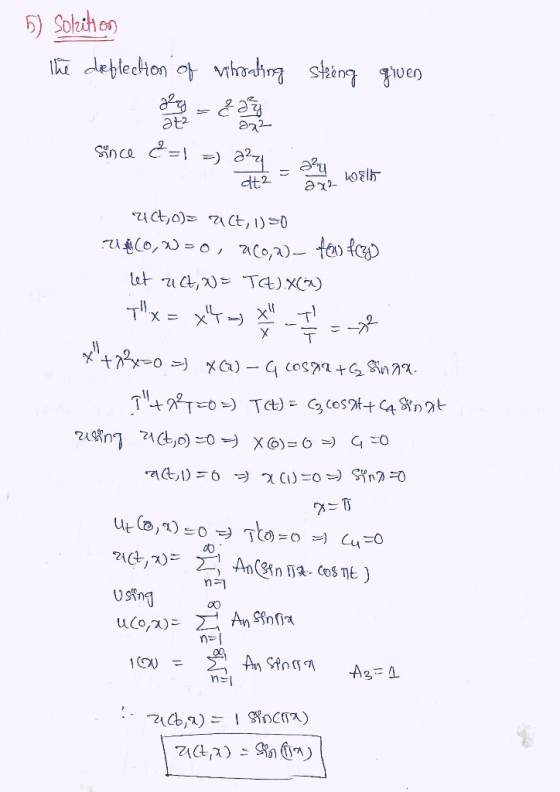
5. Consider the function z) = x(T-x). Find the deflection u(z, y,t) of thesquare m em...
5. Consider the function z) = x(T-x). Find the deflection u(z, y,t) of thesquare m em brane of side T and c2 ะไ for initial velocity 0 and initial deflection /(z,y) = F(x)F(v). 5. Consider t...
 5. Consider the function z) = x(T-x). Find the deflection u(z, y,t) of thesquare m em brane of side T and c2 ะไ for initial velocity 0 and initial deflection /(z,y) = F(x)F(v).
5. Consider the function z) = x(T-x). Find the deflection u(z, y,t) of thesquare m em brane of side T and c2 ะไ for initial velocity 0 and initial deflection /(z,y) = F(x)F(v).
5. Consider the function z) = x(T-x). Find the deflection u(z, y,t) of thesquare m em brane of side T and c2 ะไ for initial velocity 0 and initial deflection /(z,y) = F(x)F(v).
Problem 1. Consider the nonhomogencous heat equation for u(a,t) subject to the nonhomogeneous boundary conditions u(0,t1, t)- 0, and the initial condition 1--+ sin(z) u(z,0) = e solution u(z, t)...
 Problem 1. Consider the nonhomogencous heat equation for u(a,t) subject to the nonhomogeneous boundary conditions u(0,t1, t)- 0, and the initial condition 1--+ sin(z) u(z,0) = e solution u(z, t) by completing each of the following steps Find the equilibrium temperature distribution we r) Find th (b) Denote v, t)t) - ()Derive the IBVP for the function vz,t). (c) Find v(x, t) (d) Find u(x, t)
Problem 1. Consider the nonhomogencous heat equation for u(a,t) subject to the nonhomogeneous boundary...
Problem 1. Consider the nonhomogencous heat equation for u(a,t) subject to the nonhomogeneous boundary conditions u(0,t1, t)- 0, and the initial condition 1--+ sin(z) u(z,0) = e solution u(z, t) by completing each of the following steps Find the equilibrium temperature distribution we r) Find th (b) Denote v, t)t) - ()Derive the IBVP for the function vz,t). (c) Find v(x, t) (d) Find u(x, t)
Problem 1. Consider the nonhomogencous heat equation for u(a,t) subject to the nonhomogeneous boundary...
5. [12 Marks) Consider the level surface of the function f(x, y, z) defined by f(x,...
 5. [12 Marks) Consider the level surface of the function f(x, y, z) defined by f(x, y, z) = x2 + y2 + x2 = 2a?, (1) where a is a fixed real positive constant, and the point u = (0,a,a) on the surface f(x, y, z) = 2a. a) Find the gradient of f(x, y, z) at the point u. b) Calculate the normal derivative of f(x, y, 2) at u. c) Find the equation of the tangent plane...
9. Consider the beam PDE for the transverse deflection u(x, t) of an elastic beam Utt...
 9. Consider the beam PDE for the transverse deflection u(x, t) of an elastic beam Utt + Kurz = 0 for 0 < x <L (30) where K > 0 is a constant. Suppose the boundary conditions are given by (31) u(0, t) = uz(0,t) = 0 Uwx (L, t) = Uzzz(L, t) = 0 (32) and the initial conditions are (33) u(x,0) = (x) u1(x,0) = V(x) (34) Use separation of variables to find the general solution to the...
Consider a real-valued function u(x, y), where x and y are real variables. For each way...
 Consider a real-valued function u(x, y), where x and y are real variables. For each way of defining u(x, y) below, determine whether there exists a real-valued function v(x, y) such that f(z) = u(x, y) + iv(x, y) is a function analytic in some domain D C C. If such a v(x, y) exists, find one such and determine the domain of analyticity D for f(z). If such a v(x, y) does not exist, prove that it does not...
1. Consider the Partial Differential Equation ot u(0,t) = u(r, t) = 0 a(x, 0)-x (Y), sin (! We know the general solution to the Basic Heat Equation is u(z,t)-Σ b e ). n= 1 (b) Find the unique solutio...
 1. Consider the Partial Differential Equation ot u(0,t) = u(r, t) = 0 a(x, 0)-x (Y), sin (! We know the general solution to the Basic Heat Equation is u(z,t)-Σ b e ). n= 1 (b) Find the unique solution that satisfies the given initial condition ur, 0) -2. (Hint: bn is given by the Fourier Coefficients-f(z),sin(Y- UsefulFormulas/Facts for PDEs/Fourier Series 1)2 (TiT) » x sin aL(1)1 a24(부) (TiT) 1)+1 0
1. Consider the Partial Differential Equation ot u(0,t) =...
1. Consider the Partial Differential Equation ot u(0,t) = u(r, t) = 0 a(x, 0)-x (Y), sin (! We know the general solution to the Basic Heat Equation is u(z,t)-Σ b e ). n= 1 (b) Find the unique solution that satisfies the given initial condition ur, 0) -2. (Hint: bn is given by the Fourier Coefficients-f(z),sin(Y- UsefulFormulas/Facts for PDEs/Fourier Series 1)2 (TiT) » x sin aL(1)1 a24(부) (TiT) 1)+1 0
1. Consider the Partial Differential Equation ot u(0,t) =...
Consider the Laplace equation v²u(x, y, z) = 0 in 3D and find its most general...
 Consider the Laplace equation v²u(x, y, z) = 0 in 3D and find its most general solution for a parallelepiped defend by planar as (see the figure below) (x = 0,X = 2, y = 0, y = 2, (z=0,2 = 5, with the Dirichlet boundary conditions as u(0, y, z) = u(2, y, z) = 0 u(x, 0, 2) = u(x, 2, z) = 0 (u(x, y,0) = 0, u(x,y,5) = 17
3. Consider the follo 2 lu The boundary conditions are: u(0,y, t) - u(x, 0,t) - 0, ou (a, y, t) =...
 *Note: Please answer all parts, and explain all workings. Thank
you!
3. Consider the follo 2 lu The boundary conditions are: u(0,y, t) - u(x, 0,t) - 0, ou (a, y, t) = (x, b, t) = 0 ay The initial conditions are: at t-0,11-4 (x,y)--Yo(x,y) . ot a) Assume u(x,y,t) - X(x)Y(y)T(t), derive the eigenvalue problems: a) Apply the boundary conditions and derive all the possible eigenvalues for λι, λ2 and corresponding eigen-functions, Xm,Yn b) for any combination of...
*Note: Please answer all parts, and explain all workings. Thank
you!
3. Consider the follo 2 lu The boundary conditions are: u(0,y, t) - u(x, 0,t) - 0, ou (a, y, t) = (x, b, t) = 0 ay The initial conditions are: at t-0,11-4 (x,y)--Yo(x,y) . ot a) Assume u(x,y,t) - X(x)Y(y)T(t), derive the eigenvalue problems: a) Apply the boundary conditions and derive all the possible eigenvalues for λι, λ2 and corresponding eigen-functions, Xm,Yn b) for any combination of...
Problem 1. Consider the nonhomogeneous heat equation for u,t) ut = uzz + sin(2x), 0<x<π, t>0 subject to the nonhomogeneous boundary conditions u(0, t) t > 0 u(n, t) = 0, 1, - and the...
 Problem 1. Consider the nonhomogeneous heat equation for u,t) ut = uzz + sin(2x), 0<x<π, t>0 subject to the nonhomogeneous boundary conditions u(0, t) t > 0 u(n, t) = 0, 1, - and the initial condition Lee) Find the solution u(z, t) by completing each of the following steps: (a) Find the equilibrium temperature distribution ue(x). (b) Denote v(x, t) u(a, t) - e(). Derive the IBVP for the function v(x,t). (c) Find v(x, t) (d) Find u(, t)...
Problem 1. Consider the nonhomogeneous heat equation for u(x,t) subject to the nonhomogeneous boundary conditions and the initial condition e solution u(z, t) by completing each of the following...
 Problem 1. Consider the nonhomogeneous heat equation for u(x,t) subject to the nonhomogeneous boundary conditions and the initial condition e solution u(z, t) by completing each of the following steps Find the equilibrium temperature distribution ue(a) (b) Denote v(, t)t) -)Derive the IBVP for the function vz,t). (c) Find v(x, t) (d) Find u(x,t)
Problem 1. Consider the nonhomogeneous heat equation for u(x,t) subject to the nonhomogeneous boundary conditions and the initial condition e solution u(z, t) by completing each...
Problem 1. Consider the nonhomogeneous heat equation for u(x,t) subject to the nonhomogeneous boundary conditions and the initial condition e solution u(z, t) by completing each of the following steps Find the equilibrium temperature distribution ue(a) (b) Denote v(, t)t) -)Derive the IBVP for the function vz,t). (c) Find v(x, t) (d) Find u(x,t)
Problem 1. Consider the nonhomogeneous heat equation for u(x,t) subject to the nonhomogeneous boundary conditions and the initial condition e solution u(z, t) by completing each...
 5. Consider the function z) = x(T-x). Find the deflection u(z, y,t) of thesquare m em brane of side T and c2 ะไ for initial velocity 0 and initial deflection /(z,y) = F(x)F(v).
5. Consider the function z) = x(T-x). Find the deflection u(z, y,t) of thesquare m em brane of side T and c2 ะไ for initial velocity 0 and initial deflection /(z,y) = F(x)F(v).
5. Consider the function z) = x(T-x). Find the deflection u(z, y,t) of thesquare m em brane of side T and c2 ะไ for initial velocity 0 and initial deflection /(z,y) = F(x)F(v).
 Problem 1. Consider the nonhomogencous heat equation for u(a,t) subject to the nonhomogeneous boundary conditions u(0,t1, t)- 0, and the initial condition 1--+ sin(z) u(z,0) = e solution u(z, t) by completing each of the following steps Find the equilibrium temperature distribution we r) Find th (b) Denote v, t)t) - ()Derive the IBVP for the function vz,t). (c) Find v(x, t) (d) Find u(x, t)
Problem 1. Consider the nonhomogencous heat equation for u(a,t) subject to the nonhomogeneous boundary...
Problem 1. Consider the nonhomogencous heat equation for u(a,t) subject to the nonhomogeneous boundary conditions u(0,t1, t)- 0, and the initial condition 1--+ sin(z) u(z,0) = e solution u(z, t) by completing each of the following steps Find the equilibrium temperature distribution we r) Find th (b) Denote v, t)t) - ()Derive the IBVP for the function vz,t). (c) Find v(x, t) (d) Find u(x, t)
Problem 1. Consider the nonhomogencous heat equation for u(a,t) subject to the nonhomogeneous boundary...
 5. [12 Marks) Consider the level surface of the function f(x, y, z) defined by f(x, y, z) = x2 + y2 + x2 = 2a?, (1) where a is a fixed real positive constant, and the point u = (0,a,a) on the surface f(x, y, z) = 2a. a) Find the gradient of f(x, y, z) at the point u. b) Calculate the normal derivative of f(x, y, 2) at u. c) Find the equation of the tangent plane...
 9. Consider the beam PDE for the transverse deflection u(x, t) of an elastic beam Utt + Kurz = 0 for 0 < x <L (30) where K > 0 is a constant. Suppose the boundary conditions are given by (31) u(0, t) = uz(0,t) = 0 Uwx (L, t) = Uzzz(L, t) = 0 (32) and the initial conditions are (33) u(x,0) = (x) u1(x,0) = V(x) (34) Use separation of variables to find the general solution to the...
 Consider a real-valued function u(x, y), where x and y are real variables. For each way of defining u(x, y) below, determine whether there exists a real-valued function v(x, y) such that f(z) = u(x, y) + iv(x, y) is a function analytic in some domain D C C. If such a v(x, y) exists, find one such and determine the domain of analyticity D for f(z). If such a v(x, y) does not exist, prove that it does not...
 1. Consider the Partial Differential Equation ot u(0,t) = u(r, t) = 0 a(x, 0)-x (Y), sin (! We know the general solution to the Basic Heat Equation is u(z,t)-Σ b e ). n= 1 (b) Find the unique solution that satisfies the given initial condition ur, 0) -2. (Hint: bn is given by the Fourier Coefficients-f(z),sin(Y- UsefulFormulas/Facts for PDEs/Fourier Series 1)2 (TiT) » x sin aL(1)1 a24(부) (TiT) 1)+1 0
1. Consider the Partial Differential Equation ot u(0,t) =...
1. Consider the Partial Differential Equation ot u(0,t) = u(r, t) = 0 a(x, 0)-x (Y), sin (! We know the general solution to the Basic Heat Equation is u(z,t)-Σ b e ). n= 1 (b) Find the unique solution that satisfies the given initial condition ur, 0) -2. (Hint: bn is given by the Fourier Coefficients-f(z),sin(Y- UsefulFormulas/Facts for PDEs/Fourier Series 1)2 (TiT) » x sin aL(1)1 a24(부) (TiT) 1)+1 0
1. Consider the Partial Differential Equation ot u(0,t) =...
 Consider the Laplace equation v²u(x, y, z) = 0 in 3D and find its most general solution for a parallelepiped defend by planar as (see the figure below) (x = 0,X = 2, y = 0, y = 2, (z=0,2 = 5, with the Dirichlet boundary conditions as u(0, y, z) = u(2, y, z) = 0 u(x, 0, 2) = u(x, 2, z) = 0 (u(x, y,0) = 0, u(x,y,5) = 17
 *Note: Please answer all parts, and explain all workings. Thank
you!
3. Consider the follo 2 lu The boundary conditions are: u(0,y, t) - u(x, 0,t) - 0, ou (a, y, t) = (x, b, t) = 0 ay The initial conditions are: at t-0,11-4 (x,y)--Yo(x,y) . ot a) Assume u(x,y,t) - X(x)Y(y)T(t), derive the eigenvalue problems: a) Apply the boundary conditions and derive all the possible eigenvalues for λι, λ2 and corresponding eigen-functions, Xm,Yn b) for any combination of...
*Note: Please answer all parts, and explain all workings. Thank
you!
3. Consider the follo 2 lu The boundary conditions are: u(0,y, t) - u(x, 0,t) - 0, ou (a, y, t) = (x, b, t) = 0 ay The initial conditions are: at t-0,11-4 (x,y)--Yo(x,y) . ot a) Assume u(x,y,t) - X(x)Y(y)T(t), derive the eigenvalue problems: a) Apply the boundary conditions and derive all the possible eigenvalues for λι, λ2 and corresponding eigen-functions, Xm,Yn b) for any combination of...
 Problem 1. Consider the nonhomogeneous heat equation for u,t) ut = uzz + sin(2x), 0<x<π, t>0 subject to the nonhomogeneous boundary conditions u(0, t) t > 0 u(n, t) = 0, 1, - and the initial condition Lee) Find the solution u(z, t) by completing each of the following steps: (a) Find the equilibrium temperature distribution ue(x). (b) Denote v(x, t) u(a, t) - e(). Derive the IBVP for the function v(x,t). (c) Find v(x, t) (d) Find u(, t)...
 Problem 1. Consider the nonhomogeneous heat equation for u(x,t) subject to the nonhomogeneous boundary conditions and the initial condition e solution u(z, t) by completing each of the following steps Find the equilibrium temperature distribution ue(a) (b) Denote v(, t)t) -)Derive the IBVP for the function vz,t). (c) Find v(x, t) (d) Find u(x,t)
Problem 1. Consider the nonhomogeneous heat equation for u(x,t) subject to the nonhomogeneous boundary conditions and the initial condition e solution u(z, t) by completing each...
Problem 1. Consider the nonhomogeneous heat equation for u(x,t) subject to the nonhomogeneous boundary conditions and the initial condition e solution u(z, t) by completing each of the following steps Find the equilibrium temperature distribution ue(a) (b) Denote v(, t)t) -)Derive the IBVP for the function vz,t). (c) Find v(x, t) (d) Find u(x,t)
Problem 1. Consider the nonhomogeneous heat equation for u(x,t) subject to the nonhomogeneous boundary conditions and the initial condition e solution u(z, t) by completing each...
Most questions answered within 3 hours.
-
Where is the error in this code sequence?
String s1 = "Hello";
String s2 = "ello";...
asked 11 months ago -
Financial data for Joel de Paris, Inc., for last year
follow:
Joel de Paris, Inc.
Balance...
asked 11 months ago -
Consider this reaction:
Al2(SO4)3 (aq)+ BaCl3
(aq) Al2Cl6 (aq)- +
3BaSO4(s) . What is the...
asked 11 months ago -
Suppose that Savneet is considering increasing her
recent random sample from 20 car rentals to 40...
asked 11 months ago -
Trucks arrive at an unloading terminal at an average rate of 120
per hour.
Trucks arrive...
asked 11 months ago -
Why are methanol and ethanol completely soluble in water while
octanol is not very little soluble....
asked 11 months ago -
A facilities manager at a university reads in a research report
that the mean amount of...
asked 11 months ago -
When the CuSO4 is rehydrated by adding water to the anhydrous
compound, is this an endothermic...
asked 11 months ago -
A ray of sunlight is passing from diamond into crown glass; the
angle of incidence is...
asked 11 months ago -
A block of mass 0.249 kg is placed on top of a light, vertical
spring of...
asked 11 months ago -
how do the kidneys compensate in the presences of acidosis
a) trigger hyperventilate
b) reserve acid...
asked 11 months ago -
Question 501 pts
The rental rate of capital to the firm increases. Which of the
following...
asked 11 months ago