
Homework Answers
The GNFA given is :

The GNFA is transformed into its corresponding regular expression using the following steps of state elimination method :
Step 1 :
If there is an incoming edge to the initial state and an outgoing edge from the final state then create 2 new states S1 and S2 and assign them as the new initial and final states where S1 is connected to old initial state through an epsilon transition and S2 is connected to old final state through an epsilon transition.
The above property holds for the given GNFA and so the new GNFA is :
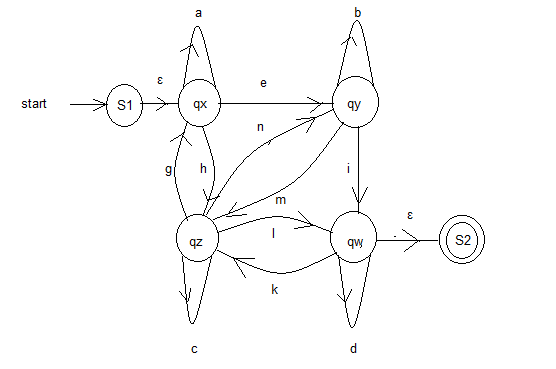
Step 2 : Eliminate state qx.
On eliminating state qx, the set of strings which can pass from state S1 to qy is represented by the regular expression a*e.
On eliminating state qx, the set of strings which can pass from state S1 to qz is represented by the regular expression a*h.
On eliminating state qx, the set of strings which can pass from state qz to qy is represented by the regular expression ga*e + n.
The GNFA is modified as :
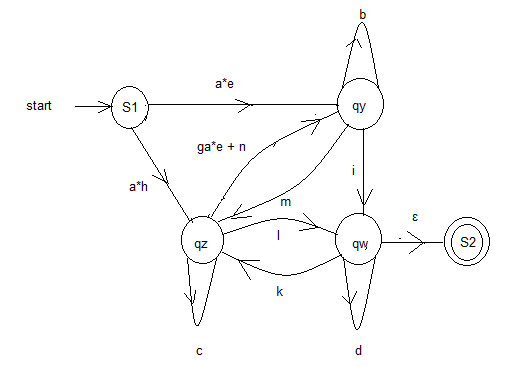
Step 3 : Eliminate state qy.
On eliminating state qy, the set of strings which can pass from state S1 to qz is represented by the regular expression a*eb*m + a*h.
On eliminating state qy, the set of strings which can pass from state S1 to qw is represented by the regular expression a*eb*i.
On eliminating state qy, the set of strings which can pass from state qz to itself is represented by the regular expression ((ga*e + n)b*m + c ).
The GNFA is modified as :
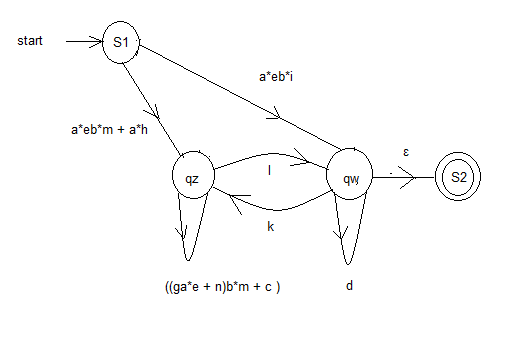
Step 4 : Eliminate state qz.
On eliminating state qz, the set of strings which can pass from state S1 to qw is represented by the regular expression (( a*eb*m + a*h )(ga*e + n)b*m + c )* l + a*eb*i ).
On eliminating state qz, the set of strings which can pass from state qw to itself is represented by the regular expression ( k(ga*e + n)b*m + c )*l + d ).
The GNFA is modified as :

Step 5 : Eliminate state qw.
On eliminating state qw, the set of strings which can pass from state S1 to S2 is represented by the regular expression (( a*eb*m + a*h )(ga*e + n)b*m + c )* l + a*eb*i ) ( k(ga*e + n)b*m + c )*l + d )*.
![start S1 (( a*eb*m + ath )(ga*e + n)b*m + c)*] + a*ebi) (k(ga*e + n)b*m + c)*+ d )* S2](http://img.homeworklib.com/questions/cf5f2800-5141-11eb-a491-47b169cadfbc.png?x-oss-process=image/resize,w_560)
So, the required regular expression is (( a*eb*m + a*h )(ga*e + n)b*m + c )* l + a*eb*i ) ( k(ga*e + n)b*m + c )*l + d )*.
Hence, the regular expression is (( a*eb*m + a*h )(ga*e + n)b*m + c )* l + a*eb*i ) ( k(ga*e + n)b*m + c )*l + d )*.
Add Answer to:
QUESTION 1 Convert the GNFA below to the corresponding regular expression. Draw any intermediate diagrams and...
Please answer any 7 of them ТОС Answer any 7 from the followings: 1. Regular expression...
 Please answer any 7 of them
ТОС Answer any 7 from the followings: 1. Regular expression to NFA: i) ab(aUb)* ii) (aba U a)*ab 2. Explain and construct a generalized NFA, 3. NFA to regular expression 0 3 91 93 8 a 4. DFA to regular expression 011 5. Explain the rules of pumping lemma briefly with an example. 6. Give an example of right linear grammar and left linear grammar. 7. L(G) = {1*20 m >= 1 and >=1}....
Please answer any 7 of them
ТОС Answer any 7 from the followings: 1. Regular expression to NFA: i) ab(aUb)* ii) (aba U a)*ab 2. Explain and construct a generalized NFA, 3. NFA to regular expression 0 3 91 93 8 a 4. DFA to regular expression 011 5. Explain the rules of pumping lemma briefly with an example. 6. Give an example of right linear grammar and left linear grammar. 7. L(G) = {1*20 m >= 1 and >=1}....
4 and 5 4) The diagrams below show a ball swinging on a string. The diagrams...
 4 and 5
4) The diagrams below show a ball swinging on a string. The diagrams show the ball's position at equal time intervals. The first position is when the ball is moving up and left. Copy these into your lab notebook and then draw acceleration vectors for the ball on each one the acceleration points the way you drew it for each diagram. The arrows show the ball's relative speed and direction at each instant and turnaround points have...
4 and 5
4) The diagrams below show a ball swinging on a string. The diagrams show the ball's position at equal time intervals. The first position is when the ball is moving up and left. Copy these into your lab notebook and then draw acceleration vectors for the ball on each one the acceleration points the way you drew it for each diagram. The arrows show the ball's relative speed and direction at each instant and turnaround points have...
beam problem QUESTION 6: Draw the free body diagram of the beam shown below and determine...
 beam problem
QUESTION 6: Draw the free body diagram of the beam shown below and determine the reactions and formulate the shear-force and bending moment equations for the beam. Sketch the shear and moment diagrams: Type your answers and intermediate calculations on the screen on the blackboard 400 N 100 N/m A 4 m 4 m
beam problem
QUESTION 6: Draw the free body diagram of the beam shown below and determine the reactions and formulate the shear-force and bending moment equations for the beam. Sketch the shear and moment diagrams: Type your answers and intermediate calculations on the screen on the blackboard 400 N 100 N/m A 4 m 4 m
Name: Question 6 (25 Points) For the shown beam below, determine the following: 1) The internal forces at F (mid-point between C & D) 2) Draw the Shear Force and Bending Moment diagrams ID: Sec:...
 Name: Question 6 (25 Points) For the shown beam below, determine the following: 1) The internal forces at F (mid-point between C & D) 2) Draw the Shear Force and Bending Moment diagrams ID: Sec: (9 Points) (16 Points) 20 N 100 N N/m
Name: Question 6 (25 Points) For the shown beam below, determine the following: 1) The internal forces at F (mid-point between C & D) 2) Draw the Shear Force and Bending Moment diagrams ID: Sec: (9...
Name: Question 6 (25 Points) For the shown beam below, determine the following: 1) The internal forces at F (mid-point between C & D) 2) Draw the Shear Force and Bending Moment diagrams ID: Sec: (9 Points) (16 Points) 20 N 100 N N/m
Name: Question 6 (25 Points) For the shown beam below, determine the following: 1) The internal forces at F (mid-point between C & D) 2) Draw the Shear Force and Bending Moment diagrams ID: Sec: (9...
Question 1: Every language is regular T/F Question 2: There exists a DFA that has only...
Question 1: Every language is regular T/F Question 2: There exists a DFA that has only one final state T/F Question 3: Let M be a DFA, and define flip(M) as the DFA which is identical to M except you flip that final state. Then for every M, the language L(M)^c (complement) = L( flip (M)). T/F Question 4: Let G be a right linear grammar, and reverse(G)=reverse of G, i.e. if G has a rule A -> w B...
Motion diagram question 19. For the following motion diagrams, draw an arrow to indicate the displacement...
 Motion diagram question
19. For the following motion diagrams, draw an arrow to indicate the displacement vector between the initial and final positions. b. 40 20. In each part of Exercise 19, is the object's displacement equal to the distance the object travels? Explain. 14. For each of the following motions, draw A motion diagram and Both position and velocity graphs a. A car starts from rest, steadily speeds up to 40 mph in 15 s, moves at a constant...
Motion diagram question
19. For the following motion diagrams, draw an arrow to indicate the displacement vector between the initial and final positions. b. 40 20. In each part of Exercise 19, is the object's displacement equal to the distance the object travels? Explain. 14. For each of the following motions, draw A motion diagram and Both position and velocity graphs a. A car starts from rest, steadily speeds up to 40 mph in 15 s, moves at a constant...
2. (10 points) Consider the beam shown below: (a) draw the complete shear diagram with corresponding...
 2. (10 points) Consider the beam shown below: (a) draw the complete shear diagram with corresponding labels and units (b) draw the complete moment diagram with corresponding labels and units (c) find the magnitude of maximum compressive normal stress (d) find the magnitude of the maximum tensile normal stress Give the value and location for all quantities along the beam and on the cross section. NOTE: The moment of inertia is I, = 99.75 in* and the centroid is given....
2. (10 points) Consider the beam shown below: (a) draw the complete shear diagram with corresponding...
 2. (10 points) Consider the beam shown below: (a) draw the complete shear diagram with corresponding labels and units (b) draw the complete moment diagram with corresponding labels and units (c) find the magnitude of maximum compressive normal stress (d) find the magnitude of the maximum tensile normal stress Give the value and location for all quantities along the beam and on the cross section. NOTE: The moment of inertia is I, = 99.75 in* and the centroid is given....
2. (10 points) Consider the beam shown below: (a) draw the complete shear diagram with corresponding...
 2. (10 points) Consider the beam shown below: (a) draw the complete shear diagram with corresponding labels and units (b) draw the complete moment diagram with corresponding labels and units (c) find the magnitude of maximum compressive normal stress (d) find the magnitude of the maximum tensile normal stress Give the value and location for all quantities along the beam and on the cross section. NOTE: The moment of inertia is 12 = 99.75 in4 and the centroid is given....
 Please answer any 7 of them
ТОС Answer any 7 from the followings: 1. Regular expression to NFA: i) ab(aUb)* ii) (aba U a)*ab 2. Explain and construct a generalized NFA, 3. NFA to regular expression 0 3 91 93 8 a 4. DFA to regular expression 011 5. Explain the rules of pumping lemma briefly with an example. 6. Give an example of right linear grammar and left linear grammar. 7. L(G) = {1*20 m >= 1 and >=1}....
Please answer any 7 of them
ТОС Answer any 7 from the followings: 1. Regular expression to NFA: i) ab(aUb)* ii) (aba U a)*ab 2. Explain and construct a generalized NFA, 3. NFA to regular expression 0 3 91 93 8 a 4. DFA to regular expression 011 5. Explain the rules of pumping lemma briefly with an example. 6. Give an example of right linear grammar and left linear grammar. 7. L(G) = {1*20 m >= 1 and >=1}....
 4 and 5
4) The diagrams below show a ball swinging on a string. The diagrams show the ball's position at equal time intervals. The first position is when the ball is moving up and left. Copy these into your lab notebook and then draw acceleration vectors for the ball on each one the acceleration points the way you drew it for each diagram. The arrows show the ball's relative speed and direction at each instant and turnaround points have...
4 and 5
4) The diagrams below show a ball swinging on a string. The diagrams show the ball's position at equal time intervals. The first position is when the ball is moving up and left. Copy these into your lab notebook and then draw acceleration vectors for the ball on each one the acceleration points the way you drew it for each diagram. The arrows show the ball's relative speed and direction at each instant and turnaround points have...
 beam problem
QUESTION 6: Draw the free body diagram of the beam shown below and determine the reactions and formulate the shear-force and bending moment equations for the beam. Sketch the shear and moment diagrams: Type your answers and intermediate calculations on the screen on the blackboard 400 N 100 N/m A 4 m 4 m
beam problem
QUESTION 6: Draw the free body diagram of the beam shown below and determine the reactions and formulate the shear-force and bending moment equations for the beam. Sketch the shear and moment diagrams: Type your answers and intermediate calculations on the screen on the blackboard 400 N 100 N/m A 4 m 4 m
 Name: Question 6 (25 Points) For the shown beam below, determine the following: 1) The internal forces at F (mid-point between C & D) 2) Draw the Shear Force and Bending Moment diagrams ID: Sec: (9 Points) (16 Points) 20 N 100 N N/m
Name: Question 6 (25 Points) For the shown beam below, determine the following: 1) The internal forces at F (mid-point between C & D) 2) Draw the Shear Force and Bending Moment diagrams ID: Sec: (9...
Name: Question 6 (25 Points) For the shown beam below, determine the following: 1) The internal forces at F (mid-point between C & D) 2) Draw the Shear Force and Bending Moment diagrams ID: Sec: (9 Points) (16 Points) 20 N 100 N N/m
Name: Question 6 (25 Points) For the shown beam below, determine the following: 1) The internal forces at F (mid-point between C & D) 2) Draw the Shear Force and Bending Moment diagrams ID: Sec: (9...
 Motion diagram question
19. For the following motion diagrams, draw an arrow to indicate the displacement vector between the initial and final positions. b. 40 20. In each part of Exercise 19, is the object's displacement equal to the distance the object travels? Explain. 14. For each of the following motions, draw A motion diagram and Both position and velocity graphs a. A car starts from rest, steadily speeds up to 40 mph in 15 s, moves at a constant...
Motion diagram question
19. For the following motion diagrams, draw an arrow to indicate the displacement vector between the initial and final positions. b. 40 20. In each part of Exercise 19, is the object's displacement equal to the distance the object travels? Explain. 14. For each of the following motions, draw A motion diagram and Both position and velocity graphs a. A car starts from rest, steadily speeds up to 40 mph in 15 s, moves at a constant...
 2. (10 points) Consider the beam shown below: (a) draw the complete shear diagram with corresponding labels and units (b) draw the complete moment diagram with corresponding labels and units (c) find the magnitude of maximum compressive normal stress (d) find the magnitude of the maximum tensile normal stress Give the value and location for all quantities along the beam and on the cross section. NOTE: The moment of inertia is I, = 99.75 in* and the centroid is given....
 2. (10 points) Consider the beam shown below: (a) draw the complete shear diagram with corresponding labels and units (b) draw the complete moment diagram with corresponding labels and units (c) find the magnitude of maximum compressive normal stress (d) find the magnitude of the maximum tensile normal stress Give the value and location for all quantities along the beam and on the cross section. NOTE: The moment of inertia is I, = 99.75 in* and the centroid is given....
 2. (10 points) Consider the beam shown below: (a) draw the complete shear diagram with corresponding labels and units (b) draw the complete moment diagram with corresponding labels and units (c) find the magnitude of maximum compressive normal stress (d) find the magnitude of the maximum tensile normal stress Give the value and location for all quantities along the beam and on the cross section. NOTE: The moment of inertia is 12 = 99.75 in4 and the centroid is given....
Most questions answered within 3 hours.
-
Where is the error in this code sequence?
String s1 = "Hello";
String s2 = "ello";...
asked 10 months ago -
Financial data for Joel de Paris, Inc., for last year
follow:
Joel de Paris, Inc.
Balance...
asked 10 months ago -
Consider this reaction:
Al2(SO4)3 (aq)+ BaCl3
(aq) Al2Cl6 (aq)- +
3BaSO4(s) . What is the...
asked 10 months ago -
Suppose that Savneet is considering increasing her
recent random sample from 20 car rentals to 40...
asked 10 months ago -
Trucks arrive at an unloading terminal at an average rate of 120
per hour.
Trucks arrive...
asked 10 months ago -
Why are methanol and ethanol completely soluble in water while
octanol is not very little soluble....
asked 10 months ago -
A facilities manager at a university reads in a research report
that the mean amount of...
asked 10 months ago -
When the CuSO4 is rehydrated by adding water to the anhydrous
compound, is this an endothermic...
asked 10 months ago -
A ray of sunlight is passing from diamond into crown glass; the
angle of incidence is...
asked 10 months ago -
A block of mass 0.249 kg is placed on top of a light, vertical
spring of...
asked 10 months ago -
how do the kidneys compensate in the presences of acidosis
a) trigger hyperventilate
b) reserve acid...
asked 10 months ago -
Question 501 pts
The rental rate of capital to the firm increases. Which of the
following...
asked 10 months ago