
Homework Answers
1.
(a)



(b)

2.
(a)


(b)
 ( Magnitude )


3.


Add Answer to:
Solve all the questions please!!
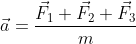
A particle with mass m - 4.40 kg accelerates according to...
QUESTION 7 In my coordinate system a particle with mass 2 kg has forces acting on...
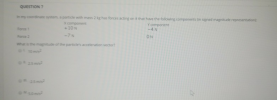 QUESTION 7 In my coordinate system a particle with mass 2 kg has forces acting on it that have the following components in signed magnitude representation X component Y component +10 N -4N -7N ON Force 1 Force 2 What is the magnitude of the particle's acceleration vector? 25.52 25mos? w.somos?
Three forces are applied on a particle of mass m= 15 kg located at the origin,...
 Three forces are applied on a particle of mass m= 15 kg located at the origin, as show below. The magnitudes are given to be FA = 15 N, FB = 35 N, Fc = 22 N, and the directions are 04 = 53°, measured from the negative x-axis, 03= 32°, measured from tl positive x-axis, and the direction of Fc is along the negative y-axis. a. Calculate the magnitude the net force on the particle. b. Calculate the direction...
An electron is a subatomic particle (m = 9.11 10-31 kg) that is subject to electric...
An electron is a subatomic particle (m = 9.11 10-31 kg) that is subject to electric forces. An electron moving in the +x direction accelerates from an initial velocity of +5.46 105 m/s to a final velocity of +1.93 106 m/s while traveling a distance of 0.041 m. The electron's acceleration is due to two electric forces parallel to the x axis: vector F 1 = +8.15 10-17 N, and vector F 2, which points in the -x direction. Find...
Two horizontal forces, P and Q, are acting on a block that is placed on a...
Two horizontal forces, P and Q, are acting on a block that is placed on a table. We know that P = 2.10î + 4.25k N but the magnitude and direction of Q are unknown. The block moves along the table. Assume there is no friction between the object and the table. Here the mass of the block is 4.55 kg. (a) Determine the force Q when the block moves with constant velocity. Express your answer in vector form. Q...
The position of a particle of mass m = 0.80 kg as a function of time...
The position of a particle of mass m = 0.80 kg as a function of time is given by ⃗r = xˆi + yˆj = (Rsinωt)ˆi + (Rcosωt)ˆj, where R = 4.0 m and ω = 2πs−1. (a) Show that the path of this particle is a circle of radius R, with its center at the origin of the xy plane. (b) Compute the velocity vector. Show that vx/vy = −y/x. (c) Compute the acceleration vector and show that it...
please answer both questions ty so much Two forces are acting on a 0.250 kg hockey...
 please answer both questions ty so much
Two forces are acting on a 0.250 kg hockey puck as it slides along the ice. The first force has a magnitude of 0.400 N and points 35.0 north of east. The second force has a magnitude of 0.580 N and points 65,0° north of east. If these are the only two forces acting on the puck, what will be the magnitude and direction of the puck's acceleration? Enter the direction as an...
please answer both questions ty so much
Two forces are acting on a 0.250 kg hockey puck as it slides along the ice. The first force has a magnitude of 0.400 N and points 35.0 north of east. The second force has a magnitude of 0.580 N and points 65,0° north of east. If these are the only two forces acting on the puck, what will be the magnitude and direction of the puck's acceleration? Enter the direction as an...
A soccer ball of mass 0.36 kg is rolling with velocity <0, 0, 1.5> m/s, when...
 A soccer ball of mass 0.36 kg is rolling with velocity <0, 0, 1.5> m/s, when you kick it. Your kick delivers an impulse of magnitude 2.7 N.s in the -x direction. The net force on the rolling ball, due to the air and the grass, is 0.34 N in the direction opposite to the direction of the ball's time 1.5 s after you kick it, assuming that the ball is at the origin at the moment it is kicked....
The figure below shows a block with mass m = 5.3 kg pulled up a ramp...
 The figure below shows a block with mass m = 5.3 kg pulled up a ramp inclined at an angle of 6 = 28° with a force of magnitude F = 33 N parallel to the ramp. m (a) If there is no friction between the block and the ramp, what is the magnitude of the block's acceleration (in m/s2)? 1.485 Draw a free-body diagram. What forces act on the block? Let the x-axis be parallel to the incline. What...
0,2gm A particle of mass : 3 kg starts from rest at point A and slides...
 0,2gm A particle of mass : 3 kg starts from rest at point A and slides around the frictton- less loop-the-loop DBC. Use g 10 m/s2 0,2 a Find the speed of the article at point E. R 1690 Find the-magnitude and direction of the acceleration of the particle at B. Be sure to include the angle between the acceleration vector and the horizontal. Pind the normal force exerted by the track on the particle at-c. (d) After going around...
At time t = 0, a 4.0 kg particle with velocity v = (5.0 m/s) i...
 At time t = 0, a 4.0 kg particle with velocity v = (5.0 m/s) i - (6.0 m/s) j is at x = 6.0 m, y = 5.0 m. It is pulled by a 2.0 N force in the negative x direction. What is the angular momentum of the particle about the origin? (Express your answer in vector form.) What torque about the origin acts on the particle? (Express your answer in vector form.) At what rate is the...
 QUESTION 7 In my coordinate system a particle with mass 2 kg has forces acting on it that have the following components in signed magnitude representation X component Y component +10 N -4N -7N ON Force 1 Force 2 What is the magnitude of the particle's acceleration vector? 25.52 25mos? w.somos?
 Three forces are applied on a particle of mass m= 15 kg located at the origin, as show below. The magnitudes are given to be FA = 15 N, FB = 35 N, Fc = 22 N, and the directions are 04 = 53°, measured from the negative x-axis, 03= 32°, measured from tl positive x-axis, and the direction of Fc is along the negative y-axis. a. Calculate the magnitude the net force on the particle. b. Calculate the direction...
 please answer both questions ty so much
Two forces are acting on a 0.250 kg hockey puck as it slides along the ice. The first force has a magnitude of 0.400 N and points 35.0 north of east. The second force has a magnitude of 0.580 N and points 65,0° north of east. If these are the only two forces acting on the puck, what will be the magnitude and direction of the puck's acceleration? Enter the direction as an...
please answer both questions ty so much
Two forces are acting on a 0.250 kg hockey puck as it slides along the ice. The first force has a magnitude of 0.400 N and points 35.0 north of east. The second force has a magnitude of 0.580 N and points 65,0° north of east. If these are the only two forces acting on the puck, what will be the magnitude and direction of the puck's acceleration? Enter the direction as an...
 A soccer ball of mass 0.36 kg is rolling with velocity <0, 0, 1.5> m/s, when you kick it. Your kick delivers an impulse of magnitude 2.7 N.s in the -x direction. The net force on the rolling ball, due to the air and the grass, is 0.34 N in the direction opposite to the direction of the ball's time 1.5 s after you kick it, assuming that the ball is at the origin at the moment it is kicked....
 The figure below shows a block with mass m = 5.3 kg pulled up a ramp inclined at an angle of 6 = 28° with a force of magnitude F = 33 N parallel to the ramp. m (a) If there is no friction between the block and the ramp, what is the magnitude of the block's acceleration (in m/s2)? 1.485 Draw a free-body diagram. What forces act on the block? Let the x-axis be parallel to the incline. What...
 0,2gm A particle of mass : 3 kg starts from rest at point A and slides around the frictton- less loop-the-loop DBC. Use g 10 m/s2 0,2 a Find the speed of the article at point E. R 1690 Find the-magnitude and direction of the acceleration of the particle at B. Be sure to include the angle between the acceleration vector and the horizontal. Pind the normal force exerted by the track on the particle at-c. (d) After going around...
 At time t = 0, a 4.0 kg particle with velocity v = (5.0 m/s) i - (6.0 m/s) j is at x = 6.0 m, y = 5.0 m. It is pulled by a 2.0 N force in the negative x direction. What is the angular momentum of the particle about the origin? (Express your answer in vector form.) What torque about the origin acts on the particle? (Express your answer in vector form.) At what rate is the...
Most questions answered within 3 hours.
-
Where is the error in this code sequence?
String s1 = "Hello";
String s2 = "ello";...
asked 10 months ago -
Financial data for Joel de Paris, Inc., for last year
follow:
Joel de Paris, Inc.
Balance...
asked 10 months ago -
Consider this reaction:
Al2(SO4)3 (aq)+ BaCl3
(aq) Al2Cl6 (aq)- +
3BaSO4(s) . What is the...
asked 10 months ago -
Suppose that Savneet is considering increasing her
recent random sample from 20 car rentals to 40...
asked 10 months ago -
Trucks arrive at an unloading terminal at an average rate of 120
per hour.
Trucks arrive...
asked 10 months ago -
Why are methanol and ethanol completely soluble in water while
octanol is not very little soluble....
asked 10 months ago -
A facilities manager at a university reads in a research report
that the mean amount of...
asked 10 months ago -
When the CuSO4 is rehydrated by adding water to the anhydrous
compound, is this an endothermic...
asked 10 months ago -
A ray of sunlight is passing from diamond into crown glass; the
angle of incidence is...
asked 10 months ago -
A block of mass 0.249 kg is placed on top of a light, vertical
spring of...
asked 10 months ago -
how do the kidneys compensate in the presences of acidosis
a) trigger hyperventilate
b) reserve acid...
asked 10 months ago -
Question 501 pts
The rental rate of capital to the firm increases. Which of the
following...
asked 10 months ago