
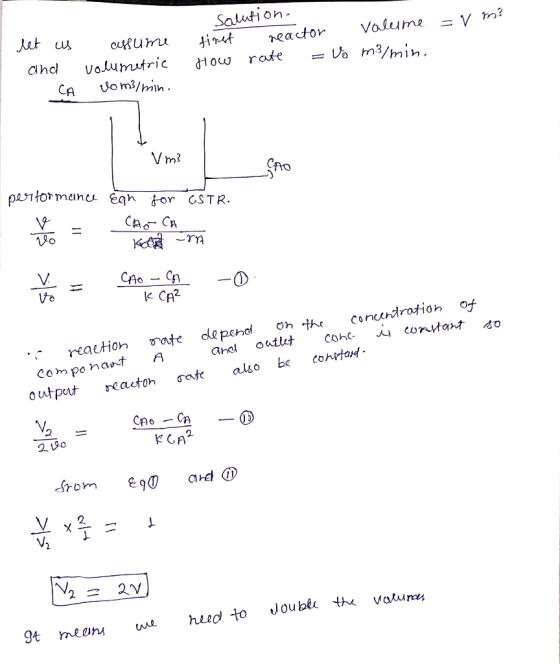
Component C is produced by the liquid phase reaction expressed above. Using a CSTR, at the reactor outlet, the reaction rate of Component A is 0.800.
Here, I want to double the production volume by changing only the volume flow rate of the raw material. How many times should the volume flow be multiplied?
Homework Answers
Add Answer to:
Component C is produced by the liquid phase reaction expressed above. Using a CSTR, at the...
An elementary reaction is operated in liquid phase in a perfect mixed flow (CSTR) reactor A...
 An elementary reaction is operated in liquid phase in a perfect mixed flow (CSTR) reactor A 3B The feeding is composed of pure reactant A at an inlet molar flowrate of 1mol.h. The reaction advancement ? is 0.8 mol.h-1. a) Compute the partial molar flowrates of A and B at the reactor outlet b) ? (h) the space time, is defined as the ratio between the volume of the liquid mixture ver the volumetric flowrate of the feeding stream q(m.h),...
R1 - LIQUID PHASE CHEMICAL REACTOR The elementary liquid phase reaction given below is carried out...
 R1 - LIQUID PHASE CHEMICAL REACTOR The elementary liquid phase reaction given below is carried out in a CSTR by isothermal operation. k > NaOAC + EtOH k = 3.59 L/mol.min NaOH + EtOAC (A) (B) (C) (D) The volume of the CSTR is 2 L and the flowrates of the feeds in the individual streams are 50 ml/min for both reactants. The concentrations of NaOH and EtoAc are 0.05 mol/L and 0.1 mol/L, respectively. [6] a) Calculate the conversion...
Problem: A reaction A+ R takes place in a constant-volume isothermal CSTR. The component mass balances...
 Problem: A reaction A+ R takes place in a constant-volume isothermal CSTR. The component mass balances are: 1401 =CH-C, -kC,C, de=C-Cp+kC/CR dt where: Cai feed concentration of A (input); CRI: feed concentration of R (assumed constant); CA, CR: concentrations of A,R, respectively, in the reactor and outlet; t, k:, positive constants. a) Linearize the equations around the design steady-state (0.0...) (and put them in deviation variable form. b) Calculate the transfer function between CR and CA c) Under what conditions...
An acid-catalyzed irreversible liquid-phase reaction A B is carried out adiabatically in a CSTR. The reaction is second...
 An acid-catalyzed irreversible liquid-phase reaction A B is carried out adiabatically in a CSTR. The reaction is second order in A. The feed is equimolar A and solvent (S, which contains catalyst), and enters the reactor at a total volumetric flow rate of 10 dm3/min at a concentration of A of 4 mol/L. The feed enters at 300 K. The product and reactant heat capacities are 15 cal/(mol°C), the solvent is 18 cal/(mol°C). The reaction rate constant at 300 K...
. Question 2: The elementary, reversible, organic, liquid-phase reaction is carried out adiabatically in a CSTR...
 .
Question 2: The elementary, reversible, organic, liquid-phase reaction is carried out adiabatically in a CSTR where 65% conversion is achiewd Ated'anonn of A and 50% excess 8, enters the reactor at 27°C with a volumetric flow rate of 2 L/s and a Cos of O.1 mol/L culate the temperature inside the reactor 2. Calculate the equilibrium conversion at the operating temperature. How close (in 3. Calculate the CSTR volume percentage) the conversion is from the equilsbrium conversion? If the...
.
Question 2: The elementary, reversible, organic, liquid-phase reaction is carried out adiabatically in a CSTR where 65% conversion is achiewd Ated'anonn of A and 50% excess 8, enters the reactor at 27°C with a volumetric flow rate of 2 L/s and a Cos of O.1 mol/L culate the temperature inside the reactor 2. Calculate the equilibrium conversion at the operating temperature. How close (in 3. Calculate the CSTR volume percentage) the conversion is from the equilsbrium conversion? If the...
please solve it right . Example: Van de Vusse Reaction in an CSTR Van de Vusse liquid phase reaction is carried out...
 please solve it right .
Example: Van de Vusse Reaction in an CSTR Van de Vusse liquid phase reaction is carried out in an isothermal CSTR according to the following stoichiometric equations: k3 where B is the desired product, and C and D are the undesired byproducts. The feed to the CSTR contains the reactant A only. The reaction rates are given by the following rate laws: 2 Additional information: k 0.8333 min k2 1.667 min, k3 0.1667 L min...
please solve it right .
Example: Van de Vusse Reaction in an CSTR Van de Vusse liquid phase reaction is carried out in an isothermal CSTR according to the following stoichiometric equations: k3 where B is the desired product, and C and D are the undesired byproducts. The feed to the CSTR contains the reactant A only. The reaction rates are given by the following rate laws: 2 Additional information: k 0.8333 min k2 1.667 min, k3 0.1667 L min...
You are given the rate equation −rA" = -kA" CA for the liquid-phase reaction A--->B. Inlet...
You are given the rate equation −rA" = -kA" CA for the liquid-phase reaction A--->B. Inlet flow rates are 100 mol/s of pure A, which has a density of 1000 kg/m3 and a molar mass 1000 g/mol. The rate constant is 1x10⁻⁶m/s. You are told the reactor has a catalyst of surface area Sg of 5 m2/g, and the catalyst density in the reactor is 25 kg/m3. a. To achieve 50% conversion in an isothermal steady-state CSTR, what is the volume required?...
Design a CSTR for the elementary consecutive gas-phase reactions A - B C. Specify the reactor...
 Design a CSTR for the elementary consecutive gas-phase reactions A - B C. Specify the reactor volume and the area of the heating coil inside the reactor for 50% conversion. a. Calculate the desired operating temperature inside the reactor. b. Calculate the volume of the reactor c. Calculate the area of the heating surface. The effluent stream should contain a ratio CB/Cc of 10. The feed is gas-phase and pure A at 400°C and 4 atm, with a molar flow...
QUESTION 5: 10 marks An elementary aqueous phase reaction A --> B+C is to be carried...
 QUESTION 5: 10 marks An elementary aqueous phase reaction A --> B+C is to be carried out in 10 points a non-ideal CSTR which has both bypassing and a dead zone in it. The measured liquid volume in the reactor is 500 dm3 and the volumetric flow rate to the reactor is 10 dm3/min with a concentration of A as Imol/dm3. The reaction rate constant is 0.5 min^-1. a) Calculate the conversion that can be expected in this reactor if...
2 of 6 04-Chem-A4/Dec 2012 1. A first-order, homogeneous, liquid-phase reaction (A - B) occurs in...
 2 of 6 04-Chem-A4/Dec 2012 1. A first-order, homogeneous, liquid-phase reaction (A - B) occurs in a CSTR that operates adiabatically at steady state. The reaction is exothermic. Data are as follows and should be considered as exact quantities CA G, 1.75 molA/L (Inlet concentration of A) 2.5 J/g-K (The heat capacity of the reacting fluid; assumed constant at all conversions.) AH, -27 000 J/molA q-30 L/min (Flow into the CSTR.) (-rA) = 1.8( 1013)e(-84000 RDCA (The rate of reaction...
 An elementary reaction is operated in liquid phase in a perfect mixed flow (CSTR) reactor A 3B The feeding is composed of pure reactant A at an inlet molar flowrate of 1mol.h. The reaction advancement ? is 0.8 mol.h-1. a) Compute the partial molar flowrates of A and B at the reactor outlet b) ? (h) the space time, is defined as the ratio between the volume of the liquid mixture ver the volumetric flowrate of the feeding stream q(m.h),...
 R1 - LIQUID PHASE CHEMICAL REACTOR The elementary liquid phase reaction given below is carried out in a CSTR by isothermal operation. k > NaOAC + EtOH k = 3.59 L/mol.min NaOH + EtOAC (A) (B) (C) (D) The volume of the CSTR is 2 L and the flowrates of the feeds in the individual streams are 50 ml/min for both reactants. The concentrations of NaOH and EtoAc are 0.05 mol/L and 0.1 mol/L, respectively. [6] a) Calculate the conversion...
 Problem: A reaction A+ R takes place in a constant-volume isothermal CSTR. The component mass balances are: 1401 =CH-C, -kC,C, de=C-Cp+kC/CR dt where: Cai feed concentration of A (input); CRI: feed concentration of R (assumed constant); CA, CR: concentrations of A,R, respectively, in the reactor and outlet; t, k:, positive constants. a) Linearize the equations around the design steady-state (0.0...) (and put them in deviation variable form. b) Calculate the transfer function between CR and CA c) Under what conditions...
 An acid-catalyzed irreversible liquid-phase reaction A B is carried out adiabatically in a CSTR. The reaction is second order in A. The feed is equimolar A and solvent (S, which contains catalyst), and enters the reactor at a total volumetric flow rate of 10 dm3/min at a concentration of A of 4 mol/L. The feed enters at 300 K. The product and reactant heat capacities are 15 cal/(mol°C), the solvent is 18 cal/(mol°C). The reaction rate constant at 300 K...
 .
Question 2: The elementary, reversible, organic, liquid-phase reaction is carried out adiabatically in a CSTR where 65% conversion is achiewd Ated'anonn of A and 50% excess 8, enters the reactor at 27°C with a volumetric flow rate of 2 L/s and a Cos of O.1 mol/L culate the temperature inside the reactor 2. Calculate the equilibrium conversion at the operating temperature. How close (in 3. Calculate the CSTR volume percentage) the conversion is from the equilsbrium conversion? If the...
.
Question 2: The elementary, reversible, organic, liquid-phase reaction is carried out adiabatically in a CSTR where 65% conversion is achiewd Ated'anonn of A and 50% excess 8, enters the reactor at 27°C with a volumetric flow rate of 2 L/s and a Cos of O.1 mol/L culate the temperature inside the reactor 2. Calculate the equilibrium conversion at the operating temperature. How close (in 3. Calculate the CSTR volume percentage) the conversion is from the equilsbrium conversion? If the...
 please solve it right .
Example: Van de Vusse Reaction in an CSTR Van de Vusse liquid phase reaction is carried out in an isothermal CSTR according to the following stoichiometric equations: k3 where B is the desired product, and C and D are the undesired byproducts. The feed to the CSTR contains the reactant A only. The reaction rates are given by the following rate laws: 2 Additional information: k 0.8333 min k2 1.667 min, k3 0.1667 L min...
please solve it right .
Example: Van de Vusse Reaction in an CSTR Van de Vusse liquid phase reaction is carried out in an isothermal CSTR according to the following stoichiometric equations: k3 where B is the desired product, and C and D are the undesired byproducts. The feed to the CSTR contains the reactant A only. The reaction rates are given by the following rate laws: 2 Additional information: k 0.8333 min k2 1.667 min, k3 0.1667 L min...
 Design a CSTR for the elementary consecutive gas-phase reactions A - B C. Specify the reactor volume and the area of the heating coil inside the reactor for 50% conversion. a. Calculate the desired operating temperature inside the reactor. b. Calculate the volume of the reactor c. Calculate the area of the heating surface. The effluent stream should contain a ratio CB/Cc of 10. The feed is gas-phase and pure A at 400°C and 4 atm, with a molar flow...
 QUESTION 5: 10 marks An elementary aqueous phase reaction A --> B+C is to be carried out in 10 points a non-ideal CSTR which has both bypassing and a dead zone in it. The measured liquid volume in the reactor is 500 dm3 and the volumetric flow rate to the reactor is 10 dm3/min with a concentration of A as Imol/dm3. The reaction rate constant is 0.5 min^-1. a) Calculate the conversion that can be expected in this reactor if...
 2 of 6 04-Chem-A4/Dec 2012 1. A first-order, homogeneous, liquid-phase reaction (A - B) occurs in a CSTR that operates adiabatically at steady state. The reaction is exothermic. Data are as follows and should be considered as exact quantities CA G, 1.75 molA/L (Inlet concentration of A) 2.5 J/g-K (The heat capacity of the reacting fluid; assumed constant at all conversions.) AH, -27 000 J/molA q-30 L/min (Flow into the CSTR.) (-rA) = 1.8( 1013)e(-84000 RDCA (The rate of reaction...
Most questions answered within 3 hours.
-
Where is the error in this code sequence?
String s1 = "Hello";
String s2 = "ello";...
asked 10 months ago -
Financial data for Joel de Paris, Inc., for last year
follow:
Joel de Paris, Inc.
Balance...
asked 10 months ago -
Consider this reaction:
Al2(SO4)3 (aq)+ BaCl3
(aq) Al2Cl6 (aq)- +
3BaSO4(s) . What is the...
asked 10 months ago -
Suppose that Savneet is considering increasing her
recent random sample from 20 car rentals to 40...
asked 10 months ago -
Trucks arrive at an unloading terminal at an average rate of 120
per hour.
Trucks arrive...
asked 10 months ago -
Why are methanol and ethanol completely soluble in water while
octanol is not very little soluble....
asked 10 months ago -
A facilities manager at a university reads in a research report
that the mean amount of...
asked 10 months ago -
When the CuSO4 is rehydrated by adding water to the anhydrous
compound, is this an endothermic...
asked 10 months ago -
A ray of sunlight is passing from diamond into crown glass; the
angle of incidence is...
asked 10 months ago -
A block of mass 0.249 kg is placed on top of a light, vertical
spring of...
asked 10 months ago -
how do the kidneys compensate in the presences of acidosis
a) trigger hyperventilate
b) reserve acid...
asked 10 months ago -
Question 501 pts
The rental rate of capital to the firm increases. Which of the
following...
asked 10 months ago