

Homework Answers
I am getting T3 and T4 as 3100R and 2050.183 R respectively. Hence work done will be Cv(T3-T4).which is coming as 179.5185 Btu/lbm. Since Q is 493.44 hence efficiency is coming 36.38%. You have provided the efficiency as 36.7% which is not far but I don't know how much error your application allowing. Check with 36.38% and if you want I will provide a detailed solution for the 2nd part . Just ask me in the comment section. Thanks a lot
Add Answer to:
You got this question right in the previous attempt. Check my work View previous attempt Required...
omework 3 Question 1 (of 8) value: 12.50 points 2 out of 3 attempts A cold...
 omework 3 Question 1 (of 8) value: 12.50 points 2 out of 3 attempts A cold air-standard cycle with variable specific heats is executed in a closed system and is composed of the following four processes: 1-2 v constant, heat addition from 14.7 psia and 80°F in the amount of 260 Btu/lbm 2-3 P constant, heat addition to 3,200 R 3-4 Isentropic expansion to 14.7 psia 4-1 P-constant, heat rejection to initial state (a) Calculate the total heat input per...
Please Plot with solution An air-standard cycle with constant specific heats is executed in a closed...
 Please Plot with solution
An air-standard cycle with constant specific heats is executed in a closed system and is composed of the following four processes: 1-2 Isentropic compression from 100 kPa and 22°C to 600 kPa 2-3 v = constant heat addition to 1500 K 3-4 Isentropic expansion to 100 kPa 4-1 P= constant heat rejection to initial state Study the effect of varying the temperature after the constant-volume heat addition from 1500 K to 2500 K in steps of...
Please Plot with solution
An air-standard cycle with constant specific heats is executed in a closed system and is composed of the following four processes: 1-2 Isentropic compression from 100 kPa and 22°C to 600 kPa 2-3 v = constant heat addition to 1500 K 3-4 Isentropic expansion to 100 kPa 4-1 P= constant heat rejection to initial state Study the effect of varying the temperature after the constant-volume heat addition from 1500 K to 2500 K in steps of...
Design a small gas turbine engine to produce 150 kW of net power. Use an air-standard...
 Design a small gas turbine engine to produce 150 kW of net power. Use an air-standard analysis (constant gas properties) and assume air enters the compressor at 100kPa and 20°C. The compressor pressure ratio is 8, the maximum cycle temperature is 800°C, and the cold air stream leaves the regenerator 10°C cooler than the hot air stream at the inlet of the regenerator. Assume a compressor isentropic efficiency of 87% and a turbine isentropic efficiency of 93%. Determine the rates...
5. Similar to 9-127 A gas turbine operates with a regenerator and two stages of reheating...
 5. Similar to 9-127 A gas turbine operates with a regenerator and two stages of reheating and intercooling. Air enters this engine at 14 psia and 50°F, the pressure ratio for each stage of compression is 2.7, the air temperature when entering a turbine is 940°F, and the regenerator operates perfectly. Determine the mass flow rate of the air passing through this engine and the rates of heat addition and rejection when this engine produces 1040 hp. Assume isentropic operations...
Do problem 9.128E using variable specific heat assumptions instead of constant. Please don't use constant specific...
 Do problem 9.128E using
variable specific heat assumptions instead of constant.
Please don't use constant specific heat
assumption
Solution 9.128E Problem Statement Reconsider Prob. 9–127E. Determine the change in the rate of heat addition to the cycle when the isentropic efficiency of each compressor is 88 percent and that of each turbine is 93 percent. Problem 9.127E A gas turbine operates with a regenerator and two stages of reheating and intercooling. Air enters this engine at 14 psia and 60°F;...
Do problem 9.128E using
variable specific heat assumptions instead of constant.
Please don't use constant specific heat
assumption
Solution 9.128E Problem Statement Reconsider Prob. 9–127E. Determine the change in the rate of heat addition to the cycle when the isentropic efficiency of each compressor is 88 percent and that of each turbine is 93 percent. Problem 9.127E A gas turbine operates with a regenerator and two stages of reheating and intercooling. Air enters this engine at 14 psia and 60°F;...
1 out of 10 attempts Assistance Check My Work View Hint View Question Print Question Help...
 1 out of 10 attempts Assistance Check My Work View Hint View Question Print Question Help Report a Problem Air P-65 psia T 120°F e,in An insulated, 64-ft3 rigid tank contains air at 65 psia and 120°F. A valve connected to the tank is now opened, and air is allowed to escape until the pressure inside drops to 16 psia. The air temperature during this process is maintained constant by an electric resistance heater placed in the tank. Determine the...
3.) Consider a cold air-standard Otto cycle. Operating data at table below. The and R =...
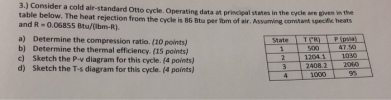 3.) Consider a cold air-standard Otto cycle. Operating data at table below. The and R = 0.06855 Btu/(lbm-R). principal states in the cycle are given in the heat rejection from the cycle is 86 Btu per Ibm of air. Assuming constant specific heats a) State TR) P(psla b) c) d) Determine the compression ratio. (10 points) Determine the thermal efficiency. (15 points) Sketch the P-v diagram for this cycle. (4 points) Sketch the T-s diagram for this cycle. (4 points)...
An air-standard cycle is executed within a closed piston–cylinder system, and it consists of the following...
 An air-standard cycle is
executed within a closed piston–cylinder system, and it consists of
the following three processes: 1–2 V = Constant heat addition from
100 kPa and 30°C to 850 kPa 2–3 Isothermal expansion until V3 =
8.5V2 3–1 P = Constant heat rejection to the initial state Assume
air has constant properties with cv = 0.718 kJ/kg·K, cp = 1.005
kJ/kg·K, R = 0.287 kJ/kg·K, and k = 1.4.
Required information An air-standard cycle is executed within a...
An air-standard cycle is
executed within a closed piston–cylinder system, and it consists of
the following three processes: 1–2 V = Constant heat addition from
100 kPa and 30°C to 850 kPa 2–3 Isothermal expansion until V3 =
8.5V2 3–1 P = Constant heat rejection to the initial state Assume
air has constant properties with cv = 0.718 kJ/kg·K, cp = 1.005
kJ/kg·K, R = 0.287 kJ/kg·K, and k = 1.4.
Required information An air-standard cycle is executed within a...
Question 3 (a) In a closed system, 0.93 kg of steam at 600 kPa and 200°C...
 Question 3 (a) In a closed system, 0.93 kg of steam at 600 kPa and 200°C undergoes an isothermal and reversible process until 0.76 kg of saturated liquid water is obtained in the system. (i) Determine the entropy change of the mass. (5 marks) (ii) Determine the amount of heat transfer of the system during the process. (3 marks) (b) A two-cylinder two-stroke diesel engine operates on an ideal Diesel cycle, of which compression ratio is 22.5 and cutoff ratio...
Required information An air-standard cycle is executed within a closed piston-cylinder system, and it consists of...
 Required information An air-standard cycle is executed within a closed piston-cylinder system, and it consists of the following three processes: 1-2 V Constant heat addition from 100 kPa and 34°C to 850 kPa 2-3 Isothermal expansion until V3-8.5V2 3-1 P Constant heat rejection to the initial state Assume air has constant properties with cv 0.718 kJ/kg-K, Cp 1.005 kJ/kg-K, R- 0.287 kJ/kg-K, and k-1.4 Determine the cycle thermal efficiency. The cycle thermal efficiency is 10.266
 omework 3 Question 1 (of 8) value: 12.50 points 2 out of 3 attempts A cold air-standard cycle with variable specific heats is executed in a closed system and is composed of the following four processes: 1-2 v constant, heat addition from 14.7 psia and 80°F in the amount of 260 Btu/lbm 2-3 P constant, heat addition to 3,200 R 3-4 Isentropic expansion to 14.7 psia 4-1 P-constant, heat rejection to initial state (a) Calculate the total heat input per...
 Please Plot with solution
An air-standard cycle with constant specific heats is executed in a closed system and is composed of the following four processes: 1-2 Isentropic compression from 100 kPa and 22°C to 600 kPa 2-3 v = constant heat addition to 1500 K 3-4 Isentropic expansion to 100 kPa 4-1 P= constant heat rejection to initial state Study the effect of varying the temperature after the constant-volume heat addition from 1500 K to 2500 K in steps of...
Please Plot with solution
An air-standard cycle with constant specific heats is executed in a closed system and is composed of the following four processes: 1-2 Isentropic compression from 100 kPa and 22°C to 600 kPa 2-3 v = constant heat addition to 1500 K 3-4 Isentropic expansion to 100 kPa 4-1 P= constant heat rejection to initial state Study the effect of varying the temperature after the constant-volume heat addition from 1500 K to 2500 K in steps of...
 Design a small gas turbine engine to produce 150 kW of net power. Use an air-standard analysis (constant gas properties) and assume air enters the compressor at 100kPa and 20°C. The compressor pressure ratio is 8, the maximum cycle temperature is 800°C, and the cold air stream leaves the regenerator 10°C cooler than the hot air stream at the inlet of the regenerator. Assume a compressor isentropic efficiency of 87% and a turbine isentropic efficiency of 93%. Determine the rates...
 5. Similar to 9-127 A gas turbine operates with a regenerator and two stages of reheating and intercooling. Air enters this engine at 14 psia and 50°F, the pressure ratio for each stage of compression is 2.7, the air temperature when entering a turbine is 940°F, and the regenerator operates perfectly. Determine the mass flow rate of the air passing through this engine and the rates of heat addition and rejection when this engine produces 1040 hp. Assume isentropic operations...
 Do problem 9.128E using
variable specific heat assumptions instead of constant.
Please don't use constant specific heat
assumption
Solution 9.128E Problem Statement Reconsider Prob. 9–127E. Determine the change in the rate of heat addition to the cycle when the isentropic efficiency of each compressor is 88 percent and that of each turbine is 93 percent. Problem 9.127E A gas turbine operates with a regenerator and two stages of reheating and intercooling. Air enters this engine at 14 psia and 60°F;...
Do problem 9.128E using
variable specific heat assumptions instead of constant.
Please don't use constant specific heat
assumption
Solution 9.128E Problem Statement Reconsider Prob. 9–127E. Determine the change in the rate of heat addition to the cycle when the isentropic efficiency of each compressor is 88 percent and that of each turbine is 93 percent. Problem 9.127E A gas turbine operates with a regenerator and two stages of reheating and intercooling. Air enters this engine at 14 psia and 60°F;...
 1 out of 10 attempts Assistance Check My Work View Hint View Question Print Question Help Report a Problem Air P-65 psia T 120°F e,in An insulated, 64-ft3 rigid tank contains air at 65 psia and 120°F. A valve connected to the tank is now opened, and air is allowed to escape until the pressure inside drops to 16 psia. The air temperature during this process is maintained constant by an electric resistance heater placed in the tank. Determine the...
 3.) Consider a cold air-standard Otto cycle. Operating data at table below. The and R = 0.06855 Btu/(lbm-R). principal states in the cycle are given in the heat rejection from the cycle is 86 Btu per Ibm of air. Assuming constant specific heats a) State TR) P(psla b) c) d) Determine the compression ratio. (10 points) Determine the thermal efficiency. (15 points) Sketch the P-v diagram for this cycle. (4 points) Sketch the T-s diagram for this cycle. (4 points)...
 An air-standard cycle is
executed within a closed piston–cylinder system, and it consists of
the following three processes: 1–2 V = Constant heat addition from
100 kPa and 30°C to 850 kPa 2–3 Isothermal expansion until V3 =
8.5V2 3–1 P = Constant heat rejection to the initial state Assume
air has constant properties with cv = 0.718 kJ/kg·K, cp = 1.005
kJ/kg·K, R = 0.287 kJ/kg·K, and k = 1.4.
Required information An air-standard cycle is executed within a...
An air-standard cycle is
executed within a closed piston–cylinder system, and it consists of
the following three processes: 1–2 V = Constant heat addition from
100 kPa and 30°C to 850 kPa 2–3 Isothermal expansion until V3 =
8.5V2 3–1 P = Constant heat rejection to the initial state Assume
air has constant properties with cv = 0.718 kJ/kg·K, cp = 1.005
kJ/kg·K, R = 0.287 kJ/kg·K, and k = 1.4.
Required information An air-standard cycle is executed within a...
 Question 3 (a) In a closed system, 0.93 kg of steam at 600 kPa and 200°C undergoes an isothermal and reversible process until 0.76 kg of saturated liquid water is obtained in the system. (i) Determine the entropy change of the mass. (5 marks) (ii) Determine the amount of heat transfer of the system during the process. (3 marks) (b) A two-cylinder two-stroke diesel engine operates on an ideal Diesel cycle, of which compression ratio is 22.5 and cutoff ratio...
 Required information An air-standard cycle is executed within a closed piston-cylinder system, and it consists of the following three processes: 1-2 V Constant heat addition from 100 kPa and 34°C to 850 kPa 2-3 Isothermal expansion until V3-8.5V2 3-1 P Constant heat rejection to the initial state Assume air has constant properties with cv 0.718 kJ/kg-K, Cp 1.005 kJ/kg-K, R- 0.287 kJ/kg-K, and k-1.4 Determine the cycle thermal efficiency. The cycle thermal efficiency is 10.266
Most questions answered within 3 hours.
-
Where is the error in this code sequence?
String s1 = "Hello";
String s2 = "ello";...
asked 10 months ago -
Financial data for Joel de Paris, Inc., for last year
follow:
Joel de Paris, Inc.
Balance...
asked 10 months ago -
Consider this reaction:
Al2(SO4)3 (aq)+ BaCl3
(aq) Al2Cl6 (aq)- +
3BaSO4(s) . What is the...
asked 10 months ago -
Suppose that Savneet is considering increasing her
recent random sample from 20 car rentals to 40...
asked 10 months ago -
Trucks arrive at an unloading terminal at an average rate of 120
per hour.
Trucks arrive...
asked 10 months ago -
Why are methanol and ethanol completely soluble in water while
octanol is not very little soluble....
asked 10 months ago -
A facilities manager at a university reads in a research report
that the mean amount of...
asked 10 months ago -
When the CuSO4 is rehydrated by adding water to the anhydrous
compound, is this an endothermic...
asked 10 months ago -
A ray of sunlight is passing from diamond into crown glass; the
angle of incidence is...
asked 10 months ago -
A block of mass 0.249 kg is placed on top of a light, vertical
spring of...
asked 10 months ago -
how do the kidneys compensate in the presences of acidosis
a) trigger hyperventilate
b) reserve acid...
asked 10 months ago -
Question 501 pts
The rental rate of capital to the firm increases. Which of the
following...
asked 10 months ago