
Homework Answers
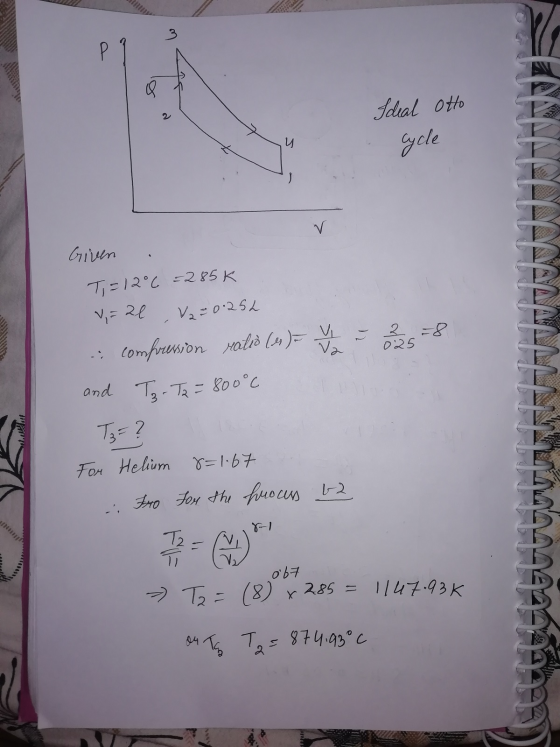
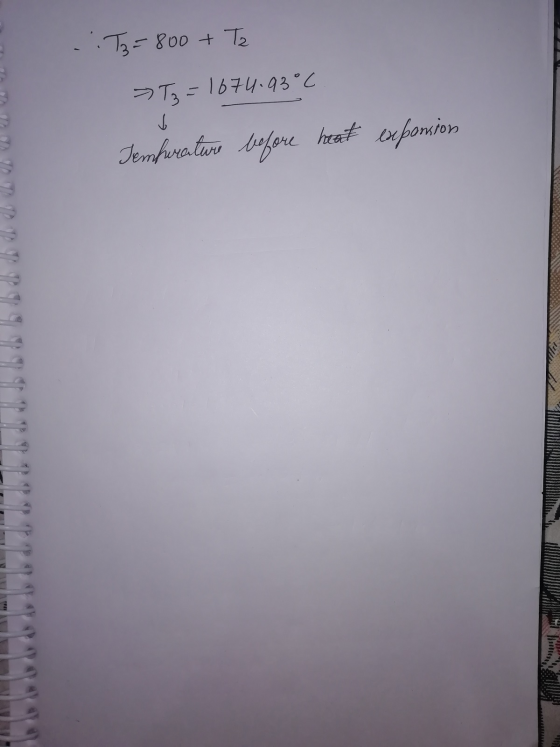
Thogh the data is not completely visible, but I have given the procedure. You can follow the steps to get the answer.
Add Answer to:
Question 20 of 73 Hollum gas andel te tyd expansion process is 0.25 Landsome cases by...
0.25 moles ofa monatomic ideal gas starts from point a (400Pa and Im3) in the diagram as shown. It undergoes a constant...
 0.25 moles ofa monatomic ideal gas starts from point a (400Pa and Im3) in the diagram as shown. It undergoes a constant pressure expansion from a to b (2m3); an isothermal process from b to c (3.2m3); a constant volume process c to d (125Pa); and an isothermal compression from d back to a. Problems 2-5 400 b a 300 2a. Find the temperature values Ta, Tb, Te and Td. 200 100 3 4 1 2 volume (m3) 2b. Find...
question details in pic. answer please 1. the expansion work in kJ is ? 2. the...
 question details in pic. answer please
1. the expansion work in kJ is ?
2. the final temperature of the ideal gas in K is?
3. the change in entropy of the gas during this process in
kJ/K is?
Problems 18-20 are based on the following description An Insulated rigid tank is divided into two equal parts by a partition. Initially, one part contains 10 kg of an ideal gas with molar mass M-16 kg/kmol, a pressure of 330 kPa,...
question details in pic. answer please
1. the expansion work in kJ is ?
2. the final temperature of the ideal gas in K is?
3. the change in entropy of the gas during this process in
kJ/K is?
Problems 18-20 are based on the following description An Insulated rigid tank is divided into two equal parts by a partition. Initially, one part contains 10 kg of an ideal gas with molar mass M-16 kg/kmol, a pressure of 330 kPa,...
3. (20 pts) In the Carnot engine (refer to the figure in question 2), an ideal...
3. (20 pts) In the Carnot engine (refer to the figure in question 2), an ideal gas undergoes a cycle of isothermal expansion (A → B), adiabatic expansion (B → C), isothermal compression (C → D), and adiabatic compression (D → A). All processes are assumed to be reversible. The volumes at the points are given that 2VA=VB and VC=2VD. Th is 650 °C and Tc is 30 °C. (1) Calculate the amount of heat added to one mole gas...
The amount of lateral expansion (mils) was determined for a sample of n=20 pulsed-power gas metal...
 The amount of lateral expansion (mils) was determined for a sample of n=20 pulsed-power gas metal ore welds used in LNG ship containment tanks. The resulting sample standard deviation was s=2.45 mils. Assuming normality, derive (give answers to 3 places past decimal) : a) a 95% confidence interval for 02 upper limit = lower limit = A Tries 0/5 a) a 95% confidence interval for o upper limit = lower limit = Tries 0/5
Question 5: (1.5 pt) What happens during an isochoric process when the temperature of a gas...
 Question 5: (1.5 pt) What happens during an isochoric process when the temperature of a gas is increased by factor of 10%? A) The volume increases by 10%. B) The pressure increases by 10%. C) Both volume and pressure increase. D) Pressure increases by less than 10%, with the balance contributing to expansion of the gas ndable container holds 2.50 moles of He gas with an initial pressure of 750 kP
Question 2: (a) Write down the equation for the work done by an expanding gas and...
 Question 2: (a) Write down the equation for the work done by an expanding gas and sketch this on a p-v diagram for a typical reversible process. [3 marks) (b) Starting from the first law of thermodynamics and the ideal gas law, show that for an isothermal expansion or compression of a gas, the process can be described by pv = constant. [5 marks] (c) Knowing that pv = constant for an isothermal process, derive the following equation for the...
question 2, please show work U. (5 punts) Fullu pulal Coulunales ,DJ UI te punt weer...
 question 2, please show work
U. (5 punts) Fullu pulal Coulunales ,DJ UI te punt weer U U 2. (10 points) Find the slope of the tangent line to r = 2-sin e ate = 3. (14 points) Find the area enclosed by one loop of r = 4 sin 20
question 2, please show work
U. (5 punts) Fullu pulal Coulunales ,DJ UI te punt weer U U 2. (10 points) Find the slope of the tangent line to r = 2-sin e ate = 3. (14 points) Find the area enclosed by one loop of r = 4 sin 20
please answer 18-20 Question 18 1 pts Problems 18-20 are based on the following description An...
 please answer 18-20
Question 18 1 pts Problems 18-20 are based on the following description An insulated rigid tank is divided into two equal parts by a partition. Initially, one part contains 10 kg of an ideal gas with molar mass M = 16 kg/kmol, a pressure of 330 kPa and a temperature of 50 oC. The other part is evacuated. The partition is now removed and the gas fills the entire tank (R.- 8.31447 k/MOLK) The expansion work in...
please answer 18-20
Question 18 1 pts Problems 18-20 are based on the following description An insulated rigid tank is divided into two equal parts by a partition. Initially, one part contains 10 kg of an ideal gas with molar mass M = 16 kg/kmol, a pressure of 330 kPa and a temperature of 50 oC. The other part is evacuated. The partition is now removed and the gas fills the entire tank (R.- 8.31447 k/MOLK) The expansion work in...
Problem 1 (20 points): Consider the ideal Bra below. The compressor, turbine, and process fluid is...
 Problem 1 (20 points): Consider the ideal Bra below. The compressor, turbine, and process fluid is air that can be modeled as an conditions for the operation of the cycle are known: mts: Consider the ideal Brayton cycle model for an aircraft engine as shown in the diagram sur, turbine, and nozzle are all assumed to operate with an isentropic efficiency of 100%. The that can be modeled as an ideal gas with constant specific heats. The following steady-state 7...
Formul Question 2 (50 points): Propane gas and burns with 20% excess air entering (molar C, Hs) at 25 C.I atm enters a reactor operating at steady state at 25 C l atm of the carbon entering with...
 Formul Question 2 (50 points): Propane gas and burns with 20% excess air entering (molar C, Hs) at 25 C.I atm enters a reactor operating at steady state at 25 C l atm of the carbon entering with the fuel, 94% s) appears in the products at CO2 and the rest as CO. Heat transfer from the reactor occurs te of 1.4 x 10° kJ per kmol or propane. Use your ideal gas tables to answer this question. ite the...
 0.25 moles ofa monatomic ideal gas starts from point a (400Pa and Im3) in the diagram as shown. It undergoes a constant pressure expansion from a to b (2m3); an isothermal process from b to c (3.2m3); a constant volume process c to d (125Pa); and an isothermal compression from d back to a. Problems 2-5 400 b a 300 2a. Find the temperature values Ta, Tb, Te and Td. 200 100 3 4 1 2 volume (m3) 2b. Find...
 question details in pic. answer please
1. the expansion work in kJ is ?
2. the final temperature of the ideal gas in K is?
3. the change in entropy of the gas during this process in
kJ/K is?
Problems 18-20 are based on the following description An Insulated rigid tank is divided into two equal parts by a partition. Initially, one part contains 10 kg of an ideal gas with molar mass M-16 kg/kmol, a pressure of 330 kPa,...
question details in pic. answer please
1. the expansion work in kJ is ?
2. the final temperature of the ideal gas in K is?
3. the change in entropy of the gas during this process in
kJ/K is?
Problems 18-20 are based on the following description An Insulated rigid tank is divided into two equal parts by a partition. Initially, one part contains 10 kg of an ideal gas with molar mass M-16 kg/kmol, a pressure of 330 kPa,...
 The amount of lateral expansion (mils) was determined for a sample of n=20 pulsed-power gas metal ore welds used in LNG ship containment tanks. The resulting sample standard deviation was s=2.45 mils. Assuming normality, derive (give answers to 3 places past decimal) : a) a 95% confidence interval for 02 upper limit = lower limit = A Tries 0/5 a) a 95% confidence interval for o upper limit = lower limit = Tries 0/5
 Question 5: (1.5 pt) What happens during an isochoric process when the temperature of a gas is increased by factor of 10%? A) The volume increases by 10%. B) The pressure increases by 10%. C) Both volume and pressure increase. D) Pressure increases by less than 10%, with the balance contributing to expansion of the gas ndable container holds 2.50 moles of He gas with an initial pressure of 750 kP
 Question 2: (a) Write down the equation for the work done by an expanding gas and sketch this on a p-v diagram for a typical reversible process. [3 marks) (b) Starting from the first law of thermodynamics and the ideal gas law, show that for an isothermal expansion or compression of a gas, the process can be described by pv = constant. [5 marks] (c) Knowing that pv = constant for an isothermal process, derive the following equation for the...
 question 2, please show work
U. (5 punts) Fullu pulal Coulunales ,DJ UI te punt weer U U 2. (10 points) Find the slope of the tangent line to r = 2-sin e ate = 3. (14 points) Find the area enclosed by one loop of r = 4 sin 20
question 2, please show work
U. (5 punts) Fullu pulal Coulunales ,DJ UI te punt weer U U 2. (10 points) Find the slope of the tangent line to r = 2-sin e ate = 3. (14 points) Find the area enclosed by one loop of r = 4 sin 20
 please answer 18-20
Question 18 1 pts Problems 18-20 are based on the following description An insulated rigid tank is divided into two equal parts by a partition. Initially, one part contains 10 kg of an ideal gas with molar mass M = 16 kg/kmol, a pressure of 330 kPa and a temperature of 50 oC. The other part is evacuated. The partition is now removed and the gas fills the entire tank (R.- 8.31447 k/MOLK) The expansion work in...
please answer 18-20
Question 18 1 pts Problems 18-20 are based on the following description An insulated rigid tank is divided into two equal parts by a partition. Initially, one part contains 10 kg of an ideal gas with molar mass M = 16 kg/kmol, a pressure of 330 kPa and a temperature of 50 oC. The other part is evacuated. The partition is now removed and the gas fills the entire tank (R.- 8.31447 k/MOLK) The expansion work in...
 Problem 1 (20 points): Consider the ideal Bra below. The compressor, turbine, and process fluid is air that can be modeled as an conditions for the operation of the cycle are known: mts: Consider the ideal Brayton cycle model for an aircraft engine as shown in the diagram sur, turbine, and nozzle are all assumed to operate with an isentropic efficiency of 100%. The that can be modeled as an ideal gas with constant specific heats. The following steady-state 7...
 Formul Question 2 (50 points): Propane gas and burns with 20% excess air entering (molar C, Hs) at 25 C.I atm enters a reactor operating at steady state at 25 C l atm of the carbon entering with the fuel, 94% s) appears in the products at CO2 and the rest as CO. Heat transfer from the reactor occurs te of 1.4 x 10° kJ per kmol or propane. Use your ideal gas tables to answer this question. ite the...
Most questions answered within 3 hours.
-
Where is the error in this code sequence?
String s1 = "Hello";
String s2 = "ello";...
asked 11 months ago -
Financial data for Joel de Paris, Inc., for last year
follow:
Joel de Paris, Inc.
Balance...
asked 11 months ago -
Consider this reaction:
Al2(SO4)3 (aq)+ BaCl3
(aq) Al2Cl6 (aq)- +
3BaSO4(s) . What is the...
asked 11 months ago -
Suppose that Savneet is considering increasing her
recent random sample from 20 car rentals to 40...
asked 11 months ago -
Trucks arrive at an unloading terminal at an average rate of 120
per hour.
Trucks arrive...
asked 11 months ago -
Why are methanol and ethanol completely soluble in water while
octanol is not very little soluble....
asked 11 months ago -
A facilities manager at a university reads in a research report
that the mean amount of...
asked 11 months ago -
When the CuSO4 is rehydrated by adding water to the anhydrous
compound, is this an endothermic...
asked 11 months ago -
A ray of sunlight is passing from diamond into crown glass; the
angle of incidence is...
asked 11 months ago -
A block of mass 0.249 kg is placed on top of a light, vertical
spring of...
asked 11 months ago -
how do the kidneys compensate in the presences of acidosis
a) trigger hyperventilate
b) reserve acid...
asked 11 months ago -
Question 501 pts
The rental rate of capital to the firm increases. Which of the
following...
asked 11 months ago