
Homework Answers
A) C = 40 + 0.8Y
I = 70 - 200i
a) At equilibrium, Y = C + I
Y = 40 + 0.8Y + 70 - 200i
0.2Y = 110 - 200i
b) If interest rate is 10% (0.1), then equilibrium income is 0.2Y = 110 - 200 (0.1)
0.2Y = 110 - 20
Y = 550 - 100 = 450
If interest rate is 5% (0.05), then equilibrium income is 0.2Y = 110 - 200 (0.05)
0.2Y = 110 - 10
Y = 550 - 50 = 500
When rate of interest falls, investment level rises.
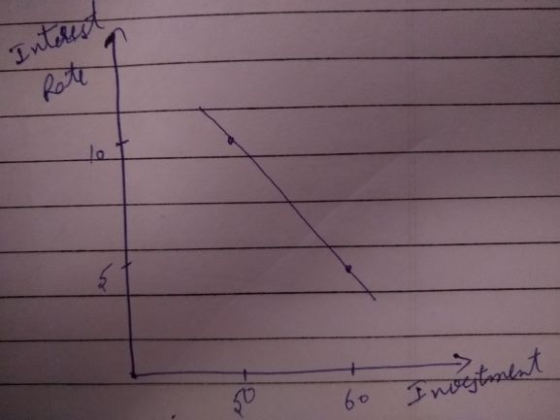
c) If Investment changes to I = 80 - 200i
Then equilibrium income would be Y = 40 + 0.8Y + 80 - 200i
0.2Y = 120 - 200i
Y = 600 - 1,000i
d) Change in rate of interest cause movement along investment - interest rate curve.
B) Quantity theory of money says that: Change in Money supply * Change in Price level = Change in Velocity of money * Change in real GDP
Money supply = 14% = 0.14
Real GDP = 5% = 0.05
Change in velocity of money is constant
0.14 * Price level = 0.05
Price level = 35.71%
As change in price (Inflation rate) is 35.71%
Nominal Interest rate = Inflation rate + Real Interest rate
11% = 35.71% + Real Interest rate
Real Interest rate = 35.71% - 11% = 24.71%
Add Answer to:
A. Consider the following equations for a little closed economy; the role of the Government is...
Question 5 of 5 3 Points Assume the velocity of money is constant. Real GDP grows...
 Question 5 of 5 3 Points Assume the velocity of money is constant. Real GDP grows by 3 percent per year, the money stock grows by 5 percent per year, and the nominal interest rate is 5 percent. What is the real interest rate? Show all formulas used and steps taken.
Suppose a closed economy is initially in the long run equilibrium. Suppose the monetary base of...
Suppose a closed economy is initially in the long run equilibrium. Suppose the monetary base of this economy is $100 million, of which people carry $10 million in form of currency/cash. 3. Assuming the banks keep a reserve ratio of 5%, what is the money supply in this economy? Suppose from now on that because of a virus, people become afraid of using currency and decide to deposit all the currency in banks, and carry money exclusively in the form...
2 8 25 25 The above table has the demand and supply schedules for money. Real...
 2 8 25 25 The above table has the demand and supply schedules for money. Real GDP increase s and, as a result, the demand for money t increases by $0.2 trlion at each level of the nominal A. 10 percent B. 7 percent. OC. 2 percent. D. 5 percent. C. E, 3 percent. 6. The GDP price index in the United States in 2002 was about 85, and real GDP in 2002 was 31 2.9 trillion (2009 dollars). x...
1. Suppose that a simple economy produced only three goods: wheat, automobiles, and chairs. The table...
 1. Suppose that a simple economy produced only three goods: wheat, automobiles, and chairs. The table below lists the quantity and prices for each of the goods for year 2000 and 2010. Based on table, answer the following questions (7.8 total points): Price in 2000 Wheat Automobiles Chairs Quantity produced in 2000 100 200 400 $5 $40,000 $10 a) Calculate nominal GDP in year 2000. 5 points) b) Suppose prices doubled by 2010 but production stayed the same. Calculate the...
Question 1. (1) (6 points) Some economic historians have noted that during the period of the...
 Question 1. (1) (6 points) Some economic historians have noted that during the period of the gold standard, gold discoveries were most likely to occur after a long deflation (for example, in 1896). Why might this be true (max 5 sentences)? You can assume that the price of gold against currency was fixed. Hint: The gold standard means that 1 HKD is exchanged with gold at a fixed rate. What does the long deflation mean about the value of gold...
2. (20 points) According to classical macroeconomics policy, money supply shocks are "neutral" (a) Explain what...
 2. (20 points) According to classical macroeconomics policy, money supply shocks are "neutral" (a) Explain what this means. (b) Based on that theory, how would a 5% increase in a nation's money supply affect its real wage rate (), all else equal? I (c) According to the quantatity of money, how would a 5% increase in money supply affect the price of goods and services (P), all else equal? (d) To be consistent with both theories, what would have to...
1) Suppose an economy is characterized by the following equations. Y = C+/+G Y = 10,500...
 1) Suppose an economy is characterized by the following equations. Y = C+/+G Y = 10,500 G = 800 TA = 1000 S = 1600+ 0.1(Y-TA) + 20001 1 = 600+ 0.20Y - 30001 Where Y is real GDP, G is government purchases of goods and services, S is total national savings, is the nominal rate of interest and I is total investment. There are no transfers in this economy and agents can only consume or save their income. a)...
Question 1: IS-LM-AD in a closed economy (35 Marks) The following represent the key equations for...
 Question 1: IS-LM-AD in a closed economy (35 Marks) The following represent the key equations for a closed economy: Md 18+0.5Y-450 Money demand C" = 6 + 0.8(Y-T)-250r 1 -33-200r u-u0.3 a) Write out the equations for the IS and LM curves for this economy, with the real Desired consumption Desired investment Initial budget position Okun's law Y-Y rate of interest (r) on the left-hand side. Next, use these relationships to find the AD curve, written with output (Y) on...
A. Assume that the demand for real money balance (M/P)d is M/P = 0.4Y – 10i....
A. Assume that the demand for real money balance (M/P)d is M/P = 0.4Y – 10i. National income is 30,000 and the price level is 100 and the growth rate of nominal money is 2 percent. The real interest rate r is fixed at 3 percent. Also assume that the expected inflation rate equals the rate of nominal money growth. B. What is the quantity of money in the economy?
Consider the following model of a closed macroeconomy, The Labour Market Y 63.246N -N2/12 N 63.24...
 Consider the following model of a closed macroeconomy, The Labour Market Y 63.246N -N2/12 N 63.246-WIP N. = 0.4142W / P (1) (2) (3) (4) Production function Labour demand Labour supply Labour market equilibrium The Goods Market C= 110 +0.75% ) (5) (6) (7) (8) (9) (10) Consumption function Investment function Government expenditure Disposable income Tax function Goods market equilibrium I 10 + 0.2 Y _ 200i G 200 T -333.333 Y=C+I+G The Money Market L = 1 00 +...
 Question 5 of 5 3 Points Assume the velocity of money is constant. Real GDP grows by 3 percent per year, the money stock grows by 5 percent per year, and the nominal interest rate is 5 percent. What is the real interest rate? Show all formulas used and steps taken.
 2 8 25 25 The above table has the demand and supply schedules for money. Real GDP increase s and, as a result, the demand for money t increases by $0.2 trlion at each level of the nominal A. 10 percent B. 7 percent. OC. 2 percent. D. 5 percent. C. E, 3 percent. 6. The GDP price index in the United States in 2002 was about 85, and real GDP in 2002 was 31 2.9 trillion (2009 dollars). x...
 1. Suppose that a simple economy produced only three goods: wheat, automobiles, and chairs. The table below lists the quantity and prices for each of the goods for year 2000 and 2010. Based on table, answer the following questions (7.8 total points): Price in 2000 Wheat Automobiles Chairs Quantity produced in 2000 100 200 400 $5 $40,000 $10 a) Calculate nominal GDP in year 2000. 5 points) b) Suppose prices doubled by 2010 but production stayed the same. Calculate the...
 Question 1. (1) (6 points) Some economic historians have noted that during the period of the gold standard, gold discoveries were most likely to occur after a long deflation (for example, in 1896). Why might this be true (max 5 sentences)? You can assume that the price of gold against currency was fixed. Hint: The gold standard means that 1 HKD is exchanged with gold at a fixed rate. What does the long deflation mean about the value of gold...
 2. (20 points) According to classical macroeconomics policy, money supply shocks are "neutral" (a) Explain what this means. (b) Based on that theory, how would a 5% increase in a nation's money supply affect its real wage rate (), all else equal? I (c) According to the quantatity of money, how would a 5% increase in money supply affect the price of goods and services (P), all else equal? (d) To be consistent with both theories, what would have to...
 1) Suppose an economy is characterized by the following equations. Y = C+/+G Y = 10,500 G = 800 TA = 1000 S = 1600+ 0.1(Y-TA) + 20001 1 = 600+ 0.20Y - 30001 Where Y is real GDP, G is government purchases of goods and services, S is total national savings, is the nominal rate of interest and I is total investment. There are no transfers in this economy and agents can only consume or save their income. a)...
 Question 1: IS-LM-AD in a closed economy (35 Marks) The following represent the key equations for a closed economy: Md 18+0.5Y-450 Money demand C" = 6 + 0.8(Y-T)-250r 1 -33-200r u-u0.3 a) Write out the equations for the IS and LM curves for this economy, with the real Desired consumption Desired investment Initial budget position Okun's law Y-Y rate of interest (r) on the left-hand side. Next, use these relationships to find the AD curve, written with output (Y) on...
 Consider the following model of a closed macroeconomy, The Labour Market Y 63.246N -N2/12 N 63.246-WIP N. = 0.4142W / P (1) (2) (3) (4) Production function Labour demand Labour supply Labour market equilibrium The Goods Market C= 110 +0.75% ) (5) (6) (7) (8) (9) (10) Consumption function Investment function Government expenditure Disposable income Tax function Goods market equilibrium I 10 + 0.2 Y _ 200i G 200 T -333.333 Y=C+I+G The Money Market L = 1 00 +...
Most questions answered within 3 hours.
-
Where is the error in this code sequence?
String s1 = "Hello";
String s2 = "ello";...
asked 10 months ago -
Financial data for Joel de Paris, Inc., for last year
follow:
Joel de Paris, Inc.
Balance...
asked 10 months ago -
Consider this reaction:
Al2(SO4)3 (aq)+ BaCl3
(aq) Al2Cl6 (aq)- +
3BaSO4(s) . What is the...
asked 10 months ago -
Suppose that Savneet is considering increasing her
recent random sample from 20 car rentals to 40...
asked 10 months ago -
Trucks arrive at an unloading terminal at an average rate of 120
per hour.
Trucks arrive...
asked 10 months ago -
Why are methanol and ethanol completely soluble in water while
octanol is not very little soluble....
asked 10 months ago -
A facilities manager at a university reads in a research report
that the mean amount of...
asked 10 months ago -
When the CuSO4 is rehydrated by adding water to the anhydrous
compound, is this an endothermic...
asked 10 months ago -
A ray of sunlight is passing from diamond into crown glass; the
angle of incidence is...
asked 10 months ago -
A block of mass 0.249 kg is placed on top of a light, vertical
spring of...
asked 10 months ago -
how do the kidneys compensate in the presences of acidosis
a) trigger hyperventilate
b) reserve acid...
asked 10 months ago -
Question 501 pts
The rental rate of capital to the firm increases. Which of the
following...
asked 10 months ago