
Homework Answers


Add Answer to:
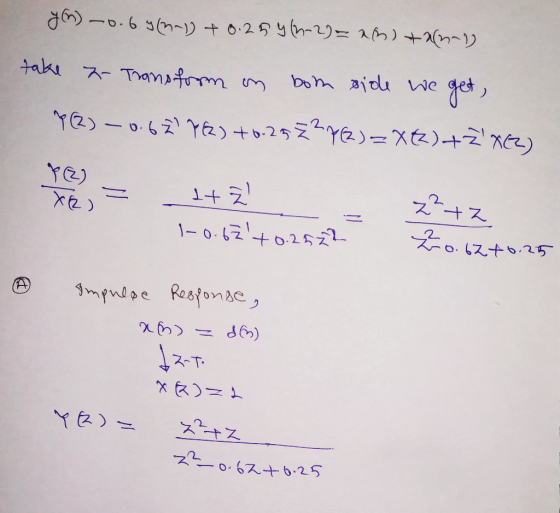
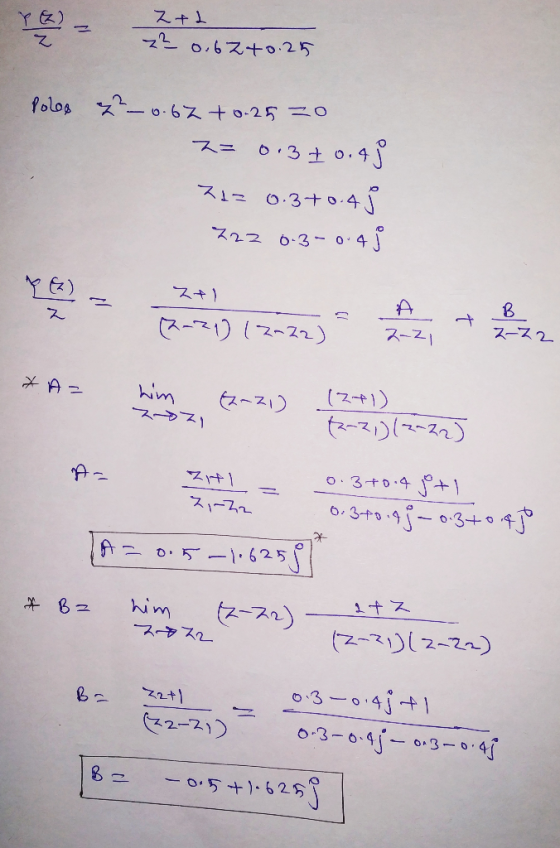
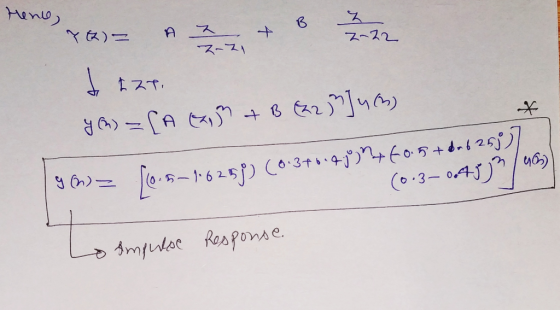
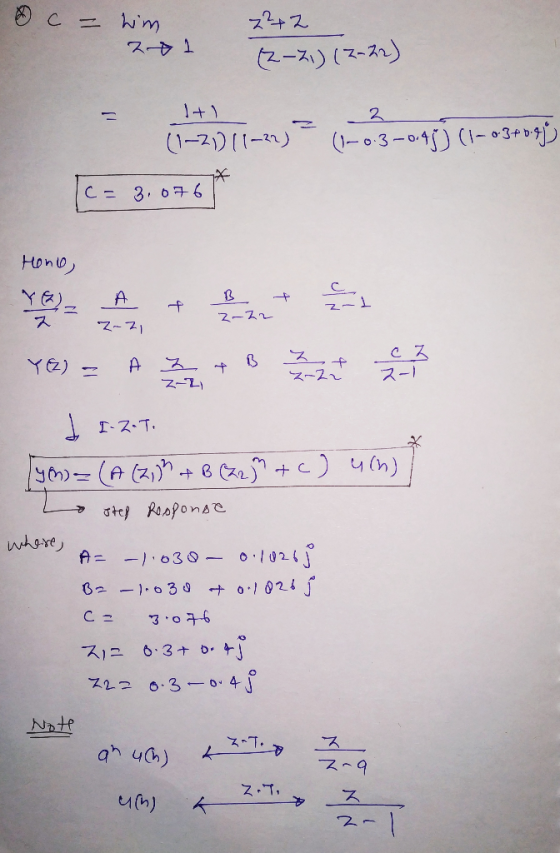
5.16. Given the following difference equation with the input-output relationship of a certain initially relaxed system...
The input-output relationship for a system is ¨y(t) + ˙y(t) = x(t). (a) Find the impulse...
The input-output relationship for a system is ¨y(t) + ˙y(t) = x(t). (a) Find the impulse response of the system. (b) Find the zero-state response when the input is a unit step. (c) Find the zero-state response when the input is x(t) = 1.6u(t) − 0.6u(t − 1).
(20 pts.) Determine the output sequence of the system with impulse response h[n] 6. u[n] when the input signal is x[n]...
 (20 pts.) Determine the output sequence of the system with impulse response h[n] 6. u[n] when the input signal is x[n] = 2e-n + sin(nn)- 2, -co <n< 0o. 7. (20 pts.) Determine the response of the system described by the difference equation 1 1 y(n)y(n1)n2)x(n 8 7 for input signal x(n) u(n) under the following initial conditions 1, y(-2) 0.5 y(-1)
(20 pts.) Determine the output sequence of the system with impulse response h[n] 6. u[n] when the input...
(20 pts.) Determine the output sequence of the system with impulse response h[n] 6. u[n] when the input signal is x[n] = 2e-n + sin(nn)- 2, -co <n< 0o. 7. (20 pts.) Determine the response of the system described by the difference equation 1 1 y(n)y(n1)n2)x(n 8 7 for input signal x(n) u(n) under the following initial conditions 1, y(-2) 0.5 y(-1)
(20 pts.) Determine the output sequence of the system with impulse response h[n] 6. u[n] when the input...
5. A system is known whose input-output relationship is determined by the following difference eq...
 5. A system is known whose input-output relationship is determined by the following difference equation: y(n)--T(n-1) = x(n) +-x(n-1) Find the system function H(z) and plot the pole-zero plot
5. A system is known whose input-output relationship is determined by the following difference equation: y(n)--T(n-1) = x(n) +-x(n-1) Find the system function H(z) and plot the pole-zero plot
5. A system is known whose input-output relationship is determined by the following difference equation: y(n)--T(n-1) = x(n) +-x(n-1) Find the system function H(z) and plot the pole-zero plot
For a causal LTI discrete-time system described by the difference equation:
For a causal LTI discrete-time system described by the difference equation: y[n] + y[n – 1] = x[n] a) Find the transfer function H(z).b) Find poles and zeros and then mark them on the z-plane (pole-zero plot). Is this system BIBO? c) Find its impulse response h[n]. d) Draw the z-domain block diagram (using the unit delay block z-1) of the discrete-time system. e) Find the output y[n] for input x[n] = 10 u[n] if all initial conditions are 0.
Consider an LTI system with input sequence x[n] and output sequence y[n] that satisfy the difference equation
Consider an LTI system with input sequence x[n] and output sequence y[n] that satisfy the difference equation 3y[n] – 7y[n – 1] + 2y[n – 2] = 3x[n] – 3x[n – 1] (2.1) The fact that sequences x[ ] and y[ ] are in input-output relation and satisfy (2.1) does not yet determine which LTI system. a) We assume each possible input sequence to this system has its Z-transform and that the impulse response of this system also has its Z-transform. Express the...
1. Given the impulse response, h[n duration 50 samples. (-0.9)"u[n, find the step response for a step input of h-(0...
 1. Given the impulse response, h[n duration 50 samples. (-0.9)"u[n, find the step response for a step input of h-(0.9)-10:491 -ones (1,50) s- conv(u,h) 2. Plot h and u using stem function for 50 samples only stem(10:491, s(1:50) 1. Given a system described by the following difference equation: yIn] 1143yn 1 0.4128y[n -2 0.0675x[n0.1349xn 0.675x[n-2] Determine the output y in response to zero input and the initial conditionsy-11 and yl-2] 2 for 50 samples using the following commands: a -,-1.143,...
Given the following difference equation that describes the input output relationship, (a) Express Y(z), the z-transform...
 Given the following difference equation that describes the input output relationship, (a) Express Y(z), the z-transform of the output, in terms of X(z), the z-transform of the input. (b) Find the system function H(z). (c) Identify the zeros and poles. Sketch the zero-pole plot. (d) For an input rn]- cos (n), find the output yn] (e) Use the zero-pole plot to explain what you obtain in d)
5- For the following system: x( Input: x(t)s u(t) Output: y() With the initial condition y(0) 1...
 5- For the following system: x( Input: x(t)s u(t) Output: y() With the initial condition y(0) 1, y(O)-0, RI-1, R2-12, CI-2F, C2-1F. Identify the natural and forced response of the system a) Find the zero input response. b) Unit impulse response. c) zero state response. d) The total response. e Identify the natural and forced response of the system.
5- For the following system: x(
Input: x(t)s u(t) Output: y() With the initial condition y(0) 1, y(O)-0, RI-1, R2-12, CI-2F,...
5- For the following system: x( Input: x(t)s u(t) Output: y() With the initial condition y(0) 1, y(O)-0, RI-1, R2-12, CI-2F, C2-1F. Identify the natural and forced response of the system a) Find the zero input response. b) Unit impulse response. c) zero state response. d) The total response. e Identify the natural and forced response of the system.
5- For the following system: x(
Input: x(t)s u(t) Output: y() With the initial condition y(0) 1, y(O)-0, RI-1, R2-12, CI-2F,...
2) An LTI DT system is defined by the difference equation: y[n] = -0.4yIn - 1]...
 2) An LTI DT system is defined by the difference equation: y[n] = -0.4yIn - 1] + x[n]. a) Derive the impulse response of the system. (2 pt) b) Determine if the system is BIBO stable. (1 pt) c) Assuming initial conditions yl-1) = 1, derive the complete system response to an input x[n] = u[n] - u[n-2), for n > 0.(2 pt) d) Derive the zero-state system response to an input z[n] = u[n] - 2u[n - 2] +...
A causal LTI system yields the following input output relationship. Find h(t), the impulse response of...
 A causal LTI system yields the following input output relationship. Find h(t), the impulse response of the system. (Hint: Try first to determine the output when the input is u(t)) a(t) y(t) LTT →t 2 2 Figure 1: An input-output pair
 (20 pts.) Determine the output sequence of the system with impulse response h[n] 6. u[n] when the input signal is x[n] = 2e-n + sin(nn)- 2, -co <n< 0o. 7. (20 pts.) Determine the response of the system described by the difference equation 1 1 y(n)y(n1)n2)x(n 8 7 for input signal x(n) u(n) under the following initial conditions 1, y(-2) 0.5 y(-1)
(20 pts.) Determine the output sequence of the system with impulse response h[n] 6. u[n] when the input...
(20 pts.) Determine the output sequence of the system with impulse response h[n] 6. u[n] when the input signal is x[n] = 2e-n + sin(nn)- 2, -co <n< 0o. 7. (20 pts.) Determine the response of the system described by the difference equation 1 1 y(n)y(n1)n2)x(n 8 7 for input signal x(n) u(n) under the following initial conditions 1, y(-2) 0.5 y(-1)
(20 pts.) Determine the output sequence of the system with impulse response h[n] 6. u[n] when the input...
 5. A system is known whose input-output relationship is determined by the following difference equation: y(n)--T(n-1) = x(n) +-x(n-1) Find the system function H(z) and plot the pole-zero plot
5. A system is known whose input-output relationship is determined by the following difference equation: y(n)--T(n-1) = x(n) +-x(n-1) Find the system function H(z) and plot the pole-zero plot
5. A system is known whose input-output relationship is determined by the following difference equation: y(n)--T(n-1) = x(n) +-x(n-1) Find the system function H(z) and plot the pole-zero plot
 1. Given the impulse response, h[n duration 50 samples. (-0.9)"u[n, find the step response for a step input of h-(0.9)-10:491 -ones (1,50) s- conv(u,h) 2. Plot h and u using stem function for 50 samples only stem(10:491, s(1:50) 1. Given a system described by the following difference equation: yIn] 1143yn 1 0.4128y[n -2 0.0675x[n0.1349xn 0.675x[n-2] Determine the output y in response to zero input and the initial conditionsy-11 and yl-2] 2 for 50 samples using the following commands: a -,-1.143,...
 Given the following difference equation that describes the input output relationship, (a) Express Y(z), the z-transform of the output, in terms of X(z), the z-transform of the input. (b) Find the system function H(z). (c) Identify the zeros and poles. Sketch the zero-pole plot. (d) For an input rn]- cos (n), find the output yn] (e) Use the zero-pole plot to explain what you obtain in d)
 5- For the following system: x( Input: x(t)s u(t) Output: y() With the initial condition y(0) 1, y(O)-0, RI-1, R2-12, CI-2F, C2-1F. Identify the natural and forced response of the system a) Find the zero input response. b) Unit impulse response. c) zero state response. d) The total response. e Identify the natural and forced response of the system.
5- For the following system: x(
Input: x(t)s u(t) Output: y() With the initial condition y(0) 1, y(O)-0, RI-1, R2-12, CI-2F,...
5- For the following system: x( Input: x(t)s u(t) Output: y() With the initial condition y(0) 1, y(O)-0, RI-1, R2-12, CI-2F, C2-1F. Identify the natural and forced response of the system a) Find the zero input response. b) Unit impulse response. c) zero state response. d) The total response. e Identify the natural and forced response of the system.
5- For the following system: x(
Input: x(t)s u(t) Output: y() With the initial condition y(0) 1, y(O)-0, RI-1, R2-12, CI-2F,...
 2) An LTI DT system is defined by the difference equation: y[n] = -0.4yIn - 1] + x[n]. a) Derive the impulse response of the system. (2 pt) b) Determine if the system is BIBO stable. (1 pt) c) Assuming initial conditions yl-1) = 1, derive the complete system response to an input x[n] = u[n] - u[n-2), for n > 0.(2 pt) d) Derive the zero-state system response to an input z[n] = u[n] - 2u[n - 2] +...
 A causal LTI system yields the following input output relationship. Find h(t), the impulse response of the system. (Hint: Try first to determine the output when the input is u(t)) a(t) y(t) LTT →t 2 2 Figure 1: An input-output pair
Most questions answered within 3 hours.
-
Where is the error in this code sequence?
String s1 = "Hello";
String s2 = "ello";...
asked 10 months ago -
Financial data for Joel de Paris, Inc., for last year
follow:
Joel de Paris, Inc.
Balance...
asked 10 months ago -
Consider this reaction:
Al2(SO4)3 (aq)+ BaCl3
(aq) Al2Cl6 (aq)- +
3BaSO4(s) . What is the...
asked 10 months ago -
Suppose that Savneet is considering increasing her
recent random sample from 20 car rentals to 40...
asked 10 months ago -
Trucks arrive at an unloading terminal at an average rate of 120
per hour.
Trucks arrive...
asked 10 months ago -
Why are methanol and ethanol completely soluble in water while
octanol is not very little soluble....
asked 10 months ago -
A facilities manager at a university reads in a research report
that the mean amount of...
asked 10 months ago -
When the CuSO4 is rehydrated by adding water to the anhydrous
compound, is this an endothermic...
asked 10 months ago -
A ray of sunlight is passing from diamond into crown glass; the
angle of incidence is...
asked 10 months ago -
A block of mass 0.249 kg is placed on top of a light, vertical
spring of...
asked 10 months ago -
how do the kidneys compensate in the presences of acidosis
a) trigger hyperventilate
b) reserve acid...
asked 10 months ago -
Question 501 pts
The rental rate of capital to the firm increases. Which of the
following...
asked 10 months ago