
Homework Answers
Add Answer to:
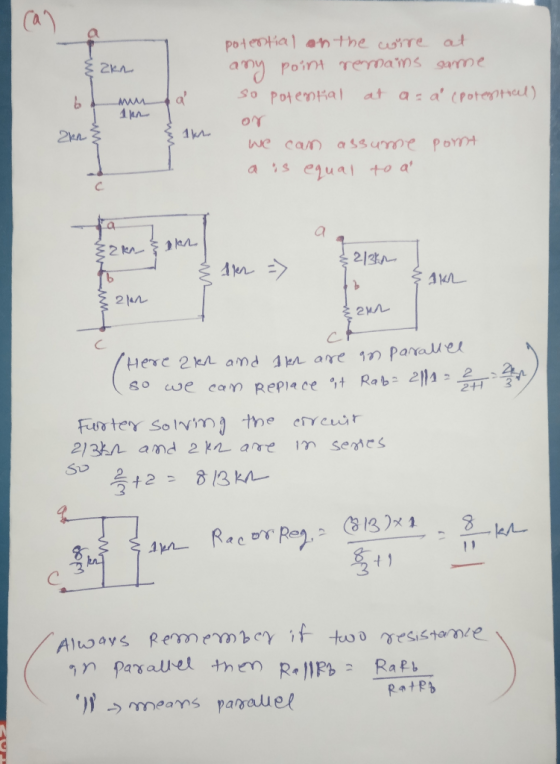
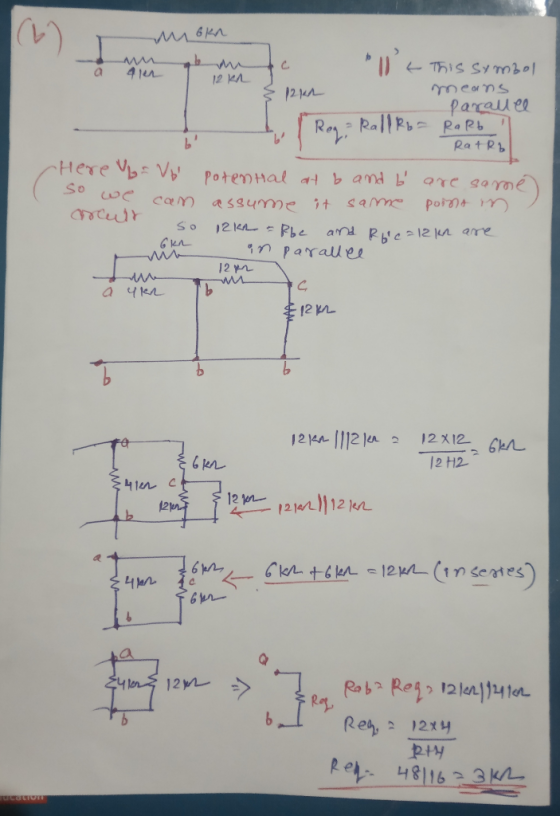
please solve a and b
2.39 Evaluate Reg for each of the circuits shown in Fig....
1.45 The diode cut-in voltage is V, = 0.7 V for the circuits shown in Figure...
 1.45 The diode cut-in voltage is V, = 0.7 V for the circuits shown in Figure P1.45. Plot Vo and Ip versus Ij over the range 0 <I1 = 2 mA for the cir- cuit shown in (a) Figure P1.45(a), (b) Figure P1.45(b), and (c) Figure P1.45(c). + 6 BRE Fiks o + 6 theo 5 3 R1 = < 1 k92 6 + 6 RE= S 1102 D21 (c) Figure P1.45
HW: Circuits and DC Instrumenta Resources < Questions of 9 > For the circuit shown in...
 HW: Circuits and DC Instrumenta Resources < Questions of 9 > For the circuit shown in the figure, determine the magnitude of the currents 19, Is, and Ipassing through batteries 2, 3, and 4, respectively. In each case, determine whether the battery is supplying power or being charged. The batteries and resistors in the circuit are assumed to be ideal and have the given properties. &= 25.5 V =3.00 V &-22.5 V & 3.00 V R 25.00 R = 10.0...
please show all steps 1. Evaluate the following. (a) L__2s+1 (6) 1*{(s– 2)e;} - 4s +31...
 please show all steps
1. Evaluate the following. (a) L__2s+1 (6) 1*{(s– 2)e;} - 4s +31 (2) L{S)} where sl) = 12 .0st<27 - {cos21 ,20 <1 - 1(s + 3) (s+1) 2. Solve Cauchy-Euler an.
please show all steps
1. Evaluate the following. (a) L__2s+1 (6) 1*{(s– 2)e;} - 4s +31 (2) L{S)} where sl) = 12 .0st<27 - {cos21 ,20 <1 - 1(s + 3) (s+1) 2. Solve Cauchy-Euler an.
3. Evaluate each of the following for the universe 2 (a) 3rvy <y where r,yEZ (b)...
 3. Evaluate each of the following for the universe 2 (a) 3rvy <y where r,yEZ (b) Vyar <y where r,y E (d) Vrvy yty where a,VEZ
= For the circuit of Fig. 8.27, let io(t < 0) = -1 mA, 1,(t >...
 = For the circuit of Fig. 8.27, let io(t < 0) = -1 mA, 1,(t > 0) = 2 mA, R 2.000 Q, R = 3,000 12, and L = 20 mH. a. Find va for t > 0. b. What is the approximate duration of the transient? 6. Sketch va(t). FIGURE 8.27
2. (5) Solve each of the following 2) (r+7)?(x-3); <0 b) 2x +3r-11x 26 Show transcribed...
 2. (5) Solve each of the following 2) (r+7)?(x-3); <0 b) 2x +3r-11x 26
In problems 3-5 evaluate ∫?⃗∙??⃗? using Stokes’ theorem. In each case ? is oriented counterclockwise when...
 In problems 3-5 evaluate ∫?⃗∙??⃗? using Stokes’ theorem. In each
case ? is oriented counterclockwise when viewed from
above.
4. F(x, y, z) = (z)i + (x2)j + (y – sin(z))k; c is the boundary of the helicoid given by Õ(r,0) =< rcos(6), rsin(0),>; Osrs 1, osos
In problems 3-5 evaluate ∫?⃗∙??⃗? using Stokes’ theorem. In each
case ? is oriented counterclockwise when viewed from
above.
4. F(x, y, z) = (z)i + (x2)j + (y – sin(z))k; c is the boundary of the helicoid given by Õ(r,0) =< rcos(6), rsin(0),>; Osrs 1, osos
can you solve this 5 problem please Q2. Using voltage divider and/or current divider to find...
 can you solve this 5 problem please
Q2. Using voltage divider and/or current divider to find the unknown on each of the circuits: 40 V -) ) ξR, υ ξR, 6 Ω 20 Ωξυ, 2.4A 1) 1890 Ω ξ10Ω 10 Ω ξ5 kΩ 360 kΩ 45 VI + υ, ξ 20 kΩ ξ90 ΚΩ Q3. Using a Y to delta transformation find the currents il, i2, and i3. And the power delivered by the source. 56 Ω 44Ω 80 Ω...
can you solve this 5 problem please
Q2. Using voltage divider and/or current divider to find the unknown on each of the circuits: 40 V -) ) ξR, υ ξR, 6 Ω 20 Ωξυ, 2.4A 1) 1890 Ω ξ10Ω 10 Ω ξ5 kΩ 360 kΩ 45 VI + υ, ξ 20 kΩ ξ90 ΚΩ Q3. Using a Y to delta transformation find the currents il, i2, and i3. And the power delivered by the source. 56 Ω 44Ω 80 Ω...
Prove this proposition please. 4.2.19) Proposition. Whenever a <b, there is a smooth function f satisfying...
 Prove this proposition please.
4.2.19) Proposition. Whenever a <b, there is a smooth function f satisfying f(2)= { € (0,1), a<:<b, VIVA *> 6. For obvious reasons, such a function is called a bump function. o M Figure 61. A bump function
Prove this proposition please.
4.2.19) Proposition. Whenever a <b, there is a smooth function f satisfying f(2)= { € (0,1), a<:<b, VIVA *> 6. For obvious reasons, such a function is called a bump function. o M Figure 61. A bump function
Please use R to solve question 1. Question 1 5 pts Binomial distribution: X~Bi(n=15,p=0.3). Evaluate Pr(2<x<7)...
 Please use R to solve question 1.
Question 1 5 pts Binomial distribution: X~Bi(n=15,p=0.3). Evaluate Pr(2<x<7) and round to three decimal places (see Lab 2). Question 2 5 pts Poisson distribution: X~Poisson(lambda=4.5). Evaluate Pr(X<11) and round to three decimal places. Question 3 5 pts Assume that X is normally distributed (X-N(0,1)). Find Pr(X=3).
Please use R to solve question 1.
Question 1 5 pts Binomial distribution: X~Bi(n=15,p=0.3). Evaluate Pr(2<x<7) and round to three decimal places (see Lab 2). Question 2 5 pts Poisson distribution: X~Poisson(lambda=4.5). Evaluate Pr(X<11) and round to three decimal places. Question 3 5 pts Assume that X is normally distributed (X-N(0,1)). Find Pr(X=3).
 1.45 The diode cut-in voltage is V, = 0.7 V for the circuits shown in Figure P1.45. Plot Vo and Ip versus Ij over the range 0 <I1 = 2 mA for the cir- cuit shown in (a) Figure P1.45(a), (b) Figure P1.45(b), and (c) Figure P1.45(c). + 6 BRE Fiks o + 6 theo 5 3 R1 = < 1 k92 6 + 6 RE= S 1102 D21 (c) Figure P1.45
 HW: Circuits and DC Instrumenta Resources < Questions of 9 > For the circuit shown in the figure, determine the magnitude of the currents 19, Is, and Ipassing through batteries 2, 3, and 4, respectively. In each case, determine whether the battery is supplying power or being charged. The batteries and resistors in the circuit are assumed to be ideal and have the given properties. &= 25.5 V =3.00 V &-22.5 V & 3.00 V R 25.00 R = 10.0...
 please show all steps
1. Evaluate the following. (a) L__2s+1 (6) 1*{(s– 2)e;} - 4s +31 (2) L{S)} where sl) = 12 .0st<27 - {cos21 ,20 <1 - 1(s + 3) (s+1) 2. Solve Cauchy-Euler an.
please show all steps
1. Evaluate the following. (a) L__2s+1 (6) 1*{(s– 2)e;} - 4s +31 (2) L{S)} where sl) = 12 .0st<27 - {cos21 ,20 <1 - 1(s + 3) (s+1) 2. Solve Cauchy-Euler an.
 3. Evaluate each of the following for the universe 2 (a) 3rvy <y where r,yEZ (b) Vyar <y where r,y E (d) Vrvy yty where a,VEZ
 = For the circuit of Fig. 8.27, let io(t < 0) = -1 mA, 1,(t > 0) = 2 mA, R 2.000 Q, R = 3,000 12, and L = 20 mH. a. Find va for t > 0. b. What is the approximate duration of the transient? 6. Sketch va(t). FIGURE 8.27
 2. (5) Solve each of the following 2) (r+7)?(x-3); <0 b) 2x +3r-11x 26
 In problems 3-5 evaluate ∫?⃗∙??⃗? using Stokes’ theorem. In each
case ? is oriented counterclockwise when viewed from
above.
4. F(x, y, z) = (z)i + (x2)j + (y – sin(z))k; c is the boundary of the helicoid given by Õ(r,0) =< rcos(6), rsin(0),>; Osrs 1, osos
In problems 3-5 evaluate ∫?⃗∙??⃗? using Stokes’ theorem. In each
case ? is oriented counterclockwise when viewed from
above.
4. F(x, y, z) = (z)i + (x2)j + (y – sin(z))k; c is the boundary of the helicoid given by Õ(r,0) =< rcos(6), rsin(0),>; Osrs 1, osos
 can you solve this 5 problem please
Q2. Using voltage divider and/or current divider to find the unknown on each of the circuits: 40 V -) ) ξR, υ ξR, 6 Ω 20 Ωξυ, 2.4A 1) 1890 Ω ξ10Ω 10 Ω ξ5 kΩ 360 kΩ 45 VI + υ, ξ 20 kΩ ξ90 ΚΩ Q3. Using a Y to delta transformation find the currents il, i2, and i3. And the power delivered by the source. 56 Ω 44Ω 80 Ω...
can you solve this 5 problem please
Q2. Using voltage divider and/or current divider to find the unknown on each of the circuits: 40 V -) ) ξR, υ ξR, 6 Ω 20 Ωξυ, 2.4A 1) 1890 Ω ξ10Ω 10 Ω ξ5 kΩ 360 kΩ 45 VI + υ, ξ 20 kΩ ξ90 ΚΩ Q3. Using a Y to delta transformation find the currents il, i2, and i3. And the power delivered by the source. 56 Ω 44Ω 80 Ω...
 Prove this proposition please.
4.2.19) Proposition. Whenever a <b, there is a smooth function f satisfying f(2)= { € (0,1), a<:<b, VIVA *> 6. For obvious reasons, such a function is called a bump function. o M Figure 61. A bump function
Prove this proposition please.
4.2.19) Proposition. Whenever a <b, there is a smooth function f satisfying f(2)= { € (0,1), a<:<b, VIVA *> 6. For obvious reasons, such a function is called a bump function. o M Figure 61. A bump function
 Please use R to solve question 1.
Question 1 5 pts Binomial distribution: X~Bi(n=15,p=0.3). Evaluate Pr(2<x<7) and round to three decimal places (see Lab 2). Question 2 5 pts Poisson distribution: X~Poisson(lambda=4.5). Evaluate Pr(X<11) and round to three decimal places. Question 3 5 pts Assume that X is normally distributed (X-N(0,1)). Find Pr(X=3).
Please use R to solve question 1.
Question 1 5 pts Binomial distribution: X~Bi(n=15,p=0.3). Evaluate Pr(2<x<7) and round to three decimal places (see Lab 2). Question 2 5 pts Poisson distribution: X~Poisson(lambda=4.5). Evaluate Pr(X<11) and round to three decimal places. Question 3 5 pts Assume that X is normally distributed (X-N(0,1)). Find Pr(X=3).
Most questions answered within 3 hours.
-
Where is the error in this code sequence?
String s1 = "Hello";
String s2 = "ello";...
asked 10 months ago -
Financial data for Joel de Paris, Inc., for last year
follow:
Joel de Paris, Inc.
Balance...
asked 10 months ago -
Consider this reaction:
Al2(SO4)3 (aq)+ BaCl3
(aq) Al2Cl6 (aq)- +
3BaSO4(s) . What is the...
asked 10 months ago -
Suppose that Savneet is considering increasing her
recent random sample from 20 car rentals to 40...
asked 10 months ago -
Trucks arrive at an unloading terminal at an average rate of 120
per hour.
Trucks arrive...
asked 10 months ago -
Why are methanol and ethanol completely soluble in water while
octanol is not very little soluble....
asked 10 months ago -
A facilities manager at a university reads in a research report
that the mean amount of...
asked 10 months ago -
When the CuSO4 is rehydrated by adding water to the anhydrous
compound, is this an endothermic...
asked 10 months ago -
A ray of sunlight is passing from diamond into crown glass; the
angle of incidence is...
asked 10 months ago -
A block of mass 0.249 kg is placed on top of a light, vertical
spring of...
asked 10 months ago -
how do the kidneys compensate in the presences of acidosis
a) trigger hyperventilate
b) reserve acid...
asked 10 months ago -
Question 501 pts
The rental rate of capital to the firm increases. Which of the
following...
asked 10 months ago