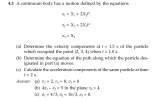
A continuum body has a motion defined by the equations:

Homework Answers
Request Answer!
We need at least 10 more requests to produce the answer.
0 / 10 have requested this problem solution
The more requests, the faster the answer.
A continuum body has a motion defined by the equations
The motion of a particle is defined by the equations x = (2t + t?) m...
 The motion of a particle is defined by the equations x = (2t + t?) m and y = (t2) m, where t is in seconds. Determine the normal and tangential components of the particle's velocity and acceleration when t = 2 s.
The motion of a particle is defined by the equations x = (2t + t?) m...
 The motion of a particle is defined by the equations x = (2t + t?) m and y = (t2) m, where t is in seconds. Determine the normal and tangential components of the particle's velocity and acceleration when t = 2 s. Select one 0 a. Vt= 6.0 m/s. Vn= 4.0 m/s, at= 2.0 m/s2, an= 2.0 m/s2 b. Vt= 1.55 m/s. Vn= 6.2 m/s at= 5.3 m/s2 an= 3.2 m/s2 c. Vt= 5.3 m/s. Vn= 3.2 m/s at=...
Le Problem 3.3 The motion of a particle is defined by the equations x=(4cos -2) (2...
 Le Problem 3.3 The motion of a particle is defined by the equations x=(4cos -2) (2 - cos act) and y =(3 sin TI)/(2 - cos al), where x and y are expressed in feet and / is expressed in seconds. Show that the path of the particle is part of the ellipse shown, and determine the velocity when (a) / -0. (b)/ 1/3 s, (c) 1 = 1 s.
6. [20 points] The following nonlinear differential equations describe the motion of a body in orbit...
 6. [20 points] The following nonlinear differential equations describe the motion of a body in orbit around two much heavier bodies. An example would be an Apollo capsule in an Earth-moon orbit. The three bodies determine a two-dimensional Cartesian plane in space The origin is at the center of mass of the two heavy bodies, the r-axis is the line through these two bodies, and the distance between their centers is taken as the unit. Thus, if μ is the...
1) Figure 5.2-1 shows the free body diagrams and the resulting equations of motion that are...
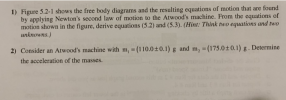 1) Figure 5.2-1 shows the free body diagrams and the resulting equations of motion that are found by applying Newton's second law of motion to the Atwood's machine. From the equations of motion shown in the figure, derive equations (5.2) and (5.3). (Hint: Think two equations and two unknowns.) 2) Consider an Atwood's machine with m, =(110. 00.1) g and m, = (175. 00.1) g. Determine the acceleration of the masses.
Equations of Motion using Lagrange Equation Use Lagranges equations to derive the equations of motion for...
 Equations of Motion using Lagrange Equation
Use Lagranges equations to derive the equations of motion for
the system.
Equations of Motion using Lagrange Equation
Use Lagranges equations to derive the equations of motion for
the system.
Equations of Motion: Translation Learning Goal: To use the equations of motion as they relate to...
 Equations of Motion: Translation Learning Goal: To use the equations of motion as they relate to linear translation of an object to determine characteristics about its motion. The car shown has a mass of m= 1200 kg and a center of mass located at G. The coefficient of static friction between the wheels and the road is us 0.240. The dimensions are a = 1.05 m. b= 1.65 m, and c= -0.350 m Assume the car starts from rest, the...
 The motion of a particle is defined by the equations x = (2t + t?) m and y = (t2) m, where t is in seconds. Determine the normal and tangential components of the particle's velocity and acceleration when t = 2 s.
 The motion of a particle is defined by the equations x = (2t + t?) m and y = (t2) m, where t is in seconds. Determine the normal and tangential components of the particle's velocity and acceleration when t = 2 s. Select one 0 a. Vt= 6.0 m/s. Vn= 4.0 m/s, at= 2.0 m/s2, an= 2.0 m/s2 b. Vt= 1.55 m/s. Vn= 6.2 m/s at= 5.3 m/s2 an= 3.2 m/s2 c. Vt= 5.3 m/s. Vn= 3.2 m/s at=...
 Le Problem 3.3 The motion of a particle is defined by the equations x=(4cos -2) (2 - cos act) and y =(3 sin TI)/(2 - cos al), where x and y are expressed in feet and / is expressed in seconds. Show that the path of the particle is part of the ellipse shown, and determine the velocity when (a) / -0. (b)/ 1/3 s, (c) 1 = 1 s.
 6. [20 points] The following nonlinear differential equations describe the motion of a body in orbit around two much heavier bodies. An example would be an Apollo capsule in an Earth-moon orbit. The three bodies determine a two-dimensional Cartesian plane in space The origin is at the center of mass of the two heavy bodies, the r-axis is the line through these two bodies, and the distance between their centers is taken as the unit. Thus, if μ is the...
 1) Figure 5.2-1 shows the free body diagrams and the resulting equations of motion that are found by applying Newton's second law of motion to the Atwood's machine. From the equations of motion shown in the figure, derive equations (5.2) and (5.3). (Hint: Think two equations and two unknowns.) 2) Consider an Atwood's machine with m, =(110. 00.1) g and m, = (175. 00.1) g. Determine the acceleration of the masses.
 Equations of Motion using Lagrange Equation
Use Lagranges equations to derive the equations of motion for
the system.
Equations of Motion using Lagrange Equation
Use Lagranges equations to derive the equations of motion for
the system.
 Equations of Motion: Translation Learning Goal: To use the equations of motion as they relate to linear translation of an object to determine characteristics about its motion. The car shown has a mass of m= 1200 kg and a center of mass located at G. The coefficient of static friction between the wheels and the road is us 0.240. The dimensions are a = 1.05 m. b= 1.65 m, and c= -0.350 m Assume the car starts from rest, the...
Most questions answered within 3 hours.
-
Where is the error in this code sequence?
String s1 = "Hello";
String s2 = "ello";...
asked 10 months ago -
Financial data for Joel de Paris, Inc., for last year
follow:
Joel de Paris, Inc.
Balance...
asked 10 months ago -
Consider this reaction:
Al2(SO4)3 (aq)+ BaCl3
(aq) Al2Cl6 (aq)- +
3BaSO4(s) . What is the...
asked 10 months ago -
Suppose that Savneet is considering increasing her
recent random sample from 20 car rentals to 40...
asked 10 months ago -
Trucks arrive at an unloading terminal at an average rate of 120
per hour.
Trucks arrive...
asked 10 months ago -
Why are methanol and ethanol completely soluble in water while
octanol is not very little soluble....
asked 10 months ago -
A facilities manager at a university reads in a research report
that the mean amount of...
asked 10 months ago -
When the CuSO4 is rehydrated by adding water to the anhydrous
compound, is this an endothermic...
asked 10 months ago -
A ray of sunlight is passing from diamond into crown glass; the
angle of incidence is...
asked 10 months ago -
A block of mass 0.249 kg is placed on top of a light, vertical
spring of...
asked 10 months ago -
how do the kidneys compensate in the presences of acidosis
a) trigger hyperventilate
b) reserve acid...
asked 10 months ago -
Question 501 pts
The rental rate of capital to the firm increases. Which of the
following...
asked 10 months ago