![1- Compute and plot the output for LTI systems with an input x[n] and unit impulse response of h[n] given by: n a) xn] = () u](http://img.homeworklib.com/questions/028c0830-52a1-11eb-8ee4-9381f8d31af3.png?x-oss-process=image/resize,w_560)
Homework Answers
Add Answer to:
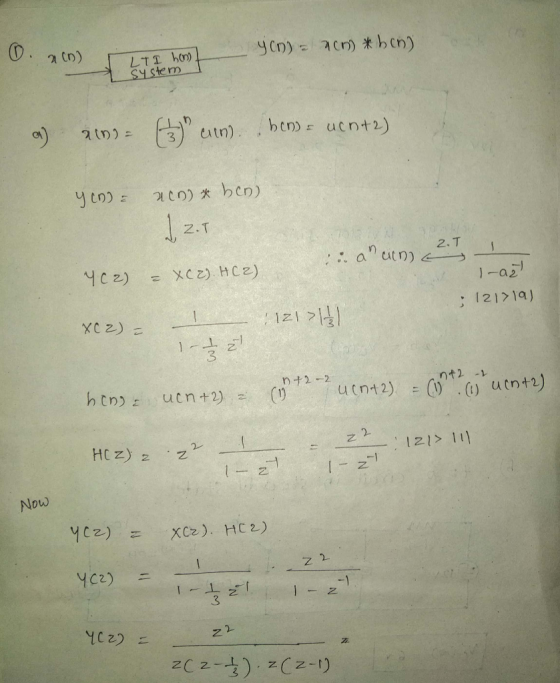
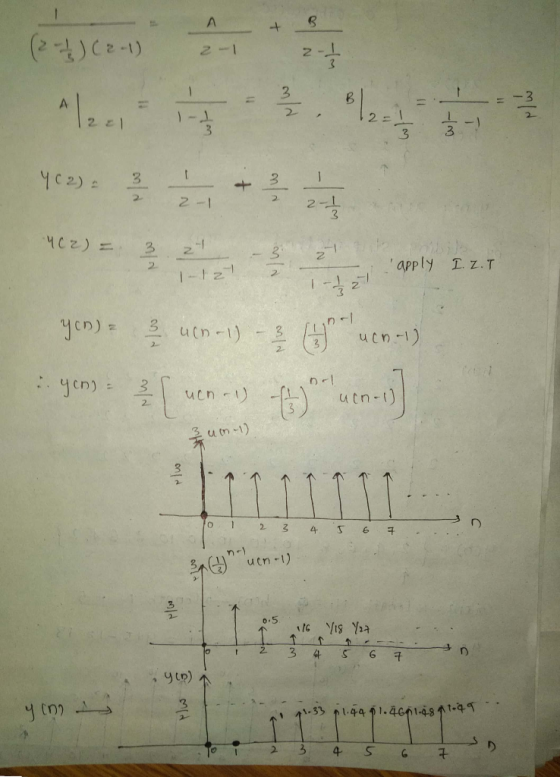
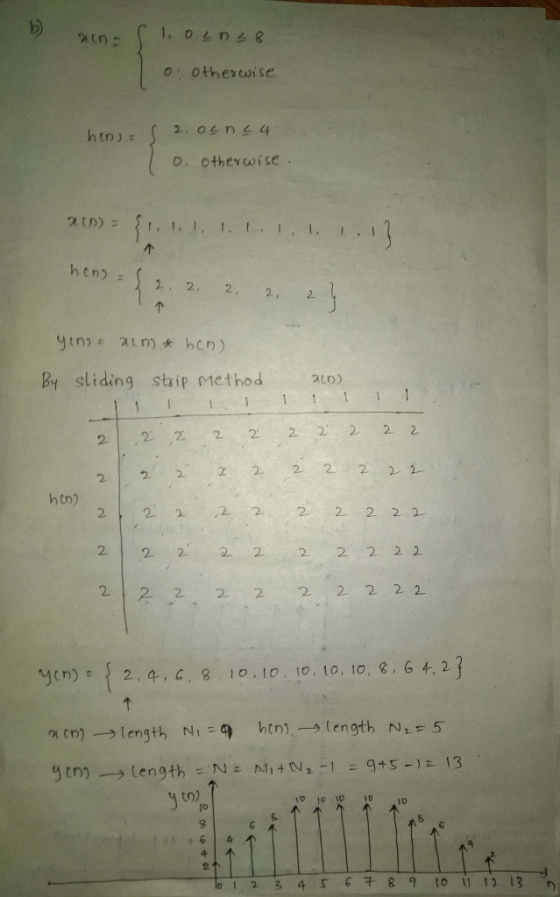
1- Compute and plot the output for LTI systems with an input x[n] and unit impulse...
1. (20 p) Compute and sketch the output y(t) of the continuous-time LTI system with impulse...
 1. (20 p) Compute and sketch the output y(t) of the continuous-time LTI system with impulse response h(t) = el-tuſt - 1)for an input signal x(t) = u(t) - ut - 3). 2. (20p) Consider an input x[n] and an unit impulse response h[n] given by n-2 x[n] = (4)”- u[n – 2] h[n] = u(n + 2] Determine and plot the output y[n] = x[n] *h[n].
1. An LTI system has an impulse response h[n] for which thez transform is a. Plot...
 1. An LTI system has an impulse response h[n] for which thez transform is a. Plot the pole-zero pattern for H(z). b. Using the fact that signals of the form z are eigenfunctions of LTI systems, determine the system output for all n if the input x [n] is given by 72 I3(2)
SIGNALS and SYSTEMS HOMEWORK-IV 1. Let X(t) be the input to an LTI system with unit...
 SIGNALS and SYSTEMS HOMEWORK-IV 1. Let X(t) be the input to an LTI system with unit impulse response h(t), where x(t) = e-tu(t) h(t) = u(t -3). Determine and plot the output y(t) = x(t) *h(t). Both analytically and graphical method. (25 p)
CONVOLUTION - Questions 4 and 5 4. Consider an LTI system with an impulse response h(n)...
 CONVOLUTION - Questions 4 and 5 4. Consider an LTI system with an impulse response h(n) = [1 2 1] for 0 <n<2. If the input to the system is x(n) = u(n)-un-2) where u(n) is the unit-step, calculate the output of the system y(n) analytically. Check your answer using the "conv" function in MATLAB. 5. Consider an LTI system with an impulse response h(n) = u(n) where u(n) is the unit-step. (a) If the input to the system is...
(Frequency response of CT LTI systems): You want to design a system whose unit impulse response has the form:
(Frequency response of CT LTI systems): You want to design a system whose unit impulse response has the form: h(t) =u(t) - u(t - N). Find all possible values of N >0 such that when the input signal x(t) = cos(πt), the output signal y(t) = 0 for all t.
Question 1 (10 pts): Consider the continuous-time LTI system S whose unit impulse response h is given by Le., h consists of a unit impulse at time 0 followed by a unit impulse at time (a) (2pts)...
 Question 1 (10 pts): Consider the continuous-time LTI system S whose unit impulse response h is given by Le., h consists of a unit impulse at time 0 followed by a unit impulse at time (a) (2pts) Obtain and plot the unit step response of S. (b) (2pts) Is S stable? Is it causal? Explain Two unrelated questions (c) (2pts) Is the ideal low-pass continuous-time filter (frequency response H(w) for H()0 otherwise) causal? Explain (d) (4 pts) Is the discrete-time...
Name: 10. [8 points] Consider a discrete-time LTI system with input x[n] and out- put y[n]....
 Name: 10. [8 points] Consider a discrete-time LTI system with input x[n] and out- put y[n]. When the input signal x[n] = (6)" is applied to the system, the output signal is y[n] = 0 for all n When the input signal xn] (3)" u[n] is applied to the system, the output signal is y[n] = A 8[n] + 2 (5)" u[n] for all n, where A is a constant number a) Find A. b) Find the impulse response of...
5- Determine whether or not each of the following LTI systems with the given impulse response...
 5- Determine whether or not each of the following LTI systems with the given impulse response are memoryless: a) h(t) = 56(t- 1) b) h(t) = eT u(t) e) h[n] sinEn) d) h[n] = 26[n] 6- Determine whether or not each of the following LTI systems with the given impulse response are stable: a) h(t) = 2 b) h(t) = e2tu(t - 1) c) h[n] = 3"u[n] d) h[n] = cos(Tm)u[n] 7- Determine whether or not each of the following...
5. For each of the following h[n] and x[n], characterize the output of the LTI system...
 5. For each of the following h[n] and x[n], characterize the output of the LTI system with impulse response h[n] and input x[n]: a. h[n] = u[n] – u[n – 4] and x[n] = 2^u[n]. b. h[n] = 8[n – 3] and x[n] = en+2. c. h[n] = (-1)" u[n] and x[n] = u[n – 1].
Problem 2: Find the impulse response h(n) of a causal LTI system if the input x(n)...
 Problem 2: Find the impulse response h(n) of a causal LTI system if the input x(n) and the output y(n) are given as follows 72 42)un-1) y(n)-G)na(n) xnun)
 1. (20 p) Compute and sketch the output y(t) of the continuous-time LTI system with impulse response h(t) = el-tuſt - 1)for an input signal x(t) = u(t) - ut - 3). 2. (20p) Consider an input x[n] and an unit impulse response h[n] given by n-2 x[n] = (4)”- u[n – 2] h[n] = u(n + 2] Determine and plot the output y[n] = x[n] *h[n].
 1. An LTI system has an impulse response h[n] for which thez transform is a. Plot the pole-zero pattern for H(z). b. Using the fact that signals of the form z are eigenfunctions of LTI systems, determine the system output for all n if the input x [n] is given by 72 I3(2)
 SIGNALS and SYSTEMS HOMEWORK-IV 1. Let X(t) be the input to an LTI system with unit impulse response h(t), where x(t) = e-tu(t) h(t) = u(t -3). Determine and plot the output y(t) = x(t) *h(t). Both analytically and graphical method. (25 p)
 CONVOLUTION - Questions 4 and 5 4. Consider an LTI system with an impulse response h(n) = [1 2 1] for 0 <n<2. If the input to the system is x(n) = u(n)-un-2) where u(n) is the unit-step, calculate the output of the system y(n) analytically. Check your answer using the "conv" function in MATLAB. 5. Consider an LTI system with an impulse response h(n) = u(n) where u(n) is the unit-step. (a) If the input to the system is...
 Question 1 (10 pts): Consider the continuous-time LTI system S whose unit impulse response h is given by Le., h consists of a unit impulse at time 0 followed by a unit impulse at time (a) (2pts) Obtain and plot the unit step response of S. (b) (2pts) Is S stable? Is it causal? Explain Two unrelated questions (c) (2pts) Is the ideal low-pass continuous-time filter (frequency response H(w) for H()0 otherwise) causal? Explain (d) (4 pts) Is the discrete-time...
 Name: 10. [8 points] Consider a discrete-time LTI system with input x[n] and out- put y[n]. When the input signal x[n] = (6)" is applied to the system, the output signal is y[n] = 0 for all n When the input signal xn] (3)" u[n] is applied to the system, the output signal is y[n] = A 8[n] + 2 (5)" u[n] for all n, where A is a constant number a) Find A. b) Find the impulse response of...
 5- Determine whether or not each of the following LTI systems with the given impulse response are memoryless: a) h(t) = 56(t- 1) b) h(t) = eT u(t) e) h[n] sinEn) d) h[n] = 26[n] 6- Determine whether or not each of the following LTI systems with the given impulse response are stable: a) h(t) = 2 b) h(t) = e2tu(t - 1) c) h[n] = 3"u[n] d) h[n] = cos(Tm)u[n] 7- Determine whether or not each of the following...
 5. For each of the following h[n] and x[n], characterize the output of the LTI system with impulse response h[n] and input x[n]: a. h[n] = u[n] – u[n – 4] and x[n] = 2^u[n]. b. h[n] = 8[n – 3] and x[n] = en+2. c. h[n] = (-1)" u[n] and x[n] = u[n – 1].
 Problem 2: Find the impulse response h(n) of a causal LTI system if the input x(n) and the output y(n) are given as follows 72 42)un-1) y(n)-G)na(n) xnun)
Most questions answered within 3 hours.
-
Where is the error in this code sequence?
String s1 = "Hello";
String s2 = "ello";...
asked 10 months ago -
Financial data for Joel de Paris, Inc., for last year
follow:
Joel de Paris, Inc.
Balance...
asked 10 months ago -
Consider this reaction:
Al2(SO4)3 (aq)+ BaCl3
(aq) Al2Cl6 (aq)- +
3BaSO4(s) . What is the...
asked 10 months ago -
Suppose that Savneet is considering increasing her
recent random sample from 20 car rentals to 40...
asked 10 months ago -
Trucks arrive at an unloading terminal at an average rate of 120
per hour.
Trucks arrive...
asked 10 months ago -
Why are methanol and ethanol completely soluble in water while
octanol is not very little soluble....
asked 10 months ago -
A facilities manager at a university reads in a research report
that the mean amount of...
asked 10 months ago -
When the CuSO4 is rehydrated by adding water to the anhydrous
compound, is this an endothermic...
asked 10 months ago -
A ray of sunlight is passing from diamond into crown glass; the
angle of incidence is...
asked 10 months ago -
A block of mass 0.249 kg is placed on top of a light, vertical
spring of...
asked 10 months ago -
how do the kidneys compensate in the presences of acidosis
a) trigger hyperventilate
b) reserve acid...
asked 10 months ago -
Question 501 pts
The rental rate of capital to the firm increases. Which of the
following...
asked 10 months ago