Consider the following single degree of freedom mass-spring damper system with m=1 kg, c=3 N.s/m, and...
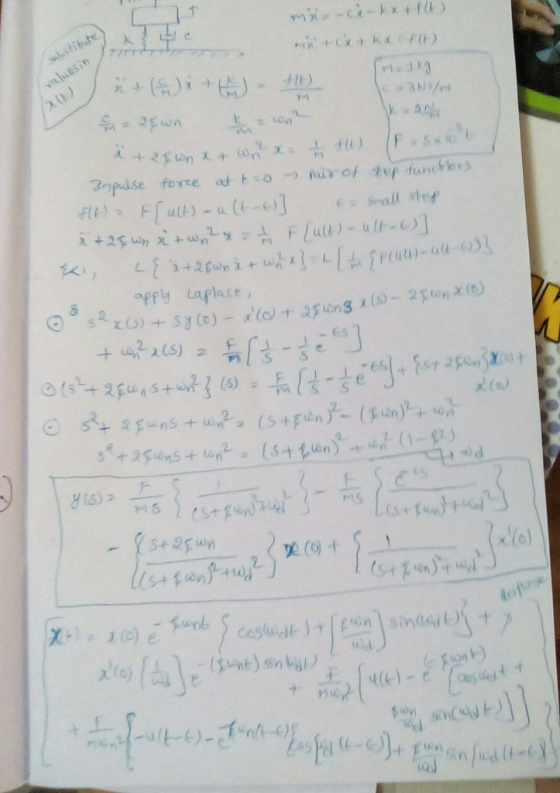
Consider the following single degree of freedom mass-spring damper system with m=1 kg, c=3 N.s/m, and k=2N/m. The system is at rest when a force 5e-3t is applied. By using the concept of the Lagrange Transform (using partial fractions), obtain the response, x(t) of the system.
Homework Answers
Add Answer to:
Consider the following single degree of freedom mass-spring
damper system with m=1 kg, c=3 N.s/m, and...
Consider a single degree of freedom (SDOF) with mass-spring-damper system
 Consider a single degree of freedom (SDOF) with mass-spring-damper system subjected to harmonic excitation having the following characteristics: Mass, m = 850 kg; stiffness, k = 80 kN/m; damping constant, c = 2000 N.s/m, forcing function amplitude, f0 = 5 N; forcing frequency, ωt = 30 rad/s. (a) Calculate the steady-state response of the system and state whether the system is underdamped, critically damped, or overdamped. (b) What happen to the steady-state response when the damping is increased to 18000 N.s/m? (Hint: Determine...
Can I get help with this 2. (20 points) The damped single degree-of-freedom mass-spring system shown...
 Can
I get help with this
2. (20 points) The damped single degree-of-freedom mass-spring system shown below has a mass m- 20 kg and a spring stiffness coefficient k 2400 N/m. a) Determine the damping coefficient of the system, if it is given that the mass exhibits a response with an amplitude of 0.02 m when the support is harmonically excited at the natural frequency of the system with an amplitude Yo-0.007 m b) Determine the amplitude of the dynamic...
Can
I get help with this
2. (20 points) The damped single degree-of-freedom mass-spring system shown below has a mass m- 20 kg and a spring stiffness coefficient k 2400 N/m. a) Determine the damping coefficient of the system, if it is given that the mass exhibits a response with an amplitude of 0.02 m when the support is harmonically excited at the natural frequency of the system with an amplitude Yo-0.007 m b) Determine the amplitude of the dynamic...
Consider the mass-spring-damper system shown below left. A spring-based force gage, with spring constant Kgage, is...
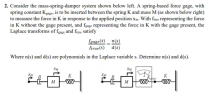 Consider the mass-spring-damper system shown below left. A
spring-based force gage, with spring constant Kgage, is to be
inserted between the spring K and mass M (as shown below right) to
measure the force in K in response to the applied position xin.
With ftrue representing the force in K without the gage present,
and fgage representing the force in K with the gage present, the
Laplace transforms of fgage and ftrue satisfy
Consider the mass-spring-damper system shown below left. A
spring-based force gage, with spring constant Kgage, is to be
inserted between the spring K and mass M (as shown below right) to
measure the force in K in response to the applied position xin.
With ftrue representing the force in K without the gage present,
and fgage representing the force in K with the gage present, the
Laplace transforms of fgage and ftrue satisfy
Question8 n the spring-mass-damper system in Figure 8, the force F, is applied to the mass and it...
 Question8 n the spring-mass-damper system in Figure 8, the force F, is applied to the mass and its displacement is measured via r(t), whilst k and c are the spring and damper constants, respectively x(t) Figure 8: A spring-mass-damper system. a) Obtain the differential equation that relates the input force F, to the measured dis- (6 marks) placement x(t) for the system in Figure 8. b) Draw the block diagram representation of the system in Figure 8. c) Based on...
Problem 1. Consider the following mass, spring, and damper system. Let the force F be the...
 Problem 1. Consider the following mass, spring, and damper system. Let the force F be the input and the position x be the output. M-1 kg b- 10 N s/m k 20 N/nm F = 1 N when t>=0 PART UNIT FEEDBACK CONTROL SYSTEM 5) Construct a unit feedback control for the mass-spring-damper system 6) Draw the block diagram of the unit feedback control system 7) Find the Transfer Function of the closed-loop (CL) system 8) Find and plot the...
A s Spring (k)-mass (m)- damper (c) system is subject to two impulses: F-2F and F-F escribe the d...
 A s Spring (k)-mass (m)- damper (c) system is subject to two impulses: F-2F and F-F escribe the displacement of the mass as a function of time in terms of m,c, k, o, and the constants in the applied force? Assume it is an underdamped system.
A s Spring (k)-mass (m)- damper (c) system is subject to two impulses: F-2F and F-F escribe the displacement of the mass as a function of time in terms of m,c, k, o, and...
A s Spring (k)-mass (m)- damper (c) system is subject to two impulses: F-2F and F-F escribe the displacement of the mass as a function of time in terms of m,c, k, o, and the constants in the applied force? Assume it is an underdamped system.
A s Spring (k)-mass (m)- damper (c) system is subject to two impulses: F-2F and F-F escribe the displacement of the mass as a function of time in terms of m,c, k, o, and...
3. Consider the following mass-spring-damper system. Let m= 1 kg, b = 10 Ns/m, and k...
 3. Consider the following mass-spring-damper system. Let m= 1 kg, b = 10 Ns/m, and k = 20 N/m. b m F k a) Derive the open-loop transfer function X(S) F(s) Plot the step response using matlab. b) Derive the closed-loop transfer function with P-controller with Kp = 300. Plot the step response using matlab. c) Derive the closed-loop transfer function with PD-controller with Ky and Ka = 10. Plot the step response using matlab. d) Derive the closed-loop transfer...
Problem 1 (Harmonic Oscillators) A mass-damper-spring system is a simple harmonic oscillator whose dynamics is governed...
 Problem 1 (Harmonic Oscillators) A mass-damper-spring system is a simple harmonic oscillator whose dynamics is governed by the equation of motion where m is the mass, c is the damping coefficient of the damper, k is the stiffness of the spring, F is the net force applied on the mass, and x is the displacement of the mass from its equilibrium point. In this problem, we focus on a mass-damper-spring system with m = 1 kg, c-4 kg/s, k-3 N/m,...
2 with spring stiffness k 1000 N/m, Consider a mass-spring-damper system shown in Figure mass m...
 2 with spring stiffness k 1000 N/m, Consider a mass-spring-damper system shown in Figure mass m = 10 kg, and damping constant c-150 N-s/m. If the initial displacement is xo-o and the initial velocity is 10 m/s (1) Find the damping ratio. (2) Is the system underdamped or overdamped? Why? (3) Calculate the damped natural frequency (4) Determine the free vibration response of the system.
Consider the mass-spring-damper system depicted in the figure below, where the input of the system is...
 Consider the mass-spring-damper system depicted in the figure below, where the input of the system is the applied force F(t) and the output of the system is xít) that is the displacement of the mass according to the coordinate system defined in that figure. Assume that force F(t) is applied for t> 0 and the system is in static equilibrium before t=0 and z(t) is measured from the static equilibrium. b m F Also, the mass of the block, the...
 Can
I get help with this
2. (20 points) The damped single degree-of-freedom mass-spring system shown below has a mass m- 20 kg and a spring stiffness coefficient k 2400 N/m. a) Determine the damping coefficient of the system, if it is given that the mass exhibits a response with an amplitude of 0.02 m when the support is harmonically excited at the natural frequency of the system with an amplitude Yo-0.007 m b) Determine the amplitude of the dynamic...
Can
I get help with this
2. (20 points) The damped single degree-of-freedom mass-spring system shown below has a mass m- 20 kg and a spring stiffness coefficient k 2400 N/m. a) Determine the damping coefficient of the system, if it is given that the mass exhibits a response with an amplitude of 0.02 m when the support is harmonically excited at the natural frequency of the system with an amplitude Yo-0.007 m b) Determine the amplitude of the dynamic...
 Consider the mass-spring-damper system shown below left. A
spring-based force gage, with spring constant Kgage, is to be
inserted between the spring K and mass M (as shown below right) to
measure the force in K in response to the applied position xin.
With ftrue representing the force in K without the gage present,
and fgage representing the force in K with the gage present, the
Laplace transforms of fgage and ftrue satisfy
Consider the mass-spring-damper system shown below left. A
spring-based force gage, with spring constant Kgage, is to be
inserted between the spring K and mass M (as shown below right) to
measure the force in K in response to the applied position xin.
With ftrue representing the force in K without the gage present,
and fgage representing the force in K with the gage present, the
Laplace transforms of fgage and ftrue satisfy
 Question8 n the spring-mass-damper system in Figure 8, the force F, is applied to the mass and its displacement is measured via r(t), whilst k and c are the spring and damper constants, respectively x(t) Figure 8: A spring-mass-damper system. a) Obtain the differential equation that relates the input force F, to the measured dis- (6 marks) placement x(t) for the system in Figure 8. b) Draw the block diagram representation of the system in Figure 8. c) Based on...
 Problem 1. Consider the following mass, spring, and damper system. Let the force F be the input and the position x be the output. M-1 kg b- 10 N s/m k 20 N/nm F = 1 N when t>=0 PART UNIT FEEDBACK CONTROL SYSTEM 5) Construct a unit feedback control for the mass-spring-damper system 6) Draw the block diagram of the unit feedback control system 7) Find the Transfer Function of the closed-loop (CL) system 8) Find and plot the...
 A s Spring (k)-mass (m)- damper (c) system is subject to two impulses: F-2F and F-F escribe the displacement of the mass as a function of time in terms of m,c, k, o, and the constants in the applied force? Assume it is an underdamped system.
A s Spring (k)-mass (m)- damper (c) system is subject to two impulses: F-2F and F-F escribe the displacement of the mass as a function of time in terms of m,c, k, o, and...
A s Spring (k)-mass (m)- damper (c) system is subject to two impulses: F-2F and F-F escribe the displacement of the mass as a function of time in terms of m,c, k, o, and the constants in the applied force? Assume it is an underdamped system.
A s Spring (k)-mass (m)- damper (c) system is subject to two impulses: F-2F and F-F escribe the displacement of the mass as a function of time in terms of m,c, k, o, and...
 3. Consider the following mass-spring-damper system. Let m= 1 kg, b = 10 Ns/m, and k = 20 N/m. b m F k a) Derive the open-loop transfer function X(S) F(s) Plot the step response using matlab. b) Derive the closed-loop transfer function with P-controller with Kp = 300. Plot the step response using matlab. c) Derive the closed-loop transfer function with PD-controller with Ky and Ka = 10. Plot the step response using matlab. d) Derive the closed-loop transfer...
 Problem 1 (Harmonic Oscillators) A mass-damper-spring system is a simple harmonic oscillator whose dynamics is governed by the equation of motion where m is the mass, c is the damping coefficient of the damper, k is the stiffness of the spring, F is the net force applied on the mass, and x is the displacement of the mass from its equilibrium point. In this problem, we focus on a mass-damper-spring system with m = 1 kg, c-4 kg/s, k-3 N/m,...
 2 with spring stiffness k 1000 N/m, Consider a mass-spring-damper system shown in Figure mass m = 10 kg, and damping constant c-150 N-s/m. If the initial displacement is xo-o and the initial velocity is 10 m/s (1) Find the damping ratio. (2) Is the system underdamped or overdamped? Why? (3) Calculate the damped natural frequency (4) Determine the free vibration response of the system.
 Consider the mass-spring-damper system depicted in the figure below, where the input of the system is the applied force F(t) and the output of the system is xít) that is the displacement of the mass according to the coordinate system defined in that figure. Assume that force F(t) is applied for t> 0 and the system is in static equilibrium before t=0 and z(t) is measured from the static equilibrium. b m F Also, the mass of the block, the...
Most questions answered within 3 hours.
-
Where is the error in this code sequence?
String s1 = "Hello";
String s2 = "ello";...
asked 11 months ago -
Financial data for Joel de Paris, Inc., for last year
follow:
Joel de Paris, Inc.
Balance...
asked 11 months ago -
Consider this reaction:
Al2(SO4)3 (aq)+ BaCl3
(aq) Al2Cl6 (aq)- +
3BaSO4(s) . What is the...
asked 11 months ago -
Suppose that Savneet is considering increasing her
recent random sample from 20 car rentals to 40...
asked 11 months ago -
Trucks arrive at an unloading terminal at an average rate of 120
per hour.
Trucks arrive...
asked 11 months ago -
Why are methanol and ethanol completely soluble in water while
octanol is not very little soluble....
asked 11 months ago -
A facilities manager at a university reads in a research report
that the mean amount of...
asked 11 months ago -
When the CuSO4 is rehydrated by adding water to the anhydrous
compound, is this an endothermic...
asked 11 months ago -
A ray of sunlight is passing from diamond into crown glass; the
angle of incidence is...
asked 11 months ago -
A block of mass 0.249 kg is placed on top of a light, vertical
spring of...
asked 11 months ago -
how do the kidneys compensate in the presences of acidosis
a) trigger hyperventilate
b) reserve acid...
asked 11 months ago -
Question 501 pts
The rental rate of capital to the firm increases. Which of the
following...
asked 11 months ago