
Homework Answers
Request Answer!
We need at least 10 more requests to produce the answer.
0 / 10 have requested this problem solution
The more requests, the faster the answer.
Add Answer to:
Problem 6: (a) Consider the following problem: max y = 5x + 4.02 + x112-ri-23 +...
Calculus 3 please answer and show steps to both questions 1. Find the Maximum and minimum...
 Calculus 3 please answer and show steps to both
questions
1. Find the Maximum and minimum values of the following function. 1 f(x, y) x2+y2 + x2y2 Sketch the graph using Maple to verify your calculations. 2. Determine the dimensions of the rectangular box, open the top, having requiring the least amount of material for its a volume of 32 cube-feet and construction. Set up the objective function and constraint. Solving the problem using absolute extremum method. Solving the problem...
Calculus 3 please answer and show steps to both
questions
1. Find the Maximum and minimum values of the following function. 1 f(x, y) x2+y2 + x2y2 Sketch the graph using Maple to verify your calculations. 2. Determine the dimensions of the rectangular box, open the top, having requiring the least amount of material for its a volume of 32 cube-feet and construction. Set up the objective function and constraint. Solving the problem using absolute extremum method. Solving the problem...
Minimize f(x,y) = x2 + xy + y2 subject to y = - 6 without using...
 Minimize f(x,y) = x2 + xy + y2 subject to y = - 6 without using the method of Lagrange multipliers; instead, solve the constraint for x or y and substitute into f(x,y). Use the constraint to rewrite f(x,y) = x² + xy + y2 as a function of one variable, g(x). g(x)=
3. Lagrange multipliers Consider a plane described by the equation nx - k, and consider a point a...
 3. Lagrange multipliers Consider a plane described by the equation nx - k, and consider a point a not on the plane (here, bold symbols (n, x, and a) are vectors, plain symbols (k) are scalars). a) Using the method of Lagrange multipliers, find the point 3 (in the plane) that is closest to the point a. Note: n is a unit vector (i.e., nTn = 1). Hint: Your objective function J(x), which you want to minimize, is distance. Your...
(2 marks) Solve (find the optimal point and objective function value at the optimal point) the...
 (2 marks) Solve (find the optimal point and objective function value at the optimal point) the following optimisation problem min 2x+ y Subject to Obtain the gradient of both the objective function and constraint function at the optimal point. What condition do they meet at the optimal point? Suppose the right-hand side of the constraint equation is increased from 1 to 1.2. Without redoing the Lagrange multiplier method obtain an estimate for the change in objective function value. Verify using...
M 4. Consider the utility maximization problem max U(x,y) = x +y s.t. x + 4y...
 M 4. Consider the utility maximization problem max U(x,y) = x +y s.t. x + 4y = 100. (a) Using the Lagrange method, find the quantities demanded of the two goods. (b) Suppose income increases from 100 to 101. What is the exact increase in the optimal value of U(x, y)? Compare with the value found in (a) for the Lagrange multiplier. (C) Suppose we change the budget constraint to px + y = m, but keep the same utility...
Solve the following Utility Maximization Problem for x* and y* that Max U(x,y)= ln(x) subject to...
 Solve the following Utility Maximization Problem for x* and y* that Max U(x,y)= ln(x) subject to Pxx + pyy = I ----.-.(2) where In denotes the natural logarithm (base e) and x and y>0. a) (25 points) by Substitution and show that your values of x* and y* max U (x*,y*). Problem 1. b) (20 points) by the Lagrange Multiplier Method
L I L I JUNULUI! SM 4. Consider the utility maximization problem max U(x,y) = (x...
 L I L I JUNULUI! SM 4. Consider the utility maximization problem max U(x,y) = (x + y s.t. x+4y= 100. (a) Using the Lagrange method, find the quantities demanded of the two goods. (1) Suppose income increases from 100 to 101. What is the exact increase in the optimal value of U(x,y)? Compare with the value found in (a) for the Lagrange multiplier (c) Suppose we change the budget constraint to px + 4y=m, but keep the same utility...
Solve for the optimal (c,l) pair in the following problem 1+0 max C ед subject to...
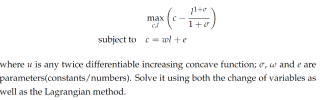 Solve for the optimal (c,l) pair in the following problem
1+0 max C ед subject to cwl+e where u is any twice differentiable increasing concave function; ơ, a, and are parameters(constants/numbers). Solve it using both the change of variables as well as the Lagrangian method.
Solve for the optimal (c,l) pair in the following problem
1+0 max C ед subject to cwl+e where u is any twice differentiable increasing concave function; ơ, a, and are parameters(constants/numbers). Solve it using both the change of variables as well as the Lagrangian method.
Consider the following LP problem. MAX: 9X1-8X2 Subject to: x1+x2≤6 -x1+x2≤3 3x1-6x2≤4 x1,x2≥0 Sketch the feasible...
Consider the following LP problem. MAX: 9X1-8X2 Subject to: x1+x2≤6 -x1+x2≤3 3x1-6x2≤4 x1,x2≥0 Sketch the feasible region for this model. What is the optimal solution? What is the optimal solution if the objective function changes to Max.-9x1+8x2?
Problem 1: Consider the following problem x+y+1=1 x2 +y2+z2 =1 max f(x ,y,z)=er+y+1 subject to (a)...
 Problem 1: Consider the following problem x+y+1=1 x2 +y2+z2 =1 max f(x ,y,z)=er+y+1 subject to (a) Solve the problem. (b) Replace the constraints byx+y+1=1.02 and x2+y2+Z2-0.98. What is the approximate change in the optimal value of the objective function? (c) Classify the candidate points for optimality in the local optimization problem.
 Calculus 3 please answer and show steps to both
questions
1. Find the Maximum and minimum values of the following function. 1 f(x, y) x2+y2 + x2y2 Sketch the graph using Maple to verify your calculations. 2. Determine the dimensions of the rectangular box, open the top, having requiring the least amount of material for its a volume of 32 cube-feet and construction. Set up the objective function and constraint. Solving the problem using absolute extremum method. Solving the problem...
Calculus 3 please answer and show steps to both
questions
1. Find the Maximum and minimum values of the following function. 1 f(x, y) x2+y2 + x2y2 Sketch the graph using Maple to verify your calculations. 2. Determine the dimensions of the rectangular box, open the top, having requiring the least amount of material for its a volume of 32 cube-feet and construction. Set up the objective function and constraint. Solving the problem using absolute extremum method. Solving the problem...
 Minimize f(x,y) = x2 + xy + y2 subject to y = - 6 without using the method of Lagrange multipliers; instead, solve the constraint for x or y and substitute into f(x,y). Use the constraint to rewrite f(x,y) = x² + xy + y2 as a function of one variable, g(x). g(x)=
 3. Lagrange multipliers Consider a plane described by the equation nx - k, and consider a point a not on the plane (here, bold symbols (n, x, and a) are vectors, plain symbols (k) are scalars). a) Using the method of Lagrange multipliers, find the point 3 (in the plane) that is closest to the point a. Note: n is a unit vector (i.e., nTn = 1). Hint: Your objective function J(x), which you want to minimize, is distance. Your...
 (2 marks) Solve (find the optimal point and objective function value at the optimal point) the following optimisation problem min 2x+ y Subject to Obtain the gradient of both the objective function and constraint function at the optimal point. What condition do they meet at the optimal point? Suppose the right-hand side of the constraint equation is increased from 1 to 1.2. Without redoing the Lagrange multiplier method obtain an estimate for the change in objective function value. Verify using...
 M 4. Consider the utility maximization problem max U(x,y) = x +y s.t. x + 4y = 100. (a) Using the Lagrange method, find the quantities demanded of the two goods. (b) Suppose income increases from 100 to 101. What is the exact increase in the optimal value of U(x, y)? Compare with the value found in (a) for the Lagrange multiplier. (C) Suppose we change the budget constraint to px + y = m, but keep the same utility...
 Solve the following Utility Maximization Problem for x* and y* that Max U(x,y)= ln(x) subject to Pxx + pyy = I ----.-.(2) where In denotes the natural logarithm (base e) and x and y>0. a) (25 points) by Substitution and show that your values of x* and y* max U (x*,y*). Problem 1. b) (20 points) by the Lagrange Multiplier Method
 L I L I JUNULUI! SM 4. Consider the utility maximization problem max U(x,y) = (x + y s.t. x+4y= 100. (a) Using the Lagrange method, find the quantities demanded of the two goods. (1) Suppose income increases from 100 to 101. What is the exact increase in the optimal value of U(x,y)? Compare with the value found in (a) for the Lagrange multiplier (c) Suppose we change the budget constraint to px + 4y=m, but keep the same utility...
 Solve for the optimal (c,l) pair in the following problem
1+0 max C ед subject to cwl+e where u is any twice differentiable increasing concave function; ơ, a, and are parameters(constants/numbers). Solve it using both the change of variables as well as the Lagrangian method.
Solve for the optimal (c,l) pair in the following problem
1+0 max C ед subject to cwl+e where u is any twice differentiable increasing concave function; ơ, a, and are parameters(constants/numbers). Solve it using both the change of variables as well as the Lagrangian method.
 Problem 1: Consider the following problem x+y+1=1 x2 +y2+z2 =1 max f(x ,y,z)=er+y+1 subject to (a) Solve the problem. (b) Replace the constraints byx+y+1=1.02 and x2+y2+Z2-0.98. What is the approximate change in the optimal value of the objective function? (c) Classify the candidate points for optimality in the local optimization problem.
Most questions answered within 3 hours.
-
Where is the error in this code sequence?
String s1 = "Hello";
String s2 = "ello";...
asked 10 months ago -
Financial data for Joel de Paris, Inc., for last year
follow:
Joel de Paris, Inc.
Balance...
asked 10 months ago -
Consider this reaction:
Al2(SO4)3 (aq)+ BaCl3
(aq) Al2Cl6 (aq)- +
3BaSO4(s) . What is the...
asked 10 months ago -
Suppose that Savneet is considering increasing her
recent random sample from 20 car rentals to 40...
asked 10 months ago -
Trucks arrive at an unloading terminal at an average rate of 120
per hour.
Trucks arrive...
asked 10 months ago -
Why are methanol and ethanol completely soluble in water while
octanol is not very little soluble....
asked 10 months ago -
A facilities manager at a university reads in a research report
that the mean amount of...
asked 10 months ago -
When the CuSO4 is rehydrated by adding water to the anhydrous
compound, is this an endothermic...
asked 10 months ago -
A ray of sunlight is passing from diamond into crown glass; the
angle of incidence is...
asked 10 months ago -
A block of mass 0.249 kg is placed on top of a light, vertical
spring of...
asked 10 months ago -
how do the kidneys compensate in the presences of acidosis
a) trigger hyperventilate
b) reserve acid...
asked 10 months ago -
Question 501 pts
The rental rate of capital to the firm increases. Which of the
following...
asked 10 months ago