
Homework Answers
Add Answer to:
1. (10+10pts.) Consider the homogeneous system x1 + x2 + (3 – 2a)x3 = 0 2x1...
4. (10+10pts.) Consider the homogeneous system 21 +22+ (3 - 2a).x3 = 0 2x1 + 12...
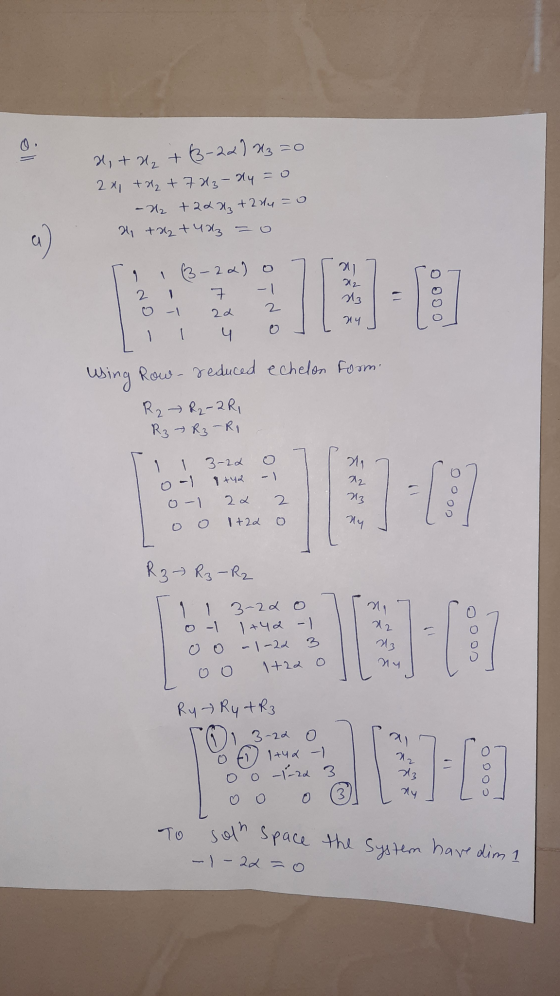
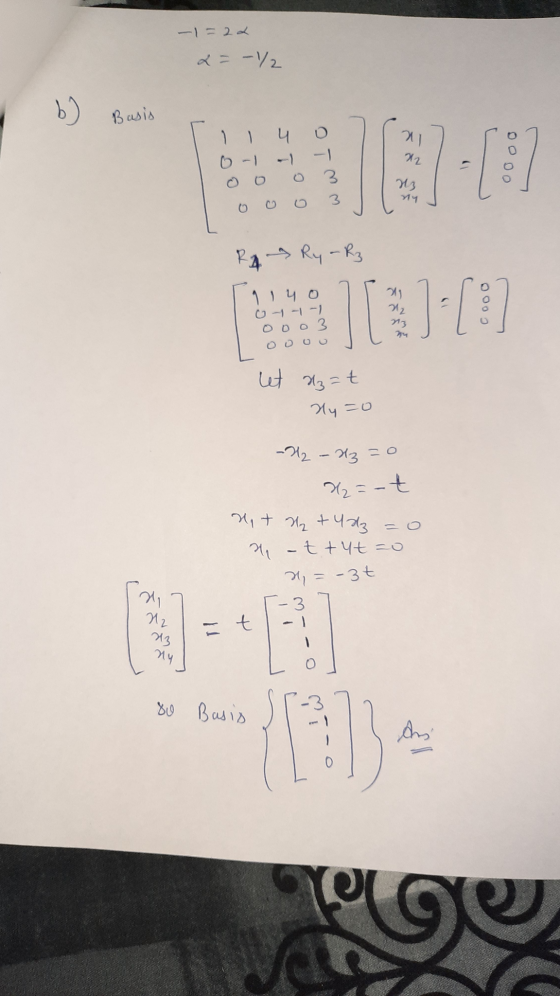
 4. (10+10pts.) Consider the homogeneous system 21 +22+ (3 - 2a).x3 = 0 2x1 + 12 + 7.03 - 14 = 0 -22 + 20.73 +2.04 = 0 21 +22 + 4x3 = 0 where a is a real constant. a. Find the value of a for which the dimension of the solution space of the system is 1. b. Find a basis of the solution space of the system for the value of a found in part (a).
Consider the linear system x1 + x2 – 2x3 + 3x4 = 0 2x1 + x2...
 Consider the linear system x1 + x2 – 2x3 + 3x4 = 0 2x1 + x2 - 6x3 + 4x4 -1 3x1 + 2x2 + px3 + 7x4 -1 X1 – X2 – 6x3 24 = t. Find the conditions (on t and p) that the system is consistent, and inconsistent. If the system is consistent, find all the possible solutions (including stating the dimension of the solution space(s) and describe the solution space(s) in parametric form).
Find the solutions of 2x1-3x2-7x3+5x4+2x5=-2 x1-2x2-4x5+3x4+x5=-2 2x1+0x2-4x3+2x4+x3=3 x1-5x2-7x3+6x4+2x5=-7
Find the solutions of 2x1-3x2-7x3+5x4+2x5=-2 x1-2x2-4x5+3x4+x5=-2 2x1+0x2-4x3+2x4+x3=3 x1-5x2-7x3+6x4+2x5=-7
2x1 − x2 − 3x3 − 2x4 = 1 x1 − x2 − 4x3 − 2x4...
2x1 − x2 − 3x3 − 2x4 = 1 x1 − x2 − 4x3 − 2x4 = 5 3x1 − x2 − x3 − 3x4 = −2 x1 + 2x3 − x4 = −4
2x1 + 4x2 + 7x3 c1: x1 +x2 +x3 ≤ 105 c2: 3x1 +4x2 +2x3 ≥...
2x1 + 4x2 + 7x3 c1: x1 +x2 +x3 ≤ 105 c2: 3x1 +4x2 +2x3 ≥ 310 c3: 2x1 +4x2 +4x3 ≥ 330 x1,x2,x3 ≥ 0 The problem was solved using a computer program and the following output was obtained variabel value reduced cost allowable increase decrease x1 0.0 -3.5 3.5 inf x2 55 0 5 7 x3 60 0 inf 5 constraint slack/surplus dual price 1 0 10 2 0 -2 3 95 0 Constraint right-hand side sensitivity constraint...
8. Given the non-homogeneous linear system of differential equations x1' = -2x1 - 7x2 + 3t...
 8. Given the non-homogeneous linear system of differential equations x1' = -2x1 - 7x2 + 3t X2 = -X1 + 4x2 + e-6 a. Find its homogeneous solution using the eigenvalue-eigenvector approach (10pts) b. Use the variation-of-parameters method to find its particular solution (10pts)
Write the solution set of the given homogeneous system in parametric vector form. 2x1+2x2 + 4x3=0...
 Write the solution set of the given homogeneous system in parametric vector form. 2x1+2x2 + 4x3=0 4x1-4x2-8x3 =0 -6x2 + 6x3 = 0 where the solution set is x-X2 X3 (Type an integer or simplified fraction for each matrix element.)
Consider the following linear transformation T: R5 → R3 where T(X1, X2, X3, X4, X5) =...
 Consider the following linear transformation T: R5 → R3 where T(X1, X2, X3, X4, X5) = (*1-X3+X4, 2X1+X2-X3+2x4, -2X1+3X3-3x4+x5) (a) Determine the standard matrix representation A of T(x). (b) Find a basis for the kernel of T(x). (c) Find a basis for the range of T(x). (d) Is T(x) one-to-one? Is T(x) onto? Explain. (e) Is T(x) invertible? Explain
Please show work Consider the following linear transformation T: RS → R3 where T(X1, X2, X3,...
 Please show work
Consider the following linear transformation T: RS → R3 where T(X1, X2, X3, X4, Xs) = (x1-X3+X4, 2x1+x2-X3+2x4, -2x1+3x3-3x4+xs) (a) Determine the standard matrix representation A of T(x). (b) Find a basis for the kernel of T(x). (c) Find a basis for the range of T(x). (d) Is T(x) one-to-one? Is T(x) onto? Explain. (e) Is T(x) invertible? Explain
Please show work
Consider the following linear transformation T: RS → R3 where T(X1, X2, X3, X4, Xs) = (x1-X3+X4, 2x1+x2-X3+2x4, -2x1+3x3-3x4+xs) (a) Determine the standard matrix representation A of T(x). (b) Find a basis for the kernel of T(x). (c) Find a basis for the range of T(x). (d) Is T(x) one-to-one? Is T(x) onto? Explain. (e) Is T(x) invertible? Explain
1. Suppose that X1, X2, and X3 E(X1) = 0, E(X2) = 1, E(X3) = 1,...
1. Suppose that X1, X2, and X3 E(X1) = 0, E(X2) = 1, E(X3) = 1, Var(X1) = 1, Var(X2) = 2, Var(X3) = 3, Cov(X1, X2) = -1, Cov(X2, X3) = 1, where X1 and X3 are independent. a.) Find the covariance cov(X1 + X2, X1 - X3). b.) Define U = 2X1 - X2 + X3. Find the mean and variance of U.
 4. (10+10pts.) Consider the homogeneous system 21 +22+ (3 - 2a).x3 = 0 2x1 + 12 + 7.03 - 14 = 0 -22 + 20.73 +2.04 = 0 21 +22 + 4x3 = 0 where a is a real constant. a. Find the value of a for which the dimension of the solution space of the system is 1. b. Find a basis of the solution space of the system for the value of a found in part (a).
 Consider the linear system x1 + x2 – 2x3 + 3x4 = 0 2x1 + x2 - 6x3 + 4x4 -1 3x1 + 2x2 + px3 + 7x4 -1 X1 – X2 – 6x3 24 = t. Find the conditions (on t and p) that the system is consistent, and inconsistent. If the system is consistent, find all the possible solutions (including stating the dimension of the solution space(s) and describe the solution space(s) in parametric form).
 8. Given the non-homogeneous linear system of differential equations x1' = -2x1 - 7x2 + 3t X2 = -X1 + 4x2 + e-6 a. Find its homogeneous solution using the eigenvalue-eigenvector approach (10pts) b. Use the variation-of-parameters method to find its particular solution (10pts)
 Write the solution set of the given homogeneous system in parametric vector form. 2x1+2x2 + 4x3=0 4x1-4x2-8x3 =0 -6x2 + 6x3 = 0 where the solution set is x-X2 X3 (Type an integer or simplified fraction for each matrix element.)
 Consider the following linear transformation T: R5 → R3 where T(X1, X2, X3, X4, X5) = (*1-X3+X4, 2X1+X2-X3+2x4, -2X1+3X3-3x4+x5) (a) Determine the standard matrix representation A of T(x). (b) Find a basis for the kernel of T(x). (c) Find a basis for the range of T(x). (d) Is T(x) one-to-one? Is T(x) onto? Explain. (e) Is T(x) invertible? Explain
 Please show work
Consider the following linear transformation T: RS → R3 where T(X1, X2, X3, X4, Xs) = (x1-X3+X4, 2x1+x2-X3+2x4, -2x1+3x3-3x4+xs) (a) Determine the standard matrix representation A of T(x). (b) Find a basis for the kernel of T(x). (c) Find a basis for the range of T(x). (d) Is T(x) one-to-one? Is T(x) onto? Explain. (e) Is T(x) invertible? Explain
Please show work
Consider the following linear transformation T: RS → R3 where T(X1, X2, X3, X4, Xs) = (x1-X3+X4, 2x1+x2-X3+2x4, -2x1+3x3-3x4+xs) (a) Determine the standard matrix representation A of T(x). (b) Find a basis for the kernel of T(x). (c) Find a basis for the range of T(x). (d) Is T(x) one-to-one? Is T(x) onto? Explain. (e) Is T(x) invertible? Explain
Most questions answered within 3 hours.
-
Where is the error in this code sequence?
String s1 = "Hello";
String s2 = "ello";...
asked 10 months ago -
Financial data for Joel de Paris, Inc., for last year
follow:
Joel de Paris, Inc.
Balance...
asked 10 months ago -
Consider this reaction:
Al2(SO4)3 (aq)+ BaCl3
(aq) Al2Cl6 (aq)- +
3BaSO4(s) . What is the...
asked 10 months ago -
Suppose that Savneet is considering increasing her
recent random sample from 20 car rentals to 40...
asked 10 months ago -
Trucks arrive at an unloading terminal at an average rate of 120
per hour.
Trucks arrive...
asked 10 months ago -
Why are methanol and ethanol completely soluble in water while
octanol is not very little soluble....
asked 10 months ago -
A facilities manager at a university reads in a research report
that the mean amount of...
asked 10 months ago -
When the CuSO4 is rehydrated by adding water to the anhydrous
compound, is this an endothermic...
asked 10 months ago -
A ray of sunlight is passing from diamond into crown glass; the
angle of incidence is...
asked 10 months ago -
A block of mass 0.249 kg is placed on top of a light, vertical
spring of...
asked 10 months ago -
how do the kidneys compensate in the presences of acidosis
a) trigger hyperventilate
b) reserve acid...
asked 10 months ago -
Question 501 pts
The rental rate of capital to the firm increases. Which of the
following...
asked 10 months ago