
Homework Answers
Part (a): The number of periods completed between time to = 0 ms and t1 = 0.9 ms are 10. Therefore the time period is,

Thus the angular frequency is,

Peak voltage at to is 70 V and at t1 is 40 V. The voltage in a damped oscillating circuit can be written as,

Here for peak value cos( ) =1. So the time constant
is,
) =1. So the time constant
is,
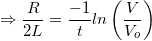

Now the resonant frequency is,

Now the capacitance can be calculated as,


Initial energy in the capacitor can be given as,

Now the energy after 17 periods can be calculated as,


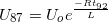
Part (b): When 87% of initial energy is dissipated, that is,

Then the time is,


Add Answer to:
A capacitor C is charged to an initial potential of 50.0 V, with an initial charge...
A charged capacitor with a capacitance of C = 5.00x10⁻³F, has an initial potential of 6.00...
 A charged capacitor with a capacitance of C = 5.00x10⁻³F, has an initial potential of 6.00 V. The capacitor is discharged by connecting a resistance R between its terminals. The graph below shows the potential across the capacitor as a funtion of t, the time elapsed since the connection. Potential (in volts) 1 8 9 2 3 4 5 6 7 Time t (in seconds) Calculate the value of R. Note that the curve passes through an intersection point. 446.67...
A capacitor C is charged to an initial potential of 60.0 V, with an initial charge...
A capacitor C is charged to an initial potential of 60.0 V, with an initial charge of Q0. It is in a circuit with a switch and an inductor with inductance L = 5.33
A capacitor with an initial potential difference of 122 V is discharged through a resistor when...
A capacitor with an initial potential difference of 122 V is discharged through a resistor when a switch between them is closed at t = 0 s. At t = 10.0 s, the potential difference across the capacitor is 1.68 V. (a) What is the time constant of the circuit? (b) What is the potential difference across the capacitor at t = 17.5 s?
A capacitor with an initial potential difference of 117 V is discharged through a resistor when...
A capacitor with an initial potential difference of 117 V is discharged through a resistor when a switch between them is closed at t = 0 s. At t = 10.0 s, the potential difference across the capacitor is 1.11 V. (a) What is the time constant of the circuit? (b) What is the potential difference across the capacitor at t = 15.7 s?
A capacitor with an initial potential difference of 181 V is discharged through a resistor when...
A capacitor with an initial potential difference of 181 V is discharged through a resistor when a switch between them is closed at t = 0 s. At t = 10.0 s, the potential difference across the capacitor is 1.08 V. (a) What is the time constant of the circuit? (b) What is the potential difference across the capacitor at t = 16.1 s?
A capacitor with an initial potential difference of 198 V is discharged through a resistor when...
A capacitor with an initial potential difference of 198 V is discharged through a resistor when a switch between them is closed at t = 0 s. At t = 10.0 s, the potential difference across the capacitor is 1.75 V. (a) What is the time constant of the circuit? (b) What is the potential difference across the capacitor at t = 19.1 s?
A capacitor with an initial potential difference of 127 V is discharged through a resistor when...
 A capacitor with an initial potential difference of 127 V is discharged through a resistor when a switch between them is closed at t-0 s. At t 10.0 s, the potential difference across the capacitor is 1.90 V. (a) what is the time constant of the circuit? (b) What is the potential difference across the capacitor at t = 18.3 s? (a) Number (b) Number 5 Co Units Units
D Question 5 1 pts A capacitor Cis in an RC circuit with an initial charge...
 D Question 5 1 pts A capacitor Cis in an RC circuit with an initial charge Qo. When the circuit is closed, the energy dissipated in the resistor is used to heat a material of specific heat cp and mass m, with an efficiency e. Assuming that the material is thermally isolated from everything except the resistor and that the heat capacity of the resistor is negligible compared with the material, what is the change in temperature of the material...
9. For the given circuit, if the initial voltage across the capacitor is vc(0*) = 0,...
 9. For the given circuit, if the initial voltage across the capacitor is vc(0*) = 0, find an expression for the voltrage across the capacitor as a function of time and graph voltage versus time. R= 100 k2 w v=100 V uc) C = 0.01 uF 10. If a 100-F capacitance is initially charged to 1000V and at t=0, it is connected to a 1-ka resistance, at what time has 50 percent of the initial energy stored in the capacitance...
QUESTION 3 Assume you have a capacitor with an initial potential difference of 100 V that...
 QUESTION 3 Assume you have a capacitor with an initial potential difference of 100 V that is discharged through a resistor when a switch between them is closed at t=0. Att= 10.0s, the potential difference across the capacitor is 1.00 V and its time constant RC is 2.17 sec. What is the potential difference V(t) across the capacitor at t= 17.0 s? 0.0396 V 0.0309 V 0.0456 V 0.0412 V QUESTION 4 The capacitance (size) of the capacitor is a...
 A charged capacitor with a capacitance of C = 5.00x10⁻³F, has an initial potential of 6.00 V. The capacitor is discharged by connecting a resistance R between its terminals. The graph below shows the potential across the capacitor as a funtion of t, the time elapsed since the connection. Potential (in volts) 1 8 9 2 3 4 5 6 7 Time t (in seconds) Calculate the value of R. Note that the curve passes through an intersection point. 446.67...
 A capacitor with an initial potential difference of 127 V is discharged through a resistor when a switch between them is closed at t-0 s. At t 10.0 s, the potential difference across the capacitor is 1.90 V. (a) what is the time constant of the circuit? (b) What is the potential difference across the capacitor at t = 18.3 s? (a) Number (b) Number 5 Co Units Units
 D Question 5 1 pts A capacitor Cis in an RC circuit with an initial charge Qo. When the circuit is closed, the energy dissipated in the resistor is used to heat a material of specific heat cp and mass m, with an efficiency e. Assuming that the material is thermally isolated from everything except the resistor and that the heat capacity of the resistor is negligible compared with the material, what is the change in temperature of the material...
 9. For the given circuit, if the initial voltage across the capacitor is vc(0*) = 0, find an expression for the voltrage across the capacitor as a function of time and graph voltage versus time. R= 100 k2 w v=100 V uc) C = 0.01 uF 10. If a 100-F capacitance is initially charged to 1000V and at t=0, it is connected to a 1-ka resistance, at what time has 50 percent of the initial energy stored in the capacitance...
 QUESTION 3 Assume you have a capacitor with an initial potential difference of 100 V that is discharged through a resistor when a switch between them is closed at t=0. Att= 10.0s, the potential difference across the capacitor is 1.00 V and its time constant RC is 2.17 sec. What is the potential difference V(t) across the capacitor at t= 17.0 s? 0.0396 V 0.0309 V 0.0456 V 0.0412 V QUESTION 4 The capacitance (size) of the capacitor is a...
Most questions answered within 3 hours.
-
Where is the error in this code sequence?
String s1 = "Hello";
String s2 = "ello";...
asked 10 months ago -
Financial data for Joel de Paris, Inc., for last year
follow:
Joel de Paris, Inc.
Balance...
asked 10 months ago -
Consider this reaction:
Al2(SO4)3 (aq)+ BaCl3
(aq) Al2Cl6 (aq)- +
3BaSO4(s) . What is the...
asked 10 months ago -
Suppose that Savneet is considering increasing her
recent random sample from 20 car rentals to 40...
asked 10 months ago -
Trucks arrive at an unloading terminal at an average rate of 120
per hour.
Trucks arrive...
asked 10 months ago -
Why are methanol and ethanol completely soluble in water while
octanol is not very little soluble....
asked 10 months ago -
A facilities manager at a university reads in a research report
that the mean amount of...
asked 10 months ago -
When the CuSO4 is rehydrated by adding water to the anhydrous
compound, is this an endothermic...
asked 10 months ago -
A ray of sunlight is passing from diamond into crown glass; the
angle of incidence is...
asked 10 months ago -
A block of mass 0.249 kg is placed on top of a light, vertical
spring of...
asked 10 months ago -
how do the kidneys compensate in the presences of acidosis
a) trigger hyperventilate
b) reserve acid...
asked 10 months ago -
Question 501 pts
The rental rate of capital to the firm increases. Which of the
following...
asked 10 months ago