

Homework Answers
Add Answer to:
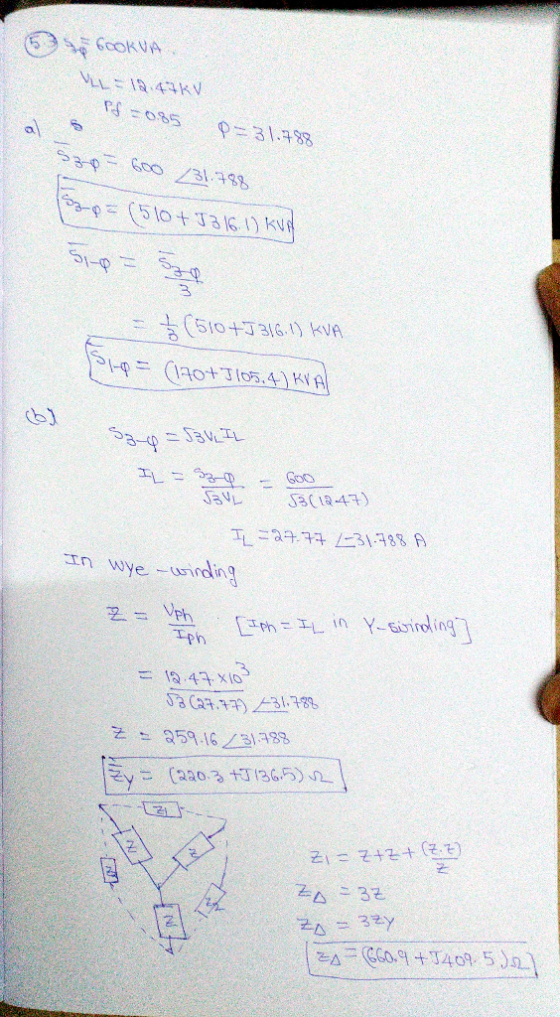
5.3. Given a 600 kVA 12.47 kV 0.85 pf lagging three-phase load: a. Compute the corresponding...
4.7. Consider a three-phase, 12.47 kV system supplying a 600 kVA load, pf 0.8 lagging. Determine...
 4.7. Consider a three-phase, 12.47 kV system supplying a 600 kVA load, pf 0.8 lagging. Determine the instantaneous power (a) per phase, and (b) in total.
3. A 12.47 kV feeder provides service to an unbalanced wye-connected load specified to be: Phase ...
 Response: Me neither :/
3. A 12.47 kV feeder provides service to an unbalanced wye-connected load specified to be: Phase a: 1000 kVA, 0.9 lagging power factor Phase b: 800 kVA, 0.95 lagging power factor Phase c: 1100 kVA, 0.85 lagging power factor a) Compute the initial load currents assuming that 60% of the load is complex power, 25% constant current, and 15% constant impedance. b) Determine the currents at the start of the second iteration if the load voltages...
Response: Me neither :/
3. A 12.47 kV feeder provides service to an unbalanced wye-connected load specified to be: Phase a: 1000 kVA, 0.9 lagging power factor Phase b: 800 kVA, 0.95 lagging power factor Phase c: 1100 kVA, 0.85 lagging power factor a) Compute the initial load currents assuming that 60% of the load is complex power, 25% constant current, and 15% constant impedance. b) Determine the currents at the start of the second iteration if the load voltages...
Three single-phase transformers rated at 250 kVA, 7200 V/600 V, 60 Hz, are connected in wye- delta on a 12.47 kv, 3-phase line. If the load is 450 kVA, calculate: a. The currents in the incoming a...
 Three single-phase transformers rated at 250 kVA, 7200 V/600 V, 60 Hz, are connected in wye- delta on a 12.47 kv, 3-phase line. If the load is 450 kVA, calculate: a. The currents in the incoming and outgoing transmission lines b. The currents in the primary and secondary windings 1. sratod t 200 w 3o0 v/6oO V 60 Hz are used to raise the
Three single-phase transformers rated at 250 kVA, 7200 V/600 V, 60 Hz, are connected in wye-...
Three single-phase transformers rated at 250 kVA, 7200 V/600 V, 60 Hz, are connected in wye- delta on a 12.47 kv, 3-phase line. If the load is 450 kVA, calculate: a. The currents in the incoming and outgoing transmission lines b. The currents in the primary and secondary windings 1. sratod t 200 w 3o0 v/6oO V 60 Hz are used to raise the
Three single-phase transformers rated at 250 kVA, 7200 V/600 V, 60 Hz, are connected in wye-...
A three-phase load of 15 kVA with a PF of 0.8 lagging is connected in parallel...
A three-phase load of 15 kVA with a PF of 0.8 lagging is connected in parallel with a three-phase load of 36 kW at 0.6 PF leading. The line-line voltage is 2000V. a) Find the total complex power and power factor. Is it inductive or capacitive? b) How much kVAR is needed to make the PF unity? c) What is the magnitude of the current going into the total load?
QUESTION 4 A three-phase Y-connected, 500 kVA, 3.2 kV, 0.85 PF-lagging, six-pole, 60 Hz synchronous generator...
 QUESTION 4 A three-phase Y-connected, 500 kVA, 3.2 kV, 0.85 PF-lagging, six-pole, 60 Hz synchronous generator has a synchronous reactance of 15 ohm and an armature resistance of 0.8 ohm. What are the electrical losses in this generator at the rated conditions? Attach File Browse My Computer Browse Content Collection QUESTION 5 If phase current of a Delta-connected three-phase system is equal to 1pu, then the line current of the same system is equal to 3 pu. Click Save and...
Problem 7 Three three-phase wye-connected loads are in parallel across a three-phase supply. The first load draws a cur...
 Problem 7 Three three-phase wye-connected loads are in parallel across a three-phase supply. The first load draws a current of 10 A at pf- 0.93 (leading), and the second and third loads (each) draw a current of 20 A at pf= 0.85 (lagging). Suppose the line-to-line voltage is 240 V. Compute the following: a) The transmission line current b) The load power factor c) The complex power supplied by the source
Problem 7 Three three-phase wye-connected loads are in parallel...
Problem 7 Three three-phase wye-connected loads are in parallel across a three-phase supply. The first load draws a current of 10 A at pf- 0.93 (leading), and the second and third loads (each) draw a current of 20 A at pf= 0.85 (lagging). Suppose the line-to-line voltage is 240 V. Compute the following: a) The transmission line current b) The load power factor c) The complex power supplied by the source
Problem 7 Three three-phase wye-connected loads are in parallel...
QUESTION 6 (MULTI-PHASE SYSTEMS) A 400 v, 50 Hz, three-phase distribution system supplies a 20 kVA, three-phase induction motor load at a power factor of 0 8 lagging, and a star-connected set of...
 QUESTION 6 (MULTI-PHASE SYSTEMS) A 400 v, 50 Hz, three-phase distribution system supplies a 20 kVA, three-phase induction motor load at a power factor of 0 8 lagging, and a star-connected set of impedances, each having a resistance of 10 Ω and an inductive reactance of 8 Ω Calculate the capacitance of delta-connected capacitors required to improve the overalil power factor to 0 95 lagging [14] TOTAL 1001
QUESTION 6 (MULTI-PHASE SYSTEMS) A 400 v, 50 Hz, three-phase distribution system...
QUESTION 6 (MULTI-PHASE SYSTEMS) A 400 v, 50 Hz, three-phase distribution system supplies a 20 kVA, three-phase induction motor load at a power factor of 0 8 lagging, and a star-connected set of impedances, each having a resistance of 10 Ω and an inductive reactance of 8 Ω Calculate the capacitance of delta-connected capacitors required to improve the overalil power factor to 0 95 lagging [14] TOTAL 1001
QUESTION 6 (MULTI-PHASE SYSTEMS) A 400 v, 50 Hz, three-phase distribution system...
A 60 Hz, balanced three-phase source is connected to a balanced load of 2815 kVA at...
 A 60 Hz, balanced three-phase source is connected to a balanced load of 2815 kVA at 0.95 pf lagging through a short transmission line with negligible resistance and a series inductive reactance of 13 12. The load is operated at 25 kV. Compute: (a) the line current magnitude (b) the line voltage magnitude at the source (c) the line-to-neutral source voltage (d) the power factor of the source
A three-phase feeder has line voltage of 13.8 kV and supplies load of 7000 kVA at...
A three-phase feeder has line voltage of 13.8 kV and supplies load of 7000 kVA at power factor of 0.8 lagging. Find: The feeder current in A, real power in kW and Reactive power in kVAr. The capacitor size in kVAr to improve the power factor to 0.98. The feeder power in kW and kVA and current in A, after installing the capacitor bank.
Problem 4 Three ideal single-phase transformers are connected in a delta/wye configuration with the primary side of the...
 Problem 4 Three ideal single-phase transformers are connected in a delta/wye configuration with the primary side of the three-phase transformer rated at 120 kV and the secondary side rated at 13.8 kV. The rated power of the transformer bank is 20 MVA. One side of the transformer bank is connected to a 120 kV transmission line, and the other side is connected to a three-phase load of 15 MVA at 0.85 lagging power factor. Compute the following: a) The turns...
 4.7. Consider a three-phase, 12.47 kV system supplying a 600 kVA load, pf 0.8 lagging. Determine the instantaneous power (a) per phase, and (b) in total.
 Response: Me neither :/
3. A 12.47 kV feeder provides service to an unbalanced wye-connected load specified to be: Phase a: 1000 kVA, 0.9 lagging power factor Phase b: 800 kVA, 0.95 lagging power factor Phase c: 1100 kVA, 0.85 lagging power factor a) Compute the initial load currents assuming that 60% of the load is complex power, 25% constant current, and 15% constant impedance. b) Determine the currents at the start of the second iteration if the load voltages...
Response: Me neither :/
3. A 12.47 kV feeder provides service to an unbalanced wye-connected load specified to be: Phase a: 1000 kVA, 0.9 lagging power factor Phase b: 800 kVA, 0.95 lagging power factor Phase c: 1100 kVA, 0.85 lagging power factor a) Compute the initial load currents assuming that 60% of the load is complex power, 25% constant current, and 15% constant impedance. b) Determine the currents at the start of the second iteration if the load voltages...
 Three single-phase transformers rated at 250 kVA, 7200 V/600 V, 60 Hz, are connected in wye- delta on a 12.47 kv, 3-phase line. If the load is 450 kVA, calculate: a. The currents in the incoming and outgoing transmission lines b. The currents in the primary and secondary windings 1. sratod t 200 w 3o0 v/6oO V 60 Hz are used to raise the
Three single-phase transformers rated at 250 kVA, 7200 V/600 V, 60 Hz, are connected in wye-...
Three single-phase transformers rated at 250 kVA, 7200 V/600 V, 60 Hz, are connected in wye- delta on a 12.47 kv, 3-phase line. If the load is 450 kVA, calculate: a. The currents in the incoming and outgoing transmission lines b. The currents in the primary and secondary windings 1. sratod t 200 w 3o0 v/6oO V 60 Hz are used to raise the
Three single-phase transformers rated at 250 kVA, 7200 V/600 V, 60 Hz, are connected in wye-...
 QUESTION 4 A three-phase Y-connected, 500 kVA, 3.2 kV, 0.85 PF-lagging, six-pole, 60 Hz synchronous generator has a synchronous reactance of 15 ohm and an armature resistance of 0.8 ohm. What are the electrical losses in this generator at the rated conditions? Attach File Browse My Computer Browse Content Collection QUESTION 5 If phase current of a Delta-connected three-phase system is equal to 1pu, then the line current of the same system is equal to 3 pu. Click Save and...
 Problem 7 Three three-phase wye-connected loads are in parallel across a three-phase supply. The first load draws a current of 10 A at pf- 0.93 (leading), and the second and third loads (each) draw a current of 20 A at pf= 0.85 (lagging). Suppose the line-to-line voltage is 240 V. Compute the following: a) The transmission line current b) The load power factor c) The complex power supplied by the source
Problem 7 Three three-phase wye-connected loads are in parallel...
Problem 7 Three three-phase wye-connected loads are in parallel across a three-phase supply. The first load draws a current of 10 A at pf- 0.93 (leading), and the second and third loads (each) draw a current of 20 A at pf= 0.85 (lagging). Suppose the line-to-line voltage is 240 V. Compute the following: a) The transmission line current b) The load power factor c) The complex power supplied by the source
Problem 7 Three three-phase wye-connected loads are in parallel...
 QUESTION 6 (MULTI-PHASE SYSTEMS) A 400 v, 50 Hz, three-phase distribution system supplies a 20 kVA, three-phase induction motor load at a power factor of 0 8 lagging, and a star-connected set of impedances, each having a resistance of 10 Ω and an inductive reactance of 8 Ω Calculate the capacitance of delta-connected capacitors required to improve the overalil power factor to 0 95 lagging [14] TOTAL 1001
QUESTION 6 (MULTI-PHASE SYSTEMS) A 400 v, 50 Hz, three-phase distribution system...
QUESTION 6 (MULTI-PHASE SYSTEMS) A 400 v, 50 Hz, three-phase distribution system supplies a 20 kVA, three-phase induction motor load at a power factor of 0 8 lagging, and a star-connected set of impedances, each having a resistance of 10 Ω and an inductive reactance of 8 Ω Calculate the capacitance of delta-connected capacitors required to improve the overalil power factor to 0 95 lagging [14] TOTAL 1001
QUESTION 6 (MULTI-PHASE SYSTEMS) A 400 v, 50 Hz, three-phase distribution system...
 A 60 Hz, balanced three-phase source is connected to a balanced load of 2815 kVA at 0.95 pf lagging through a short transmission line with negligible resistance and a series inductive reactance of 13 12. The load is operated at 25 kV. Compute: (a) the line current magnitude (b) the line voltage magnitude at the source (c) the line-to-neutral source voltage (d) the power factor of the source
 Problem 4 Three ideal single-phase transformers are connected in a delta/wye configuration with the primary side of the three-phase transformer rated at 120 kV and the secondary side rated at 13.8 kV. The rated power of the transformer bank is 20 MVA. One side of the transformer bank is connected to a 120 kV transmission line, and the other side is connected to a three-phase load of 15 MVA at 0.85 lagging power factor. Compute the following: a) The turns...
Most questions answered within 3 hours.
-
Where is the error in this code sequence?
String s1 = "Hello";
String s2 = "ello";...
asked 10 months ago -
Financial data for Joel de Paris, Inc., for last year
follow:
Joel de Paris, Inc.
Balance...
asked 10 months ago -
Consider this reaction:
Al2(SO4)3 (aq)+ BaCl3
(aq) Al2Cl6 (aq)- +
3BaSO4(s) . What is the...
asked 10 months ago -
Suppose that Savneet is considering increasing her
recent random sample from 20 car rentals to 40...
asked 10 months ago -
Trucks arrive at an unloading terminal at an average rate of 120
per hour.
Trucks arrive...
asked 10 months ago -
Why are methanol and ethanol completely soluble in water while
octanol is not very little soluble....
asked 10 months ago -
A facilities manager at a university reads in a research report
that the mean amount of...
asked 10 months ago -
When the CuSO4 is rehydrated by adding water to the anhydrous
compound, is this an endothermic...
asked 10 months ago -
A ray of sunlight is passing from diamond into crown glass; the
angle of incidence is...
asked 10 months ago -
A block of mass 0.249 kg is placed on top of a light, vertical
spring of...
asked 10 months ago -
how do the kidneys compensate in the presences of acidosis
a) trigger hyperventilate
b) reserve acid...
asked 10 months ago -
Question 501 pts
The rental rate of capital to the firm increases. Which of the
following...
asked 10 months ago