The following Implementation of the Fibonacci function is a correct, but inefficient,
def fibonacci(n):
if n <= 2:
return 1
else:
return fib(n - 1) + fib(n - 2)
In more details, the code shown runs very slowly for even relatively small values of n; it can take minutes or hours to compute even the 40th or 50th Fibonacci number. The code is inefficient because it makes too many recursive calls. It ends up recomputing each Fibonacci number many times. Which of the below recursive modification/s is/are more efficient compared to the aforementioned function.

|
|||
|
|||
|
|||
|
Homework Answers
a) A only is more efficient to compute the large Fibonacci number
because, in option B it needs more space i.e for nth fibonacci numbers it needs n space in dictionary.
also in option B there is two recursive function calls and in option A there is one recursive function calls.
Add Answer to:
The following
Implementation of the Fibonacci function is a
correct, but inefficient,
def fibonacci(n):
if n...
Programming Exercise 11.6 Х + | Instructions fib.py >_ Terminal + iit B 1 def fib(n):...
 Programming Exercise 11.6 Х + | Instructions fib.py >_ Terminal + iit B 1 def fib(n): 2 "*"Returns the nth Fibonacci number. " 3 if n < 3: lil 4 return 1 Modify the recursive Fibonacci function to employ the memoization technique discussed in this chapter. The function creates a dictionary and then defines a nested recursive helper function named memoizedFib You will need to create a dictionary to cache the sum of the fib function. The base case of...
Below you will find a recursive function that computes a Fibonacci sequence (Links to an external...
Below you will find a recursive function that computes a Fibonacci sequence (Links to an external site.). # Python program to display the Fibonacci sequence up to n-th term using recursive functions def recur_fibo(n): """Recursive function to print Fibonacci sequence""" if n <= 1: return n else: return(recur_fibo(n-1) + recur_fibo(n-2)) # Change this value for a different result nterms = 10 # uncomment to take input from the user #nterms = int(input("How many terms? ")) # check if the number...
The following is a correct implementation of a non-recursive method to find the nth Fibonacci number...
The following is a correct implementation of a non-recursive method to find the nth Fibonacci number in Java: public static long fib(int n){ long[ ] fibNums = new long[n + 1]; fibNums[0] = 0; finNums[1] = 1; for(int i = 2; i <= n; i++){ fibNums[i] = fibNums [i - 1] + finBums[i - 2]; } return fibNums[n]; } I am having trouble understanding the code. Why the creation of the long array make this...
For the following recursive implementation of a method to compute the Fibonacci S integer n, circle...
 For the following recursive implementation of a method to compute the Fibonacci S integer n, circle the line number(s) the them: s) that comprise the three parts of a recursive algorithm and label 1. public static long fibonacci(int n) ( 2 if( 1) 3. return 1; 4. else if (n 2) S. return; 6. else 7. (long fibNminus1 fibonacci(n - 1); 8. long fibNminus2- fibonacci(n -2); 9. long fibN fibNminusl + fibNminus2; 10. return fibN; 12.)
1.Take this recursive Fibonacci implementation and convert it into the caching based version discussed in class....
1.Take this recursive Fibonacci implementation and convert it into the caching based version discussed in class. Implement your caching to store a maximum of 5 values. Create 2 variations: one that stores all values and one that only stores even values. Make sure that you don't leave any gaps in your cache — if you have 5 cache entries you must cache 5 unique and valid values. Compare the caching implementations to the recursive implementation using the time utility. How...
Read the following code, threaded recursive calculation of Fibonacci number of n: #include <stdio.h> #include <stdlib.h>...
Read the following code, threaded recursive calculation of Fibonacci number of n: #include <stdio.h> #include <stdlib.h> #include <pthread.h> void *fib(void *arg); int main(int argc, char **argv){ int n = atoi(argv[1]); printf("%d\n", (int)fib(n)); } void *fib(void *arg){ int n; pthread_t thread1; pthread_t thread2; void *a; void *b; int c; n = (int)arg; if (n <= 0) return 0; if (n == 1) return 1; pthread_create(&thread1, NULL, fib, n-1); ...
Using java programming. Question 1. Write a recursive function fibo(n) that returns the nth Fibonacci number...
Using java programming. Question 1. Write a recursive function fibo(n) that returns the nth Fibonacci number which is defined as follows: fibo(0) = 0 fibo(1) = 1 fibo(n) = fibo(n-1) + fibo(n-2) for n >= 2 Question 2. Write a recursive function that calculates the sum of quintics: 1power of5 + 2power of5 + 3power of5 + … + n5 Question 3. Write a program to find a route from one given position to another given position for the knight...
Please help with this coding problem, and use the ARM sim# to test run your code....
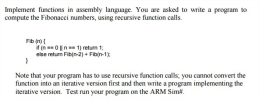 Please help with this coding problem, and use the ARM sim# to
test run your code.
Implement functions in assembly language. You are asked to write a program to compute the Fibonacci numbers, using recursive function calls. Fib(n){if (n == 0 || n == 1) return 1; else return Fib(n-2) + Fib(n-1);}
Please help with this coding problem, and use the ARM sim# to
test run your code.
Implement functions in assembly language. You are asked to write a program to compute the Fibonacci numbers, using recursive function calls. Fib(n){if (n == 0 || n == 1) return 1; else return Fib(n-2) + Fib(n-1);}
This java code won't run and I can't figure out the problem with it. Please help...
This java code won't run and I can't figure out the problem with it. Please help import java.io.*; import java.util.*; import java.math.*; import java.util.Scanner; public class Fibonacci { // Returns n-th Fibonacci number static BigInteger fib(int n) { BigInteger[] Fibo = new BigInteger[n+2]; Fibo[0] = BigInteger.ZERO; Fibo[1] = BigInteger.ONE; for (int j=2 ; j<=n ; j++) { Fibo[j] = Fibo[j-1].add(Fibo[j-2]); } return (Fibo[n]); }...
Extra Credit - Fibonacci Function (Lec. 5 topic: Recursive function and runtime stack. Use recursion to...
 Extra Credit - Fibonacci Function (Lec. 5 topic: Recursive function and runtime stack. Use recursion to calculate the Fibonacci Function 1.) Use a recursive function called fib() to calculate the Fibonacci Function for the following values for the variable n. int n = 10; int n = 20; int n = 30; int n = 40; int n = 45; int n = 46; 2.) In addition to calculating and displaying the results, use a "timer" to see how long...
 Programming Exercise 11.6 Х + | Instructions fib.py >_ Terminal + iit B 1 def fib(n): 2 "*"Returns the nth Fibonacci number. " 3 if n < 3: lil 4 return 1 Modify the recursive Fibonacci function to employ the memoization technique discussed in this chapter. The function creates a dictionary and then defines a nested recursive helper function named memoizedFib You will need to create a dictionary to cache the sum of the fib function. The base case of...
 For the following recursive implementation of a method to compute the Fibonacci S integer n, circle the line number(s) the them: s) that comprise the three parts of a recursive algorithm and label 1. public static long fibonacci(int n) ( 2 if( 1) 3. return 1; 4. else if (n 2) S. return; 6. else 7. (long fibNminus1 fibonacci(n - 1); 8. long fibNminus2- fibonacci(n -2); 9. long fibN fibNminusl + fibNminus2; 10. return fibN; 12.)
 Please help with this coding problem, and use the ARM sim# to
test run your code.
Implement functions in assembly language. You are asked to write a program to compute the Fibonacci numbers, using recursive function calls. Fib(n){if (n == 0 || n == 1) return 1; else return Fib(n-2) + Fib(n-1);}
Please help with this coding problem, and use the ARM sim# to
test run your code.
Implement functions in assembly language. You are asked to write a program to compute the Fibonacci numbers, using recursive function calls. Fib(n){if (n == 0 || n == 1) return 1; else return Fib(n-2) + Fib(n-1);}
 Extra Credit - Fibonacci Function (Lec. 5 topic: Recursive function and runtime stack. Use recursion to calculate the Fibonacci Function 1.) Use a recursive function called fib() to calculate the Fibonacci Function for the following values for the variable n. int n = 10; int n = 20; int n = 30; int n = 40; int n = 45; int n = 46; 2.) In addition to calculating and displaying the results, use a "timer" to see how long...
Most questions answered within 3 hours.
-
Where is the error in this code sequence?
String s1 = "Hello";
String s2 = "ello";...
asked 10 months ago -
Financial data for Joel de Paris, Inc., for last year
follow:
Joel de Paris, Inc.
Balance...
asked 10 months ago -
Consider this reaction:
Al2(SO4)3 (aq)+ BaCl3
(aq) Al2Cl6 (aq)- +
3BaSO4(s) . What is the...
asked 10 months ago -
Suppose that Savneet is considering increasing her
recent random sample from 20 car rentals to 40...
asked 10 months ago -
Trucks arrive at an unloading terminal at an average rate of 120
per hour.
Trucks arrive...
asked 10 months ago -
Why are methanol and ethanol completely soluble in water while
octanol is not very little soluble....
asked 10 months ago -
A facilities manager at a university reads in a research report
that the mean amount of...
asked 10 months ago -
When the CuSO4 is rehydrated by adding water to the anhydrous
compound, is this an endothermic...
asked 10 months ago -
A ray of sunlight is passing from diamond into crown glass; the
angle of incidence is...
asked 10 months ago -
A block of mass 0.249 kg is placed on top of a light, vertical
spring of...
asked 10 months ago -
how do the kidneys compensate in the presences of acidosis
a) trigger hyperventilate
b) reserve acid...
asked 10 months ago -
Question 501 pts
The rental rate of capital to the firm increases. Which of the
following...
asked 10 months ago