
Homework Answers
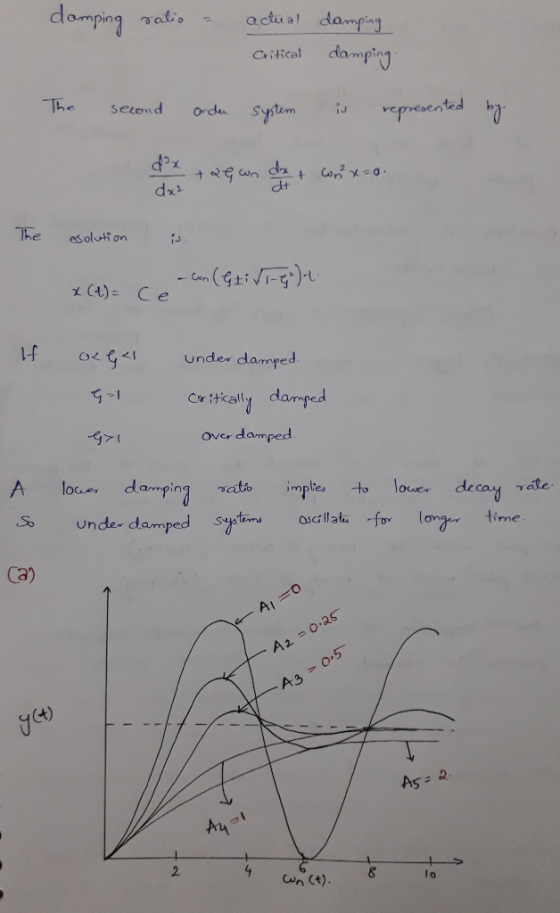
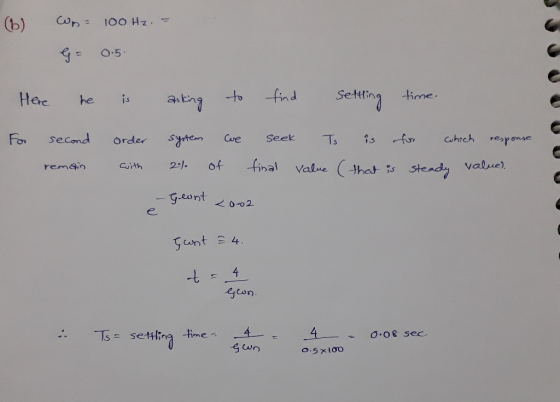
In the b part he asked to find the time to reach steady state roughly which it's equal to settling time with 2% tolerance of final value.
If you have any doubt please ask in comments.
Please give positive feedback ?thanks in advance.
Add Answer to:
1. Figure 1 plots a two-order system frequency response at five different damping ratios. The damping...
The unit step response of a second order system is 2- The unit step response of a second order system is Ste Consider the following statements: i) The under damped natural frequency is ii) The da...
 The unit step response of a second order system is
2- The unit step response of a second order system is Ste Consider the following statements: i) The under damped natural frequency is ii) The damping ratio is iii) The impulse response is
2- The unit step response of a second order system is Ste Consider the following statements: i) The under damped natural frequency is ii) The damping ratio is iii) The impulse response is
The unit step response of a second order system is
2- The unit step response of a second order system is Ste Consider the following statements: i) The under damped natural frequency is ii) The damping ratio is iii) The impulse response is
2- The unit step response of a second order system is Ste Consider the following statements: i) The under damped natural frequency is ii) The damping ratio is iii) The impulse response is
Ex: Determine the frequency response of a pressure transducer that has a damping ratio of 0.5 and a ringing frequency of 1200 Hz. The frequency response of a measurement system is determined by...
 Ex: Determine the frequency response of a pressure transducer that has a damping ratio of 0.5 and a ringing frequency of 1200 Hz. The frequency response of a measurement system is determined by M(o) and φ(a) as defined in Equations(30) and (31). Since ω.-conv 1-7 , the natural frequency of the pressure transducer is found to be on-8706 rad/s. The frequency response at selected frequencies is computed from Equations 30 and 31 as follows [1-(w/m)212+/240/m)2 M(o) 1.00 1.04 1.07 1.15...
A 2nd order dynamic system has a damping ratio, ζ = 0.5 andnatural frequency, ωn...
 A 2nd order dynamic system has a damping ratio, ζ = 0.5 and
natural frequency, ωn = 8 rad/s. The transfer
gain is K = 2. There are no zeros of the system. If the
general response to an impulse input has the form:h(t) =e(–ωnζt)[Asin(ωdt)
+ Bcos(ωdt)]; whereωd is the damped frequency. Find damped natural
frequency (ωd), value of constants A and B. Hint: To find A and B, find h(t) using “Transfer Function Property” and
compare it with the given expression...
A 2nd order dynamic system has a damping ratio, ζ = 0.5 and
natural frequency, ωn = 8 rad/s. The transfer
gain is K = 2. There are no zeros of the system. If the
general response to an impulse input has the form:h(t) =e(–ωnζt)[Asin(ωdt)
+ Bcos(ωdt)]; whereωd is the damped frequency. Find damped natural
frequency (ωd), value of constants A and B. Hint: To find A and B, find h(t) using “Transfer Function Property” and
compare it with the given expression...
4.62. Consider the following two-degree-of-freedom system and compute the response assuming modal damping ratios of (1...
 4.62. Consider the following two-degree-of-freedom system and compute the response assuming modal damping ratios of (1 = 0.05 and 12 = 0.01 :
1: The plot shown below represents the step response of a second-order LTI system (with input...
 1: The plot shown below represents the step response of a second-order LTI system (with input (t) and output y(t)) with zero initial conditions. From the step response: (a) Estimate the peak time tp, and the maximum percentage overshoot %Mp. (b) Estimate the natural frequency wn and the damping ratio c. (c) Derive a differential equation corresponding to this system using the results of parts (a) and (b). Step Response X: 085 Y: 1.261 Amplitude 0 0.5 1 1.5 2...
Question 1 The natural frequency of the original system shown in Figure la is 12 rad/s....
 Question 1 The natural frequency of the original system shown in Figure la is 12 rad/s. In order to improve its transient response, a tachometer is to be added into the original system to yield damping ratio of 0.65. a) Calculate K and K2. b) Use Simulink to model the system (Unit-step input). c) Plot system responses (before and after adding the tachometer) and discuss how the system response is improved after adding the tachometer. Ris) + Preamplifier s(s+1) Power...
Question three The figure below shows a unit step response of a second order system. From...
 Question three The figure below shows a unit step response of a second order system. From the graph of response find: 1- The rise timet, 2- The peak timet, 3- The maximum overshoot Mp 4- The damped natural frequency w 5. The transfer function. Hence find the damping ratio ζ and the natural frequency ah-Find also the transfer function of the system. r 4 02 15 25 35 45 Question Four For the control system shown in the figure below,...
1) Linearity: In order for a system to be linear it must satisfy the following equation: In other...
 need solution and code for this signal and system
problem
1) Linearity: In order for a system to be linear it must satisfy the following equation: In other words, the response of a linear system to an input that is a linear combination of two signals is the linear combination of the responses of the system to each one of these signals. Let xi)- u(t) -u(t-1) and x2t) u- u(t-2) be input signals to the systems described by the i/o...
need solution and code for this signal and system
problem
1) Linearity: In order for a system to be linear it must satisfy the following equation: In other words, the response of a linear system to an input that is a linear combination of two signals is the linear combination of the responses of the system to each one of these signals. Let xi)- u(t) -u(t-1) and x2t) u- u(t-2) be input signals to the systems described by the i/o...
2a. Determine a proper controller so that the feedback control system below will have the damping...
 2a. Determine a proper controller so that the feedback control system below will have the damping ratio of < = 0.7 and the natural frequency of n = 10.0 rad/sec. Your choices are: Proportional controller, K Lead controller, 17, a < 1 Lag controller, v a > 1 Proportional + Derivative controller, K (1 + Tas) Proportional + Integral + Derivative controller, K(1+1/(Ts) + Tas) Or Lead Lag controller If the resulting feedback control system has an order greater than...
10. Write a one-page summary of the attached paper? INTRODUCTION Many problems can develop in activated...
10. Write a one-page summary of the attached paper? INTRODUCTION Many problems can develop in activated sludge operation that adversely affect effluent quality with origins in the engineering, hydraulic and microbiological components of the process. The real "heart" of the activated sludge system is the development and maintenance of a mixed microbial culture (activated sludge) that treats wastewater and which can be managed. One definition of a wastewater treatment plant operator is a "bug farmer", one who controls the aeration...
 The unit step response of a second order system is
2- The unit step response of a second order system is Ste Consider the following statements: i) The under damped natural frequency is ii) The damping ratio is iii) The impulse response is
2- The unit step response of a second order system is Ste Consider the following statements: i) The under damped natural frequency is ii) The damping ratio is iii) The impulse response is
The unit step response of a second order system is
2- The unit step response of a second order system is Ste Consider the following statements: i) The under damped natural frequency is ii) The damping ratio is iii) The impulse response is
2- The unit step response of a second order system is Ste Consider the following statements: i) The under damped natural frequency is ii) The damping ratio is iii) The impulse response is
 Ex: Determine the frequency response of a pressure transducer that has a damping ratio of 0.5 and a ringing frequency of 1200 Hz. The frequency response of a measurement system is determined by M(o) and φ(a) as defined in Equations(30) and (31). Since ω.-conv 1-7 , the natural frequency of the pressure transducer is found to be on-8706 rad/s. The frequency response at selected frequencies is computed from Equations 30 and 31 as follows [1-(w/m)212+/240/m)2 M(o) 1.00 1.04 1.07 1.15...
 A 2nd order dynamic system has a damping ratio, ζ = 0.5 and
natural frequency, ωn = 8 rad/s. The transfer
gain is K = 2. There are no zeros of the system. If the
general response to an impulse input has the form:h(t) =e(–ωnζt)[Asin(ωdt)
+ Bcos(ωdt)]; whereωd is the damped frequency. Find damped natural
frequency (ωd), value of constants A and B. Hint: To find A and B, find h(t) using “Transfer Function Property” and
compare it with the given expression...
A 2nd order dynamic system has a damping ratio, ζ = 0.5 and
natural frequency, ωn = 8 rad/s. The transfer
gain is K = 2. There are no zeros of the system. If the
general response to an impulse input has the form:h(t) =e(–ωnζt)[Asin(ωdt)
+ Bcos(ωdt)]; whereωd is the damped frequency. Find damped natural
frequency (ωd), value of constants A and B. Hint: To find A and B, find h(t) using “Transfer Function Property” and
compare it with the given expression...
 4.62. Consider the following two-degree-of-freedom system and compute the response assuming modal damping ratios of (1 = 0.05 and 12 = 0.01 :
 1: The plot shown below represents the step response of a second-order LTI system (with input (t) and output y(t)) with zero initial conditions. From the step response: (a) Estimate the peak time tp, and the maximum percentage overshoot %Mp. (b) Estimate the natural frequency wn and the damping ratio c. (c) Derive a differential equation corresponding to this system using the results of parts (a) and (b). Step Response X: 085 Y: 1.261 Amplitude 0 0.5 1 1.5 2...
 Question 1 The natural frequency of the original system shown in Figure la is 12 rad/s. In order to improve its transient response, a tachometer is to be added into the original system to yield damping ratio of 0.65. a) Calculate K and K2. b) Use Simulink to model the system (Unit-step input). c) Plot system responses (before and after adding the tachometer) and discuss how the system response is improved after adding the tachometer. Ris) + Preamplifier s(s+1) Power...
 Question three The figure below shows a unit step response of a second order system. From the graph of response find: 1- The rise timet, 2- The peak timet, 3- The maximum overshoot Mp 4- The damped natural frequency w 5. The transfer function. Hence find the damping ratio ζ and the natural frequency ah-Find also the transfer function of the system. r 4 02 15 25 35 45 Question Four For the control system shown in the figure below,...
 need solution and code for this signal and system
problem
1) Linearity: In order for a system to be linear it must satisfy the following equation: In other words, the response of a linear system to an input that is a linear combination of two signals is the linear combination of the responses of the system to each one of these signals. Let xi)- u(t) -u(t-1) and x2t) u- u(t-2) be input signals to the systems described by the i/o...
need solution and code for this signal and system
problem
1) Linearity: In order for a system to be linear it must satisfy the following equation: In other words, the response of a linear system to an input that is a linear combination of two signals is the linear combination of the responses of the system to each one of these signals. Let xi)- u(t) -u(t-1) and x2t) u- u(t-2) be input signals to the systems described by the i/o...
 2a. Determine a proper controller so that the feedback control system below will have the damping ratio of < = 0.7 and the natural frequency of n = 10.0 rad/sec. Your choices are: Proportional controller, K Lead controller, 17, a < 1 Lag controller, v a > 1 Proportional + Derivative controller, K (1 + Tas) Proportional + Integral + Derivative controller, K(1+1/(Ts) + Tas) Or Lead Lag controller If the resulting feedback control system has an order greater than...
Most questions answered within 3 hours.
-
Where is the error in this code sequence?
String s1 = "Hello";
String s2 = "ello";...
asked 10 months ago -
Financial data for Joel de Paris, Inc., for last year
follow:
Joel de Paris, Inc.
Balance...
asked 10 months ago -
Consider this reaction:
Al2(SO4)3 (aq)+ BaCl3
(aq) Al2Cl6 (aq)- +
3BaSO4(s) . What is the...
asked 10 months ago -
Suppose that Savneet is considering increasing her
recent random sample from 20 car rentals to 40...
asked 10 months ago -
Trucks arrive at an unloading terminal at an average rate of 120
per hour.
Trucks arrive...
asked 10 months ago -
Why are methanol and ethanol completely soluble in water while
octanol is not very little soluble....
asked 10 months ago -
A facilities manager at a university reads in a research report
that the mean amount of...
asked 10 months ago -
When the CuSO4 is rehydrated by adding water to the anhydrous
compound, is this an endothermic...
asked 10 months ago -
A ray of sunlight is passing from diamond into crown glass; the
angle of incidence is...
asked 10 months ago -
A block of mass 0.249 kg is placed on top of a light, vertical
spring of...
asked 10 months ago -
how do the kidneys compensate in the presences of acidosis
a) trigger hyperventilate
b) reserve acid...
asked 10 months ago -
Question 501 pts
The rental rate of capital to the firm increases. Which of the
following...
asked 10 months ago