
Homework Answers
x = xm cos(ωt + φ)
At t = 0,
-xs/3 = xs cos(w + φ)
-1/3 = cos(φ)
Phase constant, φ = arccos(-1/3) = 1.91 rad
Comment in case any doubt please rate my answer....
Add Answer to:
What is the phase constant (from 0 to 27 rad) for the harmonic oscillator with the...
Phase Constant from Graphs Due in 7 hours, 16 minutes v (cm/s) The figure a) is a partial graph o...
 Phase Constant from Graphs Due in 7 hours, 16 minutes v (cm/s) The figure a) is a partial graph of the position function for a simple harmonic oscillator with an angular frequency of 1.7 rad/s and b) is a partial graph of the corresponding velocity function v(t). The vertical axis scales are set by xs 10 m and vs10 m/s. What is tan of the phase constant of the SHM if the position function is in the standard general cos...
ゆCourse Contents » * Omer □Notes é Evaluat Phase Constant from Graphs Due this Friday, Nov...
 ゆCourse Contents » * Omer □Notes é Evaluat Phase Constant from Graphs Due this Friday, Nov 30 at 11:59 pm (EST feedback Print ⓝIr v (cm/s) The figure a) is a partial graph of the position function for a simple harmonic oscillator with an angular frequency of 1.4 rad/s and b) is a partial graph of the corresponding velocity function v(t). The vertical are set by xs 20 m and vs - 20 m/s. What is tan of the phase...
What is the phase constant for SMH with a(t) given in the figure if the position...
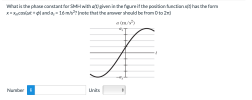 What is the phase constant for SMH with a(t) given in the figure if the position function x(t) has the form x = Xmcos(wt+Q) and as = 16 m/s2? (note that the answer should be from 0 to 2nt) a (m/s) as Number Units
answer is C why ? 2. The harmonic oscillator in the figure has a position function...
 answer is C why ?
2. The harmonic oscillator in the figure has a position function x(t) A cos(at + φ), where A = 6 cm, what is the phase constant φ? A) 70.5o or 70.5° B) 109.5° or 199.5° C) 109.5° D) 199.5° E) none of the above x (cm)
answer is C why ?
2. The harmonic oscillator in the figure has a position function x(t) A cos(at + φ), where A = 6 cm, what is the phase constant φ? A) 70.5o or 70.5° B) 109.5° or 199.5° C) 109.5° D) 199.5° E) none of the above x (cm)
A simple harmonic oscillator at the position x=0 generates a wave on a string. The oscillator...
 A simple harmonic oscillator at the position x=0 generates a
wave on a string. The oscillator moves up and down at a frequency
of 40.0 Hz and with an amplitude of 3.00 cm. At time t =
0, the oscillator is passing through the origin and moving down.
The string has a linear mass density of 50.0 g/m and is stretched
with a tension of 5.00 N.
A simple harmonic oscillator at the position x = 0 generates a wave...
A simple harmonic oscillator at the position x=0 generates a
wave on a string. The oscillator moves up and down at a frequency
of 40.0 Hz and with an amplitude of 3.00 cm. At time t =
0, the oscillator is passing through the origin and moving down.
The string has a linear mass density of 50.0 g/m and is stretched
with a tension of 5.00 N.
A simple harmonic oscillator at the position x = 0 generates a wave...
A simple harmonic oscillator of mass 0.400 kg oscillates with frequency 1.50 Hz. At t0, the...
 A simple harmonic oscillator of mass 0.400 kg oscillates with frequency 1.50 Hz. At t0, the oscillator is at position x 4.00 cm and is moving right with speed 42.0 cm/s a) Find the amplitude and phase constant for the oscillator. b) Write the equation for displacement of the oscillator (with numbers) c) Find the position, velocity, and acceleration at t 3.00 s. di Find the first tw o times the oscillation has position x -2 .75 cm.
The most general wave function of a particle in the simple harmonic oscillator potential is: V(x,...
 The most general wave function of a particle in the simple harmonic oscillator potential is: V(x, t) = (x)e-1st/ where and E, are the harmonic oscillator's stationary states and their corresponding energies. (a) Show that the expectation value of position is (hint: use the results of Problem 4): (v) = A cos (wt - ) where the real constants A and o are given by: 1 2 Ae-id-1 " Entichtin Interpret this result, comparing it with the motion of a...
Problem 42P: Chapter: CH9 - Problem: 42P At time t = 0, a forced harmonic oscillator...
 Problem 42P: Chapter: CH9 - Problem: 42P At time t = 0, a forced harmonic oscillator occupies position (0) = 0.1 mand has a velocity x(0) 0. The mass of the oscillator is m = 10 kg, and the stiffness of the spring is k-1000 N/m. Calculate the motion of the system if the forcing function is AO - FO sin wor, with F0 - 10 N and wo - 200 rad/s. An off-highway truck drives onto a concrete deck...
This scenario is for questions 1-2. A simple harmonic oscillator at the position x = 0...
 This scenario is for questions 1-2. A simple harmonic oscillator at the position x = 0 generates a wave on a string. The oscillator moves up and down at a frequency of 40.0 Hz and with an amplitude of 3.00 cm. At time t = 0, the oscillator is passing through the origin and moving down. The string has a linear mass density of 50.0 g/m and is stretched with a tension of 5.00 N. a) Find the angular frequency...
 Phase Constant from Graphs Due in 7 hours, 16 minutes v (cm/s) The figure a) is a partial graph of the position function for a simple harmonic oscillator with an angular frequency of 1.7 rad/s and b) is a partial graph of the corresponding velocity function v(t). The vertical axis scales are set by xs 10 m and vs10 m/s. What is tan of the phase constant of the SHM if the position function is in the standard general cos...
 ゆCourse Contents » * Omer □Notes é Evaluat Phase Constant from Graphs Due this Friday, Nov 30 at 11:59 pm (EST feedback Print ⓝIr v (cm/s) The figure a) is a partial graph of the position function for a simple harmonic oscillator with an angular frequency of 1.4 rad/s and b) is a partial graph of the corresponding velocity function v(t). The vertical are set by xs 20 m and vs - 20 m/s. What is tan of the phase...
 What is the phase constant for SMH with a(t) given in the figure if the position function x(t) has the form x = Xmcos(wt+Q) and as = 16 m/s2? (note that the answer should be from 0 to 2nt) a (m/s) as Number Units
 answer is C why ?
2. The harmonic oscillator in the figure has a position function x(t) A cos(at + φ), where A = 6 cm, what is the phase constant φ? A) 70.5o or 70.5° B) 109.5° or 199.5° C) 109.5° D) 199.5° E) none of the above x (cm)
answer is C why ?
2. The harmonic oscillator in the figure has a position function x(t) A cos(at + φ), where A = 6 cm, what is the phase constant φ? A) 70.5o or 70.5° B) 109.5° or 199.5° C) 109.5° D) 199.5° E) none of the above x (cm)
 A simple harmonic oscillator at the position x=0 generates a
wave on a string. The oscillator moves up and down at a frequency
of 40.0 Hz and with an amplitude of 3.00 cm. At time t =
0, the oscillator is passing through the origin and moving down.
The string has a linear mass density of 50.0 g/m and is stretched
with a tension of 5.00 N.
A simple harmonic oscillator at the position x = 0 generates a wave...
A simple harmonic oscillator at the position x=0 generates a
wave on a string. The oscillator moves up and down at a frequency
of 40.0 Hz and with an amplitude of 3.00 cm. At time t =
0, the oscillator is passing through the origin and moving down.
The string has a linear mass density of 50.0 g/m and is stretched
with a tension of 5.00 N.
A simple harmonic oscillator at the position x = 0 generates a wave...
 A simple harmonic oscillator of mass 0.400 kg oscillates with frequency 1.50 Hz. At t0, the oscillator is at position x 4.00 cm and is moving right with speed 42.0 cm/s a) Find the amplitude and phase constant for the oscillator. b) Write the equation for displacement of the oscillator (with numbers) c) Find the position, velocity, and acceleration at t 3.00 s. di Find the first tw o times the oscillation has position x -2 .75 cm.
 The most general wave function of a particle in the simple harmonic oscillator potential is: V(x, t) = (x)e-1st/ where and E, are the harmonic oscillator's stationary states and their corresponding energies. (a) Show that the expectation value of position is (hint: use the results of Problem 4): (v) = A cos (wt - ) where the real constants A and o are given by: 1 2 Ae-id-1 " Entichtin Interpret this result, comparing it with the motion of a...
 Problem 42P: Chapter: CH9 - Problem: 42P At time t = 0, a forced harmonic oscillator occupies position (0) = 0.1 mand has a velocity x(0) 0. The mass of the oscillator is m = 10 kg, and the stiffness of the spring is k-1000 N/m. Calculate the motion of the system if the forcing function is AO - FO sin wor, with F0 - 10 N and wo - 200 rad/s. An off-highway truck drives onto a concrete deck...
 This scenario is for questions 1-2. A simple harmonic oscillator at the position x = 0 generates a wave on a string. The oscillator moves up and down at a frequency of 40.0 Hz and with an amplitude of 3.00 cm. At time t = 0, the oscillator is passing through the origin and moving down. The string has a linear mass density of 50.0 g/m and is stretched with a tension of 5.00 N. a) Find the angular frequency...
Most questions answered within 3 hours.
-
Where is the error in this code sequence?
String s1 = "Hello";
String s2 = "ello";...
asked 10 months ago -
Financial data for Joel de Paris, Inc., for last year
follow:
Joel de Paris, Inc.
Balance...
asked 10 months ago -
Consider this reaction:
Al2(SO4)3 (aq)+ BaCl3
(aq) Al2Cl6 (aq)- +
3BaSO4(s) . What is the...
asked 10 months ago -
Suppose that Savneet is considering increasing her
recent random sample from 20 car rentals to 40...
asked 10 months ago -
Trucks arrive at an unloading terminal at an average rate of 120
per hour.
Trucks arrive...
asked 10 months ago -
Why are methanol and ethanol completely soluble in water while
octanol is not very little soluble....
asked 10 months ago -
A facilities manager at a university reads in a research report
that the mean amount of...
asked 10 months ago -
When the CuSO4 is rehydrated by adding water to the anhydrous
compound, is this an endothermic...
asked 10 months ago -
A ray of sunlight is passing from diamond into crown glass; the
angle of incidence is...
asked 10 months ago -
A block of mass 0.249 kg is placed on top of a light, vertical
spring of...
asked 10 months ago -
how do the kidneys compensate in the presences of acidosis
a) trigger hyperventilate
b) reserve acid...
asked 10 months ago -
Question 501 pts
The rental rate of capital to the firm increases. Which of the
following...
asked 10 months ago