
Homework Answers



Add Answer to:
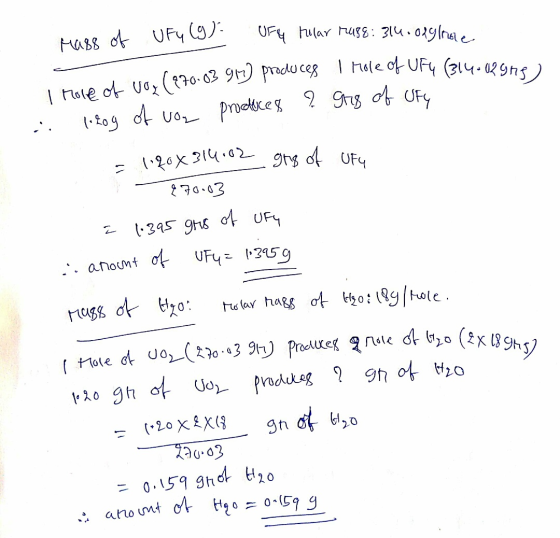
For each of the following unbalanced chemical equations, suppose 1.20 g of each reactant is taken....
For each of the following unbalanced reactions, suppose exactly 1.48 g of each reactant is taken....
For each of the following unbalanced reactions, suppose exactly 1.48 g of each reactant is taken. Indicate which reactant is the limiting reagent. Calculate the mass of each product that is expected. (a) UO2(s) + HF(aq) → UF4(aq) + H2O(l) limiting reagent [_]UO2 [_]HF UF4 produced g H2O produced g (b) NaNO3(aq) + H2SO4(aq) → Na2SO4(aq) + HNO3(aq) limiting reagent [_] NaNO3 [_] H2SO4 Na2SO4 produced g HNO3 produced g (c) Zn(s) + HCl(aq) → ZnCl2(aq) + H2(g)...
For each of the following unbalanced reactions, suppose exactly 1.33 g of each reactant is taken. Indicate which reacta...
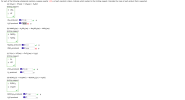 For each of the following unbalanced reactions, suppose exactly 1.33 g of each reactant is taken. Indicate which reactant is the limiting reagent. Calculate the mass of each product that is expected. (a) UO2(s) + HF(aq) → UF4(aq) + H20(1) limiting reagent UO2 HF 9 UF4 produced 40 1. 55 H20 produced 497 0.18 X 9 (b) NaNO3(aq) + H2SO4(aq) → Na2SO4(aq) + HNO3(aq) limiting reagent NaNO3 H2SO4 Na2SO4 produced 4.0) 1. 11 HNO3 produced 4. 0 0.99 9 X...
89. For each of the following unbalanced chemical equations, suppose 25.0 g of each reactant is...
 89. For each of the following unbalanced chemical equations, suppose 25.0 g of each reactant is taken. Show by calculation which reactant is limiting. Calculate the theoretical yield in grams of the product in boldface. a. CH3OH(1) + O2(g) + CO2(g) + H2O(1) b. N2(g) + O2(g) → NO(g) c. NaClO2(aq) + Cl2(g) → C102(g) + NaCl(aq) d. H2(g) + N2(g) → NH3(g)
This question has multiple parts. Work all the parts to get the most points. a For...
 This question has multiple parts. Work all the parts to get the most points. a For the following unbalanced chemical equation, suppose that exactly 1.85 g of each reactant is taken. Determine which reactant is limiting, and calculate what mass of CO2 is expected (assuming that the limiting reactant is completely consumed). CS2() + O2(g) + CO2(g) + SO2(9) Limiting reactant Mass of CO2 = b For the following unbalanced chemical equation, suppose that exactly 1.40 g of each reactant...
23) In the following equations, determine which reactant is the limiting reactant and which reactant is...
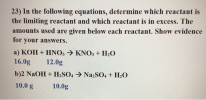 23) In the following equations, determine which reactant is the limiting reactant and which reactant is in excess. The amounts used are given below each reactant. Show evidence for your answers. a) KOH + HNO3 → KNO3 + H2O 16.0g 12.0g b)2 NaOH + H2SO4 → Na2SO4 + H2O 10.0 g 10.0g
Consider the unbalanced chemical equation below. CaSiO3(-) + HF (@)-CaF2(aq) + SiF4(g) + H2O(1) Suppose a...
 Consider the unbalanced chemical equation below. CaSiO3(-) + HF (@)-CaF2(aq) + SiF4(g) + H2O(1) Suppose a 34.3 g sample of CaSiO3 is reacted with 31.3 L of HF at 27.0 °C and 1,00 atm. Assuming the reaction goes to completion calculate the mass (in grams) of the SiF4 and H2O produced in the reaction. mass SiF4 = mass H2O Submit Hide Hints
24. For each of the following unbalanced equations, calculate how many moles of the second reactant...
 24. For each of the following unbalanced equations, calculate how many moles of the second reactant would be required to react completely with 0.557 grams of the first reactant. a. Al(s) Br2(l)-AlBr3(s) b. Hg(s) + HCIO4(a?) Hg(CIO4(aq) +H2(8) c. K(s) + P(s)-K,P(s) d. CH4(g) + Cl2(g)-CCl4(1)+HCI(g)
1. Provide balanced chemical equations for each of the chemical reactions that you performed. [Reaction (2b)...
1. Provide balanced chemical equations for each of the chemical reactions that you performed. [Reaction (2b) is omitted here.] (1a) _______ Pb(NO3)2 (aq) + ________ K2CrO4 (aq) → ________ KNO3 (aq) + ________ PbCrO4 (s) (1b) _______ Pb(NO3)2 (aq) + ________ Na2SO4 (aq) → ________ NaNO3 (aq) + ________ PbSO4 (s) (2a) _______ HCl (aq) + ________ Mg (s) → ________ MgCl2 (aq) + ________ H2 (g) (2c) _____ HC2H3O2 (aq) + ______NaHCO3 (s) → ______ NaC2H3O2 (aq) + _____...
Balance each of the following chemical equations. a) Ba(NO3)2(aq) + Na2CrO4(aq) —> BaCrO4(s) + NaNO3(aq) b)...
Balance each of the following chemical equations. a) Ba(NO3)2(aq) + Na2CrO4(aq) —> BaCrO4(s) + NaNO3(aq) b) C2H5OH(l) + O2(g) —> CO2(g) + H2O(l) c) Sr(s) + HNO3(aq)—> Sr(NO3)2(aq) + H2(g) d) CuSO4(aq) + KI(s)—> CuI(s) + I2(s) + K2SO4(aq) Show the balancing of equations using the reactants-product table.
Part E Determine the limiting reactant, given 250 g of each reactant, in the following: 3NO2(g)...
 Part E Determine the limiting reactant, given 250 g of each reactant, in the following: 3NO2(g) + H2O(1) + 2HNO3(aq) + NO(g) ANSWER: HNO3 Ο NO HO O NO₂ Part F Calculate the grams of HNO3 that would be produced. Express your answer with the appropriate units. ANSWER: m(HNO3) = Part 6 Determine the limiting reactant, given 25.0 g of each reactant, in the following: CHAO(1)+302(g) 2002(g) + 3H2O(g) ANSWER: CO2 O C₂H₂O H2O 02 Part 1 Calculate the grams...
 For each of the following unbalanced reactions, suppose exactly 1.33 g of each reactant is taken. Indicate which reactant is the limiting reagent. Calculate the mass of each product that is expected. (a) UO2(s) + HF(aq) → UF4(aq) + H20(1) limiting reagent UO2 HF 9 UF4 produced 40 1. 55 H20 produced 497 0.18 X 9 (b) NaNO3(aq) + H2SO4(aq) → Na2SO4(aq) + HNO3(aq) limiting reagent NaNO3 H2SO4 Na2SO4 produced 4.0) 1. 11 HNO3 produced 4. 0 0.99 9 X...
 89. For each of the following unbalanced chemical equations, suppose 25.0 g of each reactant is taken. Show by calculation which reactant is limiting. Calculate the theoretical yield in grams of the product in boldface. a. CH3OH(1) + O2(g) + CO2(g) + H2O(1) b. N2(g) + O2(g) → NO(g) c. NaClO2(aq) + Cl2(g) → C102(g) + NaCl(aq) d. H2(g) + N2(g) → NH3(g)
 This question has multiple parts. Work all the parts to get the most points. a For the following unbalanced chemical equation, suppose that exactly 1.85 g of each reactant is taken. Determine which reactant is limiting, and calculate what mass of CO2 is expected (assuming that the limiting reactant is completely consumed). CS2() + O2(g) + CO2(g) + SO2(9) Limiting reactant Mass of CO2 = b For the following unbalanced chemical equation, suppose that exactly 1.40 g of each reactant...
 23) In the following equations, determine which reactant is the limiting reactant and which reactant is in excess. The amounts used are given below each reactant. Show evidence for your answers. a) KOH + HNO3 → KNO3 + H2O 16.0g 12.0g b)2 NaOH + H2SO4 → Na2SO4 + H2O 10.0 g 10.0g
 Consider the unbalanced chemical equation below. CaSiO3(-) + HF (@)-CaF2(aq) + SiF4(g) + H2O(1) Suppose a 34.3 g sample of CaSiO3 is reacted with 31.3 L of HF at 27.0 °C and 1,00 atm. Assuming the reaction goes to completion calculate the mass (in grams) of the SiF4 and H2O produced in the reaction. mass SiF4 = mass H2O Submit Hide Hints
 24. For each of the following unbalanced equations, calculate how many moles of the second reactant would be required to react completely with 0.557 grams of the first reactant. a. Al(s) Br2(l)-AlBr3(s) b. Hg(s) + HCIO4(a?) Hg(CIO4(aq) +H2(8) c. K(s) + P(s)-K,P(s) d. CH4(g) + Cl2(g)-CCl4(1)+HCI(g)
 Part E Determine the limiting reactant, given 250 g of each reactant, in the following: 3NO2(g) + H2O(1) + 2HNO3(aq) + NO(g) ANSWER: HNO3 Ο NO HO O NO₂ Part F Calculate the grams of HNO3 that would be produced. Express your answer with the appropriate units. ANSWER: m(HNO3) = Part 6 Determine the limiting reactant, given 25.0 g of each reactant, in the following: CHAO(1)+302(g) 2002(g) + 3H2O(g) ANSWER: CO2 O C₂H₂O H2O 02 Part 1 Calculate the grams...
Most questions answered within 3 hours.
-
Where is the error in this code sequence?
String s1 = "Hello";
String s2 = "ello";...
asked 11 months ago -
Financial data for Joel de Paris, Inc., for last year
follow:
Joel de Paris, Inc.
Balance...
asked 11 months ago -
Consider this reaction:
Al2(SO4)3 (aq)+ BaCl3
(aq) Al2Cl6 (aq)- +
3BaSO4(s) . What is the...
asked 11 months ago -
Suppose that Savneet is considering increasing her
recent random sample from 20 car rentals to 40...
asked 11 months ago -
Trucks arrive at an unloading terminal at an average rate of 120
per hour.
Trucks arrive...
asked 11 months ago -
Why are methanol and ethanol completely soluble in water while
octanol is not very little soluble....
asked 11 months ago -
A facilities manager at a university reads in a research report
that the mean amount of...
asked 11 months ago -
When the CuSO4 is rehydrated by adding water to the anhydrous
compound, is this an endothermic...
asked 11 months ago -
A ray of sunlight is passing from diamond into crown glass; the
angle of incidence is...
asked 11 months ago -
A block of mass 0.249 kg is placed on top of a light, vertical
spring of...
asked 11 months ago -
how do the kidneys compensate in the presences of acidosis
a) trigger hyperventilate
b) reserve acid...
asked 11 months ago -
Question 501 pts
The rental rate of capital to the firm increases. Which of the
following...
asked 11 months ago