

Homework Answers
Add Answer to:
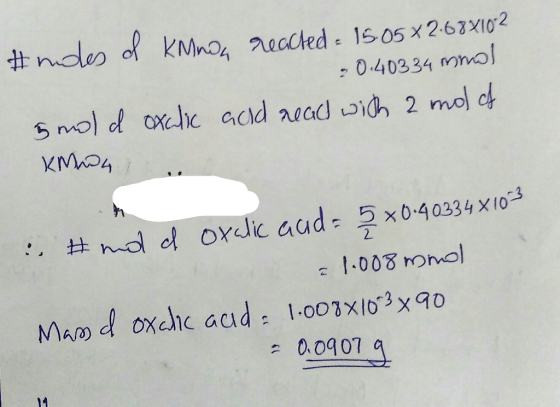
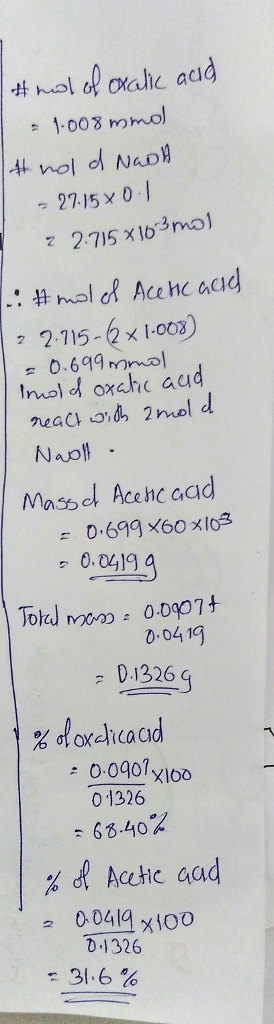
A mixture of acetic acid (CH3 CO2H monoprotic) and oxalic acid (H2C2O4; diprotic) requires 27.15 mL...
6. Oxalic acid H2C2O4 is a diprotic acid and can be used, in dilute form, as...
 6. Oxalic acid H2C2O4 is a diprotic acid and can be used, in
dilute form, as wood bleach. pKa1 = 1.237 and pKa2=4.187
A. How many milliliters of 0.0500 M NaOH would be required to
completely neutralize 10.0 mL of 0.100 M H2C2O4? (5 pts)
B. Estimate the pH at the first equivalence point of the
titration. (6 pts)
C. What is the pH at the second equivalence point of the
titration. (8 pts)
Please help with work shown, especially...
6. Oxalic acid H2C2O4 is a diprotic acid and can be used, in
dilute form, as wood bleach. pKa1 = 1.237 and pKa2=4.187
A. How many milliliters of 0.0500 M NaOH would be required to
completely neutralize 10.0 mL of 0.100 M H2C2O4? (5 pts)
B. Estimate the pH at the first equivalence point of the
titration. (6 pts)
C. What is the pH at the second equivalence point of the
titration. (8 pts)
Please help with work shown, especially...
A sample of oxalic acid (a diprotic acid of the formula H2C2O4) is dissolved in enough...
A sample of oxalic acid (a diprotic acid of the formula H2C2O4) is dissolved in enough water to make 1.00 L of solution. A 100.0 mL sample of this solution is titrated with a solution of sodium hydroxide of concentration 0.750 M and requires 20.0 mL of sodium hydroxide to reach the end point. Calculate the mass of the original oxalic acid sample.
a) Write the reaction for the neutralization oxalic acid (H2C2O4) with sodium hydroxide (NaOH). Note oxalic...
a) Write the reaction for the neutralization oxalic acid (H2C2O4) with sodium hydroxide (NaOH). Note oxalic acid is diprotic (like sulfuric acid). b) A 0.1187 g sample of an unknown, diprotic solid acid is dissolved in water. 26.36 mL of 0.1000 M sodium hydroxide is used to reach the equivalence point. How many moles of sodium hydroxide were reacted? How many moles of acid reacted? What is the molecular weight of the acid?
4. Calculate the mass of Oxalic acid (H2C2O4*2H2O) required to neutralize 20.0 ml of 0.10 M...
4. Calculate the mass of Oxalic acid (H2C2O4*2H2O) required to neutralize 20.0 ml of 0.10 M NaOH solution using the balanced chemical equation for this reaction. 5. A 0.120 g sample of pure oxalic acid (H2C2O2*2H2O) was dissolved in water and neutralized with 21.0 ml of NaOH. Calculate the molarity of NaOH. Do not use scientific notation, but do use the proper number of significant digits and units.
In a standardization process, 0.2161 g of oxalic acid (H2C2O4 : MM 90.04 g/mol) was neutralized...
In a standardization process, 0.2161 g of oxalic acid (H2C2O4 : MM 90.04 g/mol) was neutralized with 32.0 mL NaOH. Find the molarity of NaOH. H2C2O4 + 2NaOH à Na2C2O4 + 2H2O A: 0.250 M B: 0.100 M C: 0.150 M D: 0.300 M
Trial one Trial two Trial three Volume of oxalic acid (mL) 10.1 mL 10.2 mL 10.1...
Trial one Trial two Trial three Volume of oxalic acid (mL) 10.1 mL 10.2 mL 10.1 mL Moles of oxalic acid (moles) Initial volume of NaOH (mL) 18.7 mL 26.5 mL 34.6 mL Final volume of NaOH (mL) 26.5 mL 34.6 mL 42.6 mL Delivered volume of NaOH (moles) 7.8 mL 8.1 mL 8 mL Moles of NaOH (moles) Molarity of NaOH (M) Average Molarity NaOH (M) Concentration of oxalic acid (M) = 0.2567 Trial one Trial two Trial three...
Potassium hydrogen phthalate is a solid, monoprotic acid frequently used in the laboratory as a primary...
Potassium hydrogen phthalate is a solid, monoprotic acid frequently used in the laboratory as a primary standard. It has the unwieldy formula of KHC8H4O4. This is often written in shorthand notation as KHP. If 37.5 mL of a sodium hydroxide solution are needed to neutralize 2.14 grams of KHP, what is the molarity of the sodium hydroxide solution? __________M Oxalic acid dihydrate is a solid, diprotic acid that can be used in the laboratory as a primary standard. Its formula...
QUESTION 3 A solution of acetic acid, HC2H302, a weak monoprotic acid, was standardized by titration...
 QUESTION 3 A solution of acetic acid, HC2H302, a weak monoprotic acid, was standardized by titration with 0.1660 M NaOH solution. If 20.59 mL of the NaOH were required to neutralize completely 18.23 ml of the acetic acid solution, what is the molarity o of the acetic acid solution?
1) A 20.0 mL sample of lactic acid (monoprotic with Ka = 1.37 x 10⁻⁴) requires...
1) A 20.0 mL sample of lactic acid (monoprotic with Ka = 1.37 x 10⁻⁴) requires 30.0 mL of 0.200 M NaOH for titration to the equivalence point. What is the concentration of the lactic acid solution? 1.0.120 M 2. 0.200 M 3. 0.300 M 4. 6.00 x 10⁻³ M 5. cannot be found without the molar mass of lactic acid. 2) Oxalic acid is diprotic with pKa1 = 1.23 and pKa2 = 4.19. What is pKb for the hydrogen...
Oxalic acid can be used, in dilute form, as wood bleach. How many milliliters of 0.050...
Oxalic acid can be used, in dilute form, as wood bleach. How many milliliters of 0.050 M NaOH would be required to neutralize 10.0 mL of 0.100 M H2C2O4? Estimate the pH at the first equivalence point of the titration. This question! Estimate the pH at the second equivalence point of the titration.
 6. Oxalic acid H2C2O4 is a diprotic acid and can be used, in
dilute form, as wood bleach. pKa1 = 1.237 and pKa2=4.187
A. How many milliliters of 0.0500 M NaOH would be required to
completely neutralize 10.0 mL of 0.100 M H2C2O4? (5 pts)
B. Estimate the pH at the first equivalence point of the
titration. (6 pts)
C. What is the pH at the second equivalence point of the
titration. (8 pts)
Please help with work shown, especially...
6. Oxalic acid H2C2O4 is a diprotic acid and can be used, in
dilute form, as wood bleach. pKa1 = 1.237 and pKa2=4.187
A. How many milliliters of 0.0500 M NaOH would be required to
completely neutralize 10.0 mL of 0.100 M H2C2O4? (5 pts)
B. Estimate the pH at the first equivalence point of the
titration. (6 pts)
C. What is the pH at the second equivalence point of the
titration. (8 pts)
Please help with work shown, especially...
 QUESTION 3 A solution of acetic acid, HC2H302, a weak monoprotic acid, was standardized by titration with 0.1660 M NaOH solution. If 20.59 mL of the NaOH were required to neutralize completely 18.23 ml of the acetic acid solution, what is the molarity o of the acetic acid solution?
Most questions answered within 3 hours.
-
Where is the error in this code sequence?
String s1 = "Hello";
String s2 = "ello";...
asked 11 months ago -
Financial data for Joel de Paris, Inc., for last year
follow:
Joel de Paris, Inc.
Balance...
asked 11 months ago -
Consider this reaction:
Al2(SO4)3 (aq)+ BaCl3
(aq) Al2Cl6 (aq)- +
3BaSO4(s) . What is the...
asked 11 months ago -
Suppose that Savneet is considering increasing her
recent random sample from 20 car rentals to 40...
asked 11 months ago -
Trucks arrive at an unloading terminal at an average rate of 120
per hour.
Trucks arrive...
asked 11 months ago -
Why are methanol and ethanol completely soluble in water while
octanol is not very little soluble....
asked 11 months ago -
A facilities manager at a university reads in a research report
that the mean amount of...
asked 11 months ago -
When the CuSO4 is rehydrated by adding water to the anhydrous
compound, is this an endothermic...
asked 11 months ago -
A ray of sunlight is passing from diamond into crown glass; the
angle of incidence is...
asked 11 months ago -
A block of mass 0.249 kg is placed on top of a light, vertical
spring of...
asked 11 months ago -
how do the kidneys compensate in the presences of acidosis
a) trigger hyperventilate
b) reserve acid...
asked 11 months ago -
Question 501 pts
The rental rate of capital to the firm increases. Which of the
following...
asked 11 months ago