A 750 g disk and a 760 g ring, both 15 cm in diameter, are rolling...
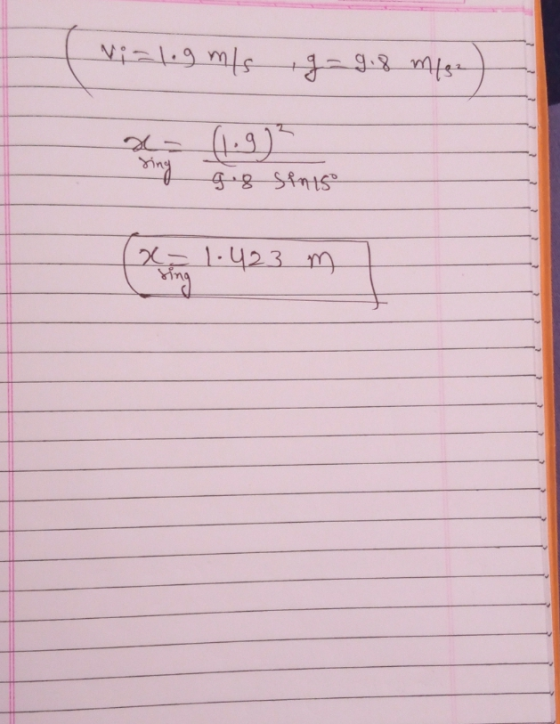
A 750 g disk and a 760 g ring, both 15 cm in diameter, are rolling along a horizontal surface at 1.9 m/s when they encounter a 15 ∘ slope.
Part A) How far up the slope does the disk travel before rolling back down?
Part B) How far up the slope does the ring travel before rolling back down?
Homework Answers
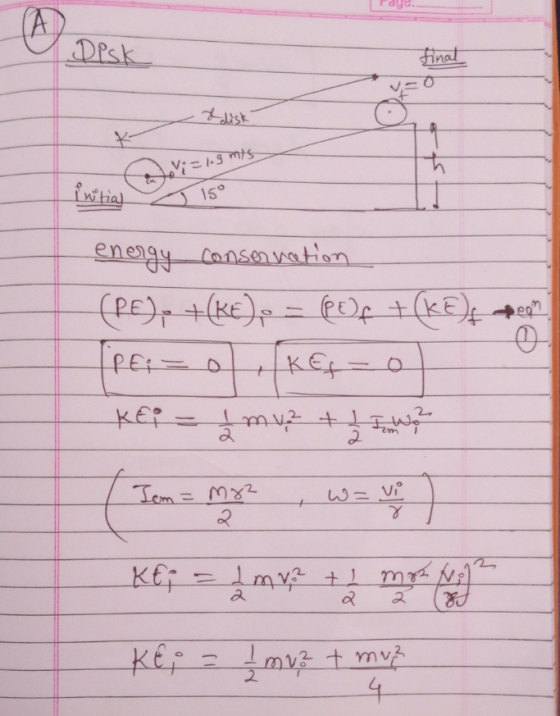
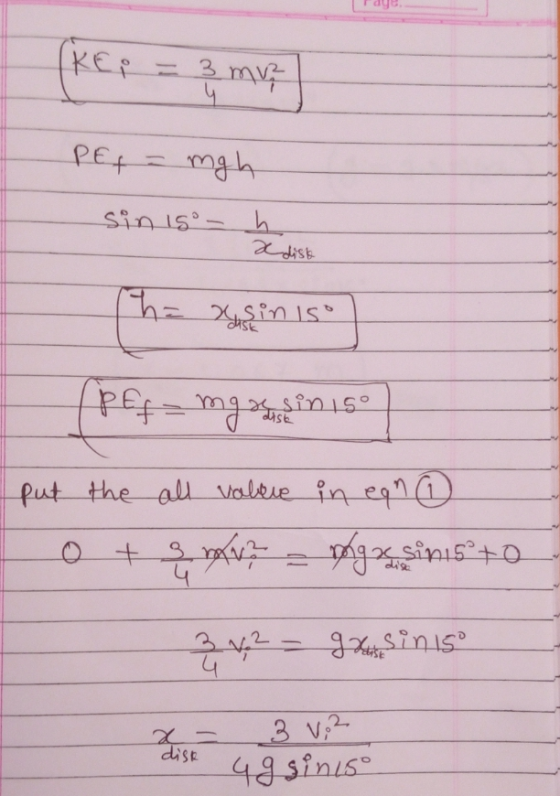


![Page KEp = f mv 2 tl mv, KE— my;) PE = mgh Siniso = h h- & sinis ring ning PE = mgesin 15° ] put the all the value of in ea](http://img.homeworklib.com/questions/2fffb340-5486-11eb-ab47-9f5b70f7dbbd.png?x-oss-process=image/resize,w_560)
Add Answer to:
A 750 g disk and a 760 g ring, both 15 cm in diameter, are
rolling...
A ring of mass 2.4kg, inner radius 6.0cm, and outer radius 8.0cm is rolling (without slipping)...
A ring of mass 2.4kg, inner radius 6.0cm, and outer radius 8.0cm is rolling (without slipping) up an inclined plane that makes an angle of theta=36.9 with the horizontal. At the moment the ring is x=2.0 m up the plane its speed is 2.8 m/s. the ring continues up the plane for some additional distance and then rolls back down. Assuming that the plane is long enough so that the ring does not roll off the top end, how far...
A 2-kg block is pushed against a spring with spring-constant k 512 N/m, compressing it 0.25 m
 A 2-kg block is pushed against a spring with spring-constant k 512 N/m, compressing it 0.25 m. When the block is released, it moves along a frictionless, horizontal surface and then up a frictionless incline with slope 53.1° (a) What is the speed of the block as it slides along the horizontal surface after having left the spring? (b) How far does the block travel up the incline before starting to slide back down?
A 2.00 kg block is pushed against a spring with negligible mass and force constant k = 400 N/m compressing it 0.220 m.
A 2.00 kg block is pushed against a spring with negligible mass and force constant k = 400 N/m compressing it 0.220 m. When the block is released, it moves along a frictionless, horizontal surface and then up a frictionless incline with slope 37.0 degree. What is the speed of the block as it slides along the horizontal surface after having left the spring? How far does the block travel up the incline before stops and starts to slide back...
A m= 2.00 kg block is pushed against a spring with negligible mass and force constant k= 300. N/m
 A m= 2.00 kg block is pushed against a spring with negligible mass and force constant k= 300. N/m, compressing it d= 0.250 m. When the block is released, it moves along a frictionless, horizontal surface and then up an incline with slope 37.0° and a coefficient of kinetic friction of 0.320. A)What is the speed of the block as it slides along the horizontal surface after having left the spring?B) How far does the object travel up the incline before...
1. A ring is sent rolling without slipping up an incline of 15°. At the base...
 1. A ring is sent rolling without slipping up an incline of 15°. At the base of the incline, the ring has an unknown speed "V". a. Draw an extended free body diagram for the ring. Make sure to include the directions for the acceleration and the angular acceleration. b. What are the magnitude and direction of the acceleration of the ring while it is rolling up the incline? c. What is the minimum value of the coefficient of static...
A uniform solid sphere with a mass of M = 360 grams and a radius R...
A uniform solid sphere with a mass of M = 360 grams and a radius R = 18.0 cm is rolling without slipping on a horizontal surface at a constant speed of 2.50 m/s. It then encounters a ramp inclined at an angle of 17.0 degrees with the horizontal, and proceeds to roll without slipping up the ramp. Use g = 10.0 m/s2. How far does the sphere travel up the ramp (measure the distance traveled along the incline) before...
please post detailed explanation Problem 4: My wedding ring is rolling down an incline of 0...
 please post detailed explanation
Problem 4: My wedding ring is rolling down an incline of 0 - 15º that has a friction coefficient of x=0.1. The ring has a mass of 5-g and a diameter of 2.5 cm. If the ring was initially at rest, what is its angular acceleration and how much time does it take to roll 0.2 meters? 0
please post detailed explanation
Problem 4: My wedding ring is rolling down an incline of 0 - 15º that has a friction coefficient of x=0.1. The ring has a mass of 5-g and a diameter of 2.5 cm. If the ring was initially at rest, what is its angular acceleration and how much time does it take to roll 0.2 meters? 0
2. A hollow cylinder (hoop) is rolling on a horizontal surface at speed y = 3.0...
 2. A hollow cylinder (hoop) is rolling on a horizontal surface at speed y = 3.0 m/s when it reaches a 15 degree incline. (a) How far up the incline will it go? (b) How long will it be on the incline before it arrives back at the bottom?
A disk 15 cm in diameter rotates counterclockwise in a horizontal plane, accelerating uniformaly from 33...
A disk 15 cm in diameter rotates counterclockwise in a horizontal plane, accelerating uniformaly from 33 rpm to 45 rpm in 1 min. A) What is the angular acceleration of the disk? B) What is the angular speed of the disk 30 sec after it starts to accelerate? C) What is the tangential speed of a point on the edge of the disk 30 sec after it starts to accelerate? D) Through how many rotations does the disk turn while...
Part A. A 43 g ice cube can slide without friction up and down a 30∘...
Part A. A 43 g ice cube can slide without friction up and down a 30∘ slope. The ice cube is pressed against a spring at the bottom of the slope, compressing the spring 10 cm. The spring constant is 29 N/m . When the ice cube is released, what total distance will it travel up the slope before reversing direction? Part B. The ice cube is replaced by a 43 g plastic cube whose coefficient of kinetic friction is...
 1. A ring is sent rolling without slipping up an incline of 15°. At the base of the incline, the ring has an unknown speed "V". a. Draw an extended free body diagram for the ring. Make sure to include the directions for the acceleration and the angular acceleration. b. What are the magnitude and direction of the acceleration of the ring while it is rolling up the incline? c. What is the minimum value of the coefficient of static...
 please post detailed explanation
Problem 4: My wedding ring is rolling down an incline of 0 - 15º that has a friction coefficient of x=0.1. The ring has a mass of 5-g and a diameter of 2.5 cm. If the ring was initially at rest, what is its angular acceleration and how much time does it take to roll 0.2 meters? 0
please post detailed explanation
Problem 4: My wedding ring is rolling down an incline of 0 - 15º that has a friction coefficient of x=0.1. The ring has a mass of 5-g and a diameter of 2.5 cm. If the ring was initially at rest, what is its angular acceleration and how much time does it take to roll 0.2 meters? 0
 2. A hollow cylinder (hoop) is rolling on a horizontal surface at speed y = 3.0 m/s when it reaches a 15 degree incline. (a) How far up the incline will it go? (b) How long will it be on the incline before it arrives back at the bottom?
Most questions answered within 3 hours.
-
Where is the error in this code sequence?
String s1 = "Hello";
String s2 = "ello";...
asked 11 months ago -
Financial data for Joel de Paris, Inc., for last year
follow:
Joel de Paris, Inc.
Balance...
asked 11 months ago -
Consider this reaction:
Al2(SO4)3 (aq)+ BaCl3
(aq) Al2Cl6 (aq)- +
3BaSO4(s) . What is the...
asked 11 months ago -
Suppose that Savneet is considering increasing her
recent random sample from 20 car rentals to 40...
asked 11 months ago -
Trucks arrive at an unloading terminal at an average rate of 120
per hour.
Trucks arrive...
asked 11 months ago -
Why are methanol and ethanol completely soluble in water while
octanol is not very little soluble....
asked 11 months ago -
A facilities manager at a university reads in a research report
that the mean amount of...
asked 11 months ago -
When the CuSO4 is rehydrated by adding water to the anhydrous
compound, is this an endothermic...
asked 11 months ago -
A ray of sunlight is passing from diamond into crown glass; the
angle of incidence is...
asked 11 months ago -
A block of mass 0.249 kg is placed on top of a light, vertical
spring of...
asked 11 months ago -
how do the kidneys compensate in the presences of acidosis
a) trigger hyperventilate
b) reserve acid...
asked 11 months ago -
Question 501 pts
The rental rate of capital to the firm increases. Which of the
following...
asked 11 months ago