
Homework Answers

![Hence Solution (4) reduces to ucast) 을 sin (2m-) 4 (2m-1) Ta &mas) ²+ in je IT mol u cart) 4 (2 m 1971 sin((2m-1) 2] e-(2m-2)](http://img.homeworklib.com/questions/4dd6d100-5505-11eb-9f26-f5f86095ca34.png?x-oss-process=image/resize,w_560)
Add Answer to:
Show that for the completely insulated bar (including the ends), ux(0,t) = 0, uz(L,t) 0, and...
(a) The heat flux through the faces at the ends of bar is found to be...
 (a) The heat flux through the faces at the ends of bar is found to be proportional to un au/an at the ends. If the bar is perfectly insulated, also at the ends x 0 and x L are adiabatic conditions, Q1 ux(0, t) = 0 0 (2'7)*n prove that the solution of the heat transfer problem above (adiabatic conditions at both ends) gives as, 2 an: nnx u(x, t) Ao t An cos n-1 where Ao and An are...
* Exercise 4: Let k,l 〉 0. The temperature of a rod insulated at the ends...
 * Exercise 4: Let k,l 〉 0. The temperature of a rod insulated at the ends with an expo- nentially decreasing heat source in it satisfies the following problem: ux (0, t) u(z,0) 0 = ux (1, t), φ(z) Find the solution to this problem by writing u as a cosine series: Ao(t) u(x, t) An(t) cos and determine limt-Hou(z, t
Consider a uniform bar of length L having an initial temperature distribution given by f(x), 0...
 Consider a uniform bar of length L having an initial temperature distribution given by f(x), 0 < x < L. Assume that the temperature at the end x=0 is held at 0°C, while the end x=L is thermally insulated. Heat is lost from the lateral surface of the bar into a surrounding medium. The temperature u(x, t) satisfies the following partial differential equation and boundary conditions aluxx – Bu = Ut, 0<x<l, t> 0 u(0,t) = 0, uz (L, t)...
1. Consider the insulated heat equation up = cum, 0 <r<L, t > 0 u (0,t)...
 1. Consider the insulated heat equation up = cum, 0 <r<L, t > 0 u (0,t) = u (L, t) = 0, t > 0 u(x,0) = f(2). What is the steady-state solution? 2. Solve the two-dimensional wave equation (with c=1/) on the unit square (i.e., [0, 1] x [0,1) with homogeneous Dirichlet boundary conditions and initial conditions: (2, y,0) = sin(x) sin(y) (,y,0) = sin(x). 3. Solve the following PDE: Uzr + Uyy = 0, 0<<1,0 <y < 2...
Problem 6 Find the temperature in in a laterally insulated bar of length L whose ends...
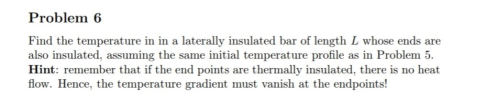 Problem 6 Find the temperature in in a laterally insulated bar of length L whose ends are also insulated, assuming the same initial temperature profile as in Problem 5. Hint: remember that if the end points are thermally insulated, there is no heat flow. Hence, the temperature gradient must vanish at the endpoints! Problem 5 Find the temperature in a laterally insulated bar of length whose ends are kept at 0° Celsius, assuming that the initial temperature distribution is in...
Problem 1 (Submit): Longitudinal vibrations of an elastic bar with zero strain and stress at both...
 Problem 1 (Submit): Longitudinal vibrations of an elastic bar with zero strain and stress at both ends satisfies the following initial-boundary value problem ras ux(0, t) = uz(r,t) 0 u(z,0) = 5 cos(x), ut(z,0) = 1-cos(2r). (a) Use the method of separation of variables to solve this problem. (b) Find the D'Alembert's solution for this initial-boundary value problem and compare it to the solution you found in (a).
Problem 1 (Submit): Longitudinal vibrations of an elastic bar with zero strain...
Problem 1 (Submit): Longitudinal vibrations of an elastic bar with zero strain and stress at both ends satisfies the following initial-boundary value problem ras ux(0, t) = uz(r,t) 0 u(z,0) = 5 cos(x), ut(z,0) = 1-cos(2r). (a) Use the method of separation of variables to solve this problem. (b) Find the D'Alembert's solution for this initial-boundary value problem and compare it to the solution you found in (a).
Problem 1 (Submit): Longitudinal vibrations of an elastic bar with zero strain...
5. [8] A bar of length a cm is insulated at both ends. Find the temperature...
 5. [8] A bar of length a cm is insulated at both ends. Find the temperature u(x,t), when 3, and u(x,0) = f(x) = x. Find and give an interpretation of the steady state solution. a =
Find the temperature u(x, t) in a rod of length L if the initial temperature is...
 Find the temperature u(x, t) in a rod of length L if the initial temperature is f(x) throughout and if the ends x = 0 and x = L are insulated. Solve if L = 2 and f(x) = Jx, 0<x< 1 10, 1<x< 2. ux, t) = + ŠL n = 1
a) Use the d'Alembert solution to solve au au - <r< ,t> 0, at2 48,2 ux,0)...
 a) Use the d'Alembert solution to solve au au - <r< ,t> 0, at2 48,2 ux,0) = cos 3x, u(,0) = 21 b) Consider the heat equation диди 0<x<1, t > 0, at ax? with boundary conditions uz (0,t) = 0, uz(1,t) = 0, > 0, and initial conditions u(x,0) = { 0, 2.0, 0<r < 0.5, 0.5 <<1. Use the method of separation of variables to solve the equation.
2. Consider the initial-boundary value problem 0 0, t >0 Uz uェェ, Uz(0, t) _ u(0, t) = 0. a(z, 0...
 PDE questions. Please show all
steps in detail.
2. Consider the initial-boundary value problem 0
PDE questions. Please show all
steps in detail.
2. Consider the initial-boundary value problem 0
 (a) The heat flux through the faces at the ends of bar is found to be proportional to un au/an at the ends. If the bar is perfectly insulated, also at the ends x 0 and x L are adiabatic conditions, Q1 ux(0, t) = 0 0 (2'7)*n prove that the solution of the heat transfer problem above (adiabatic conditions at both ends) gives as, 2 an: nnx u(x, t) Ao t An cos n-1 where Ao and An are...
 * Exercise 4: Let k,l 〉 0. The temperature of a rod insulated at the ends with an expo- nentially decreasing heat source in it satisfies the following problem: ux (0, t) u(z,0) 0 = ux (1, t), φ(z) Find the solution to this problem by writing u as a cosine series: Ao(t) u(x, t) An(t) cos and determine limt-Hou(z, t
 Consider a uniform bar of length L having an initial temperature distribution given by f(x), 0 < x < L. Assume that the temperature at the end x=0 is held at 0°C, while the end x=L is thermally insulated. Heat is lost from the lateral surface of the bar into a surrounding medium. The temperature u(x, t) satisfies the following partial differential equation and boundary conditions aluxx – Bu = Ut, 0<x<l, t> 0 u(0,t) = 0, uz (L, t)...
 1. Consider the insulated heat equation up = cum, 0 <r<L, t > 0 u (0,t) = u (L, t) = 0, t > 0 u(x,0) = f(2). What is the steady-state solution? 2. Solve the two-dimensional wave equation (with c=1/) on the unit square (i.e., [0, 1] x [0,1) with homogeneous Dirichlet boundary conditions and initial conditions: (2, y,0) = sin(x) sin(y) (,y,0) = sin(x). 3. Solve the following PDE: Uzr + Uyy = 0, 0<<1,0 <y < 2...
 Problem 6 Find the temperature in in a laterally insulated bar of length L whose ends are also insulated, assuming the same initial temperature profile as in Problem 5. Hint: remember that if the end points are thermally insulated, there is no heat flow. Hence, the temperature gradient must vanish at the endpoints! Problem 5 Find the temperature in a laterally insulated bar of length whose ends are kept at 0° Celsius, assuming that the initial temperature distribution is in...
 Problem 1 (Submit): Longitudinal vibrations of an elastic bar with zero strain and stress at both ends satisfies the following initial-boundary value problem ras ux(0, t) = uz(r,t) 0 u(z,0) = 5 cos(x), ut(z,0) = 1-cos(2r). (a) Use the method of separation of variables to solve this problem. (b) Find the D'Alembert's solution for this initial-boundary value problem and compare it to the solution you found in (a).
Problem 1 (Submit): Longitudinal vibrations of an elastic bar with zero strain...
Problem 1 (Submit): Longitudinal vibrations of an elastic bar with zero strain and stress at both ends satisfies the following initial-boundary value problem ras ux(0, t) = uz(r,t) 0 u(z,0) = 5 cos(x), ut(z,0) = 1-cos(2r). (a) Use the method of separation of variables to solve this problem. (b) Find the D'Alembert's solution for this initial-boundary value problem and compare it to the solution you found in (a).
Problem 1 (Submit): Longitudinal vibrations of an elastic bar with zero strain...
 5. [8] A bar of length a cm is insulated at both ends. Find the temperature u(x,t), when 3, and u(x,0) = f(x) = x. Find and give an interpretation of the steady state solution. a =
 Find the temperature u(x, t) in a rod of length L if the initial temperature is f(x) throughout and if the ends x = 0 and x = L are insulated. Solve if L = 2 and f(x) = Jx, 0<x< 1 10, 1<x< 2. ux, t) = + ŠL n = 1
 a) Use the d'Alembert solution to solve au au - <r< ,t> 0, at2 48,2 ux,0) = cos 3x, u(,0) = 21 b) Consider the heat equation диди 0<x<1, t > 0, at ax? with boundary conditions uz (0,t) = 0, uz(1,t) = 0, > 0, and initial conditions u(x,0) = { 0, 2.0, 0<r < 0.5, 0.5 <<1. Use the method of separation of variables to solve the equation.
 PDE questions. Please show all
steps in detail.
2. Consider the initial-boundary value problem 0
PDE questions. Please show all
steps in detail.
2. Consider the initial-boundary value problem 0
Most questions answered within 3 hours.
-
Where is the error in this code sequence?
String s1 = "Hello";
String s2 = "ello";...
asked 10 months ago -
Financial data for Joel de Paris, Inc., for last year
follow:
Joel de Paris, Inc.
Balance...
asked 10 months ago -
Consider this reaction:
Al2(SO4)3 (aq)+ BaCl3
(aq) Al2Cl6 (aq)- +
3BaSO4(s) . What is the...
asked 10 months ago -
Suppose that Savneet is considering increasing her
recent random sample from 20 car rentals to 40...
asked 10 months ago -
Trucks arrive at an unloading terminal at an average rate of 120
per hour.
Trucks arrive...
asked 10 months ago -
Why are methanol and ethanol completely soluble in water while
octanol is not very little soluble....
asked 10 months ago -
A facilities manager at a university reads in a research report
that the mean amount of...
asked 10 months ago -
When the CuSO4 is rehydrated by adding water to the anhydrous
compound, is this an endothermic...
asked 10 months ago -
A ray of sunlight is passing from diamond into crown glass; the
angle of incidence is...
asked 10 months ago -
A block of mass 0.249 kg is placed on top of a light, vertical
spring of...
asked 10 months ago -
how do the kidneys compensate in the presences of acidosis
a) trigger hyperventilate
b) reserve acid...
asked 10 months ago -
Question 501 pts
The rental rate of capital to the firm increases. Which of the
following...
asked 10 months ago