slightly confused I thought Rf 0 was solid and Rf1 is slightly liquid please any help is greatly appreciated.
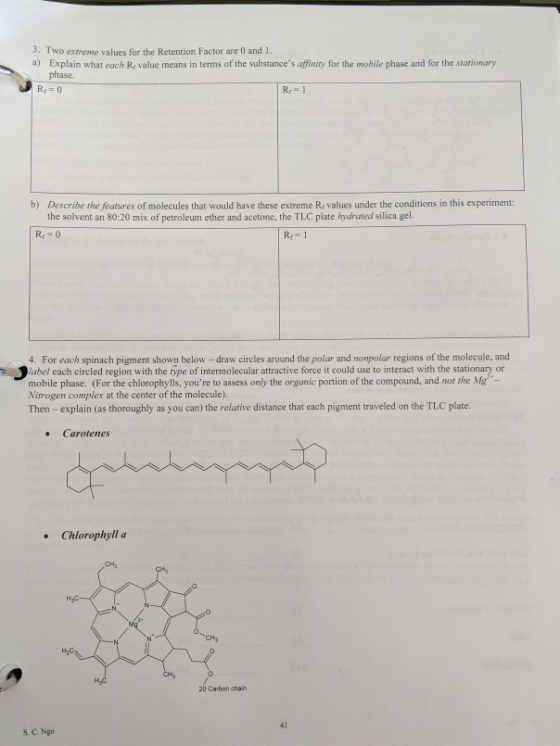
3. Two extreme values for the Retention Factor are 0 and 1
a) Explain what each Re value means in terms of the substance's affinity for the mobile phase and for the stationary phase.
b) Describe the features of molecules that would have these extreme Rr values under the conditions in this experiment: the solvent an 80:20 mix of petroleum ether and acetone, the TLC plate hydrated silica gel.
4. For each spinach pigment shown below - draw circles around the polar and nonpolar regions of the molecule, and label each circled region with the type of intermolecular attractive force it could use to interact with the stationary or mobile phase. (For the chlorophylls, you're to assess only the organic portion of the compound, and not the Mg' Nitrogen complex at the center of the molecule)
Then - explain (as thoroughly as you can) the relative distance that each pigment traveled on the TLC plate.
Carotenes
Chlorophyll a
Homework Answers
3) a) Rf=0: TLC is an adsorption
chromatography. Rf value is the ratio of distance traveled by the
spot to the distance traveled by the solvent front.
When any compound has Rf=0 this means the compound has not traveled
at all any distance. This could happen, 1) compound is highly polar
and has a very high affinity towards the polar stationary phase. 2)
compound do not have any affinity towards the mobile phase at all
3) compound is highly polar in nature.
Rf=1: When spot moves along with the solvent front the Rf value becomes 1) This could happen because compound does not have any affinity towards polar stationary phase at all. 2) compound has a very high affinity towards the mobile phase. 3) compound is non-polar.
b) The solvent is 80:20 pet ether
and acetone. Pet ether is very non-polar solvent and we are
increasing its polarity by adding a little amount of acetone as a
polar solvent. TLC plate is hydrated silica gel, means it is highly
polar due to the open hydroxyl groups.
Rf=0: When Rf value is 0, this means compound is not moving at all
with the solvent front. This could be because the compound is also
highly polar.
Rf=1: If Rf is 1 this means compound is nonpolar and it moves along
with the solvent front. It does not have any affinity towards the
polar stationary phase.
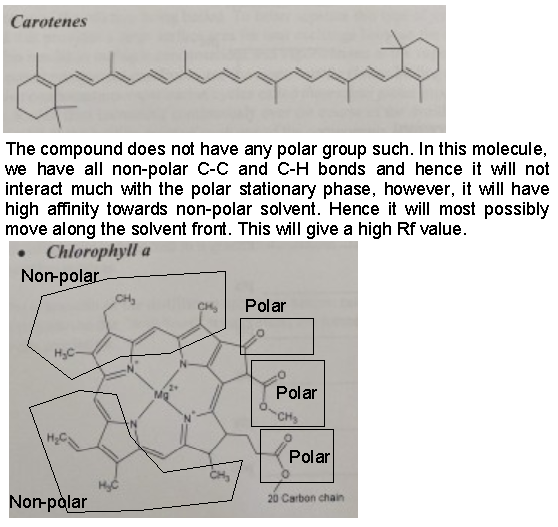
In the case of Chlorophyll, there are polar groups present along with the non-polar ring systems. These polar groups have a stronger interaction with the polar stationary phase and hence will have lower Rf value than that of carotenes.
Add Answer to:
slightly confused I thought thought Rf 0 was solid andRf1 is slightly liquid please any...
Hi can someone help me with my pre lab theory questions (1,2,3) on rate of elution...
 Hi can someone help me with my pre lab theory questions (1,2,3)
on rate of elution or Rf? Here is some background below. Please
help explain as many as possible (1-3)! I dont really get the
relation ships in this lab, thank you!
1. What factors affect the rate of elution in organic compounds? 2. Explain what is the relationship between polarities of compounds (polar/non- polar compound) and rate of elution (Rf). 3. Explain what is the relationship between solvent...
Hi can someone help me with my pre lab theory questions (1,2,3)
on rate of elution or Rf? Here is some background below. Please
help explain as many as possible (1-3)! I dont really get the
relation ships in this lab, thank you!
1. What factors affect the rate of elution in organic compounds? 2. Explain what is the relationship between polarities of compounds (polar/non- polar compound) and rate of elution (Rf). 3. Explain what is the relationship between solvent...
please do two pargraph about this pre lab and lab include Title,purpose ,chemical eqution if their...
 please do two pargraph about this pre lab and lab include
Title,purpose ,chemical eqution if their any ،Procedure
,Hazards(hazard Identification,physical and chemical
properties),Experimental Phase, Data
&Observations,Data&Observations cont (melting point and
meling point). and Calcuations
Spinach Laboratory Procedure PROCEDURES Isolation of pigment from leaves: 1. Wash the spinach leaves. Weigh 1.0 g-2.0 g of dry spinach leaves. Remove any stems and veins from the leaves before you weigh. 2. Combine 1.0 g of anhydrous magnesium sulfate with 0.5 g of sand...
please do two pargraph about this pre lab and lab include
Title,purpose ,chemical eqution if their any ،Procedure
,Hazards(hazard Identification,physical and chemical
properties),Experimental Phase, Data
&Observations,Data&Observations cont (melting point and
meling point). and Calcuations
Spinach Laboratory Procedure PROCEDURES Isolation of pigment from leaves: 1. Wash the spinach leaves. Weigh 1.0 g-2.0 g of dry spinach leaves. Remove any stems and veins from the leaves before you weigh. 2. Combine 1.0 g of anhydrous magnesium sulfate with 0.5 g of sand...
 Hi can someone help me with my pre lab theory questions (1,2,3)
on rate of elution or Rf? Here is some background below. Please
help explain as many as possible (1-3)! I dont really get the
relation ships in this lab, thank you!
1. What factors affect the rate of elution in organic compounds? 2. Explain what is the relationship between polarities of compounds (polar/non- polar compound) and rate of elution (Rf). 3. Explain what is the relationship between solvent...
Hi can someone help me with my pre lab theory questions (1,2,3)
on rate of elution or Rf? Here is some background below. Please
help explain as many as possible (1-3)! I dont really get the
relation ships in this lab, thank you!
1. What factors affect the rate of elution in organic compounds? 2. Explain what is the relationship between polarities of compounds (polar/non- polar compound) and rate of elution (Rf). 3. Explain what is the relationship between solvent...
 please do two pargraph about this pre lab and lab include
Title,purpose ,chemical eqution if their any ،Procedure
,Hazards(hazard Identification,physical and chemical
properties),Experimental Phase, Data
&Observations,Data&Observations cont (melting point and
meling point). and Calcuations
Spinach Laboratory Procedure PROCEDURES Isolation of pigment from leaves: 1. Wash the spinach leaves. Weigh 1.0 g-2.0 g of dry spinach leaves. Remove any stems and veins from the leaves before you weigh. 2. Combine 1.0 g of anhydrous magnesium sulfate with 0.5 g of sand...
please do two pargraph about this pre lab and lab include
Title,purpose ,chemical eqution if their any ،Procedure
,Hazards(hazard Identification,physical and chemical
properties),Experimental Phase, Data
&Observations,Data&Observations cont (melting point and
meling point). and Calcuations
Spinach Laboratory Procedure PROCEDURES Isolation of pigment from leaves: 1. Wash the spinach leaves. Weigh 1.0 g-2.0 g of dry spinach leaves. Remove any stems and veins from the leaves before you weigh. 2. Combine 1.0 g of anhydrous magnesium sulfate with 0.5 g of sand...
Most questions answered within 3 hours.
-
Where is the error in this code sequence?
String s1 = "Hello";
String s2 = "ello";...
asked 10 months ago -
Financial data for Joel de Paris, Inc., for last year
follow:
Joel de Paris, Inc.
Balance...
asked 10 months ago -
Consider this reaction:
Al2(SO4)3 (aq)+ BaCl3
(aq) Al2Cl6 (aq)- +
3BaSO4(s) . What is the...
asked 10 months ago -
Suppose that Savneet is considering increasing her
recent random sample from 20 car rentals to 40...
asked 10 months ago -
Trucks arrive at an unloading terminal at an average rate of 120
per hour.
Trucks arrive...
asked 10 months ago -
Why are methanol and ethanol completely soluble in water while
octanol is not very little soluble....
asked 10 months ago -
A facilities manager at a university reads in a research report
that the mean amount of...
asked 10 months ago -
When the CuSO4 is rehydrated by adding water to the anhydrous
compound, is this an endothermic...
asked 10 months ago -
A ray of sunlight is passing from diamond into crown glass; the
angle of incidence is...
asked 10 months ago -
A block of mass 0.249 kg is placed on top of a light, vertical
spring of...
asked 10 months ago -
how do the kidneys compensate in the presences of acidosis
a) trigger hyperventilate
b) reserve acid...
asked 10 months ago -
Question 501 pts
The rental rate of capital to the firm increases. Which of the
following...
asked 10 months ago