Pre-lab Study Questions (Submit upon arrival for experiment; show work or explanation to the question. )...
|
Pre-lab Study Questions (Submit upon arrival for experiment; show work or explanation to the question. ) |
||||||||||||||||
|
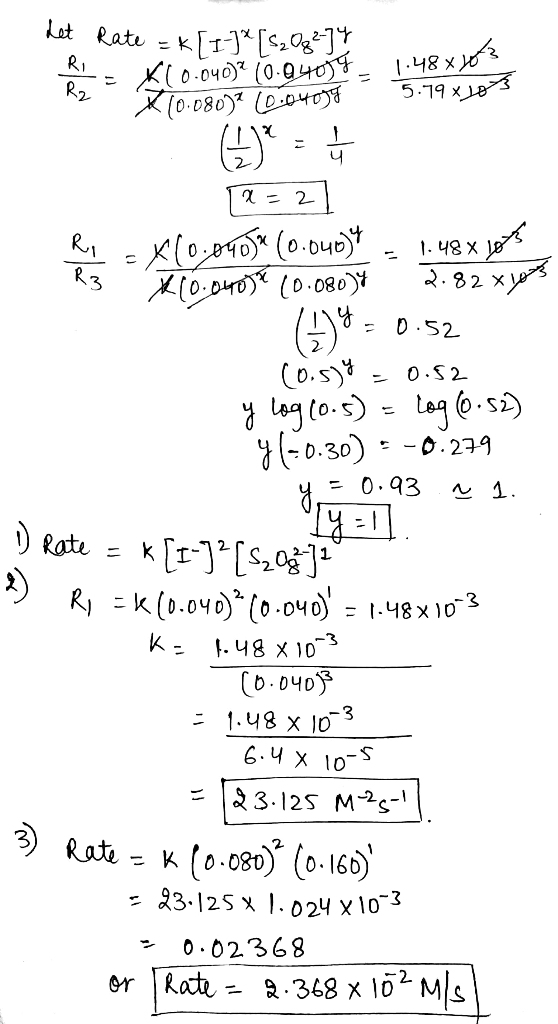
An experiment is designed to study the rates of reaction: 2 I-(aq) + S2O82-(aq) ® I2(aq) + 2 SO42-(aq)
(1) Determine the rate law of the reaction. (2) Calculate the value of k. (3) Predict the reaction rate when [I-] = 0.080 M and [S2O82-] = 0.160 M. |
Homework Answers
Add Answer to:
Pre-lab Study Questions (Submit
upon arrival for experiment;
show work or explanation to the question. )...
(1): When a 1.48-g sample of solid ammonium nitrate dissolves in 56.4 g of water in...
 (1):
When a 1.48-g sample of solid ammonium nitrate dissolves in 56.4
g of water in a coffee-cup calorimeter (see above figure) the
temperature falls from 22.00 oC to 20.09 oC.
Calculate H in kJ/mol
NH4NO3 for the solution process.
NH4NO3(s)
NH4+(aq) +
NO3-(aq)
The specific heat of water is 4.18 J/g-K.
Hsolution
= __kJ/mol NH4NO3.
(2):
The reaction S2O82-(aq) + 3
I-(aq)
2 SO42-(aq) + I3-(aq)
was studied at a certain temperature with the following
results:
Experiment
[S2O82-(aq)] (M)...
(1):
When a 1.48-g sample of solid ammonium nitrate dissolves in 56.4
g of water in a coffee-cup calorimeter (see above figure) the
temperature falls from 22.00 oC to 20.09 oC.
Calculate H in kJ/mol
NH4NO3 for the solution process.
NH4NO3(s)
NH4+(aq) +
NO3-(aq)
The specific heat of water is 4.18 J/g-K.
Hsolution
= __kJ/mol NH4NO3.
(2):
The reaction S2O82-(aq) + 3
I-(aq)
2 SO42-(aq) + I3-(aq)
was studied at a certain temperature with the following
results:
Experiment
[S2O82-(aq)] (M)...
The reaction of peroxydisulfate ion (S2O82-) with iodide ion (I -) is given below. S2O82-(aq) +...
 The reaction of peroxydisulfate ion
(S2O82-) with iodide ion (I
-) is given below.
S2O82-(aq) + 3 I
-
2SO24-(aq)
+I3-
The following data are collected at a certain temperature.
Experiment
[S2O82- ](M)
[I- ](M)
Initial Rate (M/s)
1
0.080
0.034
2.2 X 10⁻⁴
2
0.080
0.017
1.1 X 10⁻⁴
3
0.16
0.017
2.2 X 10⁻⁴
Determine the rate law.
____________________
Calculate the rate constant.
______________ /(M·s)
The reaction of peroxydisulfate ion (S2O8^2-) with iodide ion (I -) is given...
The reaction of peroxydisulfate ion
(S2O82-) with iodide ion (I
-) is given below.
S2O82-(aq) + 3 I
-
2SO24-(aq)
+I3-
The following data are collected at a certain temperature.
Experiment
[S2O82- ](M)
[I- ](M)
Initial Rate (M/s)
1
0.080
0.034
2.2 X 10⁻⁴
2
0.080
0.017
1.1 X 10⁻⁴
3
0.16
0.017
2.2 X 10⁻⁴
Determine the rate law.
____________________
Calculate the rate constant.
______________ /(M·s)
The reaction of peroxydisulfate ion (S2O8^2-) with iodide ion (I -) is given...
Rate Laws (Section)Consider the reaction of peroxydisulfate ion (S2O8 2-) with iodide ion (I - )...
Rate Laws (Section)Consider the reaction of peroxydisulfate ion (S2O8 2-) with iodide ion (I - ) in aqueous solution:S2O82 - (aq) + 3 I - (aq)→2 SO42 - (aq) + I3- (aq)At a particular temperature the initial rate of disappearance of S2O8 2 - varies with reactant concentrations in the following manner:Experiment[S2O82‑] (M)[I_] (M)Initial Rate (M/S)10.0180.0362.6 × 10-620.0270.0363.9 × 10-630.0360.0547.8 × 10-640.0500.0721.4 × 10-5(a) Determine the rate law for the reaction and state the units of the rate constant. (b)...
Pre-Lab Study Questions 1. What factors increase the rate of a chemical reaction? 2. When is...
 Pre-Lab Study Questions 1. What factors increase the rate of a chemical reaction? 2. When is equilibrium established in a reversible reaction? 3. How does a system at equilibrium respond to the addition of more reactant? 4. How does a system at equilibrium respond to the addition of more product? 5. In Part C, we look at the following reaction: Fe (aq)+SCN" (aq) P FSCN- (aq)
3. Experiments are done to study the reaction between aqueous chlorine dioxide and hydroxide ions: 2...
 3. Experiments are done to study the reaction between aqueous chlorine dioxide and hydroxide ions: 2 CIO2 (aq) + 2 OH- (aq) → C103- (aq) + ClO2- (aq) + H20 (1) Exp. # Temp (°C) [CIO2), M [ОНН, М Initial rate, M/s 125 0.015 0.050 0.0026 25 0.045 0.050 0.0234 0.060 0.080 0.0665 4 35 0.060 0.040 0.1022 25 d) If this reaction is occurring in a 1.00-liter solution in a large beaker, predict how each of the following would...
Please help with the pre- lab exercise and questions 10 and 11 Experiment 19 Heat of...
 Please help with the pre- lab exercise and questions 10 and 11
Experiment 19 Heat of Combustion: Magnesium 18, you learned about the additivity of reaction beats as you confirmed Hess's Law, In this experiment, you will use this principle as you determine a heat of reaction that would be difficult to obtain by direct measurement-the heat of combustion of magnesium ribbon. The reaction is represented by the equation This equation can be obtained by combining equations (1). (2), and...
Please help with the pre- lab exercise and questions 10 and 11
Experiment 19 Heat of Combustion: Magnesium 18, you learned about the additivity of reaction beats as you confirmed Hess's Law, In this experiment, you will use this principle as you determine a heat of reaction that would be difficult to obtain by direct measurement-the heat of combustion of magnesium ribbon. The reaction is represented by the equation This equation can be obtained by combining equations (1). (2), and...
Experiment 11: Titration Pre-Lab Report Sheet Name Lab Section: Show your work for any calculations. 1....
 Experiment 11: Titration Pre-Lab Report Sheet Name Lab Section: Show your work for any calculations. 1. Consider the reaction of sulfuric acid, H,SO., with sodium hydroxide, NaOH. H2SO (aq) + 2NaOH(aq) → 2 H2O(l) + Na:SO (aq) Suppose a beaker contains 35.0 ml of 0.175 MH SO. How many moles of NaOH are needed to react completely with the sulfuric acid? 2. In the titration of total acid with sodium hydroxide, NaOH, it was determined that 36,03 mL of 0.0980...
Lab Determination of a Rate Lavw Pre-Lab Questions 1. Determine the units of k for a...
 Lab Determination of a Rate Lavw Pre-Lab Questions 1. Determine the units of k for a first order reaction by solving the rate expression for k, and then substituting time units in seconds and concentrations in moles/liter Repeat this determination for a second order reaction 2. If the S,O,- was omitted, would the blue-black color appear in the reaction mixtures? What is the reason for adding S,0,- in the determination of the rate of the reaction between I- and S...
Pre-Lab Questions 1. Describe the hazards associated with each of the materials listed below. (2 points...
 Pre-Lab Questions 1. Describe the hazards associated with each of the materials listed below. (2 points each) a. Burning Mg ribbon b. 2 M HCI C. H gas 2. Distinguish between exothermic and endothermic reactions. (2 points) 3. Identify the general reaction type for each of the following reactions: (4 points each) a. N. (8) + 3H,(g) → 2 NH (8) b. NaOH(aq) + HCl(aq) → NaCl (aq) + H,O (1) c. Cu (s) + 2 AgNO, (aq) → Cu(NO),...
LAB PARTNER Pre-Lab Questions Answer questions 1-6 after you have read the lab experiment and studied...
 LAB PARTNER Pre-Lab Questions Answer questions 1-6 after you have read the lab experiment and studied titration in your textbook (section 7.5) and/or in the lab manual (pages xxi-xxiv). Show your work fully and clearly. Calculate the molar mass of NaOH and the molar concentration of a solution containing 3.978 g of NaOH in 750.0 mL 1. Calculate the number of moles of HCl in 50.00 mL of 0.1444 M HCl. 2. Continued on the next page. 3. Calculate the...
 (1):
When a 1.48-g sample of solid ammonium nitrate dissolves in 56.4
g of water in a coffee-cup calorimeter (see above figure) the
temperature falls from 22.00 oC to 20.09 oC.
Calculate H in kJ/mol
NH4NO3 for the solution process.
NH4NO3(s)
NH4+(aq) +
NO3-(aq)
The specific heat of water is 4.18 J/g-K.
Hsolution
= __kJ/mol NH4NO3.
(2):
The reaction S2O82-(aq) + 3
I-(aq)
2 SO42-(aq) + I3-(aq)
was studied at a certain temperature with the following
results:
Experiment
[S2O82-(aq)] (M)...
(1):
When a 1.48-g sample of solid ammonium nitrate dissolves in 56.4
g of water in a coffee-cup calorimeter (see above figure) the
temperature falls from 22.00 oC to 20.09 oC.
Calculate H in kJ/mol
NH4NO3 for the solution process.
NH4NO3(s)
NH4+(aq) +
NO3-(aq)
The specific heat of water is 4.18 J/g-K.
Hsolution
= __kJ/mol NH4NO3.
(2):
The reaction S2O82-(aq) + 3
I-(aq)
2 SO42-(aq) + I3-(aq)
was studied at a certain temperature with the following
results:
Experiment
[S2O82-(aq)] (M)...
 The reaction of peroxydisulfate ion
(S2O82-) with iodide ion (I
-) is given below.
S2O82-(aq) + 3 I
-
2SO24-(aq)
+I3-
The following data are collected at a certain temperature.
Experiment
[S2O82- ](M)
[I- ](M)
Initial Rate (M/s)
1
0.080
0.034
2.2 X 10⁻⁴
2
0.080
0.017
1.1 X 10⁻⁴
3
0.16
0.017
2.2 X 10⁻⁴
Determine the rate law.
____________________
Calculate the rate constant.
______________ /(M·s)
The reaction of peroxydisulfate ion (S2O8^2-) with iodide ion (I -) is given...
The reaction of peroxydisulfate ion
(S2O82-) with iodide ion (I
-) is given below.
S2O82-(aq) + 3 I
-
2SO24-(aq)
+I3-
The following data are collected at a certain temperature.
Experiment
[S2O82- ](M)
[I- ](M)
Initial Rate (M/s)
1
0.080
0.034
2.2 X 10⁻⁴
2
0.080
0.017
1.1 X 10⁻⁴
3
0.16
0.017
2.2 X 10⁻⁴
Determine the rate law.
____________________
Calculate the rate constant.
______________ /(M·s)
The reaction of peroxydisulfate ion (S2O8^2-) with iodide ion (I -) is given...
 Pre-Lab Study Questions 1. What factors increase the rate of a chemical reaction? 2. When is equilibrium established in a reversible reaction? 3. How does a system at equilibrium respond to the addition of more reactant? 4. How does a system at equilibrium respond to the addition of more product? 5. In Part C, we look at the following reaction: Fe (aq)+SCN" (aq) P FSCN- (aq)
 3. Experiments are done to study the reaction between aqueous chlorine dioxide and hydroxide ions: 2 CIO2 (aq) + 2 OH- (aq) → C103- (aq) + ClO2- (aq) + H20 (1) Exp. # Temp (°C) [CIO2), M [ОНН, М Initial rate, M/s 125 0.015 0.050 0.0026 25 0.045 0.050 0.0234 0.060 0.080 0.0665 4 35 0.060 0.040 0.1022 25 d) If this reaction is occurring in a 1.00-liter solution in a large beaker, predict how each of the following would...
 Please help with the pre- lab exercise and questions 10 and 11
Experiment 19 Heat of Combustion: Magnesium 18, you learned about the additivity of reaction beats as you confirmed Hess's Law, In this experiment, you will use this principle as you determine a heat of reaction that would be difficult to obtain by direct measurement-the heat of combustion of magnesium ribbon. The reaction is represented by the equation This equation can be obtained by combining equations (1). (2), and...
Please help with the pre- lab exercise and questions 10 and 11
Experiment 19 Heat of Combustion: Magnesium 18, you learned about the additivity of reaction beats as you confirmed Hess's Law, In this experiment, you will use this principle as you determine a heat of reaction that would be difficult to obtain by direct measurement-the heat of combustion of magnesium ribbon. The reaction is represented by the equation This equation can be obtained by combining equations (1). (2), and...
 Experiment 11: Titration Pre-Lab Report Sheet Name Lab Section: Show your work for any calculations. 1. Consider the reaction of sulfuric acid, H,SO., with sodium hydroxide, NaOH. H2SO (aq) + 2NaOH(aq) → 2 H2O(l) + Na:SO (aq) Suppose a beaker contains 35.0 ml of 0.175 MH SO. How many moles of NaOH are needed to react completely with the sulfuric acid? 2. In the titration of total acid with sodium hydroxide, NaOH, it was determined that 36,03 mL of 0.0980...
 Lab Determination of a Rate Lavw Pre-Lab Questions 1. Determine the units of k for a first order reaction by solving the rate expression for k, and then substituting time units in seconds and concentrations in moles/liter Repeat this determination for a second order reaction 2. If the S,O,- was omitted, would the blue-black color appear in the reaction mixtures? What is the reason for adding S,0,- in the determination of the rate of the reaction between I- and S...
 Pre-Lab Questions 1. Describe the hazards associated with each of the materials listed below. (2 points each) a. Burning Mg ribbon b. 2 M HCI C. H gas 2. Distinguish between exothermic and endothermic reactions. (2 points) 3. Identify the general reaction type for each of the following reactions: (4 points each) a. N. (8) + 3H,(g) → 2 NH (8) b. NaOH(aq) + HCl(aq) → NaCl (aq) + H,O (1) c. Cu (s) + 2 AgNO, (aq) → Cu(NO),...
 LAB PARTNER Pre-Lab Questions Answer questions 1-6 after you have read the lab experiment and studied titration in your textbook (section 7.5) and/or in the lab manual (pages xxi-xxiv). Show your work fully and clearly. Calculate the molar mass of NaOH and the molar concentration of a solution containing 3.978 g of NaOH in 750.0 mL 1. Calculate the number of moles of HCl in 50.00 mL of 0.1444 M HCl. 2. Continued on the next page. 3. Calculate the...
Most questions answered within 3 hours.
-
Where is the error in this code sequence?
String s1 = "Hello";
String s2 = "ello";...
asked 11 months ago -
Financial data for Joel de Paris, Inc., for last year
follow:
Joel de Paris, Inc.
Balance...
asked 11 months ago -
Consider this reaction:
Al2(SO4)3 (aq)+ BaCl3
(aq) Al2Cl6 (aq)- +
3BaSO4(s) . What is the...
asked 11 months ago -
Suppose that Savneet is considering increasing her
recent random sample from 20 car rentals to 40...
asked 11 months ago -
Trucks arrive at an unloading terminal at an average rate of 120
per hour.
Trucks arrive...
asked 11 months ago -
Why are methanol and ethanol completely soluble in water while
octanol is not very little soluble....
asked 11 months ago -
A facilities manager at a university reads in a research report
that the mean amount of...
asked 11 months ago -
When the CuSO4 is rehydrated by adding water to the anhydrous
compound, is this an endothermic...
asked 11 months ago -
A ray of sunlight is passing from diamond into crown glass; the
angle of incidence is...
asked 11 months ago -
A block of mass 0.249 kg is placed on top of a light, vertical
spring of...
asked 11 months ago -
how do the kidneys compensate in the presences of acidosis
a) trigger hyperventilate
b) reserve acid...
asked 11 months ago -
Question 501 pts
The rental rate of capital to the firm increases. Which of the
following...
asked 11 months ago