Data And Report Submission - Le Chatelier's Principle
Data And Report Submission - Le Chatelier's Principle
Part I: Iron Thiocyanate Reaction
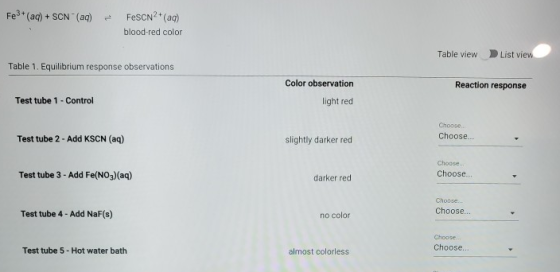
1. For test tubes 2 through 6, explain how each change affected the equilibrium in terms how each change affected the value of Qc or Kc and how this is consistent with your observation.
2. Based on your results from test tubes 5 and 6, is this reaction exothermic or endothermic. Give a reason for your choice.
Part II: Cobalt Chloride Reaction

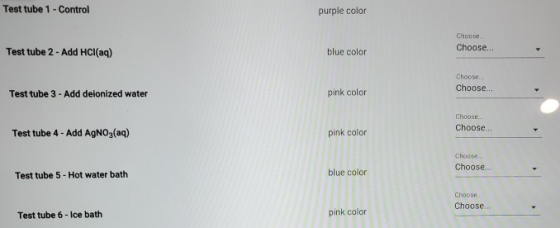
3. For test tubes 2 through 6, explain how each change affected the equilibrium in terms how each change affected the value of Qc or Kc. and how this is consistent with your observation.
4. Based on your results from test tubes 5 and 6, is this reaction exothermic or endothermic. Give a reason for your choice.
Homework Answers
Fe+3(aq) +
SCN-(aq) Fe (SCN)+2(aq)
2) addition of KSCN increases the concentration of reactant Qc decreases hence forward reaction is favored so sloution gets blood red colur
3) addition Fe(NO3)3(aq) incerase the concentration of ferric ion hence Qc decreases hence forward reaction is favored so sloution gets blood red colur
4) additon of NaF doesnt effect the equilibrium hence no change in colour is noticed , solid dont effect equilibrium
5) in Hot water bath it turns almost colourless indicate backward reaction is favored and is endothermic hence forward reaction is exothermic
part II
2) additon of HCl increases the concentraion of Cl- ion hence Qc increases if favor backward reaction henc solution get deep blue color
3) additon fo deionised water increases the concentration of the recatant , decreses the Qc that favor foraward reaction and pink color appears
4) additon of AgNO3(aq) removes the chloride from the solution hence it decreases the Qc that favor forward reaction and solution appear pink
5) on hot water bath it become blue means backward reaction is endothermic
6) on cooling if become pink means forward reaction is exothermic
in both reactions the value of Kc remain constant it change only with the change in temperature
Le Chatelier's Principle 3. For Part Ill, use Le Châteller's Principle to explain the colour changes...
 Le Chatelier's Principle 3. For Part Ill, use Le Châteller's Principle to explain the colour changes observed in test tubes 2 and 3 upon the addition of HC and A . Also, explain the observed colour changes in the test tubes placed in hot and cold water. (4 marks) Test Tube 2: Test Tube 3: Hot Water bath: Cold Water bath: Extension: 1. NaCl(aq) + HCl(aq) = NaCl(aq) + H2O + Cl2(g) When the above system is cooled, gas bubbles...
in terms of Le Chatelier's Principle Le Chatelier's Principle Post-Lab Questions (40 points) NAME Lab Day...
 in terms of Le Chatelier's Principle Le Chatelier's Principle Post-Lab Questions (40 points) NAME Lab Day Lab Instructor Date 1. Define Le Chatelier's Principle. Le chaldiers principe states that if a constraint aratur jr concentration) is appled to a sy, tem in equilibriun, the equilibrium will shift to counteract the effect 2. Why was it necessary to dilute your Fe(NCS)* stock solution? 3. Consider the following reaction: [CoC14)? (aq, blue) + 6H2O(l) = [Co(H20).]" (aq, pink) + 4Cl (aq) A....
How do I find the stress, shift and new equilibrium? Chemical Equilibria: Le Chatelier's Principle Report...
 How do I find the stress, shift and new equilibrium?
Chemical Equilibria: Le Chatelier's Principle Report Form Name: Partner's Name: " _cífany)-LabSection: MwTTH/M.TH/F Observations and Data cirele) 1. Shifing of equilibria in acid-base reactions; Stress due to common ion (a) The Chromate Ion-Dichromate Ion Equilibrium (i) Observation when H,so, is added to the Kco. solution Use net ionic equation and write out the pertinent equilibrium that illustrates what happened when H SO4 was added to the K:CrO4 solution. Indicate the...
How do I find the stress, shift and new equilibrium?
Chemical Equilibria: Le Chatelier's Principle Report Form Name: Partner's Name: " _cífany)-LabSection: MwTTH/M.TH/F Observations and Data cirele) 1. Shifing of equilibria in acid-base reactions; Stress due to common ion (a) The Chromate Ion-Dichromate Ion Equilibrium (i) Observation when H,so, is added to the Kco. solution Use net ionic equation and write out the pertinent equilibrium that illustrates what happened when H SO4 was added to the K:CrO4 solution. Indicate the...
5. Use Le Chatelier's principle to determine whether the equilibrium for the exothermic reaction below shifts...
 5. Use Le Chatelier's principle to determine whether the equilibrium for the exothermic reaction below shifts to the left, right, or does not change under each condition listed: N2(g) + 3H2(g) 2NH3(1) a. Some hydrogen is added b. A catalyst is added C. The temperature is raised d. The pressure is decreased by increasing the volume of the container
Font Open the Le Chatler's Principle Activity found in your textbook, Interactive General Chemistry. (Section 15.6,...
 Font Open the Le Chatler's Principle Activity found in your textbook, Interactive General Chemistry. (Section 15.6, Figure 15.9), run the simulation and complete the following questions. 1. Start with the default settings where K = 1.00. a. Write the expression based on the chemical equation in the upper right corner. b. Under the initial conditions of (A) = 2.00 M, and (B) = 4.00 M, is the reaction at equilibrium? How can you tell? c. Compare how Q is affected...
help please please chemistry REPORT SHEET EXPERIMENT Chemical Equilibrium: 4 Le Châtelier's Principle Part I. Changes...
 help please please
chemistry
REPORT SHEET EXPERIMENT Chemical Equilibrium: 4 Le Châtelier's Principle Part I. Changes in Reactant or Product Concentrations A. Copper and Nickel lons Colors: 1. CuSO4(aq) Blue 4. NiCl(aq) Green 2. [Cu(NH3)41+ (aq) Dok Blue 5. [Ni(NH). F+ (aq) Pale upolet 3. After HCI addition 6. After HCl addition Green Explain the effects of NH3(aq) and HCl(aq) on the Cuso, solution in terms of Le Châtelier's principle. 7. What initially forms as pale blue and pale green...
help please please
chemistry
REPORT SHEET EXPERIMENT Chemical Equilibrium: 4 Le Châtelier's Principle Part I. Changes in Reactant or Product Concentrations A. Copper and Nickel lons Colors: 1. CuSO4(aq) Blue 4. NiCl(aq) Green 2. [Cu(NH3)41+ (aq) Dok Blue 5. [Ni(NH). F+ (aq) Pale upolet 3. After HCI addition 6. After HCl addition Green Explain the effects of NH3(aq) and HCl(aq) on the Cuso, solution in terms of Le Châtelier's principle. 7. What initially forms as pale blue and pale green...
#8 10. Rewrite the nee d ed Part II. Dissolution of malum chloride a water Section...
 #8
10. Rewrite the nee d ed Part II. Dissolution of malum chloride a water Section A 1. Initial appearance of equilibrium m e Clear 2. Change after addition of cone HICH cloudy Nhile 3. Change after heating mature for 3-4 min Clear 4. Change after cooling mixture Section B Cloudy White Observations of dissolution of solid NH.C in water, The dissolution is cold, Conclusions 5. The equation for the dissolution of NHCl in water is: NH.C($) 5 NH' (aq)...
#8
10. Rewrite the nee d ed Part II. Dissolution of malum chloride a water Section A 1. Initial appearance of equilibrium m e Clear 2. Change after addition of cone HICH cloudy Nhile 3. Change after heating mature for 3-4 min Clear 4. Change after cooling mixture Section B Cloudy White Observations of dissolution of solid NH.C in water, The dissolution is cold, Conclusions 5. The equation for the dissolution of NHCl in water is: NH.C($) 5 NH' (aq)...
Le Chateler's principle In the chart below: • Indicate the color of each solution as darker...
 Le
Chateler's principle
In the chart below: • Indicate the color of each solution as darker or lighter than the control after the addition of the specified substance. • Indicate the direction the equilibrium shifted as "toward products" or "toward reactants" based on the color change. • Based on the direction of the shift, indicate the substance(s) that increased which will either be the two reactants present on the reactant side of the equilibrium equation or the complex present on...
Le
Chateler's principle
In the chart below: • Indicate the color of each solution as darker or lighter than the control after the addition of the specified substance. • Indicate the direction the equilibrium shifted as "toward products" or "toward reactants" based on the color change. • Based on the direction of the shift, indicate the substance(s) that increased which will either be the two reactants present on the reactant side of the equilibrium equation or the complex present on...
Need help understading the results of this lab that's about equilibrium and Le Chatelier's principle Reaults:...
 Need help understading the results of this lab that's about
equilibrium and Le Chatelier's principle
Reaults:
(#4) The addition of solid sodium acetate:
turned the solution green
(#5) The addition of NaOH:
turned the solution blue
System IV Acetic acid with bromocresol green indicator 1. Place about 10 drops of 0.1M HCl solution into a well and add one drop of bromocresol green to the well. Save as a color reference. 2. Place about 10 drops of 0.1M NaOH solution...
Need help understading the results of this lab that's about
equilibrium and Le Chatelier's principle
Reaults:
(#4) The addition of solid sodium acetate:
turned the solution green
(#5) The addition of NaOH:
turned the solution blue
System IV Acetic acid with bromocresol green indicator 1. Place about 10 drops of 0.1M HCl solution into a well and add one drop of bromocresol green to the well. Save as a color reference. 2. Place about 10 drops of 0.1M NaOH solution...
= 1-Lab from Chapter 15 Eq and Le Chat - Word Search Design Layout References Mailings...
 = 1-Lab from Chapter 15 Eq and Le Chat - Word Search Design Layout References Mailings Review View Help Add i nk Ink to Ink to Drawing Ink Pen Editor Shape Math C anvas Replay Convert Replay Open the Le Chatlier's Principle Activity found in your textbook, Interactive General Chemistry. (Section 15.6, Figure 15.9), run the simulation and complete the following questions. Pens insert 1. Start with the default settings where K - 1.00. a. Write the expression based on...
 Le Chatelier's Principle 3. For Part Ill, use Le Châteller's Principle to explain the colour changes observed in test tubes 2 and 3 upon the addition of HC and A . Also, explain the observed colour changes in the test tubes placed in hot and cold water. (4 marks) Test Tube 2: Test Tube 3: Hot Water bath: Cold Water bath: Extension: 1. NaCl(aq) + HCl(aq) = NaCl(aq) + H2O + Cl2(g) When the above system is cooled, gas bubbles...
 in terms of Le Chatelier's Principle Le Chatelier's Principle Post-Lab Questions (40 points) NAME Lab Day Lab Instructor Date 1. Define Le Chatelier's Principle. Le chaldiers principe states that if a constraint aratur jr concentration) is appled to a sy, tem in equilibriun, the equilibrium will shift to counteract the effect 2. Why was it necessary to dilute your Fe(NCS)* stock solution? 3. Consider the following reaction: [CoC14)? (aq, blue) + 6H2O(l) = [Co(H20).]" (aq, pink) + 4Cl (aq) A....
 How do I find the stress, shift and new equilibrium?
Chemical Equilibria: Le Chatelier's Principle Report Form Name: Partner's Name: " _cífany)-LabSection: MwTTH/M.TH/F Observations and Data cirele) 1. Shifing of equilibria in acid-base reactions; Stress due to common ion (a) The Chromate Ion-Dichromate Ion Equilibrium (i) Observation when H,so, is added to the Kco. solution Use net ionic equation and write out the pertinent equilibrium that illustrates what happened when H SO4 was added to the K:CrO4 solution. Indicate the...
How do I find the stress, shift and new equilibrium?
Chemical Equilibria: Le Chatelier's Principle Report Form Name: Partner's Name: " _cífany)-LabSection: MwTTH/M.TH/F Observations and Data cirele) 1. Shifing of equilibria in acid-base reactions; Stress due to common ion (a) The Chromate Ion-Dichromate Ion Equilibrium (i) Observation when H,so, is added to the Kco. solution Use net ionic equation and write out the pertinent equilibrium that illustrates what happened when H SO4 was added to the K:CrO4 solution. Indicate the...
 5. Use Le Chatelier's principle to determine whether the equilibrium for the exothermic reaction below shifts to the left, right, or does not change under each condition listed: N2(g) + 3H2(g) 2NH3(1) a. Some hydrogen is added b. A catalyst is added C. The temperature is raised d. The pressure is decreased by increasing the volume of the container
 Font Open the Le Chatler's Principle Activity found in your textbook, Interactive General Chemistry. (Section 15.6, Figure 15.9), run the simulation and complete the following questions. 1. Start with the default settings where K = 1.00. a. Write the expression based on the chemical equation in the upper right corner. b. Under the initial conditions of (A) = 2.00 M, and (B) = 4.00 M, is the reaction at equilibrium? How can you tell? c. Compare how Q is affected...
 help please please
chemistry
REPORT SHEET EXPERIMENT Chemical Equilibrium: 4 Le Châtelier's Principle Part I. Changes in Reactant or Product Concentrations A. Copper and Nickel lons Colors: 1. CuSO4(aq) Blue 4. NiCl(aq) Green 2. [Cu(NH3)41+ (aq) Dok Blue 5. [Ni(NH). F+ (aq) Pale upolet 3. After HCI addition 6. After HCl addition Green Explain the effects of NH3(aq) and HCl(aq) on the Cuso, solution in terms of Le Châtelier's principle. 7. What initially forms as pale blue and pale green...
help please please
chemistry
REPORT SHEET EXPERIMENT Chemical Equilibrium: 4 Le Châtelier's Principle Part I. Changes in Reactant or Product Concentrations A. Copper and Nickel lons Colors: 1. CuSO4(aq) Blue 4. NiCl(aq) Green 2. [Cu(NH3)41+ (aq) Dok Blue 5. [Ni(NH). F+ (aq) Pale upolet 3. After HCI addition 6. After HCl addition Green Explain the effects of NH3(aq) and HCl(aq) on the Cuso, solution in terms of Le Châtelier's principle. 7. What initially forms as pale blue and pale green...
 #8
10. Rewrite the nee d ed Part II. Dissolution of malum chloride a water Section A 1. Initial appearance of equilibrium m e Clear 2. Change after addition of cone HICH cloudy Nhile 3. Change after heating mature for 3-4 min Clear 4. Change after cooling mixture Section B Cloudy White Observations of dissolution of solid NH.C in water, The dissolution is cold, Conclusions 5. The equation for the dissolution of NHCl in water is: NH.C($) 5 NH' (aq)...
#8
10. Rewrite the nee d ed Part II. Dissolution of malum chloride a water Section A 1. Initial appearance of equilibrium m e Clear 2. Change after addition of cone HICH cloudy Nhile 3. Change after heating mature for 3-4 min Clear 4. Change after cooling mixture Section B Cloudy White Observations of dissolution of solid NH.C in water, The dissolution is cold, Conclusions 5. The equation for the dissolution of NHCl in water is: NH.C($) 5 NH' (aq)...
 Le
Chateler's principle
In the chart below: • Indicate the color of each solution as darker or lighter than the control after the addition of the specified substance. • Indicate the direction the equilibrium shifted as "toward products" or "toward reactants" based on the color change. • Based on the direction of the shift, indicate the substance(s) that increased which will either be the two reactants present on the reactant side of the equilibrium equation or the complex present on...
Le
Chateler's principle
In the chart below: • Indicate the color of each solution as darker or lighter than the control after the addition of the specified substance. • Indicate the direction the equilibrium shifted as "toward products" or "toward reactants" based on the color change. • Based on the direction of the shift, indicate the substance(s) that increased which will either be the two reactants present on the reactant side of the equilibrium equation or the complex present on...
 Need help understading the results of this lab that's about
equilibrium and Le Chatelier's principle
Reaults:
(#4) The addition of solid sodium acetate:
turned the solution green
(#5) The addition of NaOH:
turned the solution blue
System IV Acetic acid with bromocresol green indicator 1. Place about 10 drops of 0.1M HCl solution into a well and add one drop of bromocresol green to the well. Save as a color reference. 2. Place about 10 drops of 0.1M NaOH solution...
Need help understading the results of this lab that's about
equilibrium and Le Chatelier's principle
Reaults:
(#4) The addition of solid sodium acetate:
turned the solution green
(#5) The addition of NaOH:
turned the solution blue
System IV Acetic acid with bromocresol green indicator 1. Place about 10 drops of 0.1M HCl solution into a well and add one drop of bromocresol green to the well. Save as a color reference. 2. Place about 10 drops of 0.1M NaOH solution...
 = 1-Lab from Chapter 15 Eq and Le Chat - Word Search Design Layout References Mailings Review View Help Add i nk Ink to Ink to Drawing Ink Pen Editor Shape Math C anvas Replay Convert Replay Open the Le Chatlier's Principle Activity found in your textbook, Interactive General Chemistry. (Section 15.6, Figure 15.9), run the simulation and complete the following questions. Pens insert 1. Start with the default settings where K - 1.00. a. Write the expression based on...
Most questions answered within 3 hours.
-
Where is the error in this code sequence?
String s1 = "Hello";
String s2 = "ello";...
asked 10 months ago -
Financial data for Joel de Paris, Inc., for last year
follow:
Joel de Paris, Inc.
Balance...
asked 10 months ago -
Consider this reaction:
Al2(SO4)3 (aq)+ BaCl3
(aq) Al2Cl6 (aq)- +
3BaSO4(s) . What is the...
asked 10 months ago -
Suppose that Savneet is considering increasing her
recent random sample from 20 car rentals to 40...
asked 10 months ago -
Trucks arrive at an unloading terminal at an average rate of 120
per hour.
Trucks arrive...
asked 10 months ago -
Why are methanol and ethanol completely soluble in water while
octanol is not very little soluble....
asked 10 months ago -
A facilities manager at a university reads in a research report
that the mean amount of...
asked 10 months ago -
When the CuSO4 is rehydrated by adding water to the anhydrous
compound, is this an endothermic...
asked 10 months ago -
A ray of sunlight is passing from diamond into crown glass; the
angle of incidence is...
asked 10 months ago -
A block of mass 0.249 kg is placed on top of a light, vertical
spring of...
asked 10 months ago -
how do the kidneys compensate in the presences of acidosis
a) trigger hyperventilate
b) reserve acid...
asked 10 months ago -
Question 501 pts
The rental rate of capital to the firm increases. Which of the
following...
asked 10 months ago