You have decided to patent a new temperature scale, called the C51 unit. The C51 units...
You have decided to patent a new temperature scale, called the C51 unit. The C51 units are not based on water, but rather dichloromethane, CH2Cl2, which melts at -97C and boils at 40C. You have decided that on your scale, the freezing point of dichloromethane is +1000 C51 and the boiling point is -1000 C51. Determine the relationship to convert C into C51 and C51 into C.
Homework Answers
The relationship between two scales of any temperature
is givenn by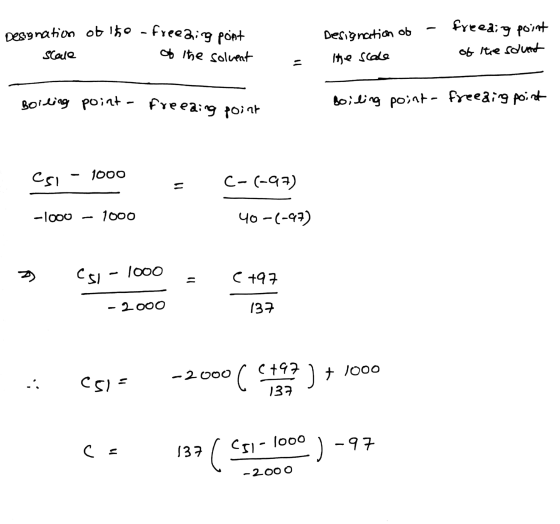
Add Answer to:
You have decided to patent a new temperature scale, called the
C51 unit. The C51 units...
A temperature scale has been defined where 11.1 degrees is the freezing point of water and...
A temperature scale has been defined where 11.1 degrees is the freezing point of water and 492 is the boiling point of water. convert 9.98 degrees C to these new deg X.
Java please The kelvin is the base unit of temperature in the International System of Units...
Java please The kelvin is the base unit of temperature in the International System of Units (SI), having the unit symbol K. It is named after the Belfast-born, Glasgow University engineer and physicist William Thomson, 1st Baron Kelvin (1824–1907). It uses absolute zero as its null point. The Celsius scale, also known as the centigrade scale, is a temperature scale used by the International System of Units (SI). The Celsius scale is based on 0 °C for the freezing point...
You decide to establish a new temperature scale on which the melting point of ammonia (-77.75...
You decide to establish a new temperature scale on which the melting point of ammonia (-77.75 ∘C) is 0∘A, and the boiling point of ammonia (-33.35∘C) is 200 ∘A. 1) What would be the boiling point of water in A? 2) What would be the temperature of absolute zero in A?
You propose a new temperature scale with temperatures given in °E. You define 0.0°E to be...
You propose a new temperature scale with temperatures given in °E. You define 0.0°E to be the normal melting point of ethanol and 255°E to be the normal boiling point of ethanol. (a) What is the normal boiling point of water in °E? (b) A temperature change of 10.0E° corresponds to how many C°? (final Answer: a) 284.2°E, b) 7.5C° please show me the complete working solution and rationale.
Wrap up question 1: You have a liter of liquid nitrogen at -250 C, well below...
Wrap up question 1: You have a liter of liquid nitrogen at -250 C, well below its boiling point. What happens as you add heat to the liquid nitrogen, before it reaches its boiling point? Wrap up question 2: You have a liter of liquid nitrogen at -250 C. If you raise the temperature to -195 C, the nitrogen will convert to the gas phase. You continue to add more heat to the nitrogen, so what happens to the temperature...
You propose a new temperature scale with temperatures given in ∘M. You define 0.0 ∘M to be the normal melting point of mercury and 100.0 ∘M to be the normal boiling point of mercury. A. What is the no...
You propose a new temperature scale with temperatures given in ∘M. You define 0.0 ∘M to be the normal melting point of mercury and 100.0 ∘M to be the normal boiling point of mercury. A. What is the normal boiling point of water in ∘M? B. A temperature change of 16.0 ∘M corresponds to how many ∘C?
13,16,19 1. Which unit of measure represents the greater change amount of temperature change: Fahremheit or...
 13,16,19
1. Which unit of measure represents the greater change amount of temperature change: Fahremheit or Celsius EXPLAIN YOUR ANSWER in a few words. 14 A) Convert 42 degC to degF. B) At what temperature, if any, do the Fahremheit and Celsius scales read the same number? 15. 180 dęgF to Kelvin degrees 80'F-32)xA+213.15:355.372K 16. Given a temperature of so degC, what would be the new temperature in degC if the temperature of the material were to triple? 17. How...
13,16,19
1. Which unit of measure represents the greater change amount of temperature change: Fahremheit or Celsius EXPLAIN YOUR ANSWER in a few words. 14 A) Convert 42 degC to degF. B) At what temperature, if any, do the Fahremheit and Celsius scales read the same number? 15. 180 dęgF to Kelvin degrees 80'F-32)xA+213.15:355.372K 16. Given a temperature of so degC, what would be the new temperature in degC if the temperature of the material were to triple? 17. How...
C++ optional exercise. You are going to convert temperatures in this program. You will give the...
C++ optional exercise. You are going to convert temperatures in this program. You will give the user the choice of converting Fahrenheit to Celsius or Celsius to Fahrenheit. With the correct answer you will also display the number entered. The user should have the option to convert as many temperatures as they want. Use functions and a menu (also a function) and, assume they will convert at least one temperature. When finished upload and submit the zipped project. the formulas...
help me out please lland 2.) You have a new set of automobile radiators to test,...
 help me out please
lland 2.) You have a new set of automobile radiators to test, but had forgotten to obtain antifreeze/radiator coolant to do the test. Let's say your test radiators are cheap/disposable. Based on the material that you covered in Chapter 8 (colligative properties), you know that you can use salt or sugar to increase the boiling point or lower the freezing point. Therefore, you attempt to do a quick-and-crude test on the radiators using ordinary Table Sugar...
help me out please
lland 2.) You have a new set of automobile radiators to test, but had forgotten to obtain antifreeze/radiator coolant to do the test. Let's say your test radiators are cheap/disposable. Based on the material that you covered in Chapter 8 (colligative properties), you know that you can use salt or sugar to increase the boiling point or lower the freezing point. Therefore, you attempt to do a quick-and-crude test on the radiators using ordinary Table Sugar...
Question 1 (1 point) Using the solubility curve, at which temperature do KCl and KCIO, have...
 Question 1 (1 point) Using the solubility curve, at which temperature do KCl and KCIO, have the same solubility? Solubility Curve Grams of solute/100g H30 to .- 30. 0 10 70 80 90 100 20 30 40 50 60 Temperature (°C) O 93°C 56°C O 85°C 0750 Previous Page Next Page Page 2 of 24 Question 2 (1 point) Saline (salt) solution is 0.9% by mass which is similar to tears, blood, and other body fluids. Which of the following...
 13,16,19
1. Which unit of measure represents the greater change amount of temperature change: Fahremheit or Celsius EXPLAIN YOUR ANSWER in a few words. 14 A) Convert 42 degC to degF. B) At what temperature, if any, do the Fahremheit and Celsius scales read the same number? 15. 180 dęgF to Kelvin degrees 80'F-32)xA+213.15:355.372K 16. Given a temperature of so degC, what would be the new temperature in degC if the temperature of the material were to triple? 17. How...
13,16,19
1. Which unit of measure represents the greater change amount of temperature change: Fahremheit or Celsius EXPLAIN YOUR ANSWER in a few words. 14 A) Convert 42 degC to degF. B) At what temperature, if any, do the Fahremheit and Celsius scales read the same number? 15. 180 dęgF to Kelvin degrees 80'F-32)xA+213.15:355.372K 16. Given a temperature of so degC, what would be the new temperature in degC if the temperature of the material were to triple? 17. How...
 help me out please
lland 2.) You have a new set of automobile radiators to test, but had forgotten to obtain antifreeze/radiator coolant to do the test. Let's say your test radiators are cheap/disposable. Based on the material that you covered in Chapter 8 (colligative properties), you know that you can use salt or sugar to increase the boiling point or lower the freezing point. Therefore, you attempt to do a quick-and-crude test on the radiators using ordinary Table Sugar...
help me out please
lland 2.) You have a new set of automobile radiators to test, but had forgotten to obtain antifreeze/radiator coolant to do the test. Let's say your test radiators are cheap/disposable. Based on the material that you covered in Chapter 8 (colligative properties), you know that you can use salt or sugar to increase the boiling point or lower the freezing point. Therefore, you attempt to do a quick-and-crude test on the radiators using ordinary Table Sugar...
 Question 1 (1 point) Using the solubility curve, at which temperature do KCl and KCIO, have the same solubility? Solubility Curve Grams of solute/100g H30 to .- 30. 0 10 70 80 90 100 20 30 40 50 60 Temperature (°C) O 93°C 56°C O 85°C 0750 Previous Page Next Page Page 2 of 24 Question 2 (1 point) Saline (salt) solution is 0.9% by mass which is similar to tears, blood, and other body fluids. Which of the following...
Most questions answered within 3 hours.
-
Where is the error in this code sequence?
String s1 = "Hello";
String s2 = "ello";...
asked 10 months ago -
Financial data for Joel de Paris, Inc., for last year
follow:
Joel de Paris, Inc.
Balance...
asked 10 months ago -
Consider this reaction:
Al2(SO4)3 (aq)+ BaCl3
(aq) Al2Cl6 (aq)- +
3BaSO4(s) . What is the...
asked 10 months ago -
Suppose that Savneet is considering increasing her
recent random sample from 20 car rentals to 40...
asked 10 months ago -
Trucks arrive at an unloading terminal at an average rate of 120
per hour.
Trucks arrive...
asked 10 months ago -
Why are methanol and ethanol completely soluble in water while
octanol is not very little soluble....
asked 10 months ago -
A facilities manager at a university reads in a research report
that the mean amount of...
asked 10 months ago -
When the CuSO4 is rehydrated by adding water to the anhydrous
compound, is this an endothermic...
asked 10 months ago -
A ray of sunlight is passing from diamond into crown glass; the
angle of incidence is...
asked 10 months ago -
A block of mass 0.249 kg is placed on top of a light, vertical
spring of...
asked 10 months ago -
how do the kidneys compensate in the presences of acidosis
a) trigger hyperventilate
b) reserve acid...
asked 10 months ago -
Question 501 pts
The rental rate of capital to the firm increases. Which of the
following...
asked 10 months ago