Consider the reaction below. The initial concentration of KBr is 0.0183 M, and the initial concentrations...
Consider the reaction below. The initial concentration of KBr is 0.0183 M, and the initial concentrations of K+ and Br− are each 0 M. If the equilibrium constant is Kc=7.76 under certain conditions, what is the equilibrium concentration of KBr?
KBr(aq)⇌K+(aq)+Br−(aq)
Remember to use correct significant figures in your answer (round your answer to the nearest hundredth).
Homework Answers
![It cag.) + Bor caq. I Given, equilibrium, KBr cag.) a (Initially) 0.0183 (change) -2 ( At equilibrium] (0.0183-2) tu So, as k](http://img.homeworklib.com/questions/e7e51140-557b-11eb-81b5-fbfdb796cd18.png?x-oss-process=image/resize,w_560)
Add Answer to:
Consider the reaction below. The initial concentration of KBr is
0.0183 M, and the initial concentrations...
The initial concentrations of L, and I in the reaction below are each 0.0401 M. If...
 The initial concentrations of L, and I in the reaction below are each 0.0401 M. If the initial concentration of I, is 0.0 M and the equilibrium constant is K. 0.25 under certain conditions, what is the equilibrium concentration (in molarity) of 12 I, (aq) = L(aq) +T" (aq) • Your answer should include two significant figures.
QUESTION 18.1 POINT The initial concentrations of Na+ and Cl” in the reaction below are each...
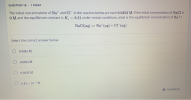 QUESTION 18.1 POINT The initial concentrations of Na+ and Cl” in the reaction below are each 0.0434 M. If the initial concentration of NaCl is OM and the equilibrium constant is K-8.21 under certain conditions, what is the equilibrium concentration of Nat? NaCl(aq) Na+ (aq) + Cl(aq) Select the correct answer below: O 0.0281 M O 0.0354 M O 0.0432 M 6,81 10 M FEEDBACK
The equilibrium constant Kc for the reaction below is 0.00491 at a certain temperature. If the initial concentrations are [Br2l-0.0860 M and [Br concentrations of these species at equilibrium. 0.0362...
 The equilibrium constant Kc for the reaction below is 0.00491 at a certain temperature. If the initial concentrations are [Br2l-0.0860 M and [Br concentrations of these species at equilibrium. 0.0362 M, calculate the [Br] =
The equilibrium constant Kc for the reaction below is 0.00491 at a certain temperature. If the initial concentrations are [Br2l-0.0860 M and [Br concentrations of these species at equilibrium. 0.0362 M, calculate the [Br] =
The equilibrium constant Kc for the reaction below is 0.00491 at a certain temperature. If the initial concentrations are [Br2l-0.0860 M and [Br concentrations of these species at equilibrium. 0.0362 M, calculate the [Br] =
Consider the reaction below. At equilibrium, the concentration of A is 0.0242 M and the concentration...
Consider the reaction below. At equilibrium, the concentration of A is 0.0242 M and the concentration of B is 0.0767 M. If the equilibrium constant is Kc=0.0266, what is the equilibrium concentration of C? 3A(g)⇌3B(g)+2C(g) Round the answer to three significant figures.
Consider the reaction and associated equilibrium constant. aA(g)⇌bB(g)Kc=2.0 A.) Find the equilibrium concentrations of A and...
 Consider the reaction and associated equilibrium constant.
aA(g)⇌bB(g)Kc=2.0
A.) Find the equilibrium concentrations of A and B for
a = 1 and b = 1. Assume that the initial
concentration of A is 1.0 M and that no B is present at the
beginning of the reaction.
B.) Find the equilibrium concentrations of
A and B for a = 2 and b = 2. Assume that the
initial concentration of A is 1.0 M and that no B is present...
Consider the reaction and associated equilibrium constant.
aA(g)⇌bB(g)Kc=2.0
A.) Find the equilibrium concentrations of A and B for
a = 1 and b = 1. Assume that the initial
concentration of A is 1.0 M and that no B is present at the
beginning of the reaction.
B.) Find the equilibrium concentrations of
A and B for a = 2 and b = 2. Assume that the
initial concentration of A is 1.0 M and that no B is present...
Consider the following reaction: Fe3+(aq)+SCN−(aq)⇌FeSCN2+(aq) A solution is made containing an initial [Fe3+] of 1.2×10⁻³ M...
Consider the following reaction: Fe3+(aq)+SCN−(aq)⇌FeSCN2+(aq) A solution is made containing an initial [Fe3+] of 1.2×10⁻³ M and an initial [SCN−] of 8.2×10⁻⁴ M . At equilibrium, [FeSCN2+]= 1.8×10⁻⁴ M . Calculate the value of the equilibrium constant (Kc)(Kc). Express your answer using two significant figures.
For the reaction H_2(g) + S(g) H_2S(g) the initial concentrations are 0.060 M H_2, 0.080 MS,...
 For the reaction H_2(g) + S(g) H_2S(g) the initial concentrations are 0.060 M H_2, 0.080 MS, and no H_2S. At equilibrium, [H_2] = 0.010 M. Calculate the concentrations of S and H_2S at equilibrium. (Be sure to give your answers to three decimal places.) M S M H_2 S Calculate the value of K under the reaction conditions at equilibrium. (Be sure your answer has the appropriate number of significant figures.)
Consider the following reaction and associated equilibrium constant: aA(g)⇌bB(g), Kc = 1.1 Find the equilibrium concentrations...
Consider the following reaction and associated equilibrium constant: aA(g)⇌bB(g), Kc = 1.1 Find the equilibrium concentrations of A and B for a = 1 and b = 2. Assume that the initial concentration of A is 1.0 M and that no B is present at the beginning of the reaction. Express your answers using two significant figures separated by a comma.
Consider the following reaction and associated equilibrium constant: aA(g)⇌bB(g), Kc = 3.2 Find the equilibrium concentrations...
Consider the following reaction and associated equilibrium constant: aA(g)⇌bB(g), Kc = 3.2 Find the equilibrium concentrations of A and B for a = 2 and b = 1. Assume that the initial concentration of A is 1.0 M and that no B is present at the beginning of the reaction. Express your answers using two significant figures separated by a comma.
(a) Write the expression for the equilibrium constant (Kc) (b) Find Kc, when the equilibrium concentrations...
 (a)
Write the expression for the equilibrium constant (Kc)
(b)
Find Kc, when the equilibrium concentrations for NOBr, NO and Br2
are 0.46 M, 0.1 M and 0.3 M respectively. Report to 3 Significant
figures.
(c)
Find Kp for the abovementioned reaction at 25°C. (R=0.082 L.
atm/mole.K)
(d)
Find Kc, for this reaction: NO(g) + 1/2 Br2 (g) <-> NOBr
(g)
1. Consider this reaction to answer the following questions touteiluna ada se in contain yo. 2NOBr (g) 2NO(g) +...
(a)
Write the expression for the equilibrium constant (Kc)
(b)
Find Kc, when the equilibrium concentrations for NOBr, NO and Br2
are 0.46 M, 0.1 M and 0.3 M respectively. Report to 3 Significant
figures.
(c)
Find Kp for the abovementioned reaction at 25°C. (R=0.082 L.
atm/mole.K)
(d)
Find Kc, for this reaction: NO(g) + 1/2 Br2 (g) <-> NOBr
(g)
1. Consider this reaction to answer the following questions touteiluna ada se in contain yo. 2NOBr (g) 2NO(g) +...
 The initial concentrations of L, and I in the reaction below are each 0.0401 M. If the initial concentration of I, is 0.0 M and the equilibrium constant is K. 0.25 under certain conditions, what is the equilibrium concentration (in molarity) of 12 I, (aq) = L(aq) +T" (aq) • Your answer should include two significant figures.
 QUESTION 18.1 POINT The initial concentrations of Na+ and Cl” in the reaction below are each 0.0434 M. If the initial concentration of NaCl is OM and the equilibrium constant is K-8.21 under certain conditions, what is the equilibrium concentration of Nat? NaCl(aq) Na+ (aq) + Cl(aq) Select the correct answer below: O 0.0281 M O 0.0354 M O 0.0432 M 6,81 10 M FEEDBACK
 The equilibrium constant Kc for the reaction below is 0.00491 at a certain temperature. If the initial concentrations are [Br2l-0.0860 M and [Br concentrations of these species at equilibrium. 0.0362 M, calculate the [Br] =
The equilibrium constant Kc for the reaction below is 0.00491 at a certain temperature. If the initial concentrations are [Br2l-0.0860 M and [Br concentrations of these species at equilibrium. 0.0362 M, calculate the [Br] =
The equilibrium constant Kc for the reaction below is 0.00491 at a certain temperature. If the initial concentrations are [Br2l-0.0860 M and [Br concentrations of these species at equilibrium. 0.0362 M, calculate the [Br] =
 Consider the reaction and associated equilibrium constant.
aA(g)⇌bB(g)Kc=2.0
A.) Find the equilibrium concentrations of A and B for
a = 1 and b = 1. Assume that the initial
concentration of A is 1.0 M and that no B is present at the
beginning of the reaction.
B.) Find the equilibrium concentrations of
A and B for a = 2 and b = 2. Assume that the
initial concentration of A is 1.0 M and that no B is present...
Consider the reaction and associated equilibrium constant.
aA(g)⇌bB(g)Kc=2.0
A.) Find the equilibrium concentrations of A and B for
a = 1 and b = 1. Assume that the initial
concentration of A is 1.0 M and that no B is present at the
beginning of the reaction.
B.) Find the equilibrium concentrations of
A and B for a = 2 and b = 2. Assume that the
initial concentration of A is 1.0 M and that no B is present...
 For the reaction H_2(g) + S(g) H_2S(g) the initial concentrations are 0.060 M H_2, 0.080 MS, and no H_2S. At equilibrium, [H_2] = 0.010 M. Calculate the concentrations of S and H_2S at equilibrium. (Be sure to give your answers to three decimal places.) M S M H_2 S Calculate the value of K under the reaction conditions at equilibrium. (Be sure your answer has the appropriate number of significant figures.)
 (a)
Write the expression for the equilibrium constant (Kc)
(b)
Find Kc, when the equilibrium concentrations for NOBr, NO and Br2
are 0.46 M, 0.1 M and 0.3 M respectively. Report to 3 Significant
figures.
(c)
Find Kp for the abovementioned reaction at 25°C. (R=0.082 L.
atm/mole.K)
(d)
Find Kc, for this reaction: NO(g) + 1/2 Br2 (g) <-> NOBr
(g)
1. Consider this reaction to answer the following questions touteiluna ada se in contain yo. 2NOBr (g) 2NO(g) +...
(a)
Write the expression for the equilibrium constant (Kc)
(b)
Find Kc, when the equilibrium concentrations for NOBr, NO and Br2
are 0.46 M, 0.1 M and 0.3 M respectively. Report to 3 Significant
figures.
(c)
Find Kp for the abovementioned reaction at 25°C. (R=0.082 L.
atm/mole.K)
(d)
Find Kc, for this reaction: NO(g) + 1/2 Br2 (g) <-> NOBr
(g)
1. Consider this reaction to answer the following questions touteiluna ada se in contain yo. 2NOBr (g) 2NO(g) +...
Most questions answered within 3 hours.
-
Where is the error in this code sequence?
String s1 = "Hello";
String s2 = "ello";...
asked 10 months ago -
Financial data for Joel de Paris, Inc., for last year
follow:
Joel de Paris, Inc.
Balance...
asked 10 months ago -
Consider this reaction:
Al2(SO4)3 (aq)+ BaCl3
(aq) Al2Cl6 (aq)- +
3BaSO4(s) . What is the...
asked 10 months ago -
Suppose that Savneet is considering increasing her
recent random sample from 20 car rentals to 40...
asked 10 months ago -
Trucks arrive at an unloading terminal at an average rate of 120
per hour.
Trucks arrive...
asked 10 months ago -
Why are methanol and ethanol completely soluble in water while
octanol is not very little soluble....
asked 10 months ago -
A facilities manager at a university reads in a research report
that the mean amount of...
asked 10 months ago -
When the CuSO4 is rehydrated by adding water to the anhydrous
compound, is this an endothermic...
asked 10 months ago -
A ray of sunlight is passing from diamond into crown glass; the
angle of incidence is...
asked 10 months ago -
A block of mass 0.249 kg is placed on top of a light, vertical
spring of...
asked 10 months ago -
how do the kidneys compensate in the presences of acidosis
a) trigger hyperventilate
b) reserve acid...
asked 10 months ago -
Question 501 pts
The rental rate of capital to the firm increases. Which of the
following...
asked 10 months ago