1)
2)
3)
4)
Help ASAP. will choose best answer quickly.
Homework Answers
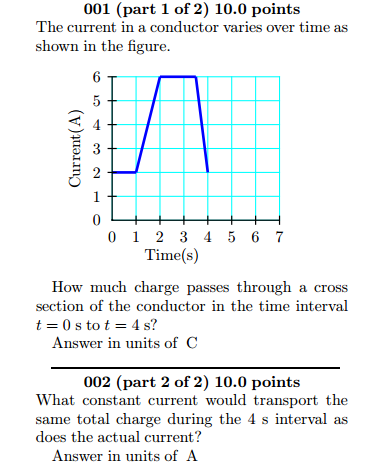
1). current = dq/dt
so Q= idt
so current passed during this time = area under the curve fro t=0 to t= 4s
so
charge transfereed=2*1+1/2*4*1+6*1.5+1/2*.5*4
= 14 Coulomb
b). i*4= 14
so i= 14/4
= 3.5 A
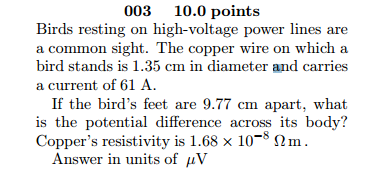
2). resistance of 9.77 cm of copper wire is R= rho*L/A
=1.68*10^-8*9.77*10^-2/[3.14*(1.35/2)^2*10^-4]
=1.1472*10^-5 ohm
so voltage difference= iR
=61*R
= 6.998*10^-4 V
=699.8 u V
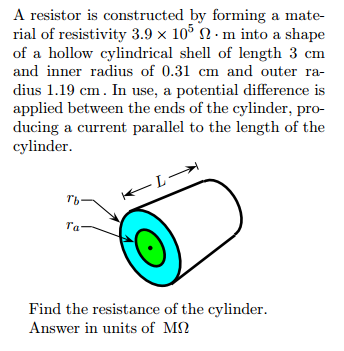
3).dR = ?*dr/(2*?*r*L)
Integrate
?dR = ?/(2*?*L) * ?(1/r)*dr
R = ?/(2*?*L) * ln(r) [r = ra to rb)
R = ?/(2*?*L) * [ln(rb) - ln(ra)]
R = ?/(2*?*L) * ln(rb/ra)
R=3.9*10^5/(2*3.14*0.03)*ln(1.19/0.31)
R=2.78 Mohm
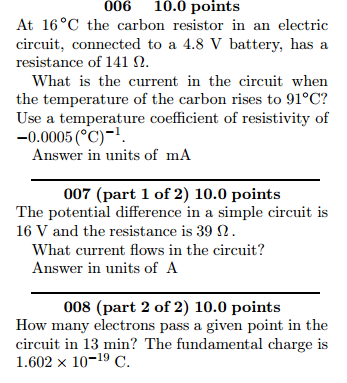
4).ner resistance is R= Ro(1-5*10^-4*(91-16)
Ro= 141
so R=135.72
so I= Vo/R
= 4.8/135.72
=0.0353688 A
= 35.368 mA
7). I= V/R
=16/39=0.41 A
8)n= i*t/1.6*10^-19
= 0.41*16*60/1.6*10^-19
= 2.46*10^21 electrons
Add Answer to:
1)
2)
3)
4)
Help ASAP. will choose best answer quickly.
The current in the conductor...
2. 4/4 POINTS PREVIOUS ANSWERS SHIPPS13 8.1.006. A current of 7.50 A flows in a conductor...
 2. 4/4 POINTS PREVIOUS ANSWERS SHIPPS13 8.1.006. A current of 7.50 A flows in a conductor for 8.0 s. How much charge passes a given point in the conductor during this time? Need Help? Talk to. Tutor 0/4 POINTS PREVIOUS ANSWERS SHIPPS13 8.E.007. To separate a 0.13 C charge from another charge, 17 ) of work is done. What is the electric potential energy of the charge? X Need Help? Talk to a Tutor Submit Answer Practice Another Version
question 2,7,9 please Charge 1. (10 points) What is the current through a conductor if X...
 question 2,7,9 please
Charge 1. (10 points) What is the current through a conductor if X electrons pass through a cross section in Y time? 2. (10 points) The current flowing through a conductor is X. If it flows for Y time, how many electrons is that X = 100 microamps, Y = 2 days 3. (10 points) A current XuA flows and Y electrons are transported. How long did it take? Resistivity 4. (10 points) An object is round...
question 2,7,9 please
Charge 1. (10 points) What is the current through a conductor if X electrons pass through a cross section in Y time? 2. (10 points) The current flowing through a conductor is X. If it flows for Y time, how many electrons is that X = 100 microamps, Y = 2 days 3. (10 points) A current XuA flows and Y electrons are transported. How long did it take? Resistivity 4. (10 points) An object is round...
The figure below is a cross-sectional view of a convial cable. The center conductor is surrounded...
 The figure below is a cross-sectional view of a convial cable. The center conductor is surrounded by a rubber layer, an outer conductor, and another rubber layer. In a particular application, the current in the inner conductor is 11 - 1.12 A out of the page and the current in the outer conductor is 3.18 A into the page. Assuming the distance de 100 m, answer the following (a) Determine the magnitude and direction of the magnetic field at point...
4) A conductor hangs as shown in the figure with the help of two flexible wires....
 4)
A conductor hangs as shown in the figure with the help of two
flexible wires. The mass amount (mass density) of the conductor per
unit length is 0.0100 kg / m. The magnitude of the magnetic field
towards the page is 3.50 T. How much should the current flow
through the conductor be so that the strain on the flexible wires
is zero? Determine the direction of the current?
H X x X X X X X X x...
4)
A conductor hangs as shown in the figure with the help of two
flexible wires. The mass amount (mass density) of the conductor per
unit length is 0.0100 kg / m. The magnitude of the magnetic field
towards the page is 3.50 T. How much should the current flow
through the conductor be so that the strain on the flexible wires
is zero? Determine the direction of the current?
H X x X X X X X X x...
Problem 4 [5 marks] B O B O Consider a current-carrying conductor shown above under the influence...
 Problem 4 [5 marks] B O B O Consider a current-carrying conductor shown above under the influence of a constant magnetic field B. At steady state, the electric force Fe due to the Hall electric field Encounteracts the magnetic force Fmexactly (above right). At this point a. [1 mark]Fel - and therefore E b. [1 mark] The conductor is a copper strip with conductivity of 5.76 x 10⁷S/m. The current in the conductor is 1 mA. The cross section of...
Please answer all parts. Thank you Problem IIA In the circuit shown in Figure IIA-(a), a...
 Please answer all parts. Thank you
Problem IIA In the circuit shown in Figure IIA-(a), a load element (R ohm) is energized by a current source that varies with time as illustrated. FIGURE IIA + V = BI(t) + 12 Vit) C v(t) 1/2 T Vm a. Deduce the wattage W = (W1 + W1) corresponding to power supplied to the load over the total period of T sec (with W1 in the interval, t = 0 to T/2 and...
Please answer all parts. Thank you
Problem IIA In the circuit shown in Figure IIA-(a), a load element (R ohm) is energized by a current source that varies with time as illustrated. FIGURE IIA + V = BI(t) + 12 Vit) C v(t) 1/2 T Vm a. Deduce the wattage W = (W1 + W1) corresponding to power supplied to the load over the total period of T sec (with W1 in the interval, t = 0 to T/2 and...
A long, cylindrical conductor of radius R carries a current I as shown in the figure...
 A long, cylindrical conductor of radius R carries a current I as shown in the figure below. The current density), however, is not uniform over the cross-section of the conductor but is a function of the radius according to ) = 2br2, where b is a constant. Find an expression for the magnetic field magnitude B at the following distances, measured from the axis. (Use the following variables as necessary: Mo, 11, 12, b, R.) (a) r1 <R B =...
I need help with the first question 5.1 The correct answer is -0.1172A From the book...
 I need help with the first question 5.1
The correct answer is -0.1172A
From the book principles of Electromagnetic
6th edition
(a) 5 × (b) 10-6s (c) 5 hr 10 ogeheous (d) 10 hr (e) 15 hr lds shown in Figure 5.19 are near a dielectric-dielectric boundary but on opposite sides ns are correct? Assume that the boundary is charge free and that ε? ε' ch of the following statements are incorrect? (a) The el Nonpolar molecules have no permanent...
I need help with the first question 5.1
The correct answer is -0.1172A
From the book principles of Electromagnetic
6th edition
(a) 5 × (b) 10-6s (c) 5 hr 10 ogeheous (d) 10 hr (e) 15 hr lds shown in Figure 5.19 are near a dielectric-dielectric boundary but on opposite sides ns are correct? Assume that the boundary is charge free and that ε? ε' ch of the following statements are incorrect? (a) The el Nonpolar molecules have no permanent...
Chapter 30, Problem 046 Your answer is partially correct. Try again. The current i through a...
 Chapter 30, Problem 046 Your answer is partially correct. Try again. The current i through a 6.5 H inductor varies with time t as shown by the graph of the figure. The inductor has a resistance of 14 2. Find the magnitude of the induced emf during the time intervals (a) t = 0 to 2 ms; (b) 2 ms to 5 ms, and (c) 5 ms to 6 ms. (Ignore the behavior at the ends of the intervals.) 6...
PLease help with this showing all steps and explanations ASAP Question 3 (option): 6) A very...
 PLease help with this showing all steps and explanations
ASAP
Question 3 (option): 6) A very long line of charge with charge density = 20 nC/em lies along the s-axis in free space. Draw (schematically) the E-field due to this line of charge. Explain what principles you used to sketch the E-field and comment on the praph. Calculate the electric field strength and displacement field at a distance d 50 cm from the line Comment on any assumptions and approximations...
PLease help with this showing all steps and explanations
ASAP
Question 3 (option): 6) A very long line of charge with charge density = 20 nC/em lies along the s-axis in free space. Draw (schematically) the E-field due to this line of charge. Explain what principles you used to sketch the E-field and comment on the praph. Calculate the electric field strength and displacement field at a distance d 50 cm from the line Comment on any assumptions and approximations...
 2. 4/4 POINTS PREVIOUS ANSWERS SHIPPS13 8.1.006. A current of 7.50 A flows in a conductor for 8.0 s. How much charge passes a given point in the conductor during this time? Need Help? Talk to. Tutor 0/4 POINTS PREVIOUS ANSWERS SHIPPS13 8.E.007. To separate a 0.13 C charge from another charge, 17 ) of work is done. What is the electric potential energy of the charge? X Need Help? Talk to a Tutor Submit Answer Practice Another Version
 question 2,7,9 please
Charge 1. (10 points) What is the current through a conductor if X electrons pass through a cross section in Y time? 2. (10 points) The current flowing through a conductor is X. If it flows for Y time, how many electrons is that X = 100 microamps, Y = 2 days 3. (10 points) A current XuA flows and Y electrons are transported. How long did it take? Resistivity 4. (10 points) An object is round...
question 2,7,9 please
Charge 1. (10 points) What is the current through a conductor if X electrons pass through a cross section in Y time? 2. (10 points) The current flowing through a conductor is X. If it flows for Y time, how many electrons is that X = 100 microamps, Y = 2 days 3. (10 points) A current XuA flows and Y electrons are transported. How long did it take? Resistivity 4. (10 points) An object is round...
 The figure below is a cross-sectional view of a convial cable. The center conductor is surrounded by a rubber layer, an outer conductor, and another rubber layer. In a particular application, the current in the inner conductor is 11 - 1.12 A out of the page and the current in the outer conductor is 3.18 A into the page. Assuming the distance de 100 m, answer the following (a) Determine the magnitude and direction of the magnetic field at point...
 4)
A conductor hangs as shown in the figure with the help of two
flexible wires. The mass amount (mass density) of the conductor per
unit length is 0.0100 kg / m. The magnitude of the magnetic field
towards the page is 3.50 T. How much should the current flow
through the conductor be so that the strain on the flexible wires
is zero? Determine the direction of the current?
H X x X X X X X X x...
4)
A conductor hangs as shown in the figure with the help of two
flexible wires. The mass amount (mass density) of the conductor per
unit length is 0.0100 kg / m. The magnitude of the magnetic field
towards the page is 3.50 T. How much should the current flow
through the conductor be so that the strain on the flexible wires
is zero? Determine the direction of the current?
H X x X X X X X X x...
 Problem 4 [5 marks] B O B O Consider a current-carrying conductor shown above under the influence of a constant magnetic field B. At steady state, the electric force Fe due to the Hall electric field Encounteracts the magnetic force Fmexactly (above right). At this point a. [1 mark]Fel - and therefore E b. [1 mark] The conductor is a copper strip with conductivity of 5.76 x 10⁷S/m. The current in the conductor is 1 mA. The cross section of...
 Please answer all parts. Thank you
Problem IIA In the circuit shown in Figure IIA-(a), a load element (R ohm) is energized by a current source that varies with time as illustrated. FIGURE IIA + V = BI(t) + 12 Vit) C v(t) 1/2 T Vm a. Deduce the wattage W = (W1 + W1) corresponding to power supplied to the load over the total period of T sec (with W1 in the interval, t = 0 to T/2 and...
Please answer all parts. Thank you
Problem IIA In the circuit shown in Figure IIA-(a), a load element (R ohm) is energized by a current source that varies with time as illustrated. FIGURE IIA + V = BI(t) + 12 Vit) C v(t) 1/2 T Vm a. Deduce the wattage W = (W1 + W1) corresponding to power supplied to the load over the total period of T sec (with W1 in the interval, t = 0 to T/2 and...
 A long, cylindrical conductor of radius R carries a current I as shown in the figure below. The current density), however, is not uniform over the cross-section of the conductor but is a function of the radius according to ) = 2br2, where b is a constant. Find an expression for the magnetic field magnitude B at the following distances, measured from the axis. (Use the following variables as necessary: Mo, 11, 12, b, R.) (a) r1 <R B =...
 I need help with the first question 5.1
The correct answer is -0.1172A
From the book principles of Electromagnetic
6th edition
(a) 5 × (b) 10-6s (c) 5 hr 10 ogeheous (d) 10 hr (e) 15 hr lds shown in Figure 5.19 are near a dielectric-dielectric boundary but on opposite sides ns are correct? Assume that the boundary is charge free and that ε? ε' ch of the following statements are incorrect? (a) The el Nonpolar molecules have no permanent...
I need help with the first question 5.1
The correct answer is -0.1172A
From the book principles of Electromagnetic
6th edition
(a) 5 × (b) 10-6s (c) 5 hr 10 ogeheous (d) 10 hr (e) 15 hr lds shown in Figure 5.19 are near a dielectric-dielectric boundary but on opposite sides ns are correct? Assume that the boundary is charge free and that ε? ε' ch of the following statements are incorrect? (a) The el Nonpolar molecules have no permanent...
 Chapter 30, Problem 046 Your answer is partially correct. Try again. The current i through a 6.5 H inductor varies with time t as shown by the graph of the figure. The inductor has a resistance of 14 2. Find the magnitude of the induced emf during the time intervals (a) t = 0 to 2 ms; (b) 2 ms to 5 ms, and (c) 5 ms to 6 ms. (Ignore the behavior at the ends of the intervals.) 6...
 PLease help with this showing all steps and explanations
ASAP
Question 3 (option): 6) A very long line of charge with charge density = 20 nC/em lies along the s-axis in free space. Draw (schematically) the E-field due to this line of charge. Explain what principles you used to sketch the E-field and comment on the praph. Calculate the electric field strength and displacement field at a distance d 50 cm from the line Comment on any assumptions and approximations...
PLease help with this showing all steps and explanations
ASAP
Question 3 (option): 6) A very long line of charge with charge density = 20 nC/em lies along the s-axis in free space. Draw (schematically) the E-field due to this line of charge. Explain what principles you used to sketch the E-field and comment on the praph. Calculate the electric field strength and displacement field at a distance d 50 cm from the line Comment on any assumptions and approximations...
Most questions answered within 3 hours.
-
Where is the error in this code sequence?
String s1 = "Hello";
String s2 = "ello";...
asked 10 months ago -
Financial data for Joel de Paris, Inc., for last year
follow:
Joel de Paris, Inc.
Balance...
asked 10 months ago -
Consider this reaction:
Al2(SO4)3 (aq)+ BaCl3
(aq) Al2Cl6 (aq)- +
3BaSO4(s) . What is the...
asked 10 months ago -
Suppose that Savneet is considering increasing her
recent random sample from 20 car rentals to 40...
asked 10 months ago -
Trucks arrive at an unloading terminal at an average rate of 120
per hour.
Trucks arrive...
asked 10 months ago -
Why are methanol and ethanol completely soluble in water while
octanol is not very little soluble....
asked 10 months ago -
A facilities manager at a university reads in a research report
that the mean amount of...
asked 10 months ago -
When the CuSO4 is rehydrated by adding water to the anhydrous
compound, is this an endothermic...
asked 10 months ago -
A ray of sunlight is passing from diamond into crown glass; the
angle of incidence is...
asked 10 months ago -
A block of mass 0.249 kg is placed on top of a light, vertical
spring of...
asked 10 months ago -
how do the kidneys compensate in the presences of acidosis
a) trigger hyperventilate
b) reserve acid...
asked 10 months ago -
Question 501 pts
The rental rate of capital to the firm increases. Which of the
following...
asked 10 months ago