Present the reaction mechanisms oftwo possible chain-killing" reactions in the cationic, the anionic, and the radical...
Present the reaction mechanisms oftwo possible chain-killing" reactions in the cationic, the anionic, and the radical polymerization of styrene ?
Homework Answers

Add Answer to:
Present the reaction mechanisms oftwo possible
chain-killing" reactions in the cationic, the anionic, and the
radical...
Present the reaction mechanisms oftwo possible chain-killing" reactions in the cationic, the anionic, and the radical...
Present the reaction mechanisms oftwo possible chain-killing" reactions in the cationic, the anionic, and the radical polymerization of styrene
DRAW OUT STRUCTURAL REACTION FOR: 1. STEP POLYMERIZATION 2. RADICAL POLYMERIZATION 3. CATIONIC POLYMERIZATION 4. ANIONIC...
DRAW OUT STRUCTURAL REACTION FOR: 1. STEP POLYMERIZATION 2. RADICAL POLYMERIZATION 3. CATIONIC POLYMERIZATION 4. ANIONIC POLYMERIZATION 5. HOMOLYTIC AND HETEROLYTIC CLEAVAGE
1.Give the mechanism for the polymerization of methyl acrylate. Condensation polymerization Radical polymerization Cationic polymerization Anionic...
1.Give the mechanism for the polymerization of methyl acrylate. Condensation polymerization Radical polymerization Cationic polymerization Anionic polymerization 2.Give the amount of sulfur in hard rubber 1 to 2% sulfur 2 to 5% sulfur 15% sulfur 10 to 30% sulfur 50% sulfur 3. List the small molecule that is expelled from the formation of Lexan®. ) Water Ammonia Methanol Hydrochloric acid Hydrobromic acid
need help on polymer chemistry question Determine which polymerization mechanism(s), i.e. radical, anionic, and cationic...
 need help on polymer chemistry question
Determine which polymerization mechanism(s), i.e. radical,
anionic, and cationic, can be used for the following monomers.
Briefly explain your answer.
H2C= CHCEH H2C= C(CH3)2 H3CHC=CHCH
need help on polymer chemistry question
Determine which polymerization mechanism(s), i.e. radical,
anionic, and cationic, can be used for the following monomers.
Briefly explain your answer.
H2C= CHCEH H2C= C(CH3)2 H3CHC=CHCH
need help on polymer chemistry question Determine which polymerization mechanism(s), i.e. radical, anionic, and cationic, can...
 need help on polymer chemistry question
Determine which polymerization mechanism(s), i.e. radical,
anionic, and cationic, can be used for the following monomers.
Briefly explain your answer.
H2C=CHCI HỌC =CHCN H2C= C(CN)
need help on polymer chemistry question
Determine which polymerization mechanism(s), i.e. radical,
anionic, and cationic, can be used for the following monomers.
Briefly explain your answer.
H2C=CHCI HỌC =CHCN H2C= C(CN)
need help on polymer chemistry question Determine which polymerization mechanism(s), i.e. radical, anionic, and cationic, can...
 need help on polymer chemistry question
Determine which polymerization mechanism(s), i.e. radical,
anionic, and cationic, can be used for the following monomers.
Briefly explain your answer.
H2C=CHCI HỌC =CHCN H2C= C(CN)
need help on polymer chemistry question
Determine which polymerization mechanism(s), i.e. radical,
anionic, and cationic, can be used for the following monomers.
Briefly explain your answer.
H2C=CHCI HỌC =CHCN H2C= C(CN)
need help on polymer chemistry question Determine which polymerization mechanism(s), i.e. radical, anionic, and cationic, can...
 need help on polymer chemistry question
Determine which polymerization mechanism(s), i.e. radical,
anionic, and cationic, can be used for the following monomers.
Briefly explain your answer.
H2C= CHCEH H2C= C(CH3)2 H3CHC=CHCH
need help on polymer chemistry question
Determine which polymerization mechanism(s), i.e. radical,
anionic, and cationic, can be used for the following monomers.
Briefly explain your answer.
H2C= CHCEH H2C= C(CH3)2 H3CHC=CHCH
Draw curved arrow mechanisms for the rin cationic initiator and (b) an anionic initiator You should Then, comment o...
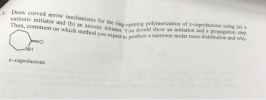 Draw curved arrow mechanisms for the rin cationic initiator and (b) an anionic initiator You should Then, comment on which method you expect to produce a s for the ring-opening polymerization of E-caprolactone using (a) a monic initiator Vou should show an initiation and a propagation step. od you expect to produce a narrower molar mass distribution and why. -NH E-caprolactone
Mechanisms Question 1 (22 marks) (a) Consider the radical chain reactions of the alkane shown below with Br, in the...
 Mechanisms Question 1 (22 marks) (a) Consider the radical chain reactions of the alkane shown below with Br, in the presence of light. H3C HH H C-CCHS CH3 Br2 hv 2 Different mono- bromo products 25 °C + (you will need to look up the bond dissociation energy (BDE) for the types of bonds formed and broken in this reactions) (i) Give the structures of the products from the reaction and using standard arrow conventions show the series of mechanistic...
b. As was shown for cationic polymerization reactions, a depolymerization reaction referred to as "back-biting" can...
 b. As was shown for cationic polymerization reactions, a depolymerization reaction referred to as "back-biting" can also occur during ROMP. Propose a mechanism for this depolymerization reaction using your structure from part a. You may use an abbreviated structure to simplify the drawing.
 need help on polymer chemistry question
Determine which polymerization mechanism(s), i.e. radical,
anionic, and cationic, can be used for the following monomers.
Briefly explain your answer.
H2C= CHCEH H2C= C(CH3)2 H3CHC=CHCH
need help on polymer chemistry question
Determine which polymerization mechanism(s), i.e. radical,
anionic, and cationic, can be used for the following monomers.
Briefly explain your answer.
H2C= CHCEH H2C= C(CH3)2 H3CHC=CHCH
 need help on polymer chemistry question
Determine which polymerization mechanism(s), i.e. radical,
anionic, and cationic, can be used for the following monomers.
Briefly explain your answer.
H2C=CHCI HỌC =CHCN H2C= C(CN)
need help on polymer chemistry question
Determine which polymerization mechanism(s), i.e. radical,
anionic, and cationic, can be used for the following monomers.
Briefly explain your answer.
H2C=CHCI HỌC =CHCN H2C= C(CN)
 need help on polymer chemistry question
Determine which polymerization mechanism(s), i.e. radical,
anionic, and cationic, can be used for the following monomers.
Briefly explain your answer.
H2C=CHCI HỌC =CHCN H2C= C(CN)
need help on polymer chemistry question
Determine which polymerization mechanism(s), i.e. radical,
anionic, and cationic, can be used for the following monomers.
Briefly explain your answer.
H2C=CHCI HỌC =CHCN H2C= C(CN)
 need help on polymer chemistry question
Determine which polymerization mechanism(s), i.e. radical,
anionic, and cationic, can be used for the following monomers.
Briefly explain your answer.
H2C= CHCEH H2C= C(CH3)2 H3CHC=CHCH
need help on polymer chemistry question
Determine which polymerization mechanism(s), i.e. radical,
anionic, and cationic, can be used for the following monomers.
Briefly explain your answer.
H2C= CHCEH H2C= C(CH3)2 H3CHC=CHCH
 Draw curved arrow mechanisms for the rin cationic initiator and (b) an anionic initiator You should Then, comment on which method you expect to produce a s for the ring-opening polymerization of E-caprolactone using (a) a monic initiator Vou should show an initiation and a propagation step. od you expect to produce a narrower molar mass distribution and why. -NH E-caprolactone
 Mechanisms Question 1 (22 marks) (a) Consider the radical chain reactions of the alkane shown below with Br, in the presence of light. H3C HH H C-CCHS CH3 Br2 hv 2 Different mono- bromo products 25 °C + (you will need to look up the bond dissociation energy (BDE) for the types of bonds formed and broken in this reactions) (i) Give the structures of the products from the reaction and using standard arrow conventions show the series of mechanistic...
 b. As was shown for cationic polymerization reactions, a depolymerization reaction referred to as "back-biting" can also occur during ROMP. Propose a mechanism for this depolymerization reaction using your structure from part a. You may use an abbreviated structure to simplify the drawing.
Most questions answered within 3 hours.
-
Where is the error in this code sequence?
String s1 = "Hello";
String s2 = "ello";...
asked 10 months ago -
Financial data for Joel de Paris, Inc., for last year
follow:
Joel de Paris, Inc.
Balance...
asked 10 months ago -
Consider this reaction:
Al2(SO4)3 (aq)+ BaCl3
(aq) Al2Cl6 (aq)- +
3BaSO4(s) . What is the...
asked 10 months ago -
Suppose that Savneet is considering increasing her
recent random sample from 20 car rentals to 40...
asked 10 months ago -
Trucks arrive at an unloading terminal at an average rate of 120
per hour.
Trucks arrive...
asked 10 months ago -
Why are methanol and ethanol completely soluble in water while
octanol is not very little soluble....
asked 10 months ago -
A facilities manager at a university reads in a research report
that the mean amount of...
asked 10 months ago -
When the CuSO4 is rehydrated by adding water to the anhydrous
compound, is this an endothermic...
asked 10 months ago -
A ray of sunlight is passing from diamond into crown glass; the
angle of incidence is...
asked 10 months ago -
A block of mass 0.249 kg is placed on top of a light, vertical
spring of...
asked 10 months ago -
how do the kidneys compensate in the presences of acidosis
a) trigger hyperventilate
b) reserve acid...
asked 10 months ago -
Question 501 pts
The rental rate of capital to the firm increases. Which of the
following...
asked 10 months ago