
Homework Answers
Case 1
Plates are placed with the original gap separation. (wider gap)
Let the plate separation be 'd'. If the area of the plates is A, then the capacitance is given by,
 ---------------------------------------------------------(1)
If the charge in the capacitor is Q, then the electric potential energy stored in the capacitor is given by,
 ---------------------------------------------------------------(2)
Case 2
Gap separation is reduced to 1/7 th of the original gap separation (narrow gap)
Let the plate separation be

If the area of the plates is A, then the new capacitance is given by,
 ---------------------------------------------------------(3)
On taking the ratio of equation (3) to equation (2), We get
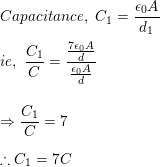
If the charge in the capacitor is Q, then the new electric potential energy stored in the capacitor is given by,
 ---------------------------------------------------------------(4)
Now the ratio of electrical potential energy stored in the capacitor with the narrow gap over the energy stored in the wider gap is given by,
 (Ans.)
Add Answer to:
If you reduce the gap between a parallel-plate capacitor to } of the original distance while...
3.A parallel plate capacitor with an air gap has a capacitance of 70µF when the plates...
3.A parallel plate capacitor with an air gap has a capacitance of 70µF when the plates are 1.4mm apart. If it stores 0.1mC on each of the plates, what is the potential difference between the plates? What is the electric field between the plates? 4.For the capacitor in the previous problem, the air gap is replaced with water (k = 80), but the charge on the plates is kept the same. What is the electric potential difference now? What is...
An air-filled, parallel-plate capacitor with area A and gap width d is connected to a battery...
 An air-filled, parallel-plate capacitor with area A and gap
width d is connected to a battery that maintains the plates at
potential difference V.
1. The plates are pulled apart so that the gap is 2 times wider,
while they remain in electrical contact with the battery terminals.
By what factor Uelectric,f/Uelectric,iUelectric,f/Uelectric,i does
the potential energy of the capacitor change? (Express your
answer to two significant figures.)
2. By what factor
Uelectric,f/Uelectric,iUelectric,f/Uelectric,i does the potential
energy of the capacitor change...
An air-filled, parallel-plate capacitor with area A and gap
width d is connected to a battery that maintains the plates at
potential difference V.
1. The plates are pulled apart so that the gap is 2 times wider,
while they remain in electrical contact with the battery terminals.
By what factor Uelectric,f/Uelectric,iUelectric,f/Uelectric,i does
the potential energy of the capacitor change? (Express your
answer to two significant figures.)
2. By what factor
Uelectric,f/Uelectric,iUelectric,f/Uelectric,i does the potential
energy of the capacitor change...
8. A parallel plate capacitor consists of two square parallel plates separated by a distance d....
 8. A parallel plate capacitor consists of two square parallel plates separated by a distance d. If I double the potential across the plates, while keeping everything else constant, what happens to the energy stored in the capacitor? A) There will be % of the energy stored B) There will be % of the energy stored C) The energy stored will remain constant D) The energy stored will double E) the energy stored will quadruple MMMMMMMM 9. The picture on...
A parallel plate capacitor has square plates with sides of length 11 cm. The distance between...
A parallel plate capacitor has square plates with sides of length 11 cm. The distance between the plates is 2 mm. The plates are charged up to 20volts. Part A What is the electric field between the plates? Express your answer using three significant figures. Electric field = N/C Part B What is the amount of charge on each plate? charge = C Part C What is the capacitance? Capacitance = μF Part D What is the energy stored by...
Suppose the distance between the plates of a parallel‑plate capacitor is increased without changing the amount...
Suppose the distance between the plates of a parallel‑plate capacitor is increased without changing the amount of charge stored on the plates. What will happen to the energy stored in the capacitor? A. it decreases B. it remains the same C. it increases
A parallel plate capacitor with capacitance C0 is connected to a battery with voltage V0 and...
A parallel plate capacitor with capacitance C0 is connected to a battery with voltage V0 and is charged fully to a charge Q0. There is an electric field E0 between the plates and energy U0 stored in the capacitor. With the battery still connected, the area of the plates are doubles and the plates are pulled to a distance three times its original distance (while still being small compared to the size of the plates). Find (in terms of the...
A parallel plate capacitor has a charge of 6.7 × 10⁻⁷ C on one plate and...
A parallel plate capacitor has a charge of 6.7 × 10⁻⁷ C on one plate and −6.7 × 10⁻⁷ C on the other. The distance between the plates is increased by 21% while the charge on each plate stays the same. What happens to the energy stored in the capacitor?
A parallel plate capacitor has a charge of 7.7 × 10⁻⁷ C on one plate and...
A parallel plate capacitor has a charge of 7.7 × 10⁻⁷ C on one plate and −7.7 × 10⁻⁷ C on the other. The distance between the plates is increased by 22% while the charge on each plate stays the same. What happens to the energy stored in the capacitor? The energy (select) decreases or increases by %.
If you double the area of a parallel-plate capacitor and reduce the distance between the plates...
 If you double the area of a parallel-plate capacitor and reduce the distance between the plates by a factor of four, how is the capacitance affected?
A parallel-plate capacitors is disconnected from a battery, and the plates are pulled a small distance...
 A parallel-plate capacitors is disconnected from a battery, and the plates are pulled a small distance farther apart. Do the following quantities increase decrease, or stay the same? (a) Capacitance (b) Charge (c) Electric Field between the plates (d) Potential difference between the plates (e) Energy stored in the capacitor
 An air-filled, parallel-plate capacitor with area A and gap
width d is connected to a battery that maintains the plates at
potential difference V.
1. The plates are pulled apart so that the gap is 2 times wider,
while they remain in electrical contact with the battery terminals.
By what factor Uelectric,f/Uelectric,iUelectric,f/Uelectric,i does
the potential energy of the capacitor change? (Express your
answer to two significant figures.)
2. By what factor
Uelectric,f/Uelectric,iUelectric,f/Uelectric,i does the potential
energy of the capacitor change...
An air-filled, parallel-plate capacitor with area A and gap
width d is connected to a battery that maintains the plates at
potential difference V.
1. The plates are pulled apart so that the gap is 2 times wider,
while they remain in electrical contact with the battery terminals.
By what factor Uelectric,f/Uelectric,iUelectric,f/Uelectric,i does
the potential energy of the capacitor change? (Express your
answer to two significant figures.)
2. By what factor
Uelectric,f/Uelectric,iUelectric,f/Uelectric,i does the potential
energy of the capacitor change...
 8. A parallel plate capacitor consists of two square parallel plates separated by a distance d. If I double the potential across the plates, while keeping everything else constant, what happens to the energy stored in the capacitor? A) There will be % of the energy stored B) There will be % of the energy stored C) The energy stored will remain constant D) The energy stored will double E) the energy stored will quadruple MMMMMMMM 9. The picture on...
 If you double the area of a parallel-plate capacitor and reduce the distance between the plates by a factor of four, how is the capacitance affected?
 A parallel-plate capacitors is disconnected from a battery, and the plates are pulled a small distance farther apart. Do the following quantities increase decrease, or stay the same? (a) Capacitance (b) Charge (c) Electric Field between the plates (d) Potential difference between the plates (e) Energy stored in the capacitor
Most questions answered within 3 hours.
-
Where is the error in this code sequence?
String s1 = "Hello";
String s2 = "ello";...
asked 10 months ago -
Financial data for Joel de Paris, Inc., for last year
follow:
Joel de Paris, Inc.
Balance...
asked 10 months ago -
Consider this reaction:
Al2(SO4)3 (aq)+ BaCl3
(aq) Al2Cl6 (aq)- +
3BaSO4(s) . What is the...
asked 10 months ago -
Suppose that Savneet is considering increasing her
recent random sample from 20 car rentals to 40...
asked 10 months ago -
Trucks arrive at an unloading terminal at an average rate of 120
per hour.
Trucks arrive...
asked 10 months ago -
Why are methanol and ethanol completely soluble in water while
octanol is not very little soluble....
asked 10 months ago -
A facilities manager at a university reads in a research report
that the mean amount of...
asked 10 months ago -
When the CuSO4 is rehydrated by adding water to the anhydrous
compound, is this an endothermic...
asked 10 months ago -
A ray of sunlight is passing from diamond into crown glass; the
angle of incidence is...
asked 10 months ago -
A block of mass 0.249 kg is placed on top of a light, vertical
spring of...
asked 10 months ago -
how do the kidneys compensate in the presences of acidosis
a) trigger hyperventilate
b) reserve acid...
asked 10 months ago -
Question 501 pts
The rental rate of capital to the firm increases. Which of the
following...
asked 10 months ago