 PLEASE ANSWER FROM
WHERE IT SAYS "Continuing from Part 1"
PLEASE ANSWER FROM
WHERE IT SAYS "Continuing from Part 1"
Homework Answers
I ran the length 5 and p = 0.5 eight times on my PC. The probability came around 0.53
I ran the length 7 and p = 0.7 five times on my PC. The probability came around 0.507
So scenario 1 definitely has greater probability.
Here's the code if you want to try it out. The code will take a few seconds to compute, especially if its an older PC.
import numpy as np
from collections import Counter
def count(ls,n): #n here defines the length of runs
    ls = ''.join(ls)
    #ms = ls.split('0')
    #ms = [i for i in ms if i]
    #cnt = Counter(ms)
    #print(cnt)
    srch = '0' + ('1'*n) + '0'
    if srch in ls:
        return 1
    else : return 0
expts = 100000
n = 100
run_length = 5 #change length of successive 1's (runs)
pr = 0.5 #change probability
ls = np.random.choice([0,1],(expts,n),p =(1-pr,pr))
fav = 0
for i in ls:
    i = list(map(str,i))
    a = count(i,run_length)
    fav = fav + a
    #print(a)
print(float(fav/expts))
#ls = [0,1,0,1,1,0,0,0,0,0,0,0,0,0,0]

#count(ls1)
Let me know if you want help figuring out how to change the parameters, I've commented what you'll need though.
Oh, and the commented counter lines are if you want to see how it runs, just remember to set the expts to around 100-1000 if you want to try to run them.
Add Answer to:
PLEASE ANSWER FROM
WHERE IT SAYS "Continuing from Part 1"
Consider a sequence of n Bernoulli...
Find the probability of exactly k successes in n repeated Bernoulli trials where the probability of...
Find the probability of exactly k successes in n repeated Bernoulli trials where the probability of success is p. (Round your answer to six decimal places.) n = 7, k = 2, p = 0.4
Problem 1 Consider a sequence of n+m independent Bernoulli trials with probability of success p in each trial. Let N be the number of successes in the first n trials and let M be the number of suc...
 Problem 1 Consider a sequence of n+m independent Bernoulli trials with probability of success p in each trial. Let N be the number of successes in the first n trials and let M be the number of successes in the remaining m trials. (a) Find the joint PMF of N and M, and the marginal PMFs of N and AM (b) Find the PMF for the total number of successes in the n +m trials.
Problem 1 Consider a sequence...
Problem 1 Consider a sequence of n+m independent Bernoulli trials with probability of success p in each trial. Let N be the number of successes in the first n trials and let M be the number of successes in the remaining m trials. (a) Find the joint PMF of N and M, and the marginal PMFs of N and AM (b) Find the PMF for the total number of successes in the n +m trials.
Problem 1 Consider a sequence...
You perform a sequence of m+n independent Bernoulli trials with success probability p between (0, 1)....
You perform a sequence of m+n independent Bernoulli trials with success probability p between (0, 1). Let X denote the number of successes in the first m trials and Y be the number of successes in the last n trials. Find f(x|z) = P(X = x|X + Y = z). Show that this function of x, which will not depend on p, is a pmf in x with integer values in [max(0, z - n), min(z,m)]. Hint: the intersection of...
a) Consider the following data on a variable that has Bernoulli distribution: X P (X) 0...
 a) Consider the following data on a variable that has Bernoulli distribution: X P (X) 0 0.3 1 0.7 Find the Expected value and the variance of X. And E(X)-X Px) b) Consider the following information for a binomial distribution: N number of trials or experiments 5 x- number of success 3 Probability of success p 0.4 and probability of failure 1-p 0.6 Find the probability of 3 successes out of 5 trials: Note P(x) Nox p* (1-p)Note: NcN!x! (N-x)!...
The statement rbinom(n,1, p) makes a sample of size n from a Bernoulli distribu- tion with...
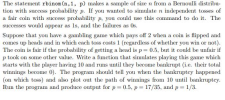 The statement rbinom(n,1, p) makes a sample of size n from a Bernoulli distribu- tion with success probability p. If you wanted to simulate n independent tosses of a fair coin with success probability p, you could use this command to do it. The successes would appear as 1s, and the failures as 0s. Suppose that you have a gambling game which pays off 2 when a coin is flipped and comes up heads and in which each toss costs...
Exercise 3: Show that (X/n)2 and X(X - 1)/n(n - 1) are both consistent estimates of p2 where X is the number of successes in n trials with constant probability p of success. Exercise 3: Show tha...
 Exercise 3: Show that (X/n)2 and X(X - 1)/n(n - 1) are both consistent estimates of p2 where X is the number of successes in n trials with constant probability p of success.
Exercise 3: Show that (X/n)2 and X(X - 1)/n(n - 1) are both consistent estimates of p2 where X is the number of successes in n trials with constant probability p of success.
Exercise 3: Show that (X/n)2 and X(X - 1)/n(n - 1) are both consistent estimates of p2 where X is the number of successes in n trials with constant probability p of success.
1 [Run Lengths] Write a function (in Python and numpy) with the following specification def run_lenths(n,...
1 [Run Lengths] Write a function (in Python and numpy) with the following specification def run_lenths(n, p): """Return a list of the run lengths in n tosses of a coin whose heads probability is p. Arguments: n--Number of tosses (a positive int), p--The probability of observing heads for any given toss (float between 0 and 1). """ For example, if the simulated sequence of coin tosses is HTTHHTHHHTTHHTTTTH, then the list of run lengths the function returns will be [1,...
Basic Probability Let us consider a sequence of Bernoulli trials with probability of success p. Such...
 Basic Probability Let us consider a sequence of Bernoulli trials with probability of success p. Such a sequence is observed until the first success occurs. We denote by X the random variable (r.v.), which gives the trial number on which the first success occurs. This way, the probability mass function (pmf) is given by Px(x) = (1 – p)?-?p which means that will be x 1 failures before the occurrence of the first success at the x-th trial. The r.v....
Use simulations to prove that the binomial distribution is correct. The binomial distribution has two parameters...
Use simulations to prove that the binomial distribution is correct. The binomial distribution has two parameters n and p. There are n trials and each has two possible outcomes, with probability p for “success” and 1-p for “failure”. The binomial gives the probability distribution for the number of successes in n trials. You will conduct simulations with r replicates, where each simulation replicates does n simulated “coin flips”. You will add up the number of successes in each coin flip,...
I need answer for example 1 . the probabilities of occurrence of these events are, respectively,...
 I need answer for example 1 .
the probabilities of occurrence of these events are, respectively, p and (1-p). Let X denotes the number of successes. Here X can take the values 0 or 1. X is said to have a Bernoulli distribution. Definition: random variables X is said to have a Bernoulli distribution and is referred to as a Bernoulli random variable, if and only if its probability distribution is given by P(X = x) = p4" for x...
I need answer for example 1 .
the probabilities of occurrence of these events are, respectively, p and (1-p). Let X denotes the number of successes. Here X can take the values 0 or 1. X is said to have a Bernoulli distribution. Definition: random variables X is said to have a Bernoulli distribution and is referred to as a Bernoulli random variable, if and only if its probability distribution is given by P(X = x) = p4" for x...
 Problem 1 Consider a sequence of n+m independent Bernoulli trials with probability of success p in each trial. Let N be the number of successes in the first n trials and let M be the number of successes in the remaining m trials. (a) Find the joint PMF of N and M, and the marginal PMFs of N and AM (b) Find the PMF for the total number of successes in the n +m trials.
Problem 1 Consider a sequence...
Problem 1 Consider a sequence of n+m independent Bernoulli trials with probability of success p in each trial. Let N be the number of successes in the first n trials and let M be the number of successes in the remaining m trials. (a) Find the joint PMF of N and M, and the marginal PMFs of N and AM (b) Find the PMF for the total number of successes in the n +m trials.
Problem 1 Consider a sequence...
 a) Consider the following data on a variable that has Bernoulli distribution: X P (X) 0 0.3 1 0.7 Find the Expected value and the variance of X. And E(X)-X Px) b) Consider the following information for a binomial distribution: N number of trials or experiments 5 x- number of success 3 Probability of success p 0.4 and probability of failure 1-p 0.6 Find the probability of 3 successes out of 5 trials: Note P(x) Nox p* (1-p)Note: NcN!x! (N-x)!...
 The statement rbinom(n,1, p) makes a sample of size n from a Bernoulli distribu- tion with success probability p. If you wanted to simulate n independent tosses of a fair coin with success probability p, you could use this command to do it. The successes would appear as 1s, and the failures as 0s. Suppose that you have a gambling game which pays off 2 when a coin is flipped and comes up heads and in which each toss costs...
 Exercise 3: Show that (X/n)2 and X(X - 1)/n(n - 1) are both consistent estimates of p2 where X is the number of successes in n trials with constant probability p of success.
Exercise 3: Show that (X/n)2 and X(X - 1)/n(n - 1) are both consistent estimates of p2 where X is the number of successes in n trials with constant probability p of success.
Exercise 3: Show that (X/n)2 and X(X - 1)/n(n - 1) are both consistent estimates of p2 where X is the number of successes in n trials with constant probability p of success.
 Basic Probability Let us consider a sequence of Bernoulli trials with probability of success p. Such a sequence is observed until the first success occurs. We denote by X the random variable (r.v.), which gives the trial number on which the first success occurs. This way, the probability mass function (pmf) is given by Px(x) = (1 – p)?-?p which means that will be x 1 failures before the occurrence of the first success at the x-th trial. The r.v....
 I need answer for example 1 .
the probabilities of occurrence of these events are, respectively, p and (1-p). Let X denotes the number of successes. Here X can take the values 0 or 1. X is said to have a Bernoulli distribution. Definition: random variables X is said to have a Bernoulli distribution and is referred to as a Bernoulli random variable, if and only if its probability distribution is given by P(X = x) = p4" for x...
I need answer for example 1 .
the probabilities of occurrence of these events are, respectively, p and (1-p). Let X denotes the number of successes. Here X can take the values 0 or 1. X is said to have a Bernoulli distribution. Definition: random variables X is said to have a Bernoulli distribution and is referred to as a Bernoulli random variable, if and only if its probability distribution is given by P(X = x) = p4" for x...
Most questions answered within 3 hours.
-
Where is the error in this code sequence?
String s1 = "Hello";
String s2 = "ello";...
asked 11 months ago -
Financial data for Joel de Paris, Inc., for last year
follow:
Joel de Paris, Inc.
Balance...
asked 11 months ago -
Consider this reaction:
Al2(SO4)3 (aq)+ BaCl3
(aq) Al2Cl6 (aq)- +
3BaSO4(s) . What is the...
asked 11 months ago -
Suppose that Savneet is considering increasing her
recent random sample from 20 car rentals to 40...
asked 11 months ago -
Trucks arrive at an unloading terminal at an average rate of 120
per hour.
Trucks arrive...
asked 11 months ago -
Why are methanol and ethanol completely soluble in water while
octanol is not very little soluble....
asked 11 months ago -
A facilities manager at a university reads in a research report
that the mean amount of...
asked 11 months ago -
When the CuSO4 is rehydrated by adding water to the anhydrous
compound, is this an endothermic...
asked 11 months ago -
A ray of sunlight is passing from diamond into crown glass; the
angle of incidence is...
asked 11 months ago -
A block of mass 0.249 kg is placed on top of a light, vertical
spring of...
asked 11 months ago -
how do the kidneys compensate in the presences of acidosis
a) trigger hyperventilate
b) reserve acid...
asked 11 months ago -
Question 501 pts
The rental rate of capital to the firm increases. Which of the
following...
asked 11 months ago