
Homework Answers
Here x is the number of trials require to get 4 succeful trials.
so here the distribution is negative binomial. with pdf
f(x) = (x-1)C3 (0.4)4(0.6)x-4
Here
E[X] = (1-p) r/p + 4 = 0.6 * 4/0.4 + 4 = 10
Var[X] = (1-p)r/p2 = 0.6 * 4/ 0.42= 15
Add Answer to:
Problem 4.23. Suppose you take a sequence a Bernoulli trials with probability p = 0.4 of...
Problem 5 (10 points). Suppose that the independent Bernoulli trials each with success probability p, are...
 Problem 5 (10 points). Suppose that the independent Bernoulli trials each with success probability p, are performed independently until the first success occurs, Let Y be the number of trials that are failure. (1) Find the possible values of Y and the probability mass function of Y. (2) Use the relationship between Y and the random variable with a geometric distribution with parameter p to find E(Y) and Var(Y).
Problem 1 Consider a sequence of n+m independent Bernoulli trials with probability of success p in each trial. Let N be the number of successes in the first n trials and let M be the number of suc...
 Problem 1 Consider a sequence of n+m independent Bernoulli trials with probability of success p in each trial. Let N be the number of successes in the first n trials and let M be the number of successes in the remaining m trials. (a) Find the joint PMF of N and M, and the marginal PMFs of N and AM (b) Find the PMF for the total number of successes in the n +m trials.
Problem 1 Consider a sequence...
Problem 1 Consider a sequence of n+m independent Bernoulli trials with probability of success p in each trial. Let N be the number of successes in the first n trials and let M be the number of successes in the remaining m trials. (a) Find the joint PMF of N and M, and the marginal PMFs of N and AM (b) Find the PMF for the total number of successes in the n +m trials.
Problem 1 Consider a sequence...
2. Suppose 4 Bernoulli trials, each with success probability p, are con ducted such that the...
 2. Suppose 4 Bernoulli trials, each with success probability p, are con ducted such that the outcomes of the 4 experiments pendent. Let the random variable X be the total number of successes over the 4 Bernoulli trials are mutually inde- (a) Write down the sample space for the experiment consisting of 4 Bernoulli trials (the sample space is all possible sequences of length 4 of successes and failures you may use the symbols S and F). (b) Give the...
You perform a sequence of m+n independent Bernoulli trials with success probability p between (0, 1)....
You perform a sequence of m+n independent Bernoulli trials with success probability p between (0, 1). Let X denote the number of successes in the first m trials and Y be the number of successes in the last n trials. Find f(x|z) = P(X = x|X + Y = z). Show that this function of x, which will not depend on p, is a pmf in x with integer values in [max(0, z - n), min(z,m)]. Hint: the intersection of...
Basic Probability Let us consider a sequence of Bernoulli trials with probability of success p. Such...
 Basic Probability Let us consider a sequence of Bernoulli trials with probability of success p. Such a sequence is observed until the first success occurs. We denote by X the random variable (r.v.), which gives the trial number on which the first success occurs. This way, the probability mass function (pmf) is given by Px(x) = (1 – p)?-?p which means that will be x 1 failures before the occurrence of the first success at the x-th trial. The r.v....
Wiout feplacement. 6.9 Consider a sequence of Bernoulli trials with success probability p. Let X denote the number of t...
 Wiout feplacement. 6.9 Consider a sequence of Bernoulli trials with success probability p. Let X denote the number of trials up to and including the first success and let Y denote the number of trials up to and including the second success. a) Identify the (marginal) PMF of X c) Determine the joint PMF of X and Y. d) Use Proposition 6.2 on page 263 and the result of part (c) to obtain the marginal PMFS of X and Y....
Assume a sequence of independent trials, each with probability p of success. Use the Law of...
Assume a sequence of independent trials, each with probability p of success. Use the Law of Large Numbers to show that the proportion of successes approaches p as the number of trials becomes large. It may be useful to think of this problem as a Bernoulli distribution and to then calculate the mean.
The geometric distribution is a probability distribution of the number X of Bernoulli trials needed to...
 The geometric distribution is a probability distribution of the number X of Bernoulli trials needed to get one success. For example, how many attempts does a basketball player need to get a goal. Given the probability of success in a single trial is p, the probability that the xth trial is the first success is: Pr(x = x|p) = (1 - p*-'p for x=1,2,3,.... Suppose, you observe n basketball players trying to score and record the number of attempts required...
Problem 2: Consider a sequence of independent trials each having a probability p (with 0 <...
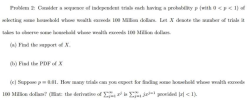 Problem 2: Consider a sequence of independent trials each having a probability p (with 0 < p < 1) of selecting some household whose wealth exceeds 100 Million dollars. Let X denote the number of trials it takes to observe some household whose wealth exceeds 100 Million dollars. (a) Find the support of X. (b) Find the PDF of X (c) Suppose p = 0.01. How many trials can you expect for finding some household whose wealth exceeds 100 Million...
Negative Binomial experiment is based on sequences of Bernoulli trials with probability of success p. Let...
Negative Binomial experiment is based on sequences of Bernoulli trials with probability of success p. Let x+m be the number of trials to achieve m successes, and then x has a negative binomial distribution. In summary, negative binomial distribution has the following properties Each trial can result in just two possible outcomes. One is called a success and the other is called a failure. The trials are independent The probability of success, denoted by p, is the...
 Problem 5 (10 points). Suppose that the independent Bernoulli trials each with success probability p, are performed independently until the first success occurs, Let Y be the number of trials that are failure. (1) Find the possible values of Y and the probability mass function of Y. (2) Use the relationship between Y and the random variable with a geometric distribution with parameter p to find E(Y) and Var(Y).
 Problem 1 Consider a sequence of n+m independent Bernoulli trials with probability of success p in each trial. Let N be the number of successes in the first n trials and let M be the number of successes in the remaining m trials. (a) Find the joint PMF of N and M, and the marginal PMFs of N and AM (b) Find the PMF for the total number of successes in the n +m trials.
Problem 1 Consider a sequence...
Problem 1 Consider a sequence of n+m independent Bernoulli trials with probability of success p in each trial. Let N be the number of successes in the first n trials and let M be the number of successes in the remaining m trials. (a) Find the joint PMF of N and M, and the marginal PMFs of N and AM (b) Find the PMF for the total number of successes in the n +m trials.
Problem 1 Consider a sequence...
 2. Suppose 4 Bernoulli trials, each with success probability p, are con ducted such that the outcomes of the 4 experiments pendent. Let the random variable X be the total number of successes over the 4 Bernoulli trials are mutually inde- (a) Write down the sample space for the experiment consisting of 4 Bernoulli trials (the sample space is all possible sequences of length 4 of successes and failures you may use the symbols S and F). (b) Give the...
 Basic Probability Let us consider a sequence of Bernoulli trials with probability of success p. Such a sequence is observed until the first success occurs. We denote by X the random variable (r.v.), which gives the trial number on which the first success occurs. This way, the probability mass function (pmf) is given by Px(x) = (1 – p)?-?p which means that will be x 1 failures before the occurrence of the first success at the x-th trial. The r.v....
 Wiout feplacement. 6.9 Consider a sequence of Bernoulli trials with success probability p. Let X denote the number of trials up to and including the first success and let Y denote the number of trials up to and including the second success. a) Identify the (marginal) PMF of X c) Determine the joint PMF of X and Y. d) Use Proposition 6.2 on page 263 and the result of part (c) to obtain the marginal PMFS of X and Y....
 The geometric distribution is a probability distribution of the number X of Bernoulli trials needed to get one success. For example, how many attempts does a basketball player need to get a goal. Given the probability of success in a single trial is p, the probability that the xth trial is the first success is: Pr(x = x|p) = (1 - p*-'p for x=1,2,3,.... Suppose, you observe n basketball players trying to score and record the number of attempts required...
 Problem 2: Consider a sequence of independent trials each having a probability p (with 0 < p < 1) of selecting some household whose wealth exceeds 100 Million dollars. Let X denote the number of trials it takes to observe some household whose wealth exceeds 100 Million dollars. (a) Find the support of X. (b) Find the PDF of X (c) Suppose p = 0.01. How many trials can you expect for finding some household whose wealth exceeds 100 Million...
Most questions answered within 3 hours.
-
Where is the error in this code sequence?
String s1 = "Hello";
String s2 = "ello";...
asked 10 months ago -
Financial data for Joel de Paris, Inc., for last year
follow:
Joel de Paris, Inc.
Balance...
asked 10 months ago -
Consider this reaction:
Al2(SO4)3 (aq)+ BaCl3
(aq) Al2Cl6 (aq)- +
3BaSO4(s) . What is the...
asked 10 months ago -
Suppose that Savneet is considering increasing her
recent random sample from 20 car rentals to 40...
asked 10 months ago -
Trucks arrive at an unloading terminal at an average rate of 120
per hour.
Trucks arrive...
asked 10 months ago -
Why are methanol and ethanol completely soluble in water while
octanol is not very little soluble....
asked 10 months ago -
A facilities manager at a university reads in a research report
that the mean amount of...
asked 10 months ago -
When the CuSO4 is rehydrated by adding water to the anhydrous
compound, is this an endothermic...
asked 10 months ago -
A ray of sunlight is passing from diamond into crown glass; the
angle of incidence is...
asked 10 months ago -
A block of mass 0.249 kg is placed on top of a light, vertical
spring of...
asked 10 months ago -
how do the kidneys compensate in the presences of acidosis
a) trigger hyperventilate
b) reserve acid...
asked 10 months ago -
Question 501 pts
The rental rate of capital to the firm increases. Which of the
following...
asked 10 months ago