
Homework Answers
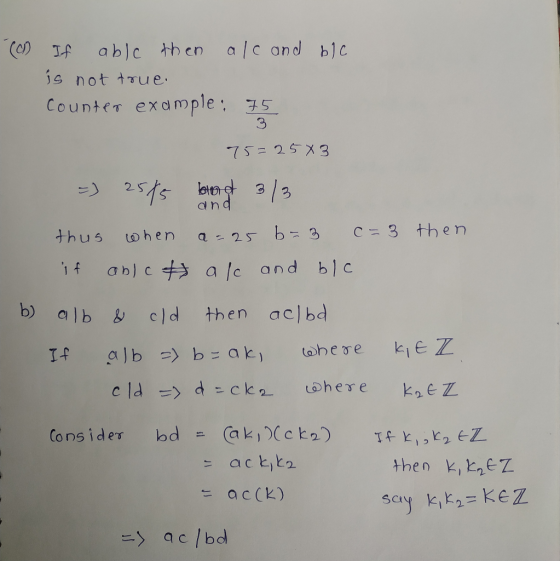
In part (c).
The given statement in part (c) is disprove.
Counter example:
a = 6, b =3 and c = 4
6 does not divide 3.
6 does not divide 4.
But 6/4*3 => 6/12 .that is 6 divides 12.
Hence given statement is disprove.
----------------------------------------------------------------------------------------------------------------------------------------------------------------
d)  then a/b.
Let us consider a does not divides b.
Which gives a^3 does not divides b^3
Which gives a^3 does not divides b^3*b (since a^3 dosent divide b^3 and a does not divide b)
Which gives a^3 does not divides b^4.
But it is given that a^3 divides b^4.
Thus a/b.
--------------------------------------------------------------------------------------------------------------------------------------------------------------
e)
Given that gcd (a,b)=1 and a /c and b /c then ab/c.
By using definition of divisibility,
a/c => c = ax' ...........(1)
b/c => c = bx'' ...........(2) [x' and x'' are integer]
gcd(a,b) = 1 gives
ax+by = 1 x, y are integers.
Multiply both sides by c.
acx+bcy = c
a(bx'')+b(ax') = c
abx''+abx' = c
ab(x'+x'') = c (x'+x'') is integer.
By divisibility, ab/c.
Add Answer to:
(d)n- 1013 2. Let a, b, c, d be integers. Prove the statement or give a...
8. (a) Prove that if p and q are prime numbers then p2 + pq is...
 8. (a) Prove that if p and q are prime numbers then p2 + pq is not a perfect square. (b) Prove that, for every integer a and every prime p, if p | a then ged(a,pb) = god(a,b). Is the converse of this statement true? Explain why or why not. (c) Prove that, for every non-zero integer n, the sum of all (positive or negative) divisors of n is equal to zero. 9. Let a and b be integers...
Let m be a positive integer and let a and b be integers relatively prime to m with (ord m a , ord...
Let m be a positive integer and let a and b be integers relatively prime to m with (ord m a , ord m b) )=1. Prove that ord m (ab)= (ord m a) (ord m b) (Hint: Let k=ord m(a),l=ord m(b), and n=ord m(ab). Then 1≡(ab)^kn≡b^kn mod m. What does this imply about l in relation to kn?
Exercise 2. Let φ denote the Euler totient function. (i) Prove that for all positive integers...
 Exercise 2. Let φ denote the Euler totient function. (i) Prove that for all positive integers m and n, if m,n are relatively prime (coprime), then φ(mn-o(m)o(n) (ii) Is the converse true? Prove or provide a counter-example.
Prove or give a counterexample: For any integers b and c and any positive integer m,...
Prove or give a counterexample: For any integers b and c and any positive integer m, if b ≡ c (mod m) then b + m ≡ c (mod m).
need help!!! plz write clearly # 2. Let a and b be non-zero coprime integers. Show...
 need help!!! plz write clearly
# 2. Let a and b be non-zero coprime integers. Show that (a) For any dia, god(d, b) = l. (b) For any cE Z, gcd(a,ged(a, bc)
need help!!! plz write clearly
# 2. Let a and b be non-zero coprime integers. Show that (a) For any dia, god(d, b) = l. (b) For any cE Z, gcd(a,ged(a, bc)
5. (a) Let m,n be coprime integers, and suppose a is an integer which is divisible...
 5. (a) Let m,n be coprime integers, and suppose a is an integer which is divisible by both m and n. Prove that mn divides a. (b) Show that the conclusion of part (a) is false if m and n are not coprime (ie, show that if m and n are not coprime, there exists an integer a such that mla and nla, but mn does not divide a). (c) Show that if hef(x,m) = 1 and hcf(y,m) = 1,...
Part 15A and 15B (15) Let n E Z+,and let d be a positive divisor of...
 Part 15A and 15B
(15) Let n E Z+,and let d be a positive divisor of n. Theorem 23.7 tells us that Zn contains exactly one subgroup of order d, but not how many elements Z has of order d. We will determine that number in this exercise. (a) Determine the number of elements in Z12 of each order d. Fill in the table below to compare your answers to the number of integers between 1 and d that are...
Part 15A and 15B
(15) Let n E Z+,and let d be a positive divisor of n. Theorem 23.7 tells us that Zn contains exactly one subgroup of order d, but not how many elements Z has of order d. We will determine that number in this exercise. (a) Determine the number of elements in Z12 of each order d. Fill in the table below to compare your answers to the number of integers between 1 and d that are...
(1) Prove or disprove the following statements. (a) Let a, b and c be integers. If...
 (1) Prove or disprove the following statements. (a) Let a, b and c be integers. If aſc and b|c, then (a + b)|c (b) Let a, b and c be integers. If aſb, then (ac)(bc)
2. Let n be a positive integer. Denote the number of positive integers less than n and rela- tive...
 number thoery
just need 2 answered
2. Let n be a positive integer. Denote the number of positive integers less than n and rela- tively prime to n by p(n). Let a, b be positive integers such that ged(a,n) god(b,n)-1 Consider the set s, = {(a), (ba), (ba), ) (see Prollern 1). Let s-A]. Show that slp(n). 1. Let a, b, c, and n be positive integers such that gcd(a, n) = gcd(b, n) = gcd(c, n) = 1 If...
number thoery
just need 2 answered
2. Let n be a positive integer. Denote the number of positive integers less than n and rela- tively prime to n by p(n). Let a, b be positive integers such that ged(a,n) god(b,n)-1 Consider the set s, = {(a), (ba), (ba), ) (see Prollern 1). Let s-A]. Show that slp(n). 1. Let a, b, c, and n be positive integers such that gcd(a, n) = gcd(b, n) = gcd(c, n) = 1 If...
 8. (a) Prove that if p and q are prime numbers then p2 + pq is not a perfect square. (b) Prove that, for every integer a and every prime p, if p | a then ged(a,pb) = god(a,b). Is the converse of this statement true? Explain why or why not. (c) Prove that, for every non-zero integer n, the sum of all (positive or negative) divisors of n is equal to zero. 9. Let a and b be integers...
 Exercise 2. Let φ denote the Euler totient function. (i) Prove that for all positive integers m and n, if m,n are relatively prime (coprime), then φ(mn-o(m)o(n) (ii) Is the converse true? Prove or provide a counter-example.
 need help!!! plz write clearly
# 2. Let a and b be non-zero coprime integers. Show that (a) For any dia, god(d, b) = l. (b) For any cE Z, gcd(a,ged(a, bc)
need help!!! plz write clearly
# 2. Let a and b be non-zero coprime integers. Show that (a) For any dia, god(d, b) = l. (b) For any cE Z, gcd(a,ged(a, bc)
 5. (a) Let m,n be coprime integers, and suppose a is an integer which is divisible by both m and n. Prove that mn divides a. (b) Show that the conclusion of part (a) is false if m and n are not coprime (ie, show that if m and n are not coprime, there exists an integer a such that mla and nla, but mn does not divide a). (c) Show that if hef(x,m) = 1 and hcf(y,m) = 1,...
 Part 15A and 15B
(15) Let n E Z+,and let d be a positive divisor of n. Theorem 23.7 tells us that Zn contains exactly one subgroup of order d, but not how many elements Z has of order d. We will determine that number in this exercise. (a) Determine the number of elements in Z12 of each order d. Fill in the table below to compare your answers to the number of integers between 1 and d that are...
Part 15A and 15B
(15) Let n E Z+,and let d be a positive divisor of n. Theorem 23.7 tells us that Zn contains exactly one subgroup of order d, but not how many elements Z has of order d. We will determine that number in this exercise. (a) Determine the number of elements in Z12 of each order d. Fill in the table below to compare your answers to the number of integers between 1 and d that are...
 (1) Prove or disprove the following statements. (a) Let a, b and c be integers. If aſc and b|c, then (a + b)|c (b) Let a, b and c be integers. If aſb, then (ac)(bc)
 number thoery
just need 2 answered
2. Let n be a positive integer. Denote the number of positive integers less than n and rela- tively prime to n by p(n). Let a, b be positive integers such that ged(a,n) god(b,n)-1 Consider the set s, = {(a), (ba), (ba), ) (see Prollern 1). Let s-A]. Show that slp(n). 1. Let a, b, c, and n be positive integers such that gcd(a, n) = gcd(b, n) = gcd(c, n) = 1 If...
number thoery
just need 2 answered
2. Let n be a positive integer. Denote the number of positive integers less than n and rela- tively prime to n by p(n). Let a, b be positive integers such that ged(a,n) god(b,n)-1 Consider the set s, = {(a), (ba), (ba), ) (see Prollern 1). Let s-A]. Show that slp(n). 1. Let a, b, c, and n be positive integers such that gcd(a, n) = gcd(b, n) = gcd(c, n) = 1 If...
Most questions answered within 3 hours.
-
Where is the error in this code sequence?
String s1 = "Hello";
String s2 = "ello";...
asked 10 months ago -
Financial data for Joel de Paris, Inc., for last year
follow:
Joel de Paris, Inc.
Balance...
asked 10 months ago -
Consider this reaction:
Al2(SO4)3 (aq)+ BaCl3
(aq) Al2Cl6 (aq)- +
3BaSO4(s) . What is the...
asked 10 months ago -
Suppose that Savneet is considering increasing her
recent random sample from 20 car rentals to 40...
asked 10 months ago -
Trucks arrive at an unloading terminal at an average rate of 120
per hour.
Trucks arrive...
asked 10 months ago -
Why are methanol and ethanol completely soluble in water while
octanol is not very little soluble....
asked 10 months ago -
A facilities manager at a university reads in a research report
that the mean amount of...
asked 10 months ago -
When the CuSO4 is rehydrated by adding water to the anhydrous
compound, is this an endothermic...
asked 10 months ago -
A ray of sunlight is passing from diamond into crown glass; the
angle of incidence is...
asked 10 months ago -
A block of mass 0.249 kg is placed on top of a light, vertical
spring of...
asked 10 months ago -
how do the kidneys compensate in the presences of acidosis
a) trigger hyperventilate
b) reserve acid...
asked 10 months ago -
Question 501 pts
The rental rate of capital to the firm increases. Which of the
following...
asked 10 months ago