
Homework Answers

Add Answer to:
1. Which of the following real gases has the largest isobaric heat capacity, Cp: a) He...
46) All of the following have free energy of formation values of zero except a) Li...
 46) All of the following have free energy of formation values of zero except a) Li (s) b) He (8) c) N (6) d) F2 (g) HF (B) If a process is both endothermic and spontaneous, then a) AU is less than 0 b) AH is less than 0 c) AG is greater than 0 d) AS is greater than 0 e) AH is equal to 0 48) The combination that always gives a spontaneous process is_ a) b) c)...
1) Which of the following processes would be expected to have the largest increase in ?Srxn...
1) Which of the following processes would be expected to have the largest increase in ?Srxn per mole of benzene? a) C6H6(l) + Cl2(g) ? C6H5Cl(l) + HCl(g) b) C6H6(l) + 15/2 O2(g) ? 6CO2(g) + 3H2O(g) c) C6H6(s) ? C6H6(g) d) 6H6(s) ? C6H6(l) e) C6H6(l) + 9/2 O2(g) ? 6CO(g) + 3H2O(g) 2) The heat of fusion of acetic acid is 11.5 kJ/mol. Its melting point is 16.6 oC. The change in entropy for the melting of acetic acid in...
Prelaboratory Assignment: Specific Heat Capacity 1. Technical objective. 2. What are the units for heat capacity,...
 Prelaboratory Assignment: Specific Heat Capacity 1. Technical objective. 2. What are the units for heat capacity, specific heat capacity, and molar heat capacity. 3. If a sample has an initial temperature of 22.15º and a final temperature of 18.45° C, what is AT? Is it any different in kelvin? A 100 g piece of metal, initially at 85° C is put (without heat loss or gain) into a cup with 50 g of water, initially at 22° C. Which of...
2) Construct a table (or use the one below) with 9,w, AU, AH as the headings....
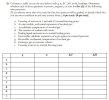 2) Construct a table (or use the one below) with 9,w, AU, AH as the headings. Determine whether each of these quantities is postive, negative, or zero for five (5) of the following nine processes. (If you choose more than five, only the first five answers will be graded, so decide which five you are most confident in and only answer those.) (4 pts each. 20 pts total) 1. Freezing of acetone at 1 atm and it's normal freezing point....
26. The internal energy can be increased by a) transferring heat from the surroundings to the...
 26. The internal energy can be increased by a) transferring heat from the surroundings to the ystem (b) transferring heat from the system to the surroundings c) doing work on the system A) a only B)b only C) c only D) a and c E) b and e 27. For the species in the reaction below, AHf is zero for 2Co (s) + H2 (3)+ 8PF3 () 2HCo(PF3)4) A) Co (s) B) H2 (3) C) PF3 (8) 1D) HCo(PF3)40 E)...
Answer the following questions A. Multiple Choices (16 point each) 1. Which of the following is...
 Answer the following questions
A. Multiple Choices (16 point each) 1. Which of the following is stro (A) , AS (B) 4. 0, AS (C) , AS (D) 4. 0, AS 2. Consider the following reaction NH.NO, OS) HOD) NIN Which of the following is (ar) true about this reaction GUNAH (A) the reaction is endothermis c hungsbe (B) This reaction must use the entry of the universet (C) This reaction is spontaneously low temperature (D) This reaction will reaction...
Answer the following questions
A. Multiple Choices (16 point each) 1. Which of the following is stro (A) , AS (B) 4. 0, AS (C) , AS (D) 4. 0, AS 2. Consider the following reaction NH.NO, OS) HOD) NIN Which of the following is (ar) true about this reaction GUNAH (A) the reaction is endothermis c hungsbe (B) This reaction must use the entry of the universet (C) This reaction is spontaneously low temperature (D) This reaction will reaction...
I need help with question 22? 16 the lab and turn two identical heating U heat...
 I need help with question 22?
16 the lab and turn two identical heating U heat 100 of pure water and 100 of me 5 are at room temperature, Aer couple of minutes of we temperature of methanol is higher than that of water. What is observation? a Liquid water has a higher boiling point than liquid methano b. Liquid methanol has a higher boiling point than liquid C. Liquid waterS our cheal capacithan d. Liquid methanol has a higher...
I need help with question 22?
16 the lab and turn two identical heating U heat 100 of pure water and 100 of me 5 are at room temperature, Aer couple of minutes of we temperature of methanol is higher than that of water. What is observation? a Liquid water has a higher boiling point than liquid methano b. Liquid methanol has a higher boiling point than liquid C. Liquid waterS our cheal capacithan d. Liquid methanol has a higher...
Chemistry midterm help please! <3 7. What is the difference between the AU and AH of...
 Chemistry midterm help please! <3
7. What is the difference between the AU and AH of a reaction? A) AU is a state function, while AH is not a state function B) AH is a state function, while AU is not a state function. C) AU = heat of reaction at constant volume conditions; AH = heat of reaction at constant-pressure conditions D) AU is the heat of reaction, AH is the work done by the reaction E) AU =...
Chemistry midterm help please! <3
7. What is the difference between the AU and AH of a reaction? A) AU is a state function, while AH is not a state function B) AH is a state function, while AU is not a state function. C) AU = heat of reaction at constant volume conditions; AH = heat of reaction at constant-pressure conditions D) AU is the heat of reaction, AH is the work done by the reaction E) AU =...
1. Out of the following, which system is decreasing in entropy? a. CH,OH,) → CH2OH() C....
 1. Out of the following, which system is decreasing in entropy? a. CH,OH,) → CH2OH() C. N2(g) + O2(g) → 2 NOG) b. NaClg) → Nataq) + Clian) d. 2 NO26) ► N20419 2. Which of the following is always spontaneous? a. C2H01) + 302(g) → 2CO2(g) + 3H2O(g) AH<0 b. Sublimation of solid CO2 C. Water freezing d. The formation of water from gaseous hydrogen and oxygen e. None of the above 3. Will liquid water evaporate at room...
Thermodynamics Practice Problems 1. Predict the sign of AS.(positive or negative) for the following reactions a...
 Thermodynamics Practice Problems 1. Predict the sign of AS.(positive or negative) for the following reactions a 2 Mg(s) +,(@) 2 Mgo (s) AS b. CH206(s) → 2C,H,OH(I) + 2003(g) AS c. 2 NH3(g) + CO2(g) → H2O(l) + NH CONH3(aq) AS d. Cu(s) (at 100°C) → Cu(s) (at 25°C) AS 2. Which two variables can indicate if a reaction is spontaneous or not? 3. The second law of thermodynamics tells us that: a Energy is conserved. b. The entropy of...
 46) All of the following have free energy of formation values of zero except a) Li (s) b) He (8) c) N (6) d) F2 (g) HF (B) If a process is both endothermic and spontaneous, then a) AU is less than 0 b) AH is less than 0 c) AG is greater than 0 d) AS is greater than 0 e) AH is equal to 0 48) The combination that always gives a spontaneous process is_ a) b) c)...
 Prelaboratory Assignment: Specific Heat Capacity 1. Technical objective. 2. What are the units for heat capacity, specific heat capacity, and molar heat capacity. 3. If a sample has an initial temperature of 22.15º and a final temperature of 18.45° C, what is AT? Is it any different in kelvin? A 100 g piece of metal, initially at 85° C is put (without heat loss or gain) into a cup with 50 g of water, initially at 22° C. Which of...
 2) Construct a table (or use the one below) with 9,w, AU, AH as the headings. Determine whether each of these quantities is postive, negative, or zero for five (5) of the following nine processes. (If you choose more than five, only the first five answers will be graded, so decide which five you are most confident in and only answer those.) (4 pts each. 20 pts total) 1. Freezing of acetone at 1 atm and it's normal freezing point....
 26. The internal energy can be increased by a) transferring heat from the surroundings to the ystem (b) transferring heat from the system to the surroundings c) doing work on the system A) a only B)b only C) c only D) a and c E) b and e 27. For the species in the reaction below, AHf is zero for 2Co (s) + H2 (3)+ 8PF3 () 2HCo(PF3)4) A) Co (s) B) H2 (3) C) PF3 (8) 1D) HCo(PF3)40 E)...
 Answer the following questions
A. Multiple Choices (16 point each) 1. Which of the following is stro (A) , AS (B) 4. 0, AS (C) , AS (D) 4. 0, AS 2. Consider the following reaction NH.NO, OS) HOD) NIN Which of the following is (ar) true about this reaction GUNAH (A) the reaction is endothermis c hungsbe (B) This reaction must use the entry of the universet (C) This reaction is spontaneously low temperature (D) This reaction will reaction...
Answer the following questions
A. Multiple Choices (16 point each) 1. Which of the following is stro (A) , AS (B) 4. 0, AS (C) , AS (D) 4. 0, AS 2. Consider the following reaction NH.NO, OS) HOD) NIN Which of the following is (ar) true about this reaction GUNAH (A) the reaction is endothermis c hungsbe (B) This reaction must use the entry of the universet (C) This reaction is spontaneously low temperature (D) This reaction will reaction...
 I need help with question 22?
16 the lab and turn two identical heating U heat 100 of pure water and 100 of me 5 are at room temperature, Aer couple of minutes of we temperature of methanol is higher than that of water. What is observation? a Liquid water has a higher boiling point than liquid methano b. Liquid methanol has a higher boiling point than liquid C. Liquid waterS our cheal capacithan d. Liquid methanol has a higher...
I need help with question 22?
16 the lab and turn two identical heating U heat 100 of pure water and 100 of me 5 are at room temperature, Aer couple of minutes of we temperature of methanol is higher than that of water. What is observation? a Liquid water has a higher boiling point than liquid methano b. Liquid methanol has a higher boiling point than liquid C. Liquid waterS our cheal capacithan d. Liquid methanol has a higher...
 Chemistry midterm help please! <3
7. What is the difference between the AU and AH of a reaction? A) AU is a state function, while AH is not a state function B) AH is a state function, while AU is not a state function. C) AU = heat of reaction at constant volume conditions; AH = heat of reaction at constant-pressure conditions D) AU is the heat of reaction, AH is the work done by the reaction E) AU =...
Chemistry midterm help please! <3
7. What is the difference between the AU and AH of a reaction? A) AU is a state function, while AH is not a state function B) AH is a state function, while AU is not a state function. C) AU = heat of reaction at constant volume conditions; AH = heat of reaction at constant-pressure conditions D) AU is the heat of reaction, AH is the work done by the reaction E) AU =...
 1. Out of the following, which system is decreasing in entropy? a. CH,OH,) → CH2OH() C. N2(g) + O2(g) → 2 NOG) b. NaClg) → Nataq) + Clian) d. 2 NO26) ► N20419 2. Which of the following is always spontaneous? a. C2H01) + 302(g) → 2CO2(g) + 3H2O(g) AH<0 b. Sublimation of solid CO2 C. Water freezing d. The formation of water from gaseous hydrogen and oxygen e. None of the above 3. Will liquid water evaporate at room...
 Thermodynamics Practice Problems 1. Predict the sign of AS.(positive or negative) for the following reactions a 2 Mg(s) +,(@) 2 Mgo (s) AS b. CH206(s) → 2C,H,OH(I) + 2003(g) AS c. 2 NH3(g) + CO2(g) → H2O(l) + NH CONH3(aq) AS d. Cu(s) (at 100°C) → Cu(s) (at 25°C) AS 2. Which two variables can indicate if a reaction is spontaneous or not? 3. The second law of thermodynamics tells us that: a Energy is conserved. b. The entropy of...
Most questions answered within 3 hours.
-
Where is the error in this code sequence?
String s1 = "Hello";
String s2 = "ello";...
asked 11 months ago -
Financial data for Joel de Paris, Inc., for last year
follow:
Joel de Paris, Inc.
Balance...
asked 11 months ago -
Consider this reaction:
Al2(SO4)3 (aq)+ BaCl3
(aq) Al2Cl6 (aq)- +
3BaSO4(s) . What is the...
asked 11 months ago -
Suppose that Savneet is considering increasing her
recent random sample from 20 car rentals to 40...
asked 11 months ago -
Trucks arrive at an unloading terminal at an average rate of 120
per hour.
Trucks arrive...
asked 11 months ago -
Why are methanol and ethanol completely soluble in water while
octanol is not very little soluble....
asked 11 months ago -
A facilities manager at a university reads in a research report
that the mean amount of...
asked 11 months ago -
When the CuSO4 is rehydrated by adding water to the anhydrous
compound, is this an endothermic...
asked 11 months ago -
A ray of sunlight is passing from diamond into crown glass; the
angle of incidence is...
asked 11 months ago -
A block of mass 0.249 kg is placed on top of a light, vertical
spring of...
asked 11 months ago -
how do the kidneys compensate in the presences of acidosis
a) trigger hyperventilate
b) reserve acid...
asked 11 months ago -
Question 501 pts
The rental rate of capital to the firm increases. Which of the
following...
asked 11 months ago