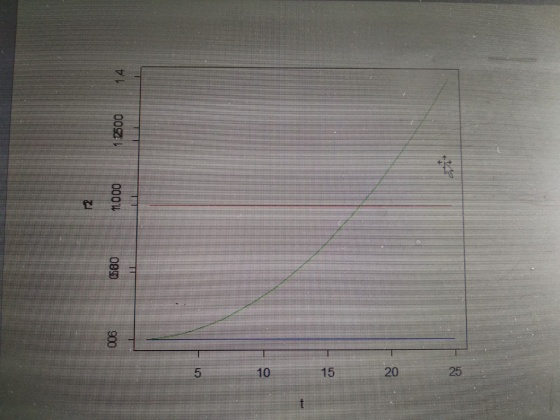
what is the R functions to plot ,on a single figure, the hazard function h(t) for...
what is the R functions to plot ,on a single figure, the hazard function h(t) for Weibull Distribution
for the cases (i) λ = 1, γ = 1, (ii) λ = 1, γ = 3, (iii) λ =1, γ =0.3, respectively. And the same thing for the survival function s(t) in separate figure
Homework Answers
![tesea[1,25,1);t #t be a lifetime 111 2 3 4 5 6 7 8 9 10 11 12 13 14 15 16 17 18 19 20 21 22 23 24 25 > l1=1:11 [1] 1 > gi=1g](http://img.homeworklib.com/questions/fc7b3b00-578a-11eb-b4bb-97ba4dc9fc91.png?x-oss-process=image/resize,w_560)
![> r3=13*33***193-1);r3 #Hazard rate for Weibull(13.93) [1] 0.30000000 0.18467166 0.13903892 0.11367874 0.09723940 0.08558849](http://img.homeworklib.com/questions/fd7b52c0-578a-11eb-867e-1d7f57e777a6.png?x-oss-process=image/resize,w_560)
![> s1=exp[-11*Ag1);s1 #s1 is survival function for Weibull(11,1) [1] 3.6787942-01 1.353353e-01 4.978707e-02 1831564e-02 6.7379](http://img.homeworklib.com/questions/ffd471f0-578a-11eb-9876-c1d08cf342e6.png?x-oss-process=image/resize,w_560)
![>3=exp(-13*+^g3);3 #s3 is survival function for Weibull(13.93) [1]0.36787944 0.29195827 0.24897839 0.21965073 0.19776880 0.18](http://img.homeworklib.com/questions/012c2d70-578b-11eb-aa9f-792a4cd69328.png?x-oss-process=image/resize,w_560)

Add Answer to:
what is the R functions to plot ,on a single figure, the hazard
function h(t) for...
3. Classifying Life Distributions. Suppose a continuous lifetime T has survival function S(O), hazard function h(i),...
 3. Classifying Life Distributions. Suppose a continuous lifetime T has survival function S(O), hazard function h(i), cumulative hazard function (1), and mean residual life m(t). Consider the following properties that I might have: I. h(t) is nondecreasing for 120, called increasing failure rate (IFR). II. HIV/1 is nondefreasing for >0, called increasing failure rate on the average (IFRA). II. ml) Sm(0) for all / 20, called new better than used (NBU). IV. m(1) decreases in 1, called decreasing mean residual...
In matlab please 3. (15 Points) Consider the following function. f(t) = 5e(-31) cos(20) a. Plot...
 In matlab please
3. (15 Points) Consider the following function. f(t) = 5e(-31) cos(20) a. Plot the function for t = 0 to 1 b. Analytically calculate the derivative. C. Calculate the derivative using the diff function d. Calculate the derivative using the gradient function e. In a separate figure, plot the derivatives obtained above in a single new figure (not subplot) using (i) solid blue line for part b, (ii) red dots for part c, and (iii) green o's...
In matlab please
3. (15 Points) Consider the following function. f(t) = 5e(-31) cos(20) a. Plot the function for t = 0 to 1 b. Analytically calculate the derivative. C. Calculate the derivative using the diff function d. Calculate the derivative using the gradient function e. In a separate figure, plot the derivatives obtained above in a single new figure (not subplot) using (i) solid blue line for part b, (ii) red dots for part c, and (iii) green o's...
In solving for the damped forced circuit 1 oscillations (particular solution) has the form 6. +R ...
 In solving for the damped forced circuit 1 oscillations (particular solution) has the form 6. +R q-Vocos(r) + dt C we found the pers istent cos (st where γ -, LC 21 2 Define rso that the amplitude of the response is proportional toT(r)- where we (1-r2)2 +4γ assume γ is a set constant (i) Show that T has a maximum Tmax-T(rmax) if γく1. In such a case find "max and T,nax (ii) Plot in T vs. r for the...
3. [24 pts] For the following piecewise functions f(t), (i) sketch a plot of f(t), (ii)...
 3. [24 pts] For the following piecewise functions f(t), (i) sketch a plot of f(t), (ii) write f(t) in terms of the Heaviside step function: H(t). (Chapter 6.3) 1, t1 -1,1St<2 (a) f(t)-〈1,2 t<3 0, 4 St t-1, 1st<2 t-3, 3st <4
Do the following in the program R Suppose a random variable X follows the Rayleigh distribution...
 Do
the following in the program R
Suppose a random variable X follows the Rayleigh distribution with probability density function given by f(x) = x/sigma^2 e^, 0 lessthanorequalto x < infinity, 0 < sigma < infinity. The cumulative distribution function is F(x) = 1 - e^, 0 lessthanorequalto x < infinity. The mean and variance of a Rayleigh random variable are. respectively. E(X) = sigma squareroot pi/2 and var(X) = (4 - pi/2) sigma^2. Plot the Rayleigh probability density function...
Do
the following in the program R
Suppose a random variable X follows the Rayleigh distribution with probability density function given by f(x) = x/sigma^2 e^, 0 lessthanorequalto x < infinity, 0 < sigma < infinity. The cumulative distribution function is F(x) = 1 - e^, 0 lessthanorequalto x < infinity. The mean and variance of a Rayleigh random variable are. respectively. E(X) = sigma squareroot pi/2 and var(X) = (4 - pi/2) sigma^2. Plot the Rayleigh probability density function...
Problem 1: Let y()- r(t+2)-r(t+1)+r(t)-r(t-1)-u(t-1)-r(t-2)+r(t-3), where r(t) is the ramp function. a) plot y(t) b) plot...
 Problem 1: Let y()- r(t+2)-r(t+1)+r(t)-r(t-1)-u(t-1)-r(t-2)+r(t-3), where r(t) is the ramp function. a) plot y(t) b) plot y'() c) Plot y(2t-3) d) calculate the energy of y(t) note: r(t) = t for t 0 and 0 for t < 0 Problem 2: Let x(t)s u(t)-u(t-2) and y(t) = t[u(t)-u(t-1)] a) b) plot x(t) and y(t) evaluate graphically and plot z(t) = x(t) * y(t) Problem 3: An LTI system has the impulse response h(t) = 5e-tu(t)-16e-2tu(t) + 13e-3t u(t) The input...
2- 5. The Weibull distribution has many applications in reliability engineering, survival analysi...
 2- 5. The Weibull distribution has many applications in reliability engineering, survival analysis, and general insurance. Let B>0, 8>0. Consider the probability density function x>0 zero otherwise Recall (Homework #1) V-Χδ has an Exponential(8-T )-Gamma(u-l,e-1 ) distribution. Let X1, . , X/ be a random sample from the above probability distribution. y-ΣΧ.Σν i has a Gamma(u-n, θ- 1 ) distribution. !!! i-l 2. suppose δ is known. Let Xi, X2, , Xn be a random sample from the distribution with...
#2) A non-repairable component has the following hazard function h)-12 tisimyear h(t)-1+2t tisinyea a) What is the probability that the component will function at least five years? b) What is the pro...
 #2) A non-repairable component has the following hazard function h)-12 tisimyear h(t)-1+2t tisinyea a) What is the probability that the component will function at least five years? b) What is the probability that it will be working between the third and sixth years? c) What is the probability that it will be working at most eight years?
#2) A non-repairable component has the following hazard function h)-12 tisimyear h(t)-1+2t tisinyea a) What is the probability that the component will function...
#2) A non-repairable component has the following hazard function h)-12 tisimyear h(t)-1+2t tisinyea a) What is the probability that the component will function at least five years? b) What is the probability that it will be working between the third and sixth years? c) What is the probability that it will be working at most eight years?
#2) A non-repairable component has the following hazard function h)-12 tisimyear h(t)-1+2t tisinyea a) What is the probability that the component will function...
7. For the production function q min(K,4L ): (a) Assume that capital K is fixed at...
 7. For the production function q min(K,4L ): (a) Assume that capital K is fixed at 100 units. Derive and plot: i, The total product function q(L) ii. The marginal product function MPL(L). iii. The average product function APL(L). (b) Suppose the price of labour w is $1 and the rental rate r is also $1. Derive and plot all cost functions; that is: i. Short run total cost. ii. Variable cost. iii. Fixed cost. iv. Short run average cost....
Using Mathematica Consider the vector-valued function r(t)=et cos t i+(sin t)/(t+4) j +t k. a) Plot...
Using Mathematica Consider the vector-valued function r(t)=et cos t i+(sin t)/(t+4) j +t k. a) Plot the curve with t going over the interval [-2, 2]. b) Plot the curve again over the same interval, but this time add the velocity vector in blue at (1, 0, 0) to the graph. c) Plot the curve again over the same interval, along with the blue velocity vector at (1, 0, 0), but this time add the acceleration vector in red at...
 3. Classifying Life Distributions. Suppose a continuous lifetime T has survival function S(O), hazard function h(i), cumulative hazard function (1), and mean residual life m(t). Consider the following properties that I might have: I. h(t) is nondecreasing for 120, called increasing failure rate (IFR). II. HIV/1 is nondefreasing for >0, called increasing failure rate on the average (IFRA). II. ml) Sm(0) for all / 20, called new better than used (NBU). IV. m(1) decreases in 1, called decreasing mean residual...
 In matlab please
3. (15 Points) Consider the following function. f(t) = 5e(-31) cos(20) a. Plot the function for t = 0 to 1 b. Analytically calculate the derivative. C. Calculate the derivative using the diff function d. Calculate the derivative using the gradient function e. In a separate figure, plot the derivatives obtained above in a single new figure (not subplot) using (i) solid blue line for part b, (ii) red dots for part c, and (iii) green o's...
In matlab please
3. (15 Points) Consider the following function. f(t) = 5e(-31) cos(20) a. Plot the function for t = 0 to 1 b. Analytically calculate the derivative. C. Calculate the derivative using the diff function d. Calculate the derivative using the gradient function e. In a separate figure, plot the derivatives obtained above in a single new figure (not subplot) using (i) solid blue line for part b, (ii) red dots for part c, and (iii) green o's...
 In solving for the damped forced circuit 1 oscillations (particular solution) has the form 6. +R q-Vocos(r) + dt C we found the pers istent cos (st where γ -, LC 21 2 Define rso that the amplitude of the response is proportional toT(r)- where we (1-r2)2 +4γ assume γ is a set constant (i) Show that T has a maximum Tmax-T(rmax) if γく1. In such a case find "max and T,nax (ii) Plot in T vs. r for the...
 3. [24 pts] For the following piecewise functions f(t), (i) sketch a plot of f(t), (ii) write f(t) in terms of the Heaviside step function: H(t). (Chapter 6.3) 1, t1 -1,1St<2 (a) f(t)-〈1,2 t<3 0, 4 St t-1, 1st<2 t-3, 3st <4
 Do
the following in the program R
Suppose a random variable X follows the Rayleigh distribution with probability density function given by f(x) = x/sigma^2 e^, 0 lessthanorequalto x < infinity, 0 < sigma < infinity. The cumulative distribution function is F(x) = 1 - e^, 0 lessthanorequalto x < infinity. The mean and variance of a Rayleigh random variable are. respectively. E(X) = sigma squareroot pi/2 and var(X) = (4 - pi/2) sigma^2. Plot the Rayleigh probability density function...
Do
the following in the program R
Suppose a random variable X follows the Rayleigh distribution with probability density function given by f(x) = x/sigma^2 e^, 0 lessthanorequalto x < infinity, 0 < sigma < infinity. The cumulative distribution function is F(x) = 1 - e^, 0 lessthanorequalto x < infinity. The mean and variance of a Rayleigh random variable are. respectively. E(X) = sigma squareroot pi/2 and var(X) = (4 - pi/2) sigma^2. Plot the Rayleigh probability density function...
 Problem 1: Let y()- r(t+2)-r(t+1)+r(t)-r(t-1)-u(t-1)-r(t-2)+r(t-3), where r(t) is the ramp function. a) plot y(t) b) plot y'() c) Plot y(2t-3) d) calculate the energy of y(t) note: r(t) = t for t 0 and 0 for t < 0 Problem 2: Let x(t)s u(t)-u(t-2) and y(t) = t[u(t)-u(t-1)] a) b) plot x(t) and y(t) evaluate graphically and plot z(t) = x(t) * y(t) Problem 3: An LTI system has the impulse response h(t) = 5e-tu(t)-16e-2tu(t) + 13e-3t u(t) The input...
 2- 5. The Weibull distribution has many applications in reliability engineering, survival analysis, and general insurance. Let B>0, 8>0. Consider the probability density function x>0 zero otherwise Recall (Homework #1) V-Χδ has an Exponential(8-T )-Gamma(u-l,e-1 ) distribution. Let X1, . , X/ be a random sample from the above probability distribution. y-ΣΧ.Σν i has a Gamma(u-n, θ- 1 ) distribution. !!! i-l 2. suppose δ is known. Let Xi, X2, , Xn be a random sample from the distribution with...
 #2) A non-repairable component has the following hazard function h)-12 tisimyear h(t)-1+2t tisinyea a) What is the probability that the component will function at least five years? b) What is the probability that it will be working between the third and sixth years? c) What is the probability that it will be working at most eight years?
#2) A non-repairable component has the following hazard function h)-12 tisimyear h(t)-1+2t tisinyea a) What is the probability that the component will function...
#2) A non-repairable component has the following hazard function h)-12 tisimyear h(t)-1+2t tisinyea a) What is the probability that the component will function at least five years? b) What is the probability that it will be working between the third and sixth years? c) What is the probability that it will be working at most eight years?
#2) A non-repairable component has the following hazard function h)-12 tisimyear h(t)-1+2t tisinyea a) What is the probability that the component will function...
 7. For the production function q min(K,4L ): (a) Assume that capital K is fixed at 100 units. Derive and plot: i, The total product function q(L) ii. The marginal product function MPL(L). iii. The average product function APL(L). (b) Suppose the price of labour w is $1 and the rental rate r is also $1. Derive and plot all cost functions; that is: i. Short run total cost. ii. Variable cost. iii. Fixed cost. iv. Short run average cost....
Most questions answered within 3 hours.
-
Where is the error in this code sequence?
String s1 = "Hello";
String s2 = "ello";...
asked 10 months ago -
Financial data for Joel de Paris, Inc., for last year
follow:
Joel de Paris, Inc.
Balance...
asked 10 months ago -
Consider this reaction:
Al2(SO4)3 (aq)+ BaCl3
(aq) Al2Cl6 (aq)- +
3BaSO4(s) . What is the...
asked 10 months ago -
Suppose that Savneet is considering increasing her
recent random sample from 20 car rentals to 40...
asked 10 months ago -
Trucks arrive at an unloading terminal at an average rate of 120
per hour.
Trucks arrive...
asked 10 months ago -
Why are methanol and ethanol completely soluble in water while
octanol is not very little soluble....
asked 10 months ago -
A facilities manager at a university reads in a research report
that the mean amount of...
asked 10 months ago -
When the CuSO4 is rehydrated by adding water to the anhydrous
compound, is this an endothermic...
asked 10 months ago -
A ray of sunlight is passing from diamond into crown glass; the
angle of incidence is...
asked 10 months ago -
A block of mass 0.249 kg is placed on top of a light, vertical
spring of...
asked 10 months ago -
how do the kidneys compensate in the presences of acidosis
a) trigger hyperventilate
b) reserve acid...
asked 10 months ago -
Question 501 pts
The rental rate of capital to the firm increases. Which of the
following...
asked 10 months ago