Consider the following network.
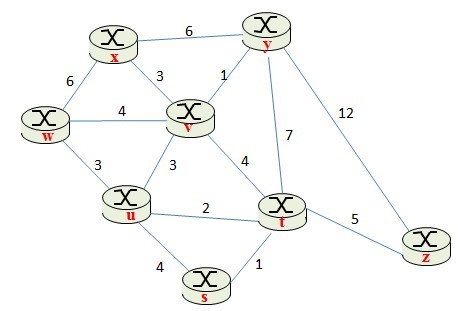
a. (16 pt.) With the indicated link costs, use Dijkstra’s shortest-path algorithm to compute the shortest path from “w” to all network nodes. Show how the algorithm works by computing the table below. Note: If there exists any tie in each step, choose the left-most column first.
|
Step |
N’ |
D(s), p(s) |
D(t), p(t) |
D(u), p(u) |
D(v), p(v) |
D(x), p(x) |
D(y), p(y) |
D(z), p(z) |
|
0 |
||||||||
|
1 |
||||||||
|
2 |
||||||||
|
3 |
||||||||
|
4 |
||||||||
|
5 |
||||||||
|
6 |
||||||||
|
7 |
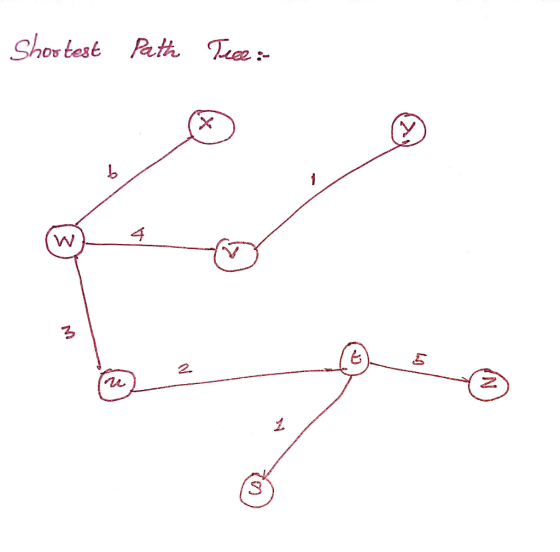
b. (7 pt.) Construct the shortest path tree from the above routing table (Hint: Slide 4-86).
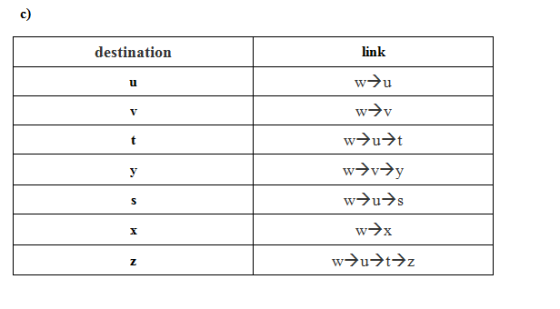
c. (7 pt.) Construct a forwarding table from the above routing table (Hint: Slide 4-86).
|
Destination |
Link |
Homework Answers

Add Answer to:
Consider the following network.
a. (16 pt.)
With the indicated link costs, use Dijkstra’s shortest-path
algorithm...
Use Dijkstra’s algorithm to find the shortest path from a to z. In each case make...
 Use Dijkstra’s algorithm to find the shortest path from a to z.
In each case make tables similar to Table 10.7.1 to show the action
of the algorithm.
15. The graph of exercise 9 (shown
above) with a = a and z = f
Note: Please include the table similar to the following format
in the answer.
11 |10 f 12--- C0 0d C1 7/ 7-1 2 all-4 4 |を 35 3 a 4 9
Use Dijkstra’s algorithm to find the shortest path from a to z.
In each case make tables similar to Table 10.7.1 to show the action
of the algorithm.
15. The graph of exercise 9 (shown
above) with a = a and z = f
Note: Please include the table similar to the following format
in the answer.
11 |10 f 12--- C0 0d C1 7/ 7-1 2 all-4 4 |を 35 3 a 4 9
Apply Dijkstra's algorithm to the following network to generate a shortest-path-tree for node C and node D
 Apply Dijkstra's algorithm to the following network to generate a shortest-path-tree for node C and node D, and build a routing table for node C and node D. Show each step of the algorithm.
computer networking help 4. 120 points) Consider a network with the following topology (1) Use Djikistra shortest...
 computer networking help
4. 120 points) Consider a network with the following topology (1) Use Djikistra shortest path algorithm to find the spanning tree which contains all form router A to the rest of the routers the network. Show the first 4 steps of the results of the algorithm. (Note that unless specified in figure, all link metrics are 1.) Answer: Step N LA 3.A 2.A (2) Assume that RIP is used as the routing protocol and all link metrics...
computer networking help
4. 120 points) Consider a network with the following topology (1) Use Djikistra shortest path algorithm to find the spanning tree which contains all form router A to the rest of the routers the network. Show the first 4 steps of the results of the algorithm. (Note that unless specified in figure, all link metrics are 1.) Answer: Step N LA 3.A 2.A (2) Assume that RIP is used as the routing protocol and all link metrics...
2. Apply Dijkstra’s algorithm as discussed in class to solve the single-source shortest-paths problem for the...
 2. Apply Dijkstra’s algorithm as discussed in class to solve the single-source shortest-paths problem for the following graph. Consider node a to be the source. (10 points) a. Show the completed table. b. State the shortest path from A to J and state its length. c. State the shortest path from A to K and state its length. d. State the shortest path from A to L and state its length. 3 5 6 4 3 2 1 2. d...
10.For the following network, use Dijkstra’s least-cost path algorithm to compute the paths from A to...
 10.For the following network, use Dijkstra’s least-cost path
algorithm to compute the paths from A to all other nodes. Show all
the steps. Draw the final least-cost path tree.
10. For the following network, use Dijkstra's least-cost path algorithm to compute the paths from A to all other nodes. Show all the steps. Draw the final least-cost path tree. 4 10
10.For the following network, use Dijkstra’s least-cost path
algorithm to compute the paths from A to all other nodes. Show all
the steps. Draw the final least-cost path tree.
10. For the following network, use Dijkstra's least-cost path algorithm to compute the paths from A to all other nodes. Show all the steps. Draw the final least-cost path tree. 4 10
Construct the shortest path tree by applyin Dijkstra's algorithm to the given network graph. Use node...
 Construct the shortest path tree by applyin Dijkstra's algorithm
to the given network graph. Use node E as the source node.
B M Z C, rk
Construct the shortest path tree by applyin Dijkstra's algorithm
to the given network graph. Use node E as the source node.
B M Z C, rk
2. Suppose that 6 routers (u, v, w, x, y and z) are connected as follows...
 2. Suppose that 6 routers (u, v, w, x, y and z) are connected as follows with the cost of each link shown next to it. ul 4 a) Use Dijkstra's algorithm to compute the least cost path from Router u (8 points) b) Construct the shortest path graph from Router u to all other routers (3 points) to all other routers in the network. from your solution in Part a Find the routing table of Router u from your...
For the network given in the following diagram, show how the link-state algorithm builds the routing...
 For the network given in the following diagram, show how the link-state algorithm builds the routing table for node x. Construct and fill the table as given below: Page 2 of 4 Iteration Initial 1 2 3 4 5 6 8
Consider the network shown below. Use Dijkstra's algorithm to find the shortest paths from node a...
 Consider the network shown below. Use Dijkstra's algorithm to find the shortest paths from node a to all other nodes. Enter your answers in the a shortest path answers in the following format: node-node-node. For example, if the ssignment link. Enter the shortest path from a to c is through node b, you would enter the answer as: a-b-c 3 5 6 6
7. Using Moore's shortest path algorithm, fill the travel time table below and indicate how they...
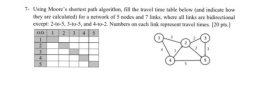 7. Using Moore's shortest path algorithm, fill the travel time table below and indicate how they are calculated) for a network of 5 nodes and 7 links, where all links are bidirectional except: 2-to-5, 3-to-5, and 4-to-2. Numbers on each link represent travel times. (20 pts.] OD 12 20 CMM
 Use Dijkstra’s algorithm to find the shortest path from a to z.
In each case make tables similar to Table 10.7.1 to show the action
of the algorithm.
15. The graph of exercise 9 (shown
above) with a = a and z = f
Note: Please include the table similar to the following format
in the answer.
11 |10 f 12--- C0 0d C1 7/ 7-1 2 all-4 4 |を 35 3 a 4 9
Use Dijkstra’s algorithm to find the shortest path from a to z.
In each case make tables similar to Table 10.7.1 to show the action
of the algorithm.
15. The graph of exercise 9 (shown
above) with a = a and z = f
Note: Please include the table similar to the following format
in the answer.
11 |10 f 12--- C0 0d C1 7/ 7-1 2 all-4 4 |を 35 3 a 4 9
 computer networking help
4. 120 points) Consider a network with the following topology (1) Use Djikistra shortest path algorithm to find the spanning tree which contains all form router A to the rest of the routers the network. Show the first 4 steps of the results of the algorithm. (Note that unless specified in figure, all link metrics are 1.) Answer: Step N LA 3.A 2.A (2) Assume that RIP is used as the routing protocol and all link metrics...
computer networking help
4. 120 points) Consider a network with the following topology (1) Use Djikistra shortest path algorithm to find the spanning tree which contains all form router A to the rest of the routers the network. Show the first 4 steps of the results of the algorithm. (Note that unless specified in figure, all link metrics are 1.) Answer: Step N LA 3.A 2.A (2) Assume that RIP is used as the routing protocol and all link metrics...
 2. Apply Dijkstra’s algorithm as discussed in class to solve the single-source shortest-paths problem for the following graph. Consider node a to be the source. (10 points) a. Show the completed table. b. State the shortest path from A to J and state its length. c. State the shortest path from A to K and state its length. d. State the shortest path from A to L and state its length. 3 5 6 4 3 2 1 2. d...
 10.For the following network, use Dijkstra’s least-cost path
algorithm to compute the paths from A to all other nodes. Show all
the steps. Draw the final least-cost path tree.
10. For the following network, use Dijkstra's least-cost path algorithm to compute the paths from A to all other nodes. Show all the steps. Draw the final least-cost path tree. 4 10
10.For the following network, use Dijkstra’s least-cost path
algorithm to compute the paths from A to all other nodes. Show all
the steps. Draw the final least-cost path tree.
10. For the following network, use Dijkstra's least-cost path algorithm to compute the paths from A to all other nodes. Show all the steps. Draw the final least-cost path tree. 4 10
 Construct the shortest path tree by applyin Dijkstra's algorithm
to the given network graph. Use node E as the source node.
B M Z C, rk
Construct the shortest path tree by applyin Dijkstra's algorithm
to the given network graph. Use node E as the source node.
B M Z C, rk
 2. Suppose that 6 routers (u, v, w, x, y and z) are connected as follows with the cost of each link shown next to it. ul 4 a) Use Dijkstra's algorithm to compute the least cost path from Router u (8 points) b) Construct the shortest path graph from Router u to all other routers (3 points) to all other routers in the network. from your solution in Part a Find the routing table of Router u from your...
 For the network given in the following diagram, show how the link-state algorithm builds the routing table for node x. Construct and fill the table as given below: Page 2 of 4 Iteration Initial 1 2 3 4 5 6 8
 Consider the network shown below. Use Dijkstra's algorithm to find the shortest paths from node a to all other nodes. Enter your answers in the a shortest path answers in the following format: node-node-node. For example, if the ssignment link. Enter the shortest path from a to c is through node b, you would enter the answer as: a-b-c 3 5 6 6
 7. Using Moore's shortest path algorithm, fill the travel time table below and indicate how they are calculated) for a network of 5 nodes and 7 links, where all links are bidirectional except: 2-to-5, 3-to-5, and 4-to-2. Numbers on each link represent travel times. (20 pts.] OD 12 20 CMM
Most questions answered within 3 hours.
-
Where is the error in this code sequence?
String s1 = "Hello";
String s2 = "ello";...
asked 11 months ago -
Financial data for Joel de Paris, Inc., for last year
follow:
Joel de Paris, Inc.
Balance...
asked 11 months ago -
Consider this reaction:
Al2(SO4)3 (aq)+ BaCl3
(aq) Al2Cl6 (aq)- +
3BaSO4(s) . What is the...
asked 11 months ago -
Suppose that Savneet is considering increasing her
recent random sample from 20 car rentals to 40...
asked 11 months ago -
Trucks arrive at an unloading terminal at an average rate of 120
per hour.
Trucks arrive...
asked 11 months ago -
Why are methanol and ethanol completely soluble in water while
octanol is not very little soluble....
asked 11 months ago -
A facilities manager at a university reads in a research report
that the mean amount of...
asked 11 months ago -
When the CuSO4 is rehydrated by adding water to the anhydrous
compound, is this an endothermic...
asked 11 months ago -
A ray of sunlight is passing from diamond into crown glass; the
angle of incidence is...
asked 11 months ago -
A block of mass 0.249 kg is placed on top of a light, vertical
spring of...
asked 11 months ago -
how do the kidneys compensate in the presences of acidosis
a) trigger hyperventilate
b) reserve acid...
asked 11 months ago -
Question 501 pts
The rental rate of capital to the firm increases. Which of the
following...
asked 11 months ago