![4 T0] Deiernine the equivalent impedance for the sircult shuwn below 200kΩ](http://img.homeworklib.com/questions/0e47e7d0-57e7-11eb-b774-5de83a0d3154.png?x-oss-process=image/resize,w_560)
Homework Answers

therefore, because the values of resistances are such that they
dominate the impedance due to inductor. therefore, the total
impedance will be nearly independent of the frequency and its value
will be always be approximately equal to  .
.
Add Answer to:
4 T0] Deiernine the equivalent impedance for the sircult shuwn below 200kΩ
For the below circuit, a) Determine the equivalent impedance of the following circuit at frequency of...
 For the below circuit,
a) Determine the equivalent impedance of the following circuit
at frequency of 20Hz
b) Calculate the currents I, IR and IC if
a voltage of 24V at 20Hz is applied to the input.
c) Draw the phase diagrams of currents I, IR and
IC .
80Ω 100μF Figure 4
For the below circuit,
a) Determine the equivalent impedance of the following circuit
at frequency of 20Hz
b) Calculate the currents I, IR and IC if
a voltage of 24V at 20Hz is applied to the input.
c) Draw the phase diagrams of currents I, IR and
IC .
80Ω 100μF Figure 4
Determine the equivalent impedance in the circuit in circuit below assuming - - 10 rad's 102...
 Determine the equivalent impedance in the circuit in circuit below assuming - - 10 rad's 102 0.5 UF w INF 100- 102
3. (20 pts) For the circuit shown below, find the equivalent impedance Z, given u-a rad/s...
 3. (20 pts) For the circuit shown below, find the equivalent impedance Z, given u-a rad/s 1/4 H 2S2
4. 12 pt] Combine all the R, L, C component into a single impedance (i.e. equivalent...
 4. 12 pt] Combine all the R, L, C component into a single impedance (i.e. equivalent impedance), then apply Ohm's law in Phasor domain to calculate the current. Express your answer in the time domain i(t). itt)-? 820 100pF 50Hz 33mH 100mH 100?
For Re-R=12 and C-1F, find the equivalent impedance magnitude as a function of frequency for the...
 For Re-R=12 and C-1F, find the equivalent impedance magnitude as a function of frequency for the circuit below: Re R Ce How does this impedance behave at high frequencies? At low frequencies?
Given a balanced three phase delta connected load with impedance 3+j6 what is impedance equivalent for...
Given a balanced three phase delta connected load with impedance 3+j6 what is impedance equivalent for a Y connection?
Determine the frequency that causes the equivalent impedance Zeq in the given circuit to be purely...
 Determine the frequency that causes the equivalent impedance Zeq in the given circuit to be purely resistive. Round the final answer to two decimal places.) Given: L 17 mH 15? The frequency that causes the equivalent impedance Zeq to be purely resistive is a 242535 63 rads.
Determine the Thévenin equivalent seen by the --j10 S2 impedance of Fig. 10.31a, and use this...
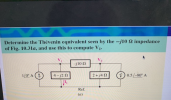 Determine the Thévenin equivalent seen by the --j10 S2 impedance of Fig. 10.31a, and use this to compute V1. -1022 1/0° © 4-j2 N 2 +34 0.5/–90° A Ref.
2. For the circuit shown in Figure 4, find the following: ° The input impedance to...
 2. For the circuit shown in Figure 4, find the following: ° The input impedance to the right of v1. This is typically done by taking the ratio of applied (input) voltage to induced current. ° The output impedance of the amplifier circuit. Note output impedance is the same at Thevenin's (equivalent) impedance
 For the below circuit,
a) Determine the equivalent impedance of the following circuit
at frequency of 20Hz
b) Calculate the currents I, IR and IC if
a voltage of 24V at 20Hz is applied to the input.
c) Draw the phase diagrams of currents I, IR and
IC .
80Ω 100μF Figure 4
For the below circuit,
a) Determine the equivalent impedance of the following circuit
at frequency of 20Hz
b) Calculate the currents I, IR and IC if
a voltage of 24V at 20Hz is applied to the input.
c) Draw the phase diagrams of currents I, IR and
IC .
80Ω 100μF Figure 4
 Determine the equivalent impedance in the circuit in circuit below assuming - - 10 rad's 102 0.5 UF w INF 100- 102
 3. (20 pts) For the circuit shown below, find the equivalent impedance Z, given u-a rad/s 1/4 H 2S2
 4. 12 pt] Combine all the R, L, C component into a single impedance (i.e. equivalent impedance), then apply Ohm's law in Phasor domain to calculate the current. Express your answer in the time domain i(t). itt)-? 820 100pF 50Hz 33mH 100mH 100?
 For Re-R=12 and C-1F, find the equivalent impedance magnitude as a function of frequency for the circuit below: Re R Ce How does this impedance behave at high frequencies? At low frequencies?
 Determine the frequency that causes the equivalent impedance Zeq in the given circuit to be purely resistive. Round the final answer to two decimal places.) Given: L 17 mH 15? The frequency that causes the equivalent impedance Zeq to be purely resistive is a 242535 63 rads.
 Determine the Thévenin equivalent seen by the --j10 S2 impedance of Fig. 10.31a, and use this to compute V1. -1022 1/0° © 4-j2 N 2 +34 0.5/–90° A Ref.
 2. For the circuit shown in Figure 4, find the following: ° The input impedance to the right of v1. This is typically done by taking the ratio of applied (input) voltage to induced current. ° The output impedance of the amplifier circuit. Note output impedance is the same at Thevenin's (equivalent) impedance
Most questions answered within 3 hours.
-
Where is the error in this code sequence?
String s1 = "Hello";
String s2 = "ello";...
asked 10 months ago -
Financial data for Joel de Paris, Inc., for last year
follow:
Joel de Paris, Inc.
Balance...
asked 10 months ago -
Consider this reaction:
Al2(SO4)3 (aq)+ BaCl3
(aq) Al2Cl6 (aq)- +
3BaSO4(s) . What is the...
asked 10 months ago -
Suppose that Savneet is considering increasing her
recent random sample from 20 car rentals to 40...
asked 10 months ago -
Trucks arrive at an unloading terminal at an average rate of 120
per hour.
Trucks arrive...
asked 10 months ago -
Why are methanol and ethanol completely soluble in water while
octanol is not very little soluble....
asked 10 months ago -
A facilities manager at a university reads in a research report
that the mean amount of...
asked 10 months ago -
When the CuSO4 is rehydrated by adding water to the anhydrous
compound, is this an endothermic...
asked 10 months ago -
A ray of sunlight is passing from diamond into crown glass; the
angle of incidence is...
asked 10 months ago -
A block of mass 0.249 kg is placed on top of a light, vertical
spring of...
asked 10 months ago -
how do the kidneys compensate in the presences of acidosis
a) trigger hyperventilate
b) reserve acid...
asked 10 months ago -
Question 501 pts
The rental rate of capital to the firm increases. Which of the
following...
asked 10 months ago