If you were building a velocity selector where the electric field pointed along the upward direction...
If you were building a velocity selector where the electric field pointed along the upward direction and a positively charged particle was traveling left to right;
a.) Would you rather the magnetic field go into or out of the page. Explain.
b.) Show that the veloicty will not be deflected. v=E/B
c.) Would your answer to part A change if the charge was negative. Explain.
Homework Answers
a) The electric and magnetic fields should act in the same region (usually, an electromagnetic field created between 2 plates). If Fe is upward, the electromagnetic force (FL=Lorentz's force) should be downward in order, for the (positive) ion, to move straightforward (condition for the same speed).
So, B should exit the page.
b)
Fe=FL <---> neE=nevB --=> v=E/B.
ne=ion charge
c) If the electric field has the same direction and sense (upward), Fe will be downward for a negative ion. Thus, the Lorentz's force should be upward. In this case B exits the page as well since the charge is negative.
Add Answer to:
If you were building a velocity selector where the electric
field pointed along the upward direction...
Velocity Selector-multiple choice
 The Velocity SelectorIn experiments where all the charged particles in a beam are required to have the same velocity (for example, when entering a mass spectrometer), scientists use a velocity selector. A velocity selector has a region of uniform electric and magnetic fields that are perpendicular to each other and perpendicular to the motion of the charged particles. Both the electric and magnetic fields exert a force on the charged particles. If a particle has precisely the right velocity, the...
PROBLEM 1 – A velocity selector (Wien Filter) has an electric field of magnitude 2470 N/C,...
PROBLEM 1 – A velocity selector (Wien Filter) has an electric field of magnitude 2470 N/C, directed vertically upward, and a horizontal magnetic field that is directed to the south. Charged particles, traveling east at a speed of 6.50 × 10³ m/s, enter the selector and are able to pass through undeflected. When a different charged particle with an electric charge of +4.00 × 10⁻¹² C enters the selector traveling east, the net force acting on it is 1.90 ×...
Problem 1a: Velocity Selector: Show that with the right ratio of electric to magnetic field strength...
Problem 1a: Velocity Selector: Show that with the right ratio of electric to magnetic field strength a particle of velocity v will proceed through both fields in a straight line at constant speed (hint: you will need an equation containing v. Also: what does the straight line at constant speed give you?). Assume that the angle of the velocity vector relative to the magnetic field vector is 90 degrees. (15 points) b: Show mathematically that the charge magnitude and sign...
A velocity selector is used in accelerator mass spectrometry to select particles based on their speed.
 A velocity selector is used in accelerator mass spectrometry to select particles based on their speed. The velocity selector is composed of orthogonal electric and magnetic fields, such that particles with the correct charge to mass ratio and speed will be unaffected, and other particles will be deflected. If the Electric Field is oriented down, What is the direction of the Magnetic Field? A charged particle moves through the velocity selector at a constant speed in a straight line. The electric field...
1. A speed selector is a device that uses both electric and magnetic fields to select...
1. A speed selector is a device that uses both electric and magnetic fields to select particles with only a certain value of velocity. (a) If a positively charged particle goes through a region of space where the electric field points directly upwards and the magnetic field points out of the page, draw a free body diagram indicating the electric and magnetic forces this particle feels. (b) If the particle can go through this region without being deflected (that is,...
A positively charged particle is moving with a constant velocity directed to the right through a...
 A positively charged particle is moving with a constant velocity directed to the right through a region of a uniform magnetic field 8 directed out of the page as shown in the figure. In which direction must an electric field be applied to keep the particle moving along a straight line? OB Upward Downward Out of the page Into the page To the right in the plane of the page To the left in the plane of the page
An unknown charged particle is fired into a velocity selector . The magnetic field in the...
 An unknown charged particle is fired into a velocity selector
. The magnetic field in the velocity selector is 1.2 T. If we would
like to select for a speed of 400 m/s , what should the magnitude
of the electric field be?
An unknown charged particle is fired into a velocity selector. The magnetic field in the velocity selector is 1.2 T. If we would like to select for a speed of 400 m/s, what should the magnitude of...
An unknown charged particle is fired into a velocity selector
. The magnetic field in the velocity selector is 1.2 T. If we would
like to select for a speed of 400 m/s , what should the magnitude
of the electric field be?
An unknown charged particle is fired into a velocity selector. The magnetic field in the velocity selector is 1.2 T. If we would like to select for a speed of 400 m/s, what should the magnitude of...
Question 20 A charged particle moving to the right along the x-axis enters a region with...
 Question 20 A charged particle moving to the right along the x-axis enters a region with a uniform electric field that is directed along the y-axis from the top of the page to the bottom of the page, as shown in the figure below. Which of the following statements is NOT true about the subsequent motion of the charged particle? You may neglect the effects of gravity and air resistance for this question. Select the correct aneu Select the correct...
A grad student is trying to build a velocity selector, shown below.
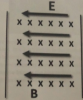 A grad student is trying to build a velocity selector, shown below. Charged particles will enter the velocity selector from the bottom and only those with the correct velocity v will be able to move in a straight line and leave at the top. The grad student's velocity selector has the electric field E pointing to the left, and the magnetic field B is pointing into the page. Explain why this arrangement will not work as a velocity selector.
1. part A)In the electric field mapping experiment, the direction of electric field lines for a...
1. part A)In the electric field mapping experiment, the direction of electric field lines for a positively charged object is outward or inward the object? part B) In the electric field mapping experiment, the direction of electric field lines for a negatively charged object is outward or inward the object? part C) In the electric field mapping experiment, the electric potential increases as you move from negative plate (on the left) to positive plate (on the right). What is the...
 A positively charged particle is moving with a constant velocity directed to the right through a region of a uniform magnetic field 8 directed out of the page as shown in the figure. In which direction must an electric field be applied to keep the particle moving along a straight line? OB Upward Downward Out of the page Into the page To the right in the plane of the page To the left in the plane of the page
 An unknown charged particle is fired into a velocity selector
. The magnetic field in the velocity selector is 1.2 T. If we would
like to select for a speed of 400 m/s , what should the magnitude
of the electric field be?
An unknown charged particle is fired into a velocity selector. The magnetic field in the velocity selector is 1.2 T. If we would like to select for a speed of 400 m/s, what should the magnitude of...
An unknown charged particle is fired into a velocity selector
. The magnetic field in the velocity selector is 1.2 T. If we would
like to select for a speed of 400 m/s , what should the magnitude
of the electric field be?
An unknown charged particle is fired into a velocity selector. The magnetic field in the velocity selector is 1.2 T. If we would like to select for a speed of 400 m/s, what should the magnitude of...
 Question 20 A charged particle moving to the right along the x-axis enters a region with a uniform electric field that is directed along the y-axis from the top of the page to the bottom of the page, as shown in the figure below. Which of the following statements is NOT true about the subsequent motion of the charged particle? You may neglect the effects of gravity and air resistance for this question. Select the correct aneu Select the correct...
Most questions answered within 3 hours.
-
Where is the error in this code sequence?
String s1 = "Hello";
String s2 = "ello";...
asked 10 months ago -
Financial data for Joel de Paris, Inc., for last year
follow:
Joel de Paris, Inc.
Balance...
asked 10 months ago -
Consider this reaction:
Al2(SO4)3 (aq)+ BaCl3
(aq) Al2Cl6 (aq)- +
3BaSO4(s) . What is the...
asked 10 months ago -
Suppose that Savneet is considering increasing her
recent random sample from 20 car rentals to 40...
asked 10 months ago -
Trucks arrive at an unloading terminal at an average rate of 120
per hour.
Trucks arrive...
asked 10 months ago -
Why are methanol and ethanol completely soluble in water while
octanol is not very little soluble....
asked 10 months ago -
A facilities manager at a university reads in a research report
that the mean amount of...
asked 10 months ago -
When the CuSO4 is rehydrated by adding water to the anhydrous
compound, is this an endothermic...
asked 10 months ago -
A ray of sunlight is passing from diamond into crown glass; the
angle of incidence is...
asked 10 months ago -
A block of mass 0.249 kg is placed on top of a light, vertical
spring of...
asked 10 months ago -
how do the kidneys compensate in the presences of acidosis
a) trigger hyperventilate
b) reserve acid...
asked 10 months ago -
Question 501 pts
The rental rate of capital to the firm increases. Which of the
following...
asked 10 months ago