An environmental chemist working for the Environmental Protection Agency (EPA) was directed to collect razor clams from a heavily
An environmental chemist working for the Environmental Protection Agency (EPA) was directed to collect razor clams from a heavily-contaminated river superfund site and analyze them for their Cd2+ content using graphite furnace atomic absorption spectrometry (GFAAS). The chemist dried the clams at 95 °C overnight and ground them in a scientific blender, resulting in approximately 50 g of homogenized dry weight. A representative 58,51 mg sample was taken from the approximately 50 g of dry material and dissolved in 100.0 mL of 0.1 M HCl to create a sample solution. Using the method of standard additions, the chemist prepared five standard solutions in 100.0 mL volumetric flasks, each containing 5.00 mL aliquots of the sample solution. Varying amounts of a 87.0 ppb (g/L) Cd2+ standard were added to each of the flasks, which were then brought to volume with 0.1 M HCI. The Ca'+ content of the solutions was then analyzed using GFAAS. resulting in the absorbance data given in the table.
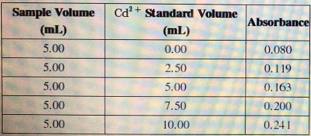
Determine the amount of Cd2+ per gram of dry clam. Express your final result as milligrams of Cd2+ per gram of dry clam.
Homework Answers


Add Answer to:
An environmental chemist working for the Environmental Protection Agency (EPA) was directed to collect razor clams from a heavily
An environmental chemist working for the Environmental Protection Agency (EPA) was directed to collect razor clams...
An environmental chemist working for the Environmental Protection Agency (EPA) was directed to collect razor clams from a heavily-contaminated river superfund site and analyze them for their Cd2+ content using graphite furnace atomic absorption spectrometry (GFAAS). The chemist dried the clams at 95 °C overnight and ground them in a scientific blender, resulting in approximately 50 g of homogenized dry weight. A representative 99.31 mg sample was taken from the approximately 50 g of dry material and dissolved in 100.0...
explaim the mechanisms amd toxological effects if type 1 diabetes in this article Exposure to arsenic...
 explaim the mechanisms amd toxological effects if type 1
diabetes in this article
Exposure to arsenic in drinking water is associated with increased prevalence of diabetes. We previously reported an association of diabetes and urinary concentration of dimethylarsinite (DMAS"), a toxic product of arsenic methylation by arsenic (+ 3 oxidation state) methyltransferase (AS3MT). Here we examine associations between AS3MT polymorphism, arsenic metabolism and diabetes. Fasting blood glucose, oral glucose tolerance and self-reported diagnoses were used to identify diabetic individuals. Inorganic...
explaim the mechanisms amd toxological effects if type 1
diabetes in this article
Exposure to arsenic in drinking water is associated with increased prevalence of diabetes. We previously reported an association of diabetes and urinary concentration of dimethylarsinite (DMAS"), a toxic product of arsenic methylation by arsenic (+ 3 oxidation state) methyltransferase (AS3MT). Here we examine associations between AS3MT polymorphism, arsenic metabolism and diabetes. Fasting blood glucose, oral glucose tolerance and self-reported diagnoses were used to identify diabetic individuals. Inorganic...
 explaim the mechanisms amd toxological effects if type 1
diabetes in this article
Exposure to arsenic in drinking water is associated with increased prevalence of diabetes. We previously reported an association of diabetes and urinary concentration of dimethylarsinite (DMAS"), a toxic product of arsenic methylation by arsenic (+ 3 oxidation state) methyltransferase (AS3MT). Here we examine associations between AS3MT polymorphism, arsenic metabolism and diabetes. Fasting blood glucose, oral glucose tolerance and self-reported diagnoses were used to identify diabetic individuals. Inorganic...
explaim the mechanisms amd toxological effects if type 1
diabetes in this article
Exposure to arsenic in drinking water is associated with increased prevalence of diabetes. We previously reported an association of diabetes and urinary concentration of dimethylarsinite (DMAS"), a toxic product of arsenic methylation by arsenic (+ 3 oxidation state) methyltransferase (AS3MT). Here we examine associations between AS3MT polymorphism, arsenic metabolism and diabetes. Fasting blood glucose, oral glucose tolerance and self-reported diagnoses were used to identify diabetic individuals. Inorganic...
Most questions answered within 3 hours.
-
Where is the error in this code sequence?
String s1 = "Hello";
String s2 = "ello";...
asked 10 months ago -
Financial data for Joel de Paris, Inc., for last year
follow:
Joel de Paris, Inc.
Balance...
asked 10 months ago -
Consider this reaction:
Al2(SO4)3 (aq)+ BaCl3
(aq) Al2Cl6 (aq)- +
3BaSO4(s) . What is the...
asked 10 months ago -
Suppose that Savneet is considering increasing her
recent random sample from 20 car rentals to 40...
asked 10 months ago -
Trucks arrive at an unloading terminal at an average rate of 120
per hour.
Trucks arrive...
asked 10 months ago -
Why are methanol and ethanol completely soluble in water while
octanol is not very little soluble....
asked 10 months ago -
A facilities manager at a university reads in a research report
that the mean amount of...
asked 10 months ago -
When the CuSO4 is rehydrated by adding water to the anhydrous
compound, is this an endothermic...
asked 10 months ago -
A ray of sunlight is passing from diamond into crown glass; the
angle of incidence is...
asked 10 months ago -
A block of mass 0.249 kg is placed on top of a light, vertical
spring of...
asked 10 months ago -
how do the kidneys compensate in the presences of acidosis
a) trigger hyperventilate
b) reserve acid...
asked 10 months ago -
Question 501 pts
The rental rate of capital to the firm increases. Which of the
following...
asked 10 months ago