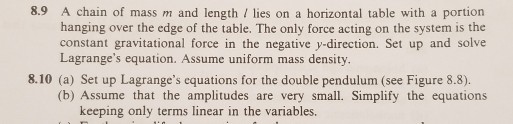
8.9.) A chain of mass m and length l lies on a
horizontal table with a portion hanging over the edgeof the table.
The only force acting on the system is the constant gravitational
force in the negative y- direction. Set up and solve Lagrange's
equation. Assume uniform mass density.
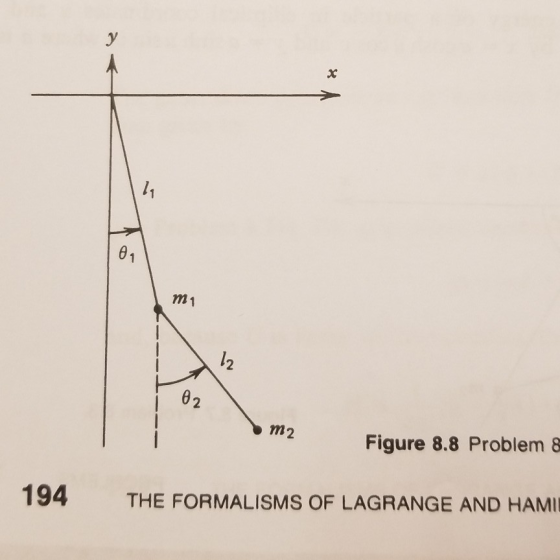
8.10.) a) Set up Lagrange's equations for the double pendulum
(Figure 8.8).
b) Assume that the amplitudes are very small. Simplify the
equations keeping only terms linear in the variables.
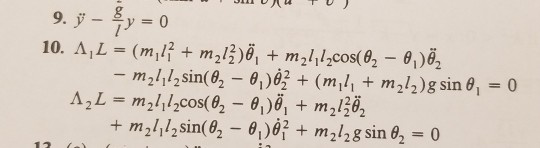
The third picture is the answers to the problems according to the textbook
Homework Answers
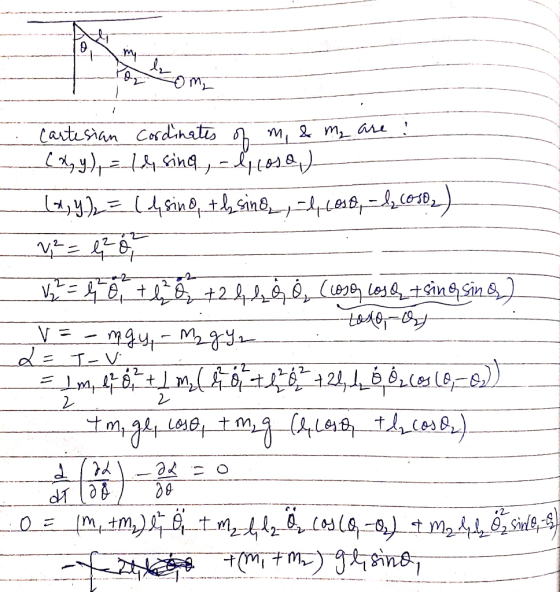
 There is a small error in the
solution given in the attachment I have checked my answer from
other books as well.
There is a small error in the
solution given in the attachment I have checked my answer from
other books as well.
Add Answer to:
8.9.) A chain of mass m and length l lies on a
horizontal table with a...
A uniform thin rod of mass M and length L lies on the positive x-axis with...
A uniform thin rod of mass M and length L lies on the positive x-axis with one end at the origin.Consider an element of the rod of length dx., and mass dm at point where 0<x<L. a) What is the gravitational field produced by the mass element of any value of X? b)Calculate the total gravitational field produced by the rod. C)Find the gravitational force on a point particle of mass m0 at x0. D) Show that for x0>>L the...
Prob. 7.3: A simple pendulum (mass M and length L) is suspended from a cart (mass...
 Prob. 7.3: A simple pendulum (mass M and length L) is suspended from a cart (mass m) that canoscillate on the end of a spring of spring constant k, as shown in the figure at right. (a) Write the Lagrangian in terms of the generalized coordinates x and ?, where x is the extension of the spring from its equilibrium length and ? is the angle of the pendulum from the vertical. Find the two Lagrange equations. (b) Simplify the...
A plane pendulum of length L and mass m is suspended from a block of mass...
 A plane pendulum of length L and mass m is suspended from a
block of mass M. The block moves without friction and is
constrained to move horizontally only (i.e. along the x axis). You
may assume all motion is confined to the xy plane. At t = 0, both
masses are at rest, the block is at
, and the pendulum has angular deflection
with respect to the y axis.
a) Using
and
as generalized coordinates, find the Lagrangian...
A plane pendulum of length L and mass m is suspended from a
block of mass M. The block moves without friction and is
constrained to move horizontally only (i.e. along the x axis). You
may assume all motion is confined to the xy plane. At t = 0, both
masses are at rest, the block is at
, and the pendulum has angular deflection
with respect to the y axis.
a) Using
and
as generalized coordinates, find the Lagrangian...
Figure 4: Top view of force table. (3) Figure 5 is an inclined-plane system that will...
 Figure 4: Top view of force table. (3) Figure 5 is an inclined-plane system that will be stud- ied in the first part of this experiment. As labelled in the figure, the x (y) direction is parallel (perpendicular) to the inclined plane, and the gravitational acceleration is downward. If the hanging mass m is too small, the block mass M on the inclined plane slides down. When the hanging mass is gradually increased to a lower-bound value mi such that...
4. Consider a double pendulum with identical length, L and mass, m constrained to move in...
 4. Consider a double pendulum with identical length, L and mass, m constrained to move in the x-y plane. Using the Cartesian coordinates, x and y write down the kinetic and potential energies of the system in terms of, and θ2. Find the Lagrangian and two corresponding equations for the system. Assume the angles 0, and 02 are both very small so that sin θ θ and cos θ 1 and state the approximate equations
Part 1: (Theory) Simple Pendulum 1. Consider a mass m hanging from a string of length...
 Part 1: (Theory) Simple Pendulum 1. Consider a mass m hanging from a string of length L that makes an angle with the vertical (shown below). Assume the string is massless and that the hanging object is a point mass. Use Newton's Second Law directly to show that the equation of motion for this simple pendulum can be written: (LO) = -mgsin(o), (1) dia where is the angular displacement of the pendulum from its vertical equilibrium position (and is a...
A uniform board of length L and mass M lies near a boundary that separates two regions
A uniform board of length L and mass M lies near a boundary that separates two regions. In region 1, the coefficient of kinetic friction between the board and the surface is μ1, and in region 2, the coefficient is μ2. The positive direction is shown in the figure.What is the total work done by the external force in pulling the board from region 1 to region 2? (Again, assume that the board moves at constant velocity.)Express your answer in...
A block of mass m lies on a horizontal table. The coefficient of static friction between...
A block of mass m lies on a horizontal table. The coefficient of static friction between the block and the table is ?s. The coefficient of kinetic friction is ?k, with ?k<?s. 1)If the block is at rest (and the only forces acting on the block are the force due to gravity and the normal force from the table), what is the magnitude of the force due to friction? 2)Suppose you want to move the block, but you want to...
Consider a mass m suspended from a massless spring that obeys Hooke's Law (i.e. the force...
 Consider a mass m suspended from a massless spring that obeys Hooke's Law (i.e. the force required to stretch or compress it is proportional to the distance stretched/compressed). The kinetic energy T of the system is mv2/2, where v is the velocity of the mass, and the potential energy V of the system is kr-/2, where k is the spring constant and x is the displacement of the mass from its gravitational equilibrium position. Using Lagrange's equations for mechanics (with...
(10 pts) A stick with length l and mass M is allowed to fall due to...
 (10 pts) A stick with length l and mass M is allowed to fall due to gravitational force. The surface on which the stick rests is frictionless. Use the angle φ and x position of point P shown in the figure as the two generalized coordinates and write down the equations of motion for the stick Sliding without friction
 Prob. 7.3: A simple pendulum (mass M and length L) is suspended from a cart (mass m) that canoscillate on the end of a spring of spring constant k, as shown in the figure at right. (a) Write the Lagrangian in terms of the generalized coordinates x and ?, where x is the extension of the spring from its equilibrium length and ? is the angle of the pendulum from the vertical. Find the two Lagrange equations. (b) Simplify the...
 A plane pendulum of length L and mass m is suspended from a
block of mass M. The block moves without friction and is
constrained to move horizontally only (i.e. along the x axis). You
may assume all motion is confined to the xy plane. At t = 0, both
masses are at rest, the block is at
, and the pendulum has angular deflection
with respect to the y axis.
a) Using
and
as generalized coordinates, find the Lagrangian...
A plane pendulum of length L and mass m is suspended from a
block of mass M. The block moves without friction and is
constrained to move horizontally only (i.e. along the x axis). You
may assume all motion is confined to the xy plane. At t = 0, both
masses are at rest, the block is at
, and the pendulum has angular deflection
with respect to the y axis.
a) Using
and
as generalized coordinates, find the Lagrangian...
 Figure 4: Top view of force table. (3) Figure 5 is an inclined-plane system that will be stud- ied in the first part of this experiment. As labelled in the figure, the x (y) direction is parallel (perpendicular) to the inclined plane, and the gravitational acceleration is downward. If the hanging mass m is too small, the block mass M on the inclined plane slides down. When the hanging mass is gradually increased to a lower-bound value mi such that...
 4. Consider a double pendulum with identical length, L and mass, m constrained to move in the x-y plane. Using the Cartesian coordinates, x and y write down the kinetic and potential energies of the system in terms of, and θ2. Find the Lagrangian and two corresponding equations for the system. Assume the angles 0, and 02 are both very small so that sin θ θ and cos θ 1 and state the approximate equations
 Part 1: (Theory) Simple Pendulum 1. Consider a mass m hanging from a string of length L that makes an angle with the vertical (shown below). Assume the string is massless and that the hanging object is a point mass. Use Newton's Second Law directly to show that the equation of motion for this simple pendulum can be written: (LO) = -mgsin(o), (1) dia where is the angular displacement of the pendulum from its vertical equilibrium position (and is a...
 Consider a mass m suspended from a massless spring that obeys Hooke's Law (i.e. the force required to stretch or compress it is proportional to the distance stretched/compressed). The kinetic energy T of the system is mv2/2, where v is the velocity of the mass, and the potential energy V of the system is kr-/2, where k is the spring constant and x is the displacement of the mass from its gravitational equilibrium position. Using Lagrange's equations for mechanics (with...
 (10 pts) A stick with length l and mass M is allowed to fall due to gravitational force. The surface on which the stick rests is frictionless. Use the angle φ and x position of point P shown in the figure as the two generalized coordinates and write down the equations of motion for the stick Sliding without friction
Most questions answered within 3 hours.
-
Where is the error in this code sequence?
String s1 = "Hello";
String s2 = "ello";...
asked 11 months ago -
Financial data for Joel de Paris, Inc., for last year
follow:
Joel de Paris, Inc.
Balance...
asked 11 months ago -
Consider this reaction:
Al2(SO4)3 (aq)+ BaCl3
(aq) Al2Cl6 (aq)- +
3BaSO4(s) . What is the...
asked 11 months ago -
Suppose that Savneet is considering increasing her
recent random sample from 20 car rentals to 40...
asked 11 months ago -
Trucks arrive at an unloading terminal at an average rate of 120
per hour.
Trucks arrive...
asked 11 months ago -
Why are methanol and ethanol completely soluble in water while
octanol is not very little soluble....
asked 11 months ago -
A facilities manager at a university reads in a research report
that the mean amount of...
asked 11 months ago -
When the CuSO4 is rehydrated by adding water to the anhydrous
compound, is this an endothermic...
asked 11 months ago -
A ray of sunlight is passing from diamond into crown glass; the
angle of incidence is...
asked 11 months ago -
A block of mass 0.249 kg is placed on top of a light, vertical
spring of...
asked 11 months ago -
how do the kidneys compensate in the presences of acidosis
a) trigger hyperventilate
b) reserve acid...
asked 11 months ago -
Question 501 pts
The rental rate of capital to the firm increases. Which of the
following...
asked 11 months ago