
Homework Answers
cavitation will begin when pressure of liquid is below the
vapour pressure for given condition 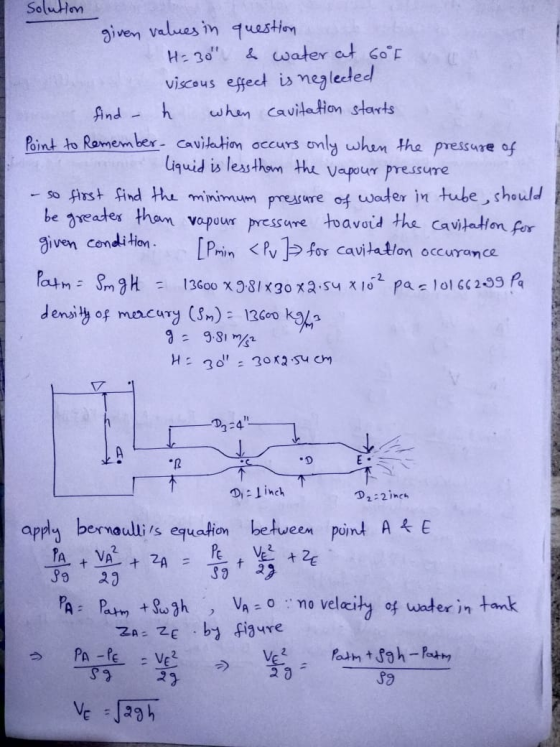
 . pressure is minimum where
diameter of tube is minimum.
. pressure is minimum where
diameter of tube is minimum.
ans =if height of water column in tank is less than or equal to 0.6792m cavitation will occur
Add Answer to:
Water at 60°F flows from a large tank as shown in the figure below. Atmospheric pressure...
Water flows steadily from the large open tank shown in the figure below. If viscous effects...
 Water flows steadily from the large open tank shown in the
figure below. If viscous effects are negligible, determine (a) the
flowrate, Q, (b) the mercury manometer reading, h.
4. 1m 1.9m 0.07m Mercury 0.09m
Water flows steadily from the large open tank shown in the
figure below. If viscous effects are negligible, determine (a) the
flowrate, Q, (b) the mercury manometer reading, h.
4. 1m 1.9m 0.07m Mercury 0.09m
Water is siphoned from a large tank and discharges into the atmosphere through a 2-in.-diameter tube...
 Water is siphoned from a large tank and discharges into the
atmosphere through a 2-in.-diameter tube as shown in the figure
below. The end of the tube is 3 ft below the tank bottom, and
viscous effects are negligible. Determine the volume flowrate from
the tank. Determine the maximum height, H, over which the water can
be siphoned without cavitation occurring. Atmospheric pressure is
14.7 psia, and the water vapor pressure is 0.26 psia
Water is siphoned from a large tank and discharges into the
atmosphere through a 2-in.-diameter tube as shown in the figure
below. The end of the tube is 3 ft below the tank bottom, and
viscous effects are negligible. Determine the volume flowrate from
the tank. Determine the maximum height, H, over which the water can
be siphoned without cavitation occurring. Atmospheric pressure is
14.7 psia, and the water vapor pressure is 0.26 psia
Water flows steadily from a large tank as shown in the figure. The height of water...
 Water flows steadily from a large tank as shown in the figure. The height of water in the tank is H = 4 m represents the height from the centerline of the horizontal pipe to the surface of the water in the tank. The water flows out of the tank through a pipe with diameter of 4 cm. The stream of water flows through a bend (= 30 degrees, L = 2.88 m) and exits as a free jet through...
Water is siphoned from the large tank shown below. Flow is steady and viscous effects are...
 Water is siphoned from the large tank shown below. Flow is steady and viscous effects are negligible. a) Determine the flowrate from the tank; b) Determine the pressure at points 1, 2 and 3; c) Where is the critical point for cavitation? 2-in.-diameter hose 2 ft |(3) 3 ft 8 ft
View Policies Current Attempt in Progress Water flows from a large tank through a large pipe...
 View Policies Current Attempt in Progress Water flows from a large tank through a large pipe that splits into two smaller pipes as shown in the figure below. The tip of the inclined pipe is at the same level as the bottom of the reservoir. If viscous effects are negligible, determine (a) the flowrate from the tank, (b) the pressure at point (1). Assumed, -0.05 m. d2 -0.03 m,dy-0.02 m, 2-9 m, and h - 7m. diameterd, diameter,
Part A The barometer shown here (Figure 1) measures atmospheric pressure in millimeters of mercury (mmHg)....
Part A The barometer shown here (Figure 1) measures atmospheric pressure in millimeters of mercury (mmHg). According to this barometer, what is the atmospheric pressure P in inches of mercury (inHg)? Express your answer in inches of mercury using five significant figures. P = inHg SubmitHintsMy AnswersGive UpReview Part Part B At a pressure of 897 mbar , what would the height of the mercury in the column of a mercury barometer? Express your answer numerically in millimeters of mercury....
The tank shown in the figure below contains air at atmospheric pressure above the water surface....
 The tank shown in the figure below contains air at atmospheric pressure above the water surface. The velocity of the water flowing from the tank is22.5 ft./sec. Determine the water level (h). D-12 in. Ait p- 14.7 psia → V:" 22.5 ft/sec
10. As shown in Figure 5.31, when water flows out of the water tank with a...
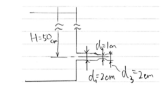 10. As shown in Figure 5.31, when water flows out of the water
tank with a head of 50 cm through the throttle, find the pressure
at the throttle.
with explaination please
H=50cm dalon dizem dz 20
10. As shown in Figure 5.31, when water flows out of the water
tank with a head of 50 cm through the throttle, find the pressure
at the throttle.
with explaination please
H=50cm dalon dizem dz 20
Water flows steadily from an open tank as shown in the figure. The elevation of...
 Water flows steadily from an open tank as shown in the figure.
The elevation of
point 1 is H = 13 m ,
and the elevation of points 2 and 3 is h = 2 m .
The cross-sectional area at point 2 is 0.00069 m 2
; at point 3, where the water is
discharged, it is 0.00158 m 2 . The
cross-sectional area of the tank is very large compared with the
cross-sectional area of the pipe. Find...
Water flows steadily from an open tank as shown in the figure.
The elevation of
point 1 is H = 13 m ,
and the elevation of points 2 and 3 is h = 2 m .
The cross-sectional area at point 2 is 0.00069 m 2
; at point 3, where the water is
discharged, it is 0.00158 m 2 . The
cross-sectional area of the tank is very large compared with the
cross-sectional area of the pipe. Find...
Question 2 4 pts Question 1lb) If viscous effects are negligible, determine the flow rate Qt (m3/s) at Point 1 in the large pipe if h-5.8 m and V2 66m/s The density of water is 1000 kg/m3. Atm...
 Question 2 4 pts Question 1lb) If viscous effects are negligible, determine the flow rate Qt (m3/s) at Point 1 in the large pipe if h-5.8 m and V2 66m/s The density of water is 1000 kg/m3. Atmospheric pressure Patm 101.325 kPa. Gravitational acceleration g- 9.81 m/s Your answer should be in m3/s and accurate to4d.р. Question 3 3 pts If viscous effects are negligible, determine the gauge pressure p1 (kPa) at Point 1 in the large pipe for Q1...
 Water flows steadily from the large open tank shown in the
figure below. If viscous effects are negligible, determine (a) the
flowrate, Q, (b) the mercury manometer reading, h.
4. 1m 1.9m 0.07m Mercury 0.09m
Water flows steadily from the large open tank shown in the
figure below. If viscous effects are negligible, determine (a) the
flowrate, Q, (b) the mercury manometer reading, h.
4. 1m 1.9m 0.07m Mercury 0.09m
 Water is siphoned from a large tank and discharges into the
atmosphere through a 2-in.-diameter tube as shown in the figure
below. The end of the tube is 3 ft below the tank bottom, and
viscous effects are negligible. Determine the volume flowrate from
the tank. Determine the maximum height, H, over which the water can
be siphoned without cavitation occurring. Atmospheric pressure is
14.7 psia, and the water vapor pressure is 0.26 psia
Water is siphoned from a large tank and discharges into the
atmosphere through a 2-in.-diameter tube as shown in the figure
below. The end of the tube is 3 ft below the tank bottom, and
viscous effects are negligible. Determine the volume flowrate from
the tank. Determine the maximum height, H, over which the water can
be siphoned without cavitation occurring. Atmospheric pressure is
14.7 psia, and the water vapor pressure is 0.26 psia
 Water flows steadily from a large tank as shown in the figure. The height of water in the tank is H = 4 m represents the height from the centerline of the horizontal pipe to the surface of the water in the tank. The water flows out of the tank through a pipe with diameter of 4 cm. The stream of water flows through a bend (= 30 degrees, L = 2.88 m) and exits as a free jet through...
 Water is siphoned from the large tank shown below. Flow is steady and viscous effects are negligible. a) Determine the flowrate from the tank; b) Determine the pressure at points 1, 2 and 3; c) Where is the critical point for cavitation? 2-in.-diameter hose 2 ft |(3) 3 ft 8 ft
 View Policies Current Attempt in Progress Water flows from a large tank through a large pipe that splits into two smaller pipes as shown in the figure below. The tip of the inclined pipe is at the same level as the bottom of the reservoir. If viscous effects are negligible, determine (a) the flowrate from the tank, (b) the pressure at point (1). Assumed, -0.05 m. d2 -0.03 m,dy-0.02 m, 2-9 m, and h - 7m. diameterd, diameter,
 The tank shown in the figure below contains air at atmospheric pressure above the water surface. The velocity of the water flowing from the tank is22.5 ft./sec. Determine the water level (h). D-12 in. Ait p- 14.7 psia → V:" 22.5 ft/sec
 10. As shown in Figure 5.31, when water flows out of the water
tank with a head of 50 cm through the throttle, find the pressure
at the throttle.
with explaination please
H=50cm dalon dizem dz 20
10. As shown in Figure 5.31, when water flows out of the water
tank with a head of 50 cm through the throttle, find the pressure
at the throttle.
with explaination please
H=50cm dalon dizem dz 20
 Water flows steadily from an open tank as shown in the figure.
The elevation of
point 1 is H = 13 m ,
and the elevation of points 2 and 3 is h = 2 m .
The cross-sectional area at point 2 is 0.00069 m 2
; at point 3, where the water is
discharged, it is 0.00158 m 2 . The
cross-sectional area of the tank is very large compared with the
cross-sectional area of the pipe. Find...
Water flows steadily from an open tank as shown in the figure.
The elevation of
point 1 is H = 13 m ,
and the elevation of points 2 and 3 is h = 2 m .
The cross-sectional area at point 2 is 0.00069 m 2
; at point 3, where the water is
discharged, it is 0.00158 m 2 . The
cross-sectional area of the tank is very large compared with the
cross-sectional area of the pipe. Find...
 Question 2 4 pts Question 1lb) If viscous effects are negligible, determine the flow rate Qt (m3/s) at Point 1 in the large pipe if h-5.8 m and V2 66m/s The density of water is 1000 kg/m3. Atmospheric pressure Patm 101.325 kPa. Gravitational acceleration g- 9.81 m/s Your answer should be in m3/s and accurate to4d.р. Question 3 3 pts If viscous effects are negligible, determine the gauge pressure p1 (kPa) at Point 1 in the large pipe for Q1...
Most questions answered within 3 hours.
-
Where is the error in this code sequence?
String s1 = "Hello";
String s2 = "ello";...
asked 10 months ago -
Financial data for Joel de Paris, Inc., for last year
follow:
Joel de Paris, Inc.
Balance...
asked 10 months ago -
Consider this reaction:
Al2(SO4)3 (aq)+ BaCl3
(aq) Al2Cl6 (aq)- +
3BaSO4(s) . What is the...
asked 10 months ago -
Suppose that Savneet is considering increasing her
recent random sample from 20 car rentals to 40...
asked 10 months ago -
Trucks arrive at an unloading terminal at an average rate of 120
per hour.
Trucks arrive...
asked 10 months ago -
Why are methanol and ethanol completely soluble in water while
octanol is not very little soluble....
asked 10 months ago -
A facilities manager at a university reads in a research report
that the mean amount of...
asked 10 months ago -
When the CuSO4 is rehydrated by adding water to the anhydrous
compound, is this an endothermic...
asked 10 months ago -
A ray of sunlight is passing from diamond into crown glass; the
angle of incidence is...
asked 10 months ago -
A block of mass 0.249 kg is placed on top of a light, vertical
spring of...
asked 10 months ago -
how do the kidneys compensate in the presences of acidosis
a) trigger hyperventilate
b) reserve acid...
asked 10 months ago -
Question 501 pts
The rental rate of capital to the firm increases. Which of the
following...
asked 10 months ago