
Homework Answers

Add Answer to:
hen a metal was exposed to photons at a frequency of 3.73x10¹⁵ s-1 electrons were emitted...
When 289-nm photons are incident on the surface of a metal, electrons are ejected from it...
 When 289-nm photons are incident on the surface of a metal, electrons are ejected from it and the stopping potential is 2.69 V. Find the energy of incident photons: E,= (4.287 eV. Find the kinetic energy of ejected electrons: K= eV. Find the work function of the metal: p= 1.597 ✓ev. Find the wavelength of the least energetic photon that can induce the photo- electric effect in this metal 2 = 778 nm.
The minimum frequency of light needed to eject electrons from a metal is called the threshold...
 The minimum frequency of light needed to eject electrons from a metal is called the threshold frequency, Vo. Find the minimum energy needed to eject electrons from a metal with a threshold frequency of 3.79 x 10¹⁴ -! Eo 25.11 x10⁻²⁰ J With what maximum kinetic energy will electrons be ejected when this metal is exposed to light with a wavelength of 245 nm? 56.025 x10⁻¹⁹ -electron Incorrect
When light of frequency 1.30x 10¹⁵ s-1 shines on the surface of cesium metal, electrons are...
When light of frequency 1.30x 10¹⁵ s-1 shines on the surface of cesium metal, electrons are ejected with a maximum kinetic energy of 5.2x 10⁻¹⁹ J.Calculate the wavelength of this light in nm
Electrons are emitted from the surface of a metal when it's exposed to light. This is...
Electrons are emitted from the surface of a metal when it's exposed to light. This is called the photoelectric effect. Each metal has a certain threshold frequency of light, below which nothing happens. Right at this threshold frequency, an electron is emitted. Above this frequency, the electron is emitted and the extra energy is transferred to the electron. The equation for this phenomenon is KE=hν−hν0KE=hν−hν0 where KEKEKE is the kinetic energy of the emitted electron, h=6.63×10⁻³⁴J⋅sh=6.63×10⁻³⁴J⋅s is Planck's constant, ννnu...
Question 1 (1 point) If light with a frequency below the cutoff frequency for a certain...
Question 1 (1 point) If light with a frequency below the cutoff frequency for a certain metal hits that metal: Question 1 options: electrons will be ejected after the intensity of the light reaches a certain value no electrons will be ejected electrons will be ejected, but will fall back to the metal the light will be re-radiated by the metal I don't know. Question 2 (1 point) One electron-volt is equivalent to Question 2 options: 1 J 1 V...
Which of the following statements is correct for photoelectric effect? (A) In order to eject electrons...
Which of the following statements is correct for photoelectric effect? (A) In order to eject electrons from a metal surface, the wavelength of photon must be shorter than the threshold wavelength. (B) In order to eject electrons from a metal surface, the frequency of photon must be lower than the cut-off frequency. (C) The work function increases with increasing the frequency of photons. (D) The work function increases with increasing the wavelength of photons. (E) The kinetic energy of ejected...
Light striking a metal surface causes electrons to be emitted from the metal via the photoelectric...
Light striking a metal surface causes electrons to be emitted from the metal via the photoelectric effect.In a particular experiment to study the photoelectric effect, the frequency of the incident light and the temperature of the metal are held constant. Assuming that the light incident on the metal surface causes electrons to be ejected from the metal, what happens if the intensity of the incident light is increased?Check all that apply.The work function of the metal decreases.The number of electrons...
14) Photons of energy 6.0 J are incident on a metal. It is found that current...
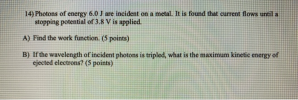 14) Photons of energy 6.0 J are incident on a metal. It is found that current flows until a stopping potential of 3.8 V is applied. A) Find the work function. (5 points) B) If the wavelength of incident photons is tripled, what is the maximum kinetic energy of ejected electrons? (5 points)
This question has multiple parts. Work all the parts to get the most points. The energy...
 This question has multiple parts. Work all the parts to get the most points. The energy of a photon needed to cause ejection of an electron from a photoemissive metal is expressed as the sum of the binding energy of the electron plus the kinetic energy of the emitted electron. When photons of 4.40x10⁷m light strike a calcium metal surface, electrons are ejected with a kinetic energy of 1.75x10⁻²⁰ J. a Calculate the binding energy of the calcium electrons. b...
The minimum frequency of light needed to eject electrons from a metal is called the threshold frequency, v0.
The minimum frequency of light needed to eject electrons from a metal is called the threshold frequency, v0. Find the minimum energy needed to eject electrons from a metal with a threshold frequency of 2.60 x 10¹⁴s-1 With what maximum kinetic energy will electrons be ejected when this metal is exposed to light with a wavelength of ct 275 nm?
 When 289-nm photons are incident on the surface of a metal, electrons are ejected from it and the stopping potential is 2.69 V. Find the energy of incident photons: E,= (4.287 eV. Find the kinetic energy of ejected electrons: K= eV. Find the work function of the metal: p= 1.597 ✓ev. Find the wavelength of the least energetic photon that can induce the photo- electric effect in this metal 2 = 778 nm.
 The minimum frequency of light needed to eject electrons from a metal is called the threshold frequency, Vo. Find the minimum energy needed to eject electrons from a metal with a threshold frequency of 3.79 x 10¹⁴ -! Eo 25.11 x10⁻²⁰ J With what maximum kinetic energy will electrons be ejected when this metal is exposed to light with a wavelength of 245 nm? 56.025 x10⁻¹⁹ -electron Incorrect
 14) Photons of energy 6.0 J are incident on a metal. It is found that current flows until a stopping potential of 3.8 V is applied. A) Find the work function. (5 points) B) If the wavelength of incident photons is tripled, what is the maximum kinetic energy of ejected electrons? (5 points)
 This question has multiple parts. Work all the parts to get the most points. The energy of a photon needed to cause ejection of an electron from a photoemissive metal is expressed as the sum of the binding energy of the electron plus the kinetic energy of the emitted electron. When photons of 4.40x10⁷m light strike a calcium metal surface, electrons are ejected with a kinetic energy of 1.75x10⁻²⁰ J. a Calculate the binding energy of the calcium electrons. b...
Most questions answered within 3 hours.
-
Where is the error in this code sequence?
String s1 = "Hello";
String s2 = "ello";...
asked 11 months ago -
Financial data for Joel de Paris, Inc., for last year
follow:
Joel de Paris, Inc.
Balance...
asked 11 months ago -
Consider this reaction:
Al2(SO4)3 (aq)+ BaCl3
(aq) Al2Cl6 (aq)- +
3BaSO4(s) . What is the...
asked 11 months ago -
Suppose that Savneet is considering increasing her
recent random sample from 20 car rentals to 40...
asked 11 months ago -
Trucks arrive at an unloading terminal at an average rate of 120
per hour.
Trucks arrive...
asked 11 months ago -
Why are methanol and ethanol completely soluble in water while
octanol is not very little soluble....
asked 11 months ago -
A facilities manager at a university reads in a research report
that the mean amount of...
asked 11 months ago -
When the CuSO4 is rehydrated by adding water to the anhydrous
compound, is this an endothermic...
asked 11 months ago -
A ray of sunlight is passing from diamond into crown glass; the
angle of incidence is...
asked 11 months ago -
A block of mass 0.249 kg is placed on top of a light, vertical
spring of...
asked 11 months ago -
how do the kidneys compensate in the presences of acidosis
a) trigger hyperventilate
b) reserve acid...
asked 11 months ago -
Question 501 pts
The rental rate of capital to the firm increases. Which of the
following...
asked 11 months ago