
Homework Answers
Request Answer!
We need at least 10 more requests to produce the answer.
0 / 10 have requested this problem solution
The more requests, the faster the answer.
Add Answer to:
Use the following information to answer the next question The following pairs of solutions are mixed:...
Which of the following pairs of aqueous solutions will form a precipitate when mixed? Which of...
Which of the following pairs of aqueous solutions will form a precipitate when mixed? Which of the following pairs of aqueous solutions will form a precipitate when mixed? Pb(C2H3O2)2 + Li2SO4 KOH + Na2S KNO3 + NaOH (NH4)2SO4 + NaI None of the above solution pairs will produce a precipitate.
Which of the following pairs of aqueous solutions will form a precipitate when mixed? HBr +...
Which of the following pairs of aqueous solutions will form a precipitate when mixed? HBr + NaOH Na2S + HF Li2CO3 + HNO3 MgCl2 + KOH All of these solution pairs will produce a precipitate.
Which of the following pairs of aqueous solutions will form a precipitate when mixed? KOH +Na2S...
 Which of the following pairs of aqueous solutions will form a precipitate when mixed? KOH +Na2S (NH4)2SO4 + Kl Ca(C2H3022+ Na2S04 KNO3 LiOH None of these solution pairs will produce a precipitate
Question 2 Which of the following pairs of solutions will give a precipitate when mixed? Ca(CH3COO)2 (aq) and NH4Cl...
 Question 2 Which of the following pairs of solutions will give a precipitate when mixed? Ca(CH3COO)2 (aq) and NH4Cl(aq) NaCH3COO (20) and CaCl2(aq) K2SO4 (aq) and Cu(NO3)2(aq) Pb(NO3)2(aq) and Kl(aq) Fe(NO33lag) and Li2SO4(20)
Use the solubility table to answer the following. You do not need to mix any chemicals....
 Use the solubility table to answer the following. You do not need to mix any chemicals. 1. Circle the following compounds if they will not dissolve completely or will form ppt in H a CaSO4 (s) Cu(IO3)2(s) AgNO3(s) Baco3 (s) Pb(NO3)2(s) Al(OH)3(s) 2. circle all of the following solutions that will form a precipitate with addition of Mg(IO3)2 aq) Ba (NO3)2(aq) Pb (NO3)2(aq) K2CO3 (aq) CuCl2(aq) NH40H (aq) ZnSO4(aq) 3. Circle all of the following solutions that will not form...
Which pair of aqueous solutions will form a precipitate when mixed? A: NH4NO3(aq) + Li2CO3(aq) B:...
Which pair of aqueous solutions will form a precipitate when mixed? A: NH4NO3(aq) + Li2CO3(aq) B: Hg2(NO3)2(aq) + LiI(aq) C: NaCl(aq) + Li3PO4(aq) D: AgC2H3O2(aq) + Cu(NO3)2(aq) Please explain why the answer would be a precipitate
Which of the following pairs of aqueous solutions will produce a precipitate when mixed? Which of...
Which of the following pairs of aqueous solutions will produce a precipitate when mixed? Which of the following pairs of aqueous solutions will produce a precipitate when mixed? A)K2CO3 + H2SO4 B)Li2S + HCl CuCl2 + KOH C)HBr + LiOH D)All of these solution pairs will produce a precipitate.
1. For the following reactions, determine the products when two solutions are mixed. Use the solubility...
 1. For the following reactions, determine the products when two solutions are mixed. Use the solubility rules to predict whether a precipitate would form. If no reaction occurs, write "NR”. Be sure to balance your reaction and include all states of matter. The first one has been done for you. a) 3 Ba(NO3)2 (aq) + Al2(SO4)3 (aq) → 2 AI(NO3)3 (aq) + 3 BaSO4 (s) b) LINO3(aq) + Mg(C2H302)2 (aq) → c) NiSO4 (aq) + K3PO4 (aq) → d) Na2S...
Which of the following pairs of aqueous solutions will form a precipitate when mixed? a. Li...
 Which of the following pairs of aqueous solutions will form a precipitate when mixed? a. Li COs Nal b. Li SOs+KOH d. e. None of these solution pairs will produce a precipitate. All of these solution pairs will produce a precipitate.
Mixing which of the following pairs of solutions will result in formation of a precipitate? A....
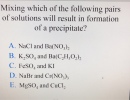 Mixing which of the following pairs of solutions will result in formation of a precipitate? A. NaCl and Ba(NO)2 B. K2SO, and Ba(C,H,O2)2 C. FeSO, and KI D. NaBr and Cr(NO3)3 E. MgSO, and CuCl
 Which of the following pairs of aqueous solutions will form a precipitate when mixed? KOH +Na2S (NH4)2SO4 + Kl Ca(C2H3022+ Na2S04 KNO3 LiOH None of these solution pairs will produce a precipitate
 Question 2 Which of the following pairs of solutions will give a precipitate when mixed? Ca(CH3COO)2 (aq) and NH4Cl(aq) NaCH3COO (20) and CaCl2(aq) K2SO4 (aq) and Cu(NO3)2(aq) Pb(NO3)2(aq) and Kl(aq) Fe(NO33lag) and Li2SO4(20)
 Use the solubility table to answer the following. You do not need to mix any chemicals. 1. Circle the following compounds if they will not dissolve completely or will form ppt in H a CaSO4 (s) Cu(IO3)2(s) AgNO3(s) Baco3 (s) Pb(NO3)2(s) Al(OH)3(s) 2. circle all of the following solutions that will form a precipitate with addition of Mg(IO3)2 aq) Ba (NO3)2(aq) Pb (NO3)2(aq) K2CO3 (aq) CuCl2(aq) NH40H (aq) ZnSO4(aq) 3. Circle all of the following solutions that will not form...
 1. For the following reactions, determine the products when two solutions are mixed. Use the solubility rules to predict whether a precipitate would form. If no reaction occurs, write "NR”. Be sure to balance your reaction and include all states of matter. The first one has been done for you. a) 3 Ba(NO3)2 (aq) + Al2(SO4)3 (aq) → 2 AI(NO3)3 (aq) + 3 BaSO4 (s) b) LINO3(aq) + Mg(C2H302)2 (aq) → c) NiSO4 (aq) + K3PO4 (aq) → d) Na2S...
 Which of the following pairs of aqueous solutions will form a precipitate when mixed? a. Li COs Nal b. Li SOs+KOH d. e. None of these solution pairs will produce a precipitate. All of these solution pairs will produce a precipitate.
 Mixing which of the following pairs of solutions will result in formation of a precipitate? A. NaCl and Ba(NO)2 B. K2SO, and Ba(C,H,O2)2 C. FeSO, and KI D. NaBr and Cr(NO3)3 E. MgSO, and CuCl
Most questions answered within 3 hours.
-
Where is the error in this code sequence?
String s1 = "Hello";
String s2 = "ello";...
asked 10 months ago -
Financial data for Joel de Paris, Inc., for last year
follow:
Joel de Paris, Inc.
Balance...
asked 10 months ago -
Consider this reaction:
Al2(SO4)3 (aq)+ BaCl3
(aq) Al2Cl6 (aq)- +
3BaSO4(s) . What is the...
asked 10 months ago -
Suppose that Savneet is considering increasing her
recent random sample from 20 car rentals to 40...
asked 10 months ago -
Trucks arrive at an unloading terminal at an average rate of 120
per hour.
Trucks arrive...
asked 10 months ago -
Why are methanol and ethanol completely soluble in water while
octanol is not very little soluble....
asked 10 months ago -
A facilities manager at a university reads in a research report
that the mean amount of...
asked 10 months ago -
When the CuSO4 is rehydrated by adding water to the anhydrous
compound, is this an endothermic...
asked 10 months ago -
A ray of sunlight is passing from diamond into crown glass; the
angle of incidence is...
asked 10 months ago -
A block of mass 0.249 kg is placed on top of a light, vertical
spring of...
asked 10 months ago -
how do the kidneys compensate in the presences of acidosis
a) trigger hyperventilate
b) reserve acid...
asked 10 months ago -
Question 501 pts
The rental rate of capital to the firm increases. Which of the
following...
asked 10 months ago