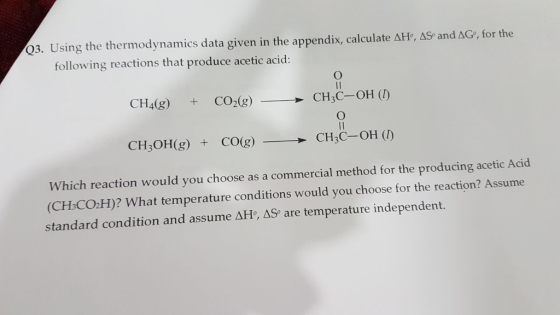
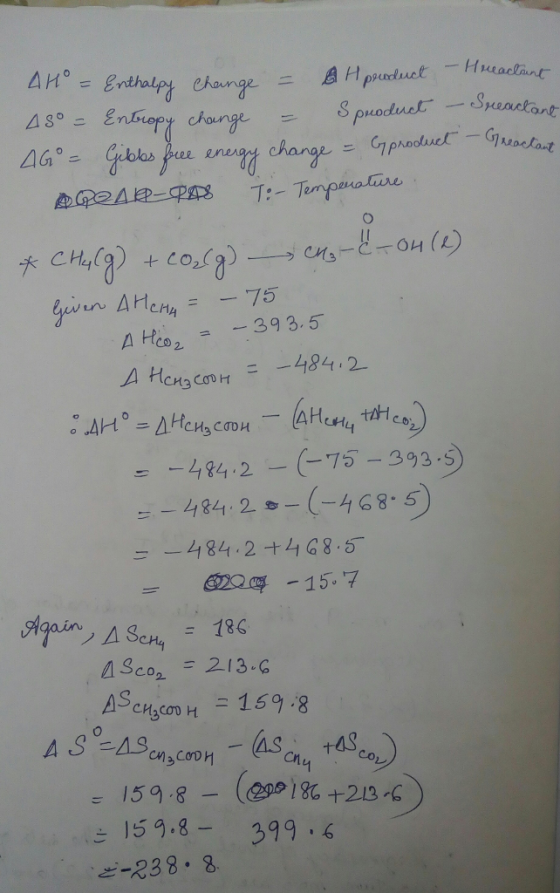
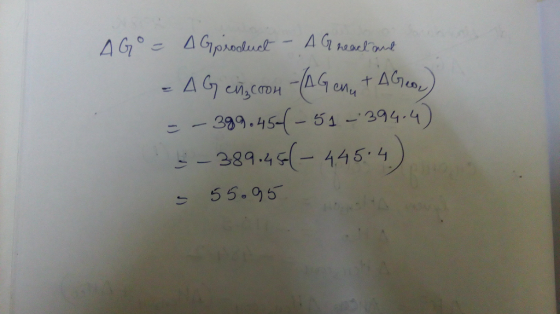
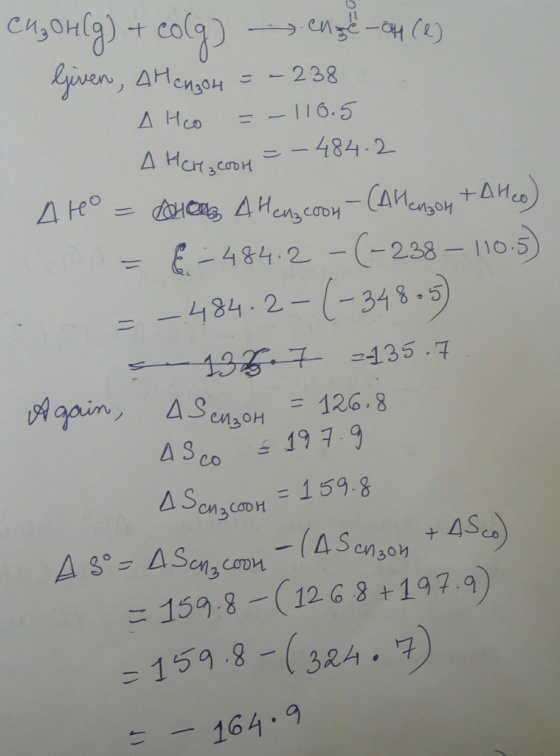
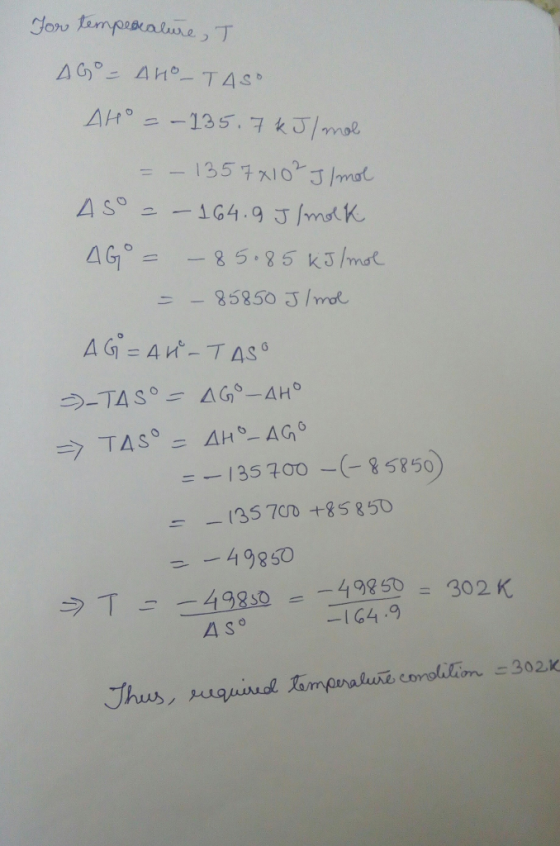
Here are the delta H, delta S and delta G values from my textbook: (first value is delta H, second value is delta S, third is delta G)
CO2: -393.5 , 213.6 , -394.4
CH4: -75, 186, -51
CO : -110.5 , 197.9 , -137.3
CH3COOH : -484.2 , 159.8 , -389.45
CH3OH : -238 , 126.8 , -166.3
Homework Answers

Add Answer to:
Here are the delta H,
delta S and delta G values from my textbook: (first value...
Consider the reaction CO(g)+ 2H2(g)----> CH3OH(l) at 25 degrees C.
Delta G f(CO)= -137.3 kJ/molDelta G f(CH3OH)= -166.3 kJ/molDelta H f(CO)= -110.5 kJ/molDelta H f(CH3OH)= -238.7 kJ/molS(CO)= 197.9 J/K molS(CH3OH)= 126.8 J/K molCalculate Delta G at 25 Degrees Celcius.
3 attempts left Check my work Enter your answer in the provided box. Calculate AG for...
 3 attempts left Check my work Enter your answer in the provided box. Calculate AG for the reaction at 25°C. 2C6H61) + 1502(8) 12C028) + 6H20(1) agº = kJ AH° (kJ/mol Agº (kJ/mol) sº (J/K mol) 5.69 2.4 Substance C(graphite) C(diamond) CO(g) CO2(g) CO2(aq) C0,- (aq) O(g) O2(8) O3(aq) O3(8) H20(1) CH 1.90 -110.5 -393.5 -412.9 -676.3 249.4 2.87 --137.3 -394.4 -386.2 --528.1 230.1 0 16.3 163.4 -237.2 124.5 197.9 213.6 121.3 -53.1 160.95 205.0 110.88 237.6 -12.09 142.2 -285.8...
Please explain the correct answer to both questions. Thank you! Incorrect Question 19 0/1 pts The...
 Please explain the correct
answer to both questions. Thank you!
Incorrect Question 19 0/1 pts The value of A Sº for the catalytic hydrogenation of acetylene to ethene, C2H2(g) + H2(g) →C2H4 (g) is_ J/K.mol. Use the following thermodynamic quantities for selected substances at 298.15 K (25°C). Substance AHºf (kJ/mol) AG°f (kJ/mol) S (J/K-mol) 2.84 Carbon C(s, diamond) 1.88 C(s, graphite) 0 C2H2(g) 226.7 C2H4 (g) 52.30 C2H6 (g) -84.68 CO(g) -110.5 CO2 (g) -393.5 209.2 68.11 -32.89 -137.2 -394.4...
Please explain the correct
answer to both questions. Thank you!
Incorrect Question 19 0/1 pts The value of A Sº for the catalytic hydrogenation of acetylene to ethene, C2H2(g) + H2(g) →C2H4 (g) is_ J/K.mol. Use the following thermodynamic quantities for selected substances at 298.15 K (25°C). Substance AHºf (kJ/mol) AG°f (kJ/mol) S (J/K-mol) 2.84 Carbon C(s, diamond) 1.88 C(s, graphite) 0 C2H2(g) 226.7 C2H4 (g) 52.30 C2H6 (g) -84.68 CO(g) -110.5 CO2 (g) -393.5 209.2 68.11 -32.89 -137.2 -394.4...
Use the data found in the Thermodynamic Values link under Reference Materials to calculate ΔHo (KJ),...
 Use the data found in the Thermodynamic Values
link under Reference Materials to calculate
ΔHo (KJ), ΔSo (J/K) and
ΔGo(KJ) and ΔGo from the
equation ΔGo ≈ ΔHo - TΔSo
at 25.0 oC for
1. C2H5OH
(g) → C2H4
(g) + H2O (l)
2. 2 C4H10
(l) + ___ O2 (g) → ___
CO2 (g) + ___ H2O
(l) (Do not change a coefficient
that is shown)
3. 2 C4H10 (g) + ___ O2
(g) → ___ CO2 (g) + ___
H2O (l) (Do not change
a coefficient that...
Use the data found in the Thermodynamic Values
link under Reference Materials to calculate
ΔHo (KJ), ΔSo (J/K) and
ΔGo(KJ) and ΔGo from the
equation ΔGo ≈ ΔHo - TΔSo
at 25.0 oC for
1. C2H5OH
(g) → C2H4
(g) + H2O (l)
2. 2 C4H10
(l) + ___ O2 (g) → ___
CO2 (g) + ___ H2O
(l) (Do not change a coefficient
that is shown)
3. 2 C4H10 (g) + ___ O2
(g) → ___ CO2 (g) + ___
H2O (l) (Do not change
a coefficient that...
Use the data found in the Thermodynamic Values link under Reference Materials to calculate ΔHo (KJ),...
 Use the data found in the Thermodynamic Values
link under Reference Materials to calculate
ΔHo (KJ), ΔSo (J/K) and
ΔGo(KJ) and ΔGo from the
equation ΔGo ≈ ΔHo - TΔSo
at 25.0 oC for
1. 1
C2H5OH(g) + ___ O2
(g) → ___ CO2 (g) + ___
H2O (g) (Do not change
a coefficient that is shown)
2. 2 C4H10 (l) + ___
O2 (g) → ___ CO2 (g) +
___ H2O (g) (Do not
change a coefficient that is shown)
3. C2H5OH
(l) → C2H4
(g) + H2O
(g) ...
Use the data found in the Thermodynamic Values
link under Reference Materials to calculate
ΔHo (KJ), ΔSo (J/K) and
ΔGo(KJ) and ΔGo from the
equation ΔGo ≈ ΔHo - TΔSo
at 25.0 oC for
1. 1
C2H5OH(g) + ___ O2
(g) → ___ CO2 (g) + ___
H2O (g) (Do not change
a coefficient that is shown)
2. 2 C4H10 (l) + ___
O2 (g) → ___ CO2 (g) +
___ H2O (g) (Do not
change a coefficient that is shown)
3. C2H5OH
(l) → C2H4
(g) + H2O
(g) ...
6C02(g) + 6H2O(1)— C6H1206+602(g) Using standard thermodynamic data at 298K, calculate the free energy change when...
 6C02(g) + 6H2O(1)— C6H1206+602(g) Using standard thermodynamic data at 298K, calculate the free energy change when 1.92 moles of CO2(g) react at standard conditions. AGºrxn = Carbon AH°F (kJ/mol) AG°f (kJ/mol) Sº (J/mol K) 5.7 2.4 C(s, graphite) C(s, diamond) C(9) CC14 (1) 1.9 716.7 2.9 671.3 158.1 -135.4 -65.2 216.4 CCl4(9) -102.9 -60.6 309.9 CHCl3(1) -134.5 -73.7 201.7 CHCl3(9) -103.1 -70.3 295.7 CH4(9) -74.8 -50.7 186.3 CH3OH(g) -200.7 -162.0 239.8 CH3OH(1) -238.7 -166.3 126.8 H2CO(g) -116.0 219.0 HCOOH(g) -363.0...
1.) The value of S° for the oxidation of carbon to carbon dioxide, is __________ J/K...
 1.) The value of
S° for the oxidation of carbon to carbon dioxide,
is __________ J/K
mol. The combustion of carbon, as in charcoal briquettes, in the
presence of abundant oxygen produces carbon dioxide.
2.)The value of
S° for the reaction
is __________ J/K.
3.)The value of
S° for the decomposition of gaseous sulfur dioxide to solid
elemental sulfur and gaseous oxygen,
is __________ J/K
mol.
Use the table below to answer the questions that follow. Thermodynamic Quantities for Selected...
1.) The value of
S° for the oxidation of carbon to carbon dioxide,
is __________ J/K
mol. The combustion of carbon, as in charcoal briquettes, in the
presence of abundant oxygen produces carbon dioxide.
2.)The value of
S° for the reaction
is __________ J/K.
3.)The value of
S° for the decomposition of gaseous sulfur dioxide to solid
elemental sulfur and gaseous oxygen,
is __________ J/K
mol.
Use the table below to answer the questions that follow. Thermodynamic Quantities for Selected...
(2) (24 pts) A fuel cell produces electricity via a combustion reaction. A DMFC is a...
 (2) (24 pts) A fuel cell produces electricity via a combustion reaction. A DMFC is a proton-exchange fuel cell that uses methanol CH3OH) as the fuel, which reacts with molecular oxygen to produce carbon dioxide and water. (a) (4 pts) Write the balanced combustion reaction for this methanol fuel cell. (b) (4 pts) Write the balanced half-reactions occurring at the cathode and anode of this fuel cell (assume standard acidic conditions) (e) (4 pts) Evaluate AGº (kJ) and AE° (V)...
Consider the reaction 2 CO2(g) +5 H2(e) C H2(e) + 4H2O(g) Using the standard thermodynamic data...
 Consider the reaction 2 CO2(g) +5 H2(e) C H2(e) + 4H2O(g) Using the standard thermodynamic data in the tables linked above, calculate the equilibrium constant for this reaction at 298.15K ANSWER: Submit Answer Retry Entire Group more group attempts remaining AH,(kJ/mol) AG® (kJ/mol) Sº (J/mol K) -238.7 -116.0 126.8 219.0 -363.0 249.0 135.1 -166.3 -110.0 -351.0 125.0 209.2 68.2 - 129.0 202.0 226.7 200.9 52.3 - 166.0 -53.0 -277.7 219.6 250.0 242.0 160.7 -13.0 -235.1 282.7 Carbon CH3OH (1) H2CO...
Thermodynamics Practice Problems 1. Predict the sign of AS.(positive or negative) for the following reactions a...
 Thermodynamics Practice Problems 1. Predict the sign of AS.(positive or negative) for the following reactions a 2 Mg(s) +,(@) 2 Mgo (s) AS b. CH206(s) → 2C,H,OH(I) + 2003(g) AS c. 2 NH3(g) + CO2(g) → H2O(l) + NH CONH3(aq) AS d. Cu(s) (at 100°C) → Cu(s) (at 25°C) AS 2. Which two variables can indicate if a reaction is spontaneous or not? 3. The second law of thermodynamics tells us that: a Energy is conserved. b. The entropy of...
 3 attempts left Check my work Enter your answer in the provided box. Calculate AG for the reaction at 25°C. 2C6H61) + 1502(8) 12C028) + 6H20(1) agº = kJ AH° (kJ/mol Agº (kJ/mol) sº (J/K mol) 5.69 2.4 Substance C(graphite) C(diamond) CO(g) CO2(g) CO2(aq) C0,- (aq) O(g) O2(8) O3(aq) O3(8) H20(1) CH 1.90 -110.5 -393.5 -412.9 -676.3 249.4 2.87 --137.3 -394.4 -386.2 --528.1 230.1 0 16.3 163.4 -237.2 124.5 197.9 213.6 121.3 -53.1 160.95 205.0 110.88 237.6 -12.09 142.2 -285.8...
 Please explain the correct
answer to both questions. Thank you!
Incorrect Question 19 0/1 pts The value of A Sº for the catalytic hydrogenation of acetylene to ethene, C2H2(g) + H2(g) →C2H4 (g) is_ J/K.mol. Use the following thermodynamic quantities for selected substances at 298.15 K (25°C). Substance AHºf (kJ/mol) AG°f (kJ/mol) S (J/K-mol) 2.84 Carbon C(s, diamond) 1.88 C(s, graphite) 0 C2H2(g) 226.7 C2H4 (g) 52.30 C2H6 (g) -84.68 CO(g) -110.5 CO2 (g) -393.5 209.2 68.11 -32.89 -137.2 -394.4...
Please explain the correct
answer to both questions. Thank you!
Incorrect Question 19 0/1 pts The value of A Sº for the catalytic hydrogenation of acetylene to ethene, C2H2(g) + H2(g) →C2H4 (g) is_ J/K.mol. Use the following thermodynamic quantities for selected substances at 298.15 K (25°C). Substance AHºf (kJ/mol) AG°f (kJ/mol) S (J/K-mol) 2.84 Carbon C(s, diamond) 1.88 C(s, graphite) 0 C2H2(g) 226.7 C2H4 (g) 52.30 C2H6 (g) -84.68 CO(g) -110.5 CO2 (g) -393.5 209.2 68.11 -32.89 -137.2 -394.4...
 Use the data found in the Thermodynamic Values
link under Reference Materials to calculate
ΔHo (KJ), ΔSo (J/K) and
ΔGo(KJ) and ΔGo from the
equation ΔGo ≈ ΔHo - TΔSo
at 25.0 oC for
1. C2H5OH
(g) → C2H4
(g) + H2O (l)
2. 2 C4H10
(l) + ___ O2 (g) → ___
CO2 (g) + ___ H2O
(l) (Do not change a coefficient
that is shown)
3. 2 C4H10 (g) + ___ O2
(g) → ___ CO2 (g) + ___
H2O (l) (Do not change
a coefficient that...
Use the data found in the Thermodynamic Values
link under Reference Materials to calculate
ΔHo (KJ), ΔSo (J/K) and
ΔGo(KJ) and ΔGo from the
equation ΔGo ≈ ΔHo - TΔSo
at 25.0 oC for
1. C2H5OH
(g) → C2H4
(g) + H2O (l)
2. 2 C4H10
(l) + ___ O2 (g) → ___
CO2 (g) + ___ H2O
(l) (Do not change a coefficient
that is shown)
3. 2 C4H10 (g) + ___ O2
(g) → ___ CO2 (g) + ___
H2O (l) (Do not change
a coefficient that...
 Use the data found in the Thermodynamic Values
link under Reference Materials to calculate
ΔHo (KJ), ΔSo (J/K) and
ΔGo(KJ) and ΔGo from the
equation ΔGo ≈ ΔHo - TΔSo
at 25.0 oC for
1. 1
C2H5OH(g) + ___ O2
(g) → ___ CO2 (g) + ___
H2O (g) (Do not change
a coefficient that is shown)
2. 2 C4H10 (l) + ___
O2 (g) → ___ CO2 (g) +
___ H2O (g) (Do not
change a coefficient that is shown)
3. C2H5OH
(l) → C2H4
(g) + H2O
(g) ...
Use the data found in the Thermodynamic Values
link under Reference Materials to calculate
ΔHo (KJ), ΔSo (J/K) and
ΔGo(KJ) and ΔGo from the
equation ΔGo ≈ ΔHo - TΔSo
at 25.0 oC for
1. 1
C2H5OH(g) + ___ O2
(g) → ___ CO2 (g) + ___
H2O (g) (Do not change
a coefficient that is shown)
2. 2 C4H10 (l) + ___
O2 (g) → ___ CO2 (g) +
___ H2O (g) (Do not
change a coefficient that is shown)
3. C2H5OH
(l) → C2H4
(g) + H2O
(g) ...
 6C02(g) + 6H2O(1)— C6H1206+602(g) Using standard thermodynamic data at 298K, calculate the free energy change when 1.92 moles of CO2(g) react at standard conditions. AGºrxn = Carbon AH°F (kJ/mol) AG°f (kJ/mol) Sº (J/mol K) 5.7 2.4 C(s, graphite) C(s, diamond) C(9) CC14 (1) 1.9 716.7 2.9 671.3 158.1 -135.4 -65.2 216.4 CCl4(9) -102.9 -60.6 309.9 CHCl3(1) -134.5 -73.7 201.7 CHCl3(9) -103.1 -70.3 295.7 CH4(9) -74.8 -50.7 186.3 CH3OH(g) -200.7 -162.0 239.8 CH3OH(1) -238.7 -166.3 126.8 H2CO(g) -116.0 219.0 HCOOH(g) -363.0...
 1.) The value of
S° for the oxidation of carbon to carbon dioxide,
is __________ J/K
mol. The combustion of carbon, as in charcoal briquettes, in the
presence of abundant oxygen produces carbon dioxide.
2.)The value of
S° for the reaction
is __________ J/K.
3.)The value of
S° for the decomposition of gaseous sulfur dioxide to solid
elemental sulfur and gaseous oxygen,
is __________ J/K
mol.
Use the table below to answer the questions that follow. Thermodynamic Quantities for Selected...
1.) The value of
S° for the oxidation of carbon to carbon dioxide,
is __________ J/K
mol. The combustion of carbon, as in charcoal briquettes, in the
presence of abundant oxygen produces carbon dioxide.
2.)The value of
S° for the reaction
is __________ J/K.
3.)The value of
S° for the decomposition of gaseous sulfur dioxide to solid
elemental sulfur and gaseous oxygen,
is __________ J/K
mol.
Use the table below to answer the questions that follow. Thermodynamic Quantities for Selected...
 (2) (24 pts) A fuel cell produces electricity via a combustion reaction. A DMFC is a proton-exchange fuel cell that uses methanol CH3OH) as the fuel, which reacts with molecular oxygen to produce carbon dioxide and water. (a) (4 pts) Write the balanced combustion reaction for this methanol fuel cell. (b) (4 pts) Write the balanced half-reactions occurring at the cathode and anode of this fuel cell (assume standard acidic conditions) (e) (4 pts) Evaluate AGº (kJ) and AE° (V)...
 Consider the reaction 2 CO2(g) +5 H2(e) C H2(e) + 4H2O(g) Using the standard thermodynamic data in the tables linked above, calculate the equilibrium constant for this reaction at 298.15K ANSWER: Submit Answer Retry Entire Group more group attempts remaining AH,(kJ/mol) AG® (kJ/mol) Sº (J/mol K) -238.7 -116.0 126.8 219.0 -363.0 249.0 135.1 -166.3 -110.0 -351.0 125.0 209.2 68.2 - 129.0 202.0 226.7 200.9 52.3 - 166.0 -53.0 -277.7 219.6 250.0 242.0 160.7 -13.0 -235.1 282.7 Carbon CH3OH (1) H2CO...
 Thermodynamics Practice Problems 1. Predict the sign of AS.(positive or negative) for the following reactions a 2 Mg(s) +,(@) 2 Mgo (s) AS b. CH206(s) → 2C,H,OH(I) + 2003(g) AS c. 2 NH3(g) + CO2(g) → H2O(l) + NH CONH3(aq) AS d. Cu(s) (at 100°C) → Cu(s) (at 25°C) AS 2. Which two variables can indicate if a reaction is spontaneous or not? 3. The second law of thermodynamics tells us that: a Energy is conserved. b. The entropy of...
Most questions answered within 3 hours.
-
Where is the error in this code sequence?
String s1 = "Hello";
String s2 = "ello";...
asked 11 months ago -
Financial data for Joel de Paris, Inc., for last year
follow:
Joel de Paris, Inc.
Balance...
asked 11 months ago -
Consider this reaction:
Al2(SO4)3 (aq)+ BaCl3
(aq) Al2Cl6 (aq)- +
3BaSO4(s) . What is the...
asked 11 months ago -
Suppose that Savneet is considering increasing her
recent random sample from 20 car rentals to 40...
asked 11 months ago -
Trucks arrive at an unloading terminal at an average rate of 120
per hour.
Trucks arrive...
asked 11 months ago -
Why are methanol and ethanol completely soluble in water while
octanol is not very little soluble....
asked 11 months ago -
A facilities manager at a university reads in a research report
that the mean amount of...
asked 11 months ago -
When the CuSO4 is rehydrated by adding water to the anhydrous
compound, is this an endothermic...
asked 11 months ago -
A ray of sunlight is passing from diamond into crown glass; the
angle of incidence is...
asked 11 months ago -
A block of mass 0.249 kg is placed on top of a light, vertical
spring of...
asked 11 months ago -
how do the kidneys compensate in the presences of acidosis
a) trigger hyperventilate
b) reserve acid...
asked 11 months ago -
Question 501 pts
The rental rate of capital to the firm increases. Which of the
following...
asked 11 months ago